Do you know those folks who claim they can’t even think before their first cup of coffee? It’s a tired cliché about coffee and being human, but it’s a spot-on analogy for the connection between Google Merchant Center and Google Shopping. Think of it this way: Google Merchant Center is to Google Shopping what coffee is to caffeine addicts. If your Google Merchant Center account isn’t completely optimized, your Google Shopping campaigns won’t even get out of bed, let alone achieve success.
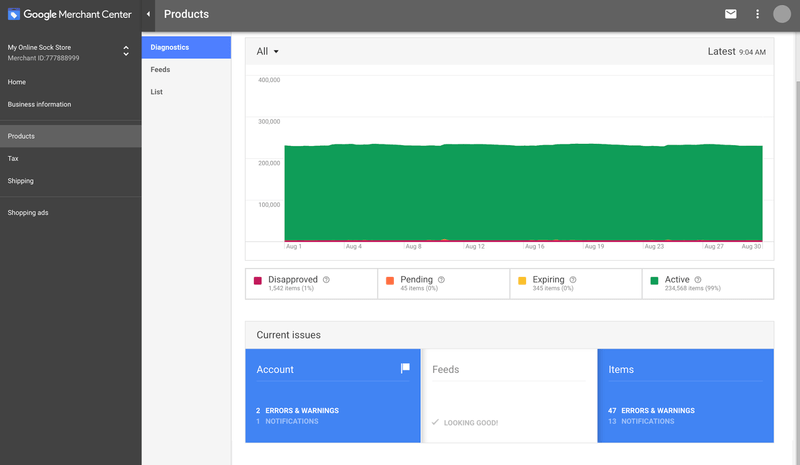
That’s precisely why this guide is dedicated to taking you on a comprehensive tour of Google Merchant Center. We’ll explore all the essential elements you need to start seeing real success with Google Shopping ads. Here’s a quick overview of the questions we’ll have covered by the end:
- What exactly is Google Merchant Center?
- What’s the purpose of Google Merchant Center?
- What’s a Google Merchant Center feed?
- Is there a cost associated with Google Merchant Center?
- How can I set up a Google Merchant Center account?
- How do I handle shipping configurations within Google Merchant Center?
- Can you explain Google Merchant Center promotions?
- What should I do if my Google Merchant Center account gets suspended? Ready to dive in? Let’s go!
What is Google Merchant Center?
Google Merchant Center is a digital hub where businesses like yours can input and manage details about the products you sell, whether it’s online or in a physical storefront.
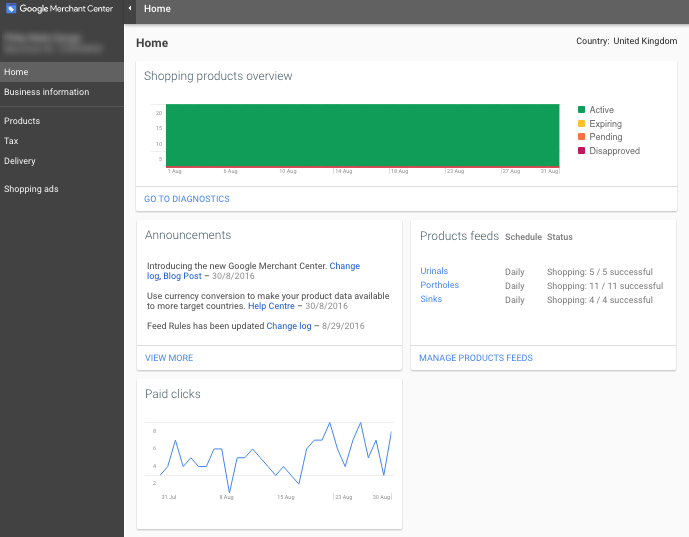
While it empowers you to handle a variety of tasks, its core strength is centralization. With Google Merchant Center, you can consolidate all the vital details about your retail operation in one easily accessible online location. Convenient, wouldn’t you say?
Are there any fees to use Google Merchant Center?
Good news—Google Merchant Center is completely free to use. However, keep in mind that you’ll still be charged for clicks on your Google Shopping ads.
How do I get a Google Merchant Center account set up?
If you don’t have one already, start by creating a Gmail account. Then, head over to the Google Merchant Center website and follow the instructions to set up your account. Once it’s ready, you can use that website to access Google Merchant Center from anywhere.
What is Google Merchant Center used for?
To put it simply, Google Merchant Center is the engine behind your Google Shopping campaigns, your local inventory ads, and your Shopping Actions promotions.
Google Shopping
As I mentioned earlier, Google Merchant Center is best known for its role in Google Shopping. This retail marketing platform operates under the umbrella of Google Ads. Without current and well-optimized product data stored in Google Merchant Center, you won’t be eligible to launch Google Shopping campaigns. If some of these terms seem a bit unclear, don’t worry; we’ll delve into more detail in the next section.
Local Inventory Ads
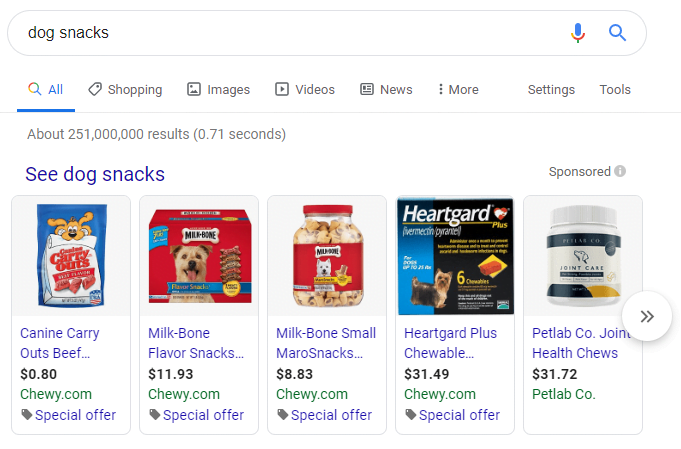
Your Google Merchant Center account does more than just manage Shopping campaigns; it’s also the driving force behind local inventory ads. With a local inventory ad, you can let potential customers in your vicinity know that you have the products they’re looking for available in a nearby brick-and-mortar store. While Google Shopping ads allow you to promote products you sell both online and offline, local inventory ads are designed specifically for offline sales.
Shopping Actions
The last way to leverage Google Merchant Center that I’ll discuss here is Shopping Actions. To put it in Google’s own words, Shopping Actions is a shopping program that “enables retailers to showcase their products across various Google platforms … and creates a seamless shopping experience [for consumers] with features like a shareable list, universal shopping cart, and instant checkout.” In essence, by joining the Shopping Actions program, you gain the ability to sell products across Google Shopping, Google Images, YouTube, and even voice search. Of course, none of this is possible without—you guessed it—a well-maintained Google Merchant Center account. There’s a lot more to explore with Shopping Actions, but we’ll dedicate a separate guide to that. For now, we’ll keep our focus on Google Shopping for the rest of this tour, as it’s the most common application of Google Merchant Center.
What is a Google Merchant Center feed?
Think of a Google Merchant Center feed (sometimes called a Google Shopping feed or product data feed) as a spreadsheet. This spreadsheet organizes important information about your products in a way that’s easy for Google to understand. This feed is arguably the most critical element of your entire Google Merchant Center account: it’s the primary information source Google uses to build Shopping ads for your products.
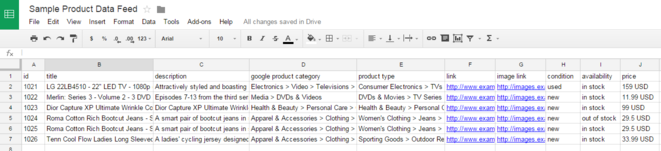
That’s right, Google handles the creation of your Shopping ads—you don’t need to choose keywords or craft traditional ad copy. Your role is to populate the different fields within your Google Merchant Center feed. Google then uses this information to automatically generate Shopping ads on your behalf. Every field in your Google Merchant Center feed provides Google with a specific piece of information. They use this information to figure out when your product is a good match for someone’s search and what that potential customer needs to know about your product. This brings up a crucial question: What exactly are these fields, and what makes them so important? Let’s take a closer look at a few of the most important ones: product title, product image, and product category.
Product Title
The blue, clickable text you see at the top of your Shopping ad? That’s your product title.
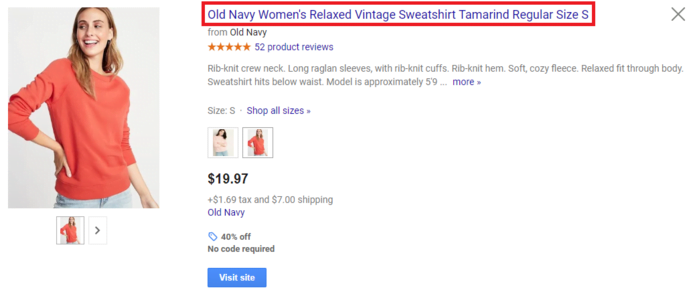
When you’re working to optimize your Google Merchant Center feed, your product title deserves top priority. Why? It’s the very first thing Google analyzes to determine which products are the best fit for a shopper’s search. Without a well-optimized product title, your chances of getting your product in front of interested buyers are slim. So, how do you go about optimizing your product title? Use a keyword research tool to understand how potential customers are searching for products like yours, and then incorporate high-volume keywords into your product title. This probably sounds a lot like search engine optimization, and you’d be right! Optimizing your product title is essentially about speaking your customers’ language to demonstrate to Google that your product is relevant—and therefore deserves a prominent Shopping ad position.
Product Image
Your product image is, as you might expect, the visual representation of your product that appears to the left of your product title.
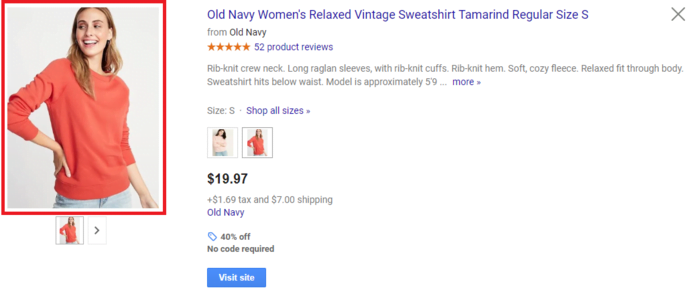
The product image is a critical part of your Google Merchant Center feed for a simple reason: Nobody is going to click on an ad with a poor-quality image. After all, gaining a new customer means building trust, and a bad or unprofessional image is a surefire way to turn potential customers away. For those who need a little help getting started, I recommend checking out these 14 product photography tips. As you’re going through them, remember that Google has some rules: no watermarks, no additional text, and no logos allowed.
Product Category
Unlike your product title and image, your product category is something only Google sees. It’s strictly a behind-the-scenes attribute used to determine which products are most relevant to a user’s search query. Your potential customers will never even know it exists! To make your product eligible to show up in Shopping results, you need to select a category from the Google Product Taxonomy (GPT). Available to download for free boasts over 6,000 categories and subcategories. As I mentioned, your product category plays a vital role in showing Google why your product is relevant to a search. The more precise you can be with your subcategory selections, the better. For instance, let’s imagine you’re selling bicycle shorts. You could categorize them broadly like this: Apparel & Accessories > Clothing > Activewear However, you’ll get much better results by being more specific, like this: Apparel & Accessories > Clothing > Activewear > Bicycle Activewear > Bicycle Shorts & Briefs
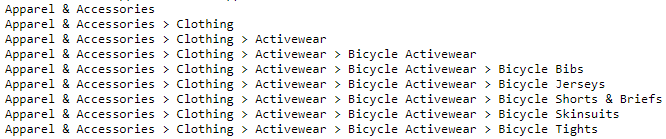
You get the idea—the more granular, the better your results!
How can I add products to Google Merchant Center?
As your business grows and you’re ready to promote a wider range of products through Shopping ads, there are several ways to add them to Google Merchant Center. While we don’t recommend it, you could technically update your feed manually and then upload it to the platform. However, a much less tedious approach is to set up scheduled fetches. In simple terms, you provide Google with the URL of your feed and specify how often you want to add new products, and they’ll take care of the rest. Just navigate to the Products tab, select the feed you’d like to automate, click on Schedule, and you can configure the details from there.
How do I set up shipping in Google Merchant Center?
Before you can start promoting products with Shopping ads, you need to tell potential customers how much you charge for shipping. According to Google, unexpected shipping costs are a leading cause of shopping cart abandonment. It’s safe to say that your shipping settings are a mission-critical part of your Google Merchant Center account. Crucial Note: The shipping costs you provide to Google Merchant Center must be equal to or greater than the shipping costs displayed on your website. Misleading Shopping users with artificially low shipping costs will land you in hot water. One of the many great things about Google Merchant Center is the flexibility it offers with shipping options. Whether you have a flat rate, calculate shipping based on the total order value, or use the rates of third-party carriers, Google Merchant Center can accommodate your needs. You can even set up custom shipping tables that determine the shipping cost for a specific product based on its size or the delivery destination. We won’t bore you with a step-by-step walkthrough of setting up shipping in Google Merchant Center; Google’s already taken care of that in detail. Instead, we’d rather focus on something that may seem obvious but is incredibly important: The shipping option you choose should align with your overall business objectives. When configuring your shipping details in Google Merchant Center, take a moment to think about why you’re using Shopping ads in the first place. Are you primarily aiming to drive more conversions? Or is your objective more nuanced, like trying to boost your average order value? The key takeaway here is that different shipping options make sense depending on your goals. If your priority is simply to increase overall conversions, offering free shipping is generally a good strategy. On the other hand, if your goal is to bump up your average order value (AOV), you might want to consider offering free shipping only to those who spend above a certain amount. It’s a small distinction that can make a big difference.
What are Google Merchant Center promotions?
Google Merchant Center promotions empower you to use your Shopping ads to present potential customers with special offers, like discounted prices or free shipping. Once a promotion is active on your ad, shoppers will either see it displayed at the bottom of the ad, or they’ll need to click a “special offer” link (also found at the bottom of the ad). Either way, incorporating Google Merchant Center promotions is a fantastic way to make your Shopping ads more appealing and drive more sales.
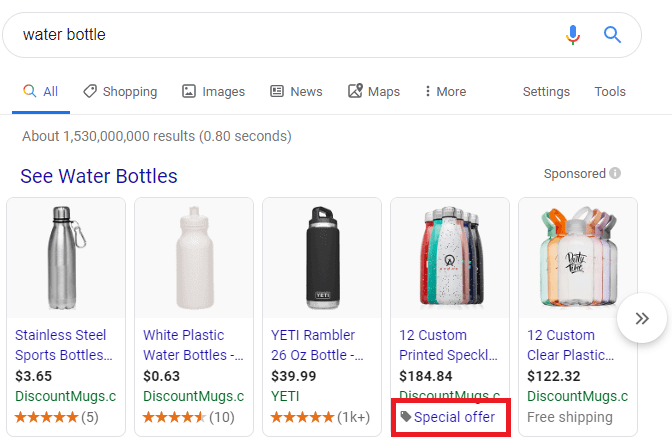
Important Note: Keep in mind that Google Merchant Center promotions are currently available only to advertisers in the US, UK, Germany, France, India, and Australia. If you’re based in one of these countries and want to start running promotions, you can apply to do so here. Once you’ve created a product data feed and received Google’s stamp of approval, you can move on to setting up promotions (which also require approval before going live). Here are the three main promotion types you can submit for approval via Google Merchant Center:
- Discounts: Examples include a 10% price reduction or a BOGO (buy one, get one) offer.
- Shipping: This could be free shipping, a 50% shipping discount, and so on.
- Free Gifts: Think along the lines of a free product or a free electronic gift card. We’re not going to waste your time by tediously listing every single rule and regulation associated with Google Merchant Center promotions; long list of policies. Instead, let’s explore some best practices to make sure you’re getting the most out of the promotions program.
1. Align your Google Merchant Center promotion with your broader business goals
If your aim is to clear out inventory by a certain date, running a BOGO promotion could be the way to go. If you’re trying to build brand loyalty and attract repeat customers, a free gift promotion might be more effective. And if boosting your AOV is the name of the game, consider a discount promotion that kicks in when a customer’s order exceeds a specific amount.
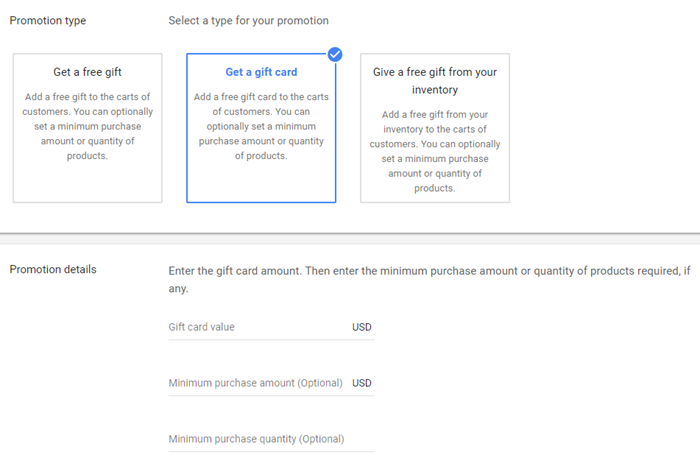
2. Offer free electronic gift cards during the holiday season
Let’s face it, we’ve all been there—sometimes even the most organized among us procrastinate on buying gifts for loved ones. In fact, some shoppers wait so long that shipping their orders in time for a holiday becomes impossible. The good news? You can swoop in and save the day with a well-timed Google Merchant Center promotion! By offering a free gift card to those last-minute shoppers, you’re providing them with something they can give as a placeholder until the actual gift arrives.
3. There are creative ways to work around Google’s promotion restrictions
You might notice that one of the policies for Google Merchant Center promotions states that you can’t offer discounts exclusively to first-time customers—or so they say. The not-so-secret workaround involves creating a similar audience. Here’s how it works: Start by building a remarketing list of people who have purchased a specific product from your store (let’s use a bike helmet as an example). Next, use that list to generate a similar audience: a group of users who haven’t bought anything from you yet but whose online behavior suggests they’re interested in doing so. Finally, apply that audience to a Shopping campaign and offer them a discount that’s too good to pass up!
What should I do if my Google Merchant Center account is suspended?
We’ve covered a lot of ground in this guide. Rest assured, this is the last section you need to worry about. To ensure a consistently positive experience for everyone, Google’s team regularly reviews Google Merchant Center accounts. If, for any reason, some of your products are found to be in violation of Google Shopping policy, you’ll receive a warning email and be given one week to rectify the issue. During this warning period, your Shopping ads will generally continue running as usual (unless the violation is deemed extremely serious).
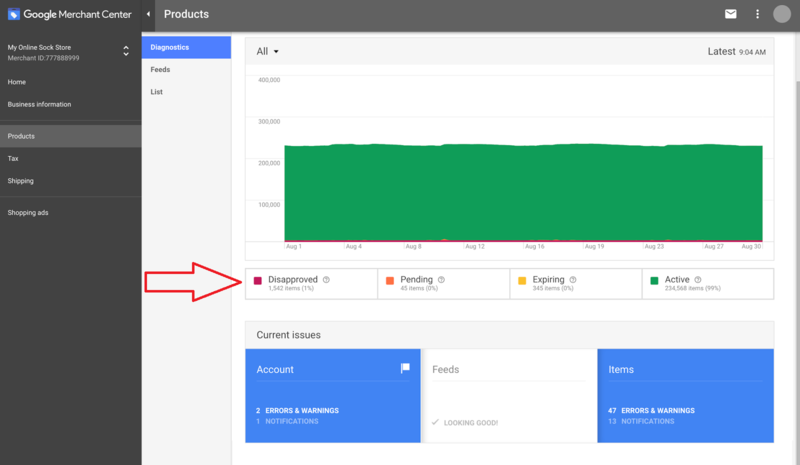
If you address all the violations within that week, you’re in the clear. However, if any violations remain unresolved, your Google Merchant Center account will be suspended, and none of your products—even those not related to the violations—will be eligible for Shopping ads. It’s important to note that a suspension of your Google Merchant Center account doesn’t mean you’re banned from all Google advertising networks; the suspension applies only to Shopping ads. If you ever find yourself in this (not-uncommon) situation, don’t panic—it’s not the end of the world. Getting your Google Merchant Center account reinstated is a relatively straightforward process. First and foremost: Address the violations that led to the suspension. There’s no way around this; every single issue needs to be resolved before you can resume advertising on Google Shopping. Once that’s done, manually request a review from the Google team. If they review your account and give you the green light, you’re back in business! If they determine you’re still in violation, you’ll have one more chance to request a review before entering a cool-down period. This is a week-long period where your ads are inactive, and you won’t be able to request another review. As you can see, there’s plenty of opportunity to correct course if your Google Merchant Center account is suspended. As long as you’re proactive about resolving violations as soon as you’re notified, your Shopping ads should keep running smoothly, and your ecommerce business can continue to flourish.
Take the plunge into Google Merchant Center today!
Having a solid understanding of Google Merchant Center is crucial for anyone serious about growing their ecommerce business with the help of Google Shopping ads. While it’s not necessarily a walk in the park, there’s no reason why you can’t master it through a bit of trial and error. So, what are you waiting for? Dive headfirst into Google Merchant Center! Using this blog post as your roadmap, you’ll be well on your way to generating significant revenue through Google Shopping ads.