Let’s be real, Bing lives in Google’s massive shadow. After all, Google dominates as the world’s most visited website, racking up a mind-blowing 3.5 billion searches daily. It’s so deeply ingrained in our lives, tech, politics, and even language that “Googling” has become synonymous with online searching.
Bing, however, tells a different tale. Since its debut a decade ago, it’s safe to say that Bing hasn’t quite achieved the same level of recognition. As the twenty-fifth most visited site, Bing.com maintains a low marketing profile, making it rare to hear anyone “Binging it” or proudly declaring themselves a Bing devotee. Bing often finds itself overlooked at best and, at worst, the punchline of jokes.
You might be surprised to learn that you likely use Bing more than you realize. Here’s why:
1. Bing powers nearly half of US searches
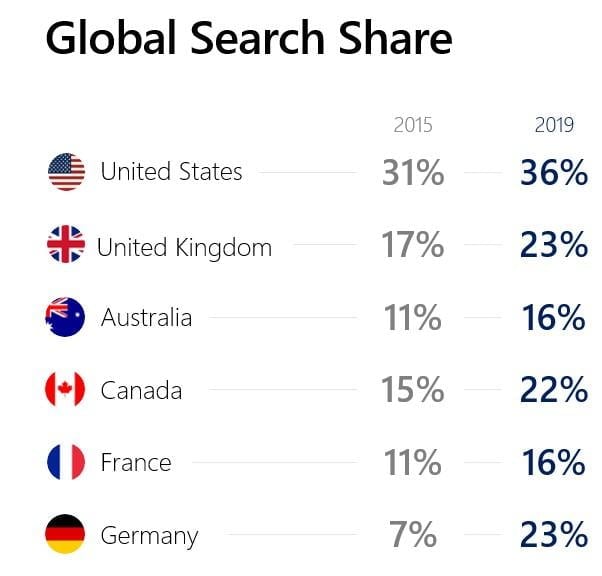
In March 2019 alone, 126 million unique US users conducted 6 billion searches across the Bing network, according to ComScore data.. Today, Bing commands a staggering 36% of the US desktop search market. Yes, you read that right!
Nearly half of the US population conducts a Bing-powered search monthly. While this doesn’t mean everyone exclusively uses Bing.com, many users embrace a “bi-searchual” approach, leveraging both Google and Bing for different tasks or across various devices. Interestingly, 66 million Americans rely solely on Bing-powered search engines, foregoing Google altogether.
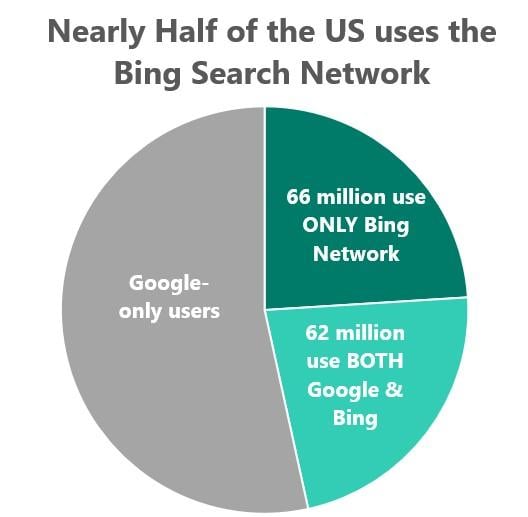
This multi-platform search behavior has significant implications for advertisers. Since many consumers might encounter your brand on Bing first, SMBs advertising on Bing often experience a 26% increase in branded searches on Google.
2. Bing search is fueled by 1.5 billion Windows devices
Microsoft undeniably reigns as a tech powerhouse. Currently, over 1.5 Billion devices powered by Windows are in use, with more than 900 million using Windows 10. running Windows 10. This number is skyrocketing, especially in the workplace, where Windows dominates. In fact, you’re likely reading this on a Windows device right now!
And guess what? Microsoft also owns a little search engine called “Bing.” Unsurprisingly, a significant chunk of traffic from these Windows 10 devices flows directly to Bing.

While the Bing logo might not be plastered across your PC, that unassuming search bar in the corner serves as a direct pipeline to Bing. Ask Cortana a question, and she’ll gladly “Bing it” for you. Even those lock screen searches? You guessed it—Bing!

3. Bing is seamlessly integrated with other Microsoft products
Microsoft’s reach extends far beyond your hardware and operating system. Even die-hard Apple fans likely use Microsoft products and might be Binging without realizing it!
Edge / Internet Explorer
A significant portion of users still rely on Microsoft’s Edge or Internet Explorer, the default browsers pre-installed on PCs, representing 8% and 6.7% of the US Desktop browser market. of the desktop market. And you guessed it—Bing is their default search engine. Many users sticking with their default browser don’t even think to switch their default search engine.
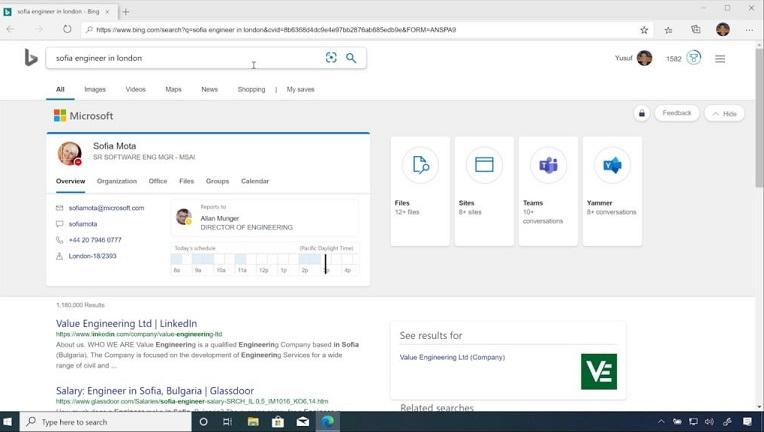
Microsoft Office, Outlook, Word, Excel, Teams, Skype, and More!
With a staggering 1.2 billion users, Microsoft Office subtly exposes users to Bing without them even knowing. Have you ever used the ribbon’s search bar or right-clicked a keyword to search within an email or a document? Congratulations, you’ve just Binged! Beyond Office, other Microsoft apps like Skype and Teams also incorporate Bing for their search functionality.
Xbox
Microsoft’s influence extends beyond the office and computer screens, captivating over 65 million active gamers who unwind with their Xbox consoles. And when these players take a break from the action to search for new games, apps, or even dinner, they find themselves navigating the digital world through Bing on their Xbox!
4. Voice search through Cortana and Alexa is powered by Bing
It comes as no surprise that Cortana, Windows’ trusty voice assistant deeply integrated with Windows devices, keeps her voice search within the Microsoft family, relying on Bing. In fact, Cortana accounts for a quarter of all searches conducted through the Windows 10 taskbar.
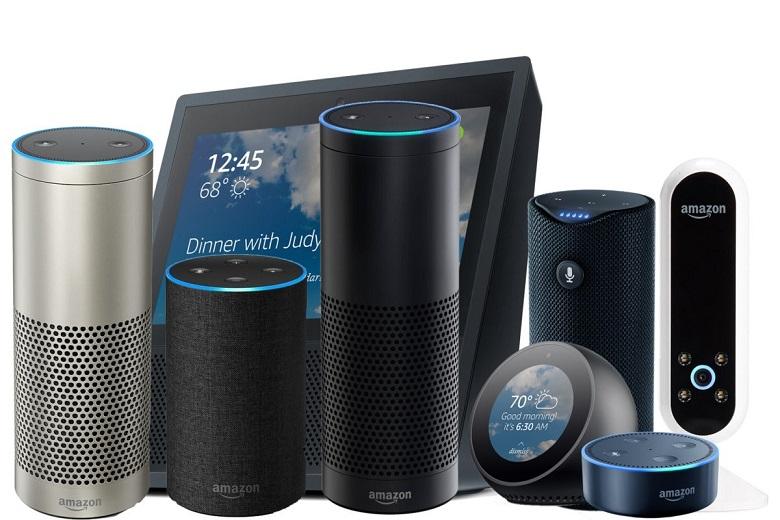
But Bing’s voice search reach expands even further thanks to a familiar name—Alexa. Yes, Amazon’s Alexa brings Bing into a staggering 100 million households! This number is only expected to climb as Alexa becomes the voice assistant of choice for Facebook Portal.
5. Numerous search engines partner with Bing
Default search engines aside, you might not be directly typing “bing.com” to explore the web. However, if you’re not a “Google.com” enthusiast, chances are you’re using a search engine partially powered by Microsoft’s Bing. Microsoft collaborates with a multitude of smaller search engines to fuel their results and ads, including:
- Yahoo! (11.7% of the US Market Share)
- AOL (~1% US Market Share)
- DuckDuckGo (~1% US Market Share)
- Ecosia
- MSN
- Lycos
- Search.com
- ClassifiedAds.com And the list goes on!
Microsoft Adverting offers a unique advantage over Google Ads. Besides serving ads across all these search engines through a single platform, advertisers gain granular control by reviewing ad performance on individual engines, allowing them to target or exclude specific platforms from their campaigns.
6. Bing powers search results for popular ecommerce platforms
While many shoppers initiate their journey through search, neither Google nor Bing holds a monopoly over online ecommerce. Establishing a strong online presence requires extending beyond search engine results. That’s why Microsoft has strategically partnered with major ecommerce platforms such as:
- Amazon
- OfferUp
- GumTree
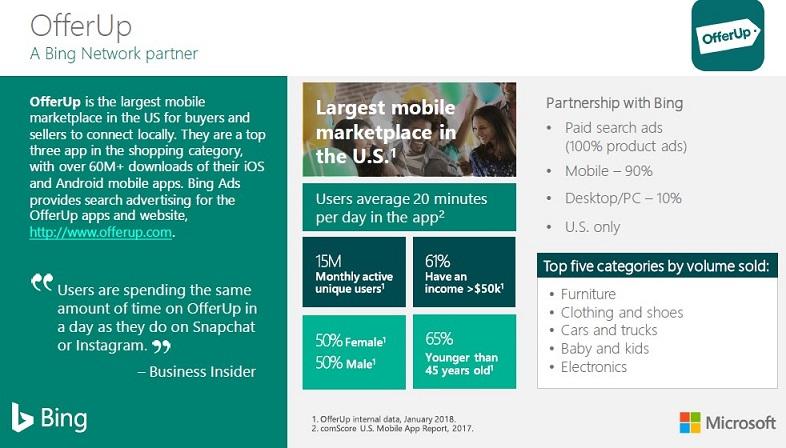
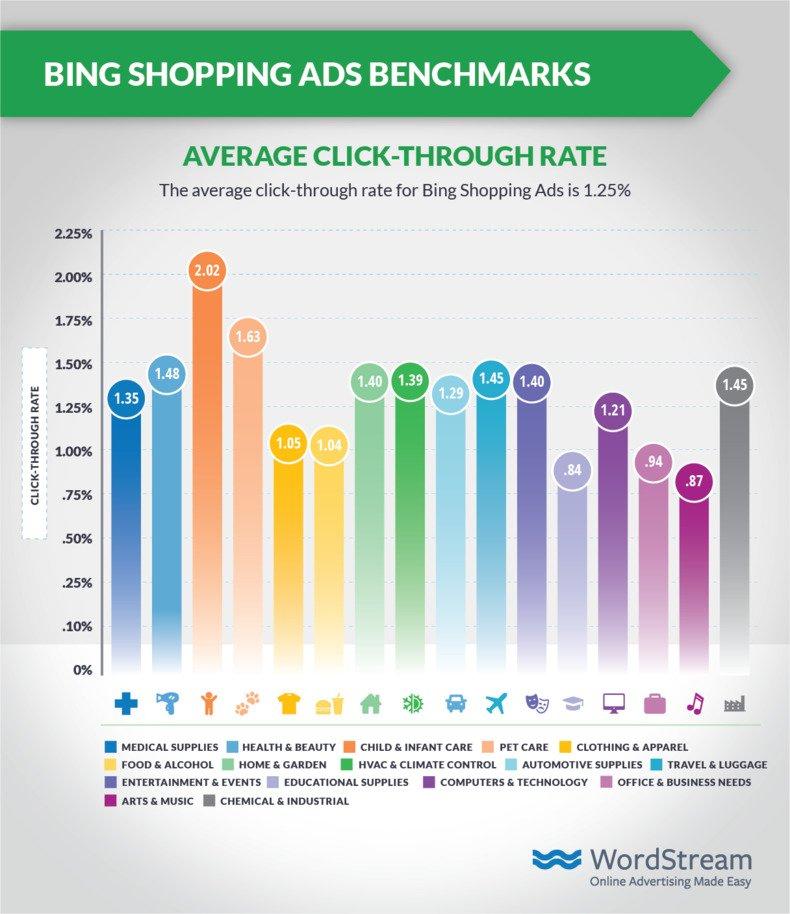
As a result, Bing’s reach extends to over a third of all online retail searches. These audiences beyond the Bing search result page are highly engaged and receptive to targeted advertising. Advertisers seeking to connect with these audiences have witnessed remarkable success through shopping campaigns across various industries on Bing. On average:
- Bing shopping campaigns boast a 45% higher ad click-through rate (CTR) compared to Google
- Bing’s average cost per click (CPC) on shopping ads is 30% lower than Google’s average.
- The average cost to acquire a customer (CPA) through Bing shopping was approximately 40% lower than on Google shopping.
7. International audiences are increasingly turning to Bing
The United States undoubtedly claims the lion’s share of Bing users. Still, the gap is narrowing rapidly on the international stage. With the rise of Windows 10, Bing is powering more searches than ever. In the United Kingdom, nearly a quarter of all desktop searches run on Bing. Canada follows closely with 22% of desktop searches powered by Bing. Even in Australia, Bing is gaining traction, capturing a notable 16% of searches.
Globally, Bing processes an impressive 11 billion searches every month.
8. Bing attracts a distinct demographic compared to Google
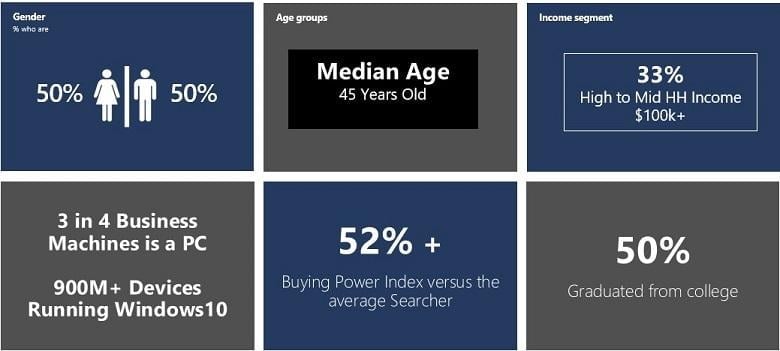
Google’s mass-market appeal makes targeting specific demographics a nuanced endeavor. Since a significant portion of Bing’s user base accesses it from their work PCs, particularly during the workday, Bing attracts a different audience compared to Google. For 40 hours a week, Bing holds a firm grip on the search activity of these white-collar professionals. Generally, Bing’s audience tends to be:
- Slightly older, with an average age of 45 (compared to the US average of 38).
- More educated, with 50% possessing some college education and 17% holding an advanced degree.
- More affluent, with one-third reporting a household income exceeding $100k. The average Bing user spends 35% more while shopping online compared to Google users.
- More likely to be married (46%) and have children living at home (30%)
9. Bing dominates specific industries
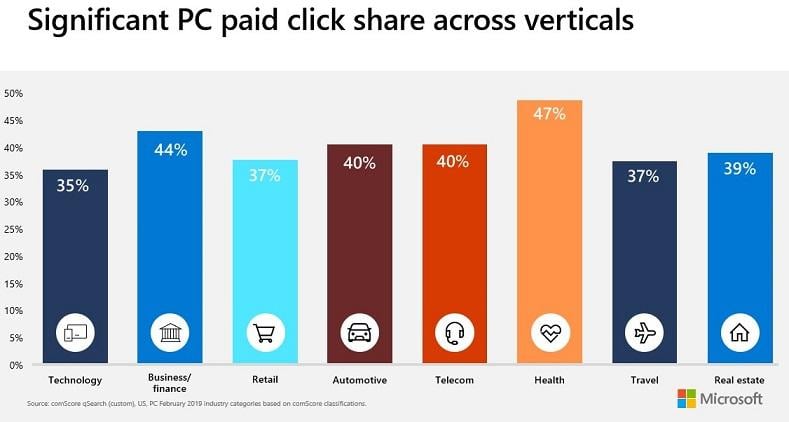
While Bing commands a respectable 36% of the US desktop search market share across all industries, its influence is even more pronounced in certain sectors. Given the prevalence of Bing usage on work computers, it’s no surprise that 44% of all business and finance-related paid search clicks originate from the Bing Search Network.
Similarly, industries requiring extensive pre-purchase research, such as automotive (40%), real estate (39%), and travel (37%), witness higher cross-device and cross-network search behavior, leading users to Bing.
Bing’s older demographic profile also translates into a strong presence in the healthcare industry, attracting 47% of all paid search clicks within this sector.
10. Bing is trusted by 500,000 advertisers
Many people might be unaware of their Bing usage. Still, Bing has quietly experienced 100 consecutive months of market share growth in recent years—a fact that hasn’t gone unnoticed by savvy advertisers. Earlier this year, Microsoft proudly announced that 500,000 advertisers serve ads on Bing through Microsoft Advertising. While half a million advertisers might seem like a considerable number, it represents a small fraction of the tens of millions utilizing Google Ads, resulting in significantly less competition on the Bing SERP.
This reduced competition translates into substantial advantages for those leveraging Microsoft Advertising. After analyzing data from over 1,200 advertisers across various industries on Bing, we’ve observed that:
- Bing consistently delivers an almost 50% higher ad click-through rate (CTR) compared to Google.
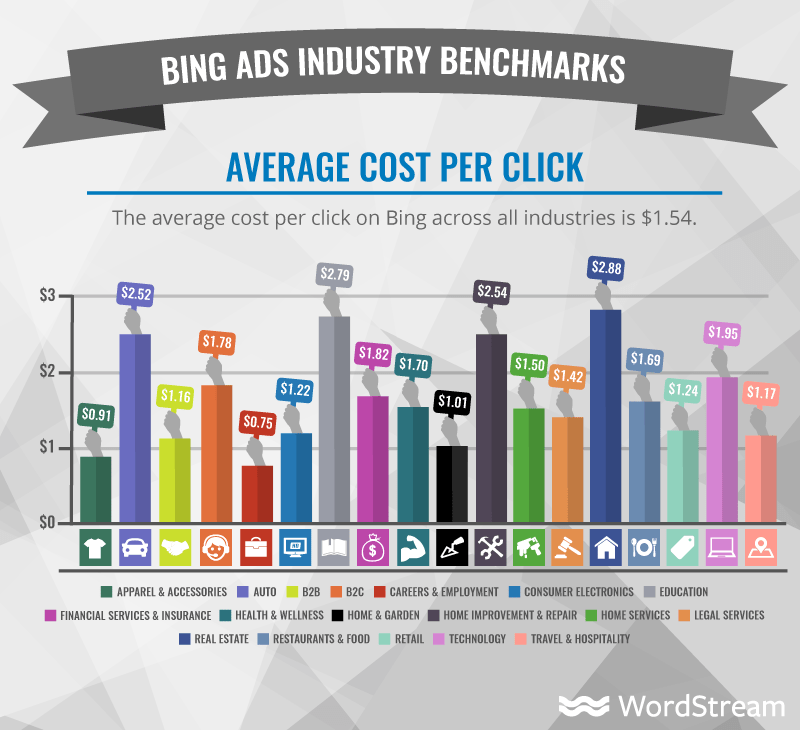
- Bing’s average cost per click (CPC) is 33% lower than Google’s.
- The average cost to acquire a customer (CPA) on Bing is roughly 30% lower than on Google.
Furthermore, managing Bing campaigns through Microsoft Advertising is remarkably straightforward. You can easily import existing Google Ads campaigns into Microsoft Advertising to hit the ground running. As you refine your Google campaigns, you can even selectively choose which changes to sync with Microsoft Advertising daily.
Bing’s influence is far greater than you might perceive, and as word spreads, advertisers are taking notice. Ignoring Microsoft Advertising means overlooking a significant portion of the market, often during those crucial moments when consumers are poised to make substantial purchases. If you’re ready to ensure your ads reach your target audience, regardless of their preferred search engine, connect with our team today!