The internet relies heavily on online advertising, but it also raises concerns about user privacy due to its dependence on personal data. This guide explains how Google’s consent mode addresses these concerns by giving users control over how their data is used for online advertising, and provides steps for its implementation.
Table of contents
- What is user consent in online advertising?
- What is Google consent mode?
- How does Google consent mode work?
- Why use Google consent mode?
- Who can enable Google consent mode?
- How to implement Google consent mode
What is user consent in online advertising?
In today’s digital age, privacy is a major concern. Numerous regulations, such as the GDPR in Europe and CCPA in California, are designed to protect personal information and give individuals more control over its use. The rapid growth of technology and the internet has led to an explosion of data, raising ethical and legal questions about its use, particularly in advertising.
Online advertising, while crucial for funding free online content, relies heavily on user data for targeted advertising. This practice, while beneficial for personalized content, raises concerns about user privacy and data usage.
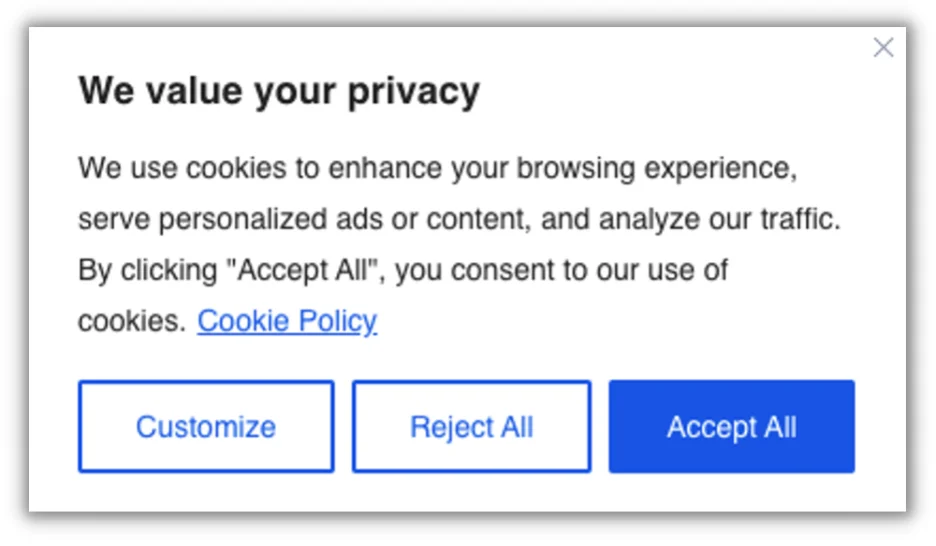 Source
User consent is key. It means you have the right to decide whether advertisers can use your data. Obtaining user consent is crucial for advertisers to comply with privacy regulations and maintain user trust. This mutual agreement benefits both parties – users get more relevant ads, and advertisers can deliver them responsibly.
Source
User consent is key. It means you have the right to decide whether advertisers can use your data. Obtaining user consent is crucial for advertisers to comply with privacy regulations and maintain user trust. This mutual agreement benefits both parties – users get more relevant ads, and advertisers can deliver them responsibly.
 Want to know your real Google Ads performance? Get a free, instant audit » Google Ads Performance Grader
What is Google consent mode?
Developed by Google, consent mode helps balance effective online advertising with user privacy. It’s a flexible framework designed for websites to adapt to evolving privacy regulations, allowing them to tailor the use of Google Ads and analytics based on user preferences.
By prioritizing transparency and user control, Google’s consent mode is a step towards building trust and improving the online experience.
How does Google consent mode work?
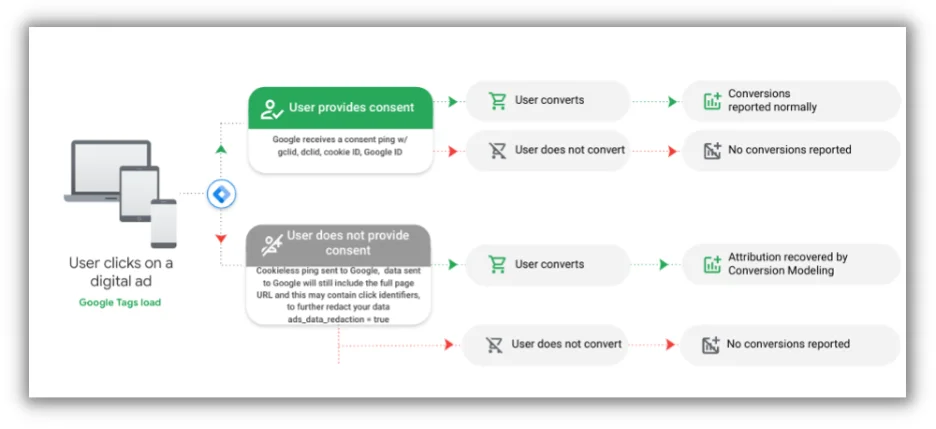
Consent mode allows your website or app to inform Google about user choices regarding cookies and app permissions, influencing how Google tags function. It interacts with your cookie consent banner, adjusting how Google Analytics, Ads, and other tags operate based on user choices.
For example, when a user interacts with an ad and takes a specific action, Google receives information without storing personal data, ensuring privacy. Without user action, no data is shared, safeguarding user privacy in online measurement.
This diagram illustrates the process:
Why use Google consent mode?
76% of website visitors disregard cookie banners. If a consent banner rejecting cookies is encountered, a decline in Google Ads account data might be observed.
Consent mode helps to address this issue by enhancing data accuracy through advanced reporting and modeling techniques. Here’s how consent mode can be beneficial:
- Lost conversions modeling: Estimates and analyzes conversions potentially lost due to user consent requirements.
- Simplified compliance: Simplifies adherence to privacy regulations, particularly when using Google Analytics with other tools.
- Optional functions: Enables optional features like remarketing in Google Analytics 4 (GA4) even before obtaining consent for Analytics.
- Cookieless mode: Prepares your setup for Google Analytics’ cookieless mode when consent is required for Analytics.
- Future privacy features: Aligns with Google Analytics’ future privacy efforts, including upcoming features for measuring user behavior without relying on cookies.
GA4 users will soon be able to model user behavior that may be affected by the absence of cookie consent.
Who can use Google consent mode?
Consider implementing Google consent mode if you identify with any of these categories:
- Google Ads, SA360, or DV360 users: Especially relevant for those tracking conversions using these Google advertising platforms.
- Google Analytics users: Essential for those relying on Google Analytics as their primary conversion tracking tool.
- Interest in future-proofing: A strategic choice for staying ahead of the curve in terms of privacy compliance and measurement.
- EEA + UK region: Highly recommended for websites and online businesses operating in the European Economic Area (EEA) and the United Kingdom (UK) to ensure compliance with regional privacy regulations. To utilize consent mode effectively, ensure you fulfill these requirements:
- Have gtag.js or Google Tag Manager set up: These tools, essential for managing tracking and analytics services, should be implemented across your website.
- Have an existing consent banner: A cookie consent banner, either existing or planned for implementation, is necessary. This banner seeks visitor consent for using cookies and tracking technologies.
- Have cookie settings confirmation enabled: A mechanism allowing users to confirm their cookie preferences by selecting acceptable cookie and tracking types is crucial.
Beyond websites, Google consent mode extends to mobile apps through the Google Analytics for Firebase SDK, ensuring user privacy and compliance with data protection laws.
 Optimize your Google Ads account for success. Download now » The Last Guide to Google Ads Account Structure You’ll Ever Need
How to implement Google consent mode
Implement Google consent mode either through a Consent Management Platform (CMP) or directly on your website using IAB TCF or Google consent mode to balance website functionality with user privacy.
Here’s a simplified integration guide:
IAB TCF (Interactive Advertising Bureau’s Transparency and Consent Framework)
This framework establishes the foundation for your consent system by defining rules and standards for obtaining user consent for cookies and tracking.
Code to enable IAB TCF support: window[‘gtag_enable_tcf_support’] = true; This code snippet activates IAB TCF support, preparing your website for consent handling according to the framework.
Consent Management Platforms
These platforms play a crucial role in managing user consent by displaying pop-up banners requesting consent and managing responses.
Code to set consent defaults: gtag(‘consent’, ‘default’, { ‘ad_storage’: ‘denied’, ‘analytics_storage’: ‘granted’ }); This code sets default consent: advertising data storage is denied, while Analytics data storage is granted, pending user consent. For detailed code implementation instructions, consult Google here.
Google Tag Manager
If you don’t use a CMP, a template in GTM (Google Tag Manager) can be used for implementing consent mode, such as the gTag. Manual implementation is also possible. For comprehensive steps and code examples, refer to the this Google Help Center article on consent implementation with GTM.
Decide if Google consent mode is right for you
Google’s consent mode offers a proactive approach to balancing effective advertising with user privacy in a digital environment where trust and privacy are paramount. By prioritizing transparency, user control, and compliance with privacy laws while enhancing data accuracy, Consent Mode adapts to the ever-changing online landscape, paving the way for a privacy-centric future for advertising.
Implementing consent mode allows businesses to strike a balance between effective advertising and user privacy, fostering a more trustworthy online space. It’s a significant step towards advertising that prioritizes user engagement without compromising privacy - a promising future for online advertising.