There’s a lot of debate about the importance of Quality Score in Google Ads. Some argue it’s crucial for a healthy account, leading to lower costs and better results, while others see it as a trivial metric compared to cost per conversion and ROI.

This article will settle the debate and clarify what truly matters in PPC reporting.
Understanding Quality Score
Quality Score is Google’s method of ranking advertisers on search engine result pages (SERPs) and determining their ad costs. It prevents advertisers with large budgets from dominating the platform with irrelevant ads. By considering factors like click-through rate (CTR), keyword relevance, landing page quality, ad text relevance, and historical account performance, Quality Score ensures that higher-quality ads are prioritized.
Each time your ad is eligible to appear on a SERP, Google assigns it a score between 1 and 10, influencing its ranking and even allowing it to outrank higher bids.
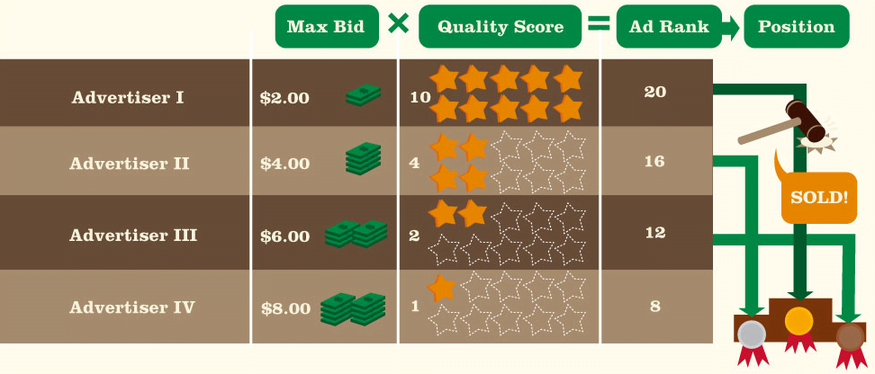
Beyond ad position, Quality Score significantly impacts the price you pay for each click.
The Relationship Between Quality Score and Cost Per Click
Your cost per click (CPC) is calculated using the following formula: (Ad Rank of the advertiser below you / Your Quality Score) + $0.01. This formula demonstrates how a high Quality Score can lead to a higher ad rank, even when competing with higher bids.
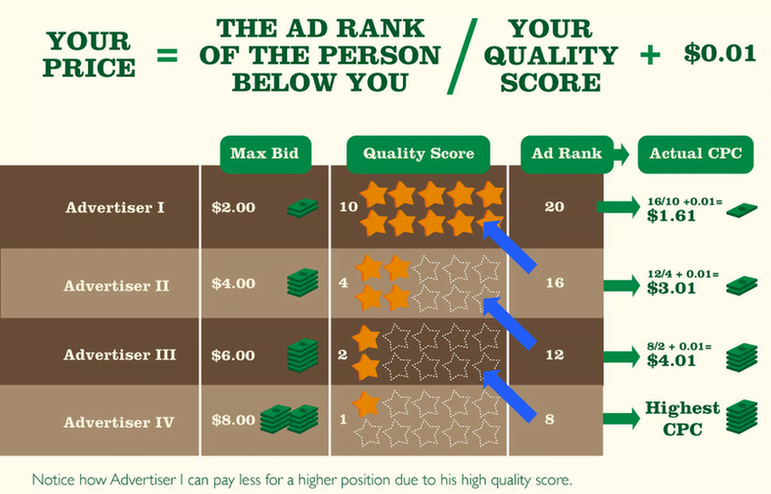
While this relationship is known, the increasing importance of Quality Score over time is often overlooked.
The Evolution of CPC and Quality Score
Research from 2009 demonstrated significant CPC savings with higher Quality Scores, with a score of 10 yielding a 30% discount compared to a score of 7. However, average Quality Scores have declined since then, now sitting around 5.
This shift has amplified the impact of Quality Score on cost savings. Today, a score of 10 results in a 50% discount compared to the average advertiser, while a score of 6 offers a 17% discount.
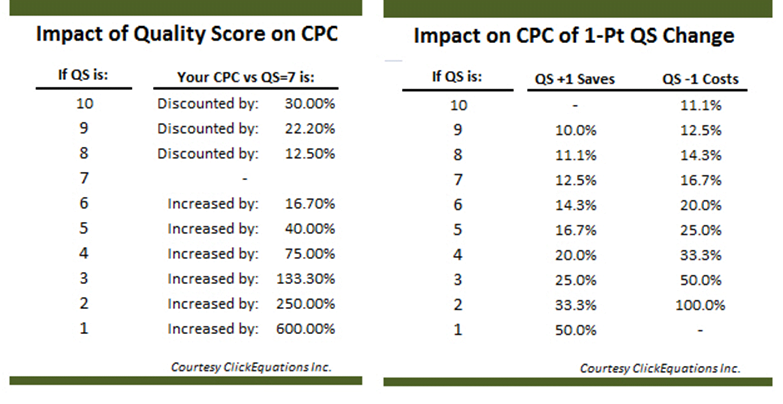
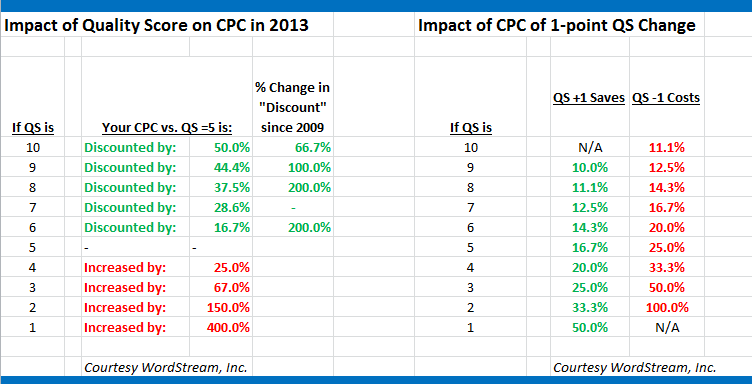
Despite these findings, some argue that CPC savings are insignificant compared to cost per conversion. This perspective overlooks the crucial role Quality Score plays in determining your CPA.
The Intertwined Nature of Quality Score and CPA Optimization
Contrary to what some believe, Quality Score directly impacts cost per conversion. By analyzing data from numerous campaigns representing a substantial ad spend, a clear correlation emerges: higher Quality Scores are associated with lower CPAs.
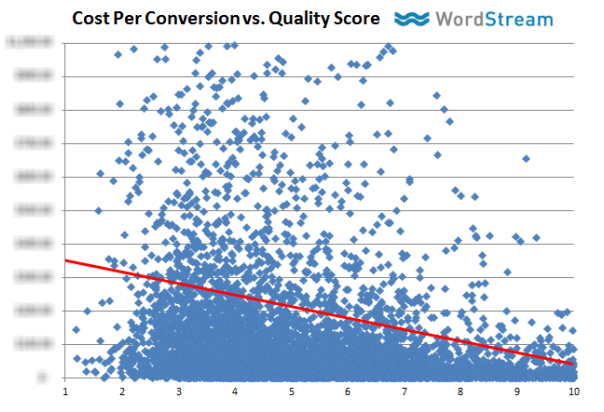
This connection highlights that optimizing for Quality Score is fundamentally the same as optimizing for CPA.
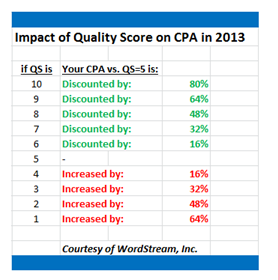
Failing to maintain a Quality Score above the average can result in a considerable penalty, potentially increasing your cost per action by up to 64% compared to competitors. Essentially, each point above the average Quality Score leads to a 16% decrease in CPA, while each point below increases CPA by 16%. Similar findings from other studies reinforce this relationship.
While higher Quality Score keywords demonstrated slightly better conversion rates, the lower CPAs are primarily driven by lower CPCs, directly influenced by Quality Score.
(Note: I wrote about my findings over at Search Engine Land last week – A detailed discussion on this data can be found in the comments section of [link removed].)
Enhancing Your Quality Score: Four Effective Strategies
Optimizing for Quality Score and cost efficiency go hand in hand. Higher Quality Scores result in lower CPCs, ultimately leading to lower CPAs.
Here’s how to elevate your Quality Score:
- Utilize ad extensions: Ad extensions and sitelinks expand your ads, offering more opportunities for clicks and boosting CTR without additional cost.
- Craft compelling ad copy: Implement proven strategies, such as incorporating symbols and exclamation points, to enhance CTR.
- Target brand terms: Bidding on brand keywords, known for high CTRs and conversion rates, can improve your overall account average.
- Structure your account strategically: Organize ad groups around specific themes and divide large ad groups (50+ keywords) into smaller, more focused groups for better relevance.
Let me know your thoughts on these findings. Feel free to share any questions or challenges you have with the data.