It’s generally safe to assume that many advertisers don’t put a lot of thought into their Facebook (Meta) ad bidding strategies. However, the platform has a lot more to offer than the “set it and forget it” approach that many new marketers take. I’ve said it before, and I’ll say it again: relying on these digital ad networks (tech giants) to make decisions for you can be risky. But how true is this when it comes to Facebook bidding strategies? In this article, I’ll explain Facebook bidding and what I think is needed to compete effectively.
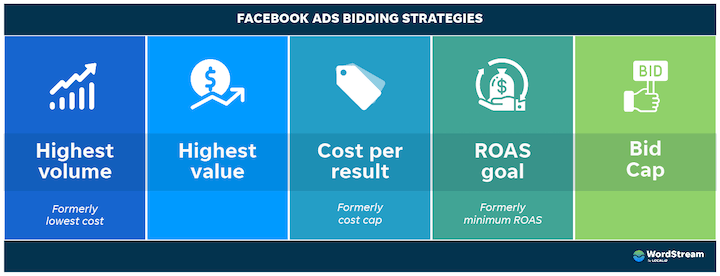
Table of contents
- Facebook bidding and the ad auction
- The importance of your Facebook bidding strategy
- The five bidding strategies in Facebook ads
- The best bidding strategy
Facebook bidding and the ad auction
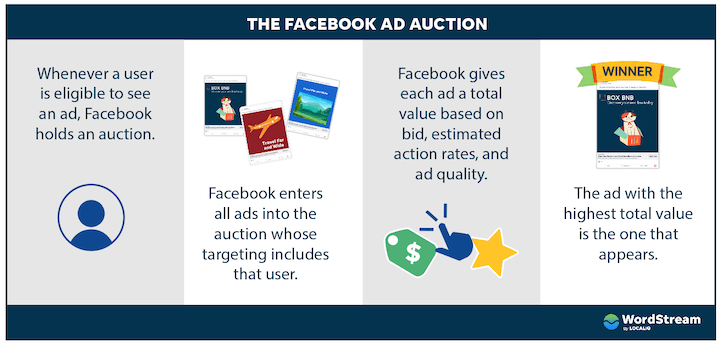
Your chosen bidding strategy in Facebook advertising determines how you want Facebook’s algorithm to bid for you in ad auctions. In other words, it decides how you want to compete in the auction when you launch a campaign, ad set, or ad, to ensure your ad reaches the right people at the right time, within your budget and business goals. The key is understanding how the ad auction works. When an ad space becomes available, any advertisers targeting that user on Facebook enter an auction. This is why costs are generally higher for smaller audiences—there’s more competition. Competition also heats up during peak seasons like holidays, leading to higher advertising costs. According to Meta, the auction’s winner is “the ad with the highest total value” to “ensure that the winning ad maximizes value for both people and businesses.” The “total value” is determined by three factors:
- Bid: This is simply how much you’re willing to pay for your desired advertising outcome.
- Estimated action rates: This is an estimate of how likely a specific user is to engage with or convert from a particular ad. Basically, it’s the probability that displaying an ad will lead to the desired action from the user.
- Ad quality: This metric measures user feedback and considers ad attributes like information withholding, exaggerated language, and “engagement bait.”
 While the first component is more straightforward, the last two components of “total value” in Facebook ads depend on your marketing expertise and your desired outcome.
How important is your Facebook bidding strategy?
Across all platforms, bidding strategies have always been a source of obsession and anxiety in online advertising. This mainly comes from the misconception that it’s the one thing you have the most control over. I call it a misconception because countless other controllable factors in your ad strategy are just as crucial, and they usually boil down to basic marketing principles. If your ad copy, creative, and targeting are poorly planned, your bid strategy won’t matter.
 Speaking of fundamentals…
Free guide: The 7 Facebook Advertising Fundamentals
However, if you have all of those elements in place, your bidding strategy becomes critical to your ads’ overall success.
Facebook bidding strategies
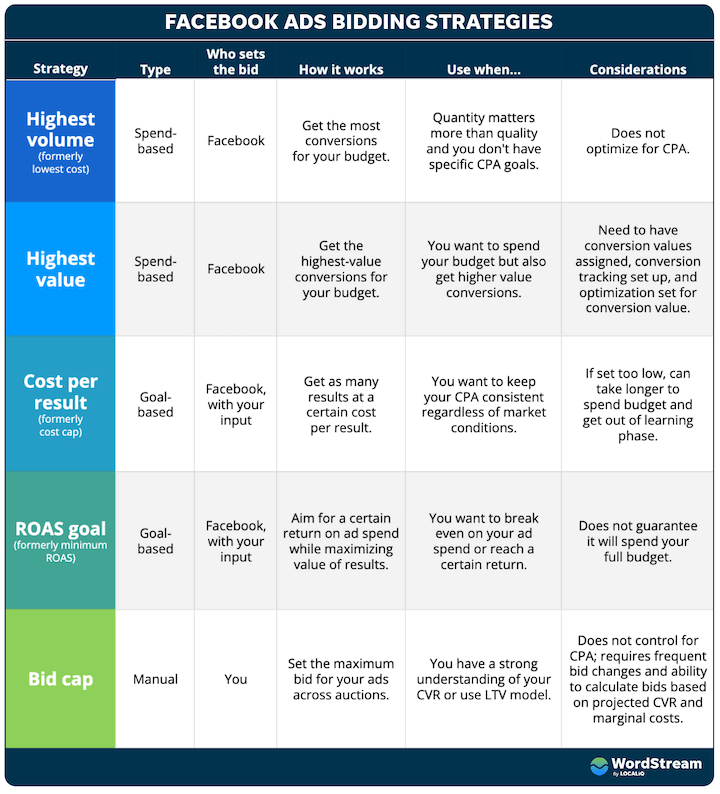
Facebook provides three broad bidding strategy categories to maximize your campaigns and optimize for your goals: spend-based, goal-based, and manual. These include:
- Highest volume (formerly lowest cost)
- Highest value
- Cost per result (formerly cost cap)
- ROAS goal (formerly minimum ROAS)
- Bid cap
Spend-based bidding strategies
Spend-based bidding, the default when you choose a campaign objective, is the simplest. This strategy’s core principle is: “focus on spending your entire budget to generate the most results or value.” This strategy has two sub-categories:
1. Highest volume
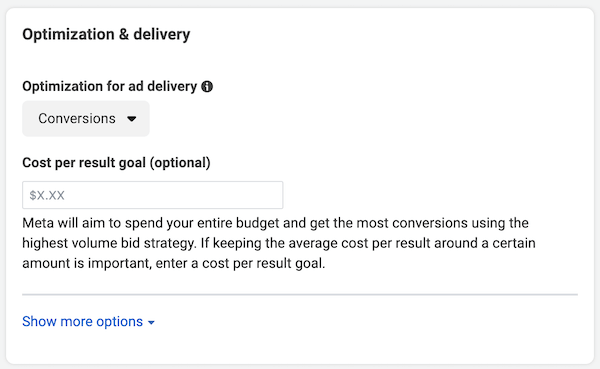
Within your set budget, this method maximizes conversion delivery. You’re essentially instructing Facebook to deliver as many results as possible for a set budget. This is similar to Maximize Clicks bidding in Google Ads. This strategy is ideal if you want to spend your entire budget without a specific cost per action (CPA) or return on ad spend (ROAS) target. If auction competition drops, your CPA may fall, but if it rises, so might your CPA.
2. Highest value
This one is more focused on e-commerce and ROAS because it prioritizes higher-value purchases or conversions while spending your budget. For instance, a seller might use this to sell a more expensive item to maximize profit and return on ad spend. This strategy prioritizes conversion value over conversion volume (much like max conversion value bidding in Google Ads).
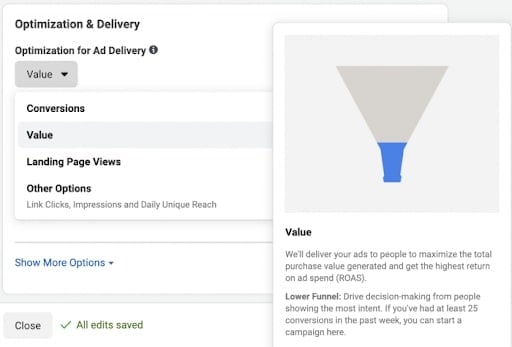 Image source
This strategy helps you use your entire budget while generating higher-quality conversions. However, you must have conversion tracking enabled and conversion values assigned to your products or services.
Image source
This strategy helps you use your entire budget while generating higher-quality conversions. However, you must have conversion tracking enabled and conversion values assigned to your products or services.
Goal-based bidding strategies
Goal-based bidding allows you to specify a target cost or value.
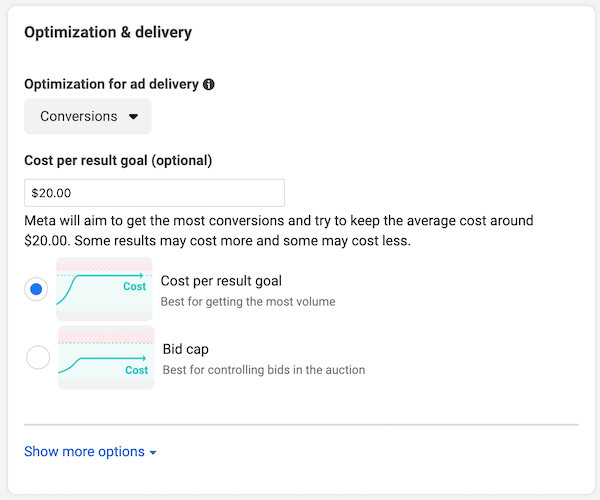
3. Cost per result bidding (formerly cost cap)
This bidding strategy aims to maintain the average cost per result you specify, as the name suggests. This is useful if you know the maximum cost per conversion or result you can afford while maintaining advertising profitability. Remember that Facebook will try to average your cost per result over the campaign’s duration. As a result, your cost per result may be lower one day and higher the next. Also, if you set it too low, Facebook may take longer to spend your budget and exit the learning phase. Facebook can only begin optimizing ad delivery once it has exited the learning phase. Costs and performance will fluctuate until then. This strategy works best if you have a firm grasp of your average CPA. If you’re unsure, experiment with highest volume bidding for a while to establish a baseline.
4. ROAS goal (formerly minimum ROAS)
Return on ad spend is a common bidding strategy for advertisers whose conversions generate direct revenue. Because the goal is directly related to sales, e-commerce businesses typically favor this strategy as a way to ensure their advertising remains profitable. This strategy is less popular among those whose conversions do not result in direct revenue because assigning a conversion value may be challenging. Keep in mind that if you’re new to Facebook advertising, you’ll need to verify your business or run ads for a few weeks first.
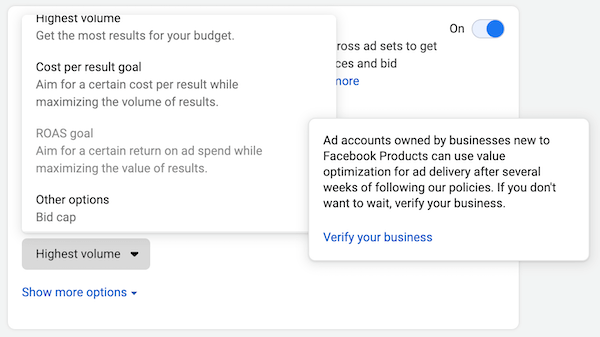 The distinction between ROAS goal and highest value is that the former does not guarantee that Facebook will spend your entire budget. It will try to maximize your opportunities while staying within your ROAS target.
Manual bidding in Facebook
Manual bidding, an older (and some might argue dying) strategy, allows you to specify how much you want to bid in ad auctions.
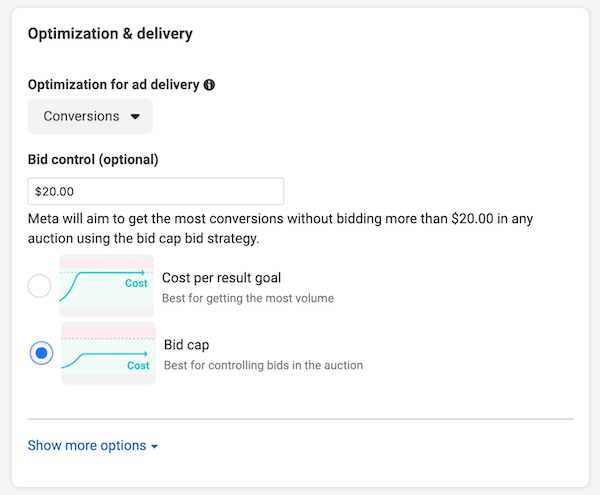
5. Bid cap
This bidding strategy allows you to set a maximum bid for your ads across all auctions. This is in contrast to allowing Facebook to dynamically adjust your bids in competition with other advertisers. If you have a strong understanding of your Facebook ad costs, confidence in your conversion rates, and the ability to calculate the right bid, you would choose this bid strategy.
Which Facebook bidding strategy is best?
I’ve divided businesses into two categories based on their Facebook objectives and the strategies I believe will work best for them:
Suggested bidding strategies for lead generation businesses
Many, if not most, advertisers use Facebook ads to generate leads. That is, their ads do not promote direct purchases but rather content downloads, free trials, or consultations. The ads lead users to a landing page or an in-platform lead form to gather information. I work with a lot of these advertisers, and Facebook is a great platform for generating low-cost leads that eventually turn into customers. This means that because conversions are not purchases, they do not have a direct monetary value. My recommendation for this objective is to use either highest volume or cost per result. The former tends to be more successful for most businesses I work with, especially when the ideal cost per conversion is unknown. If you have your entire marketing funnel mapped out, including costs and conversion rates, setting a target cost per action makes more sense. It depends on how sophisticated your lead generation and marketing and sales operations are.
Suggested bidding strategies for ecommerce businesses
If you run ads that lead users to make a purchase with a set dollar amount, I recommend cost per result, ROAS goal, or highest value. Because your conversion actions have a specific “value,” your goal isn’t always to maximize conversion volume through spending, but to maximize the return on your advertising investment.
Find more ways to get the most for your budget using the free Facebook Ads Grader.
My preferred bidding strategy for e-commerce clients is ROAS goal because it allows us to plan and strategize based on what will generate the most profit from our ad budget.
Keep it simple
I frequently discuss my distrust of tech behemoths like Google and Facebook, and how their primary goal is to spend your money under the guise of “automation.” While I believe this is true to some extent, I also recognize that Facebook’s algorithm can work wonders when given the right information. As a result, when it comes to Facebook bidding strategies, I recommend sticking to the most basic approach. As previously stated, the majority of my clients use a highest volume spend-based bidding strategy and are quite profitable. The most important factor to consider when deciding on Facebook bidding strategies is the type of business you have, as well as the specific goals and conversions you want to achieve through the platform.