Regardless of their awareness or beliefs, the SEO community took notice when Matt Cutts announced that guest blogging is dead. While we’d like to think guest blogging is solely for knowledge sharing, the reality is that most of us have engaged in it for the associated links. The discussion this week has revolved around links: the viability of guest blogging without links and alternative link-building methods.
However, are we missing the bigger picture? Guest blogging was just one tactic within a broader link-building strategy. Google is systematically dismantling all our link-building tactics. Instead of seeking a guest blogging substitute, perhaps it’s time to envision a system independent of links.
We believe we’ve identified such a system. Continue reading to understand our reasoning.
A Concise History of Links in SEO
Let’s revisit some fundamental SEO principles: Search engines initially relied solely on keywords. This approach was flawed due to the ease of keyword manipulation. People stuffed keywords into meta tags and employed tactics like invisible text (white text on a white background).
Then, Google revolutionized search. They recognized the significance of hyperlinks – links weren’t just connectors, they were endorsements. Links implied trust and value in the linked content. Consequently, Google’s ranking algorithm heavily emphasized incoming links, which were harder to manipulate.
You can see where this is headed. The SEO industry flourished alongside Google’s dominance. While link acquisition was more challenging than keyword stuffing, SEO professionals discovered ways to exploit the system and manipulate this “natural” ranking signal.
Here’s how it unfolded:
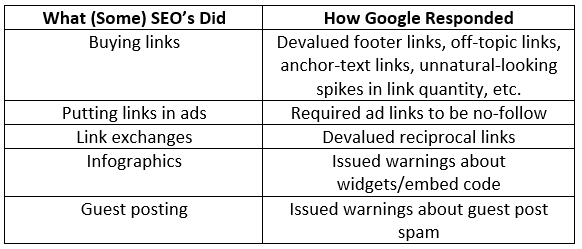
The prevailing advice from SEO experts and thought leaders (ourselves included) to websites and businesses aiming to improve rankings is:
- Generate high-quality content that naturally attracts links.
- Don’t focus solely on link acquisition; instead, provide value to the online world.
This approach is effective for now, but it’s not a permanent solution. As individuals discover increasingly innovative link-building methods, Google faces the challenge of distinguishing between “good” and “bad” links. I predict that the next iteration of Google (or its successor) won’t rely as heavily on links – they’ll likely carry significantly less weight as a ranking signal.
How Google Is Undermining Its Own Value System
Google’s current stance on links and link building is riddled with inconsistencies and dead ends:
- Google’s foundation rests on the principle that off-page factors outweigh on-page factors. They’re gradually realizing that off-page factors are also susceptible to manipulation. However, instead of seeking the next groundbreaking factor (like links once were, which were difficult to manipulate), they’re fixated on tweaking their existing algorithm and reprimanding SEO professionals. The latest target of this criticism is guest blogging.
- Matt Cutts recently stated that guest posting is acceptable… “as long as it’s not done for search engine optimization (SEO).” Let’s pause and acknowledge the absurdity of this statement. It suggests that your intentions, rather than your actions, are what matter. Guest posting is permissible only if driven by pure altruism. Google supposedly discerns this altruism by the absence of links. However, if publishers adhered to this advice, we’d have an abundance of “great content” devoid of outbound links. Without links, how can Google assess quality?
- Cutts seems to believe that people seek links as an end in themselves. He suggests guest posting for exposure and branding, but not for links. However, the desire for links stems from the same reasons one might seek a bylined article in Forbes: Links provide exposure, both directly (through referral traffic) and indirectly, through SEO. Similarly, high rankings aren’t sought for their own sake; they’re desired for the exposure they bring. Cutts acknowledges the legitimacy of marketers pursuing exposure, but for some reason, links are no longer considered a valid means to that end. This is ironic, considering Google’s entire premise hinges on the significance of links.
- Imagine Cutts stating, “Using keywords is acceptable if it’s not for search engine optimization (SEO)” or “Creating YouTube videos is acceptable if it’s not for search engine optimization (SEO).” These statements would sound ludicrous. We understand that certain tactics are beneficial for SEO, and Google can’t realistically differentiate between content that’s naturally optimized and content optimized intentionally. Google lacks the capacity for a Turing test; it can’t peer into our souls. The algorithm’s objective should be to rank the best content, not content created with the purest intentions and the least technical SEO knowledge.
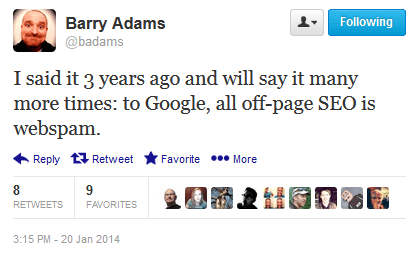
- As Barry Adams said on Twitter recently, Google has essentially come to view any off-page optimization as spam. However, they’re drawing the line rather arbitrarily. You’re free to inundate people with a constant stream of content, hoping they’ll link to it, but directly requesting a link is frowned upon.
- The number of businesses and websites is constantly growing, but the coveted first page of Google remains limited. Attention is scarce. Content alone cannot be the answer (and I say this as someone whose job title includes the word “content”) because we are already inundated with it. Businesses should be able to exist without churning out endless “content.” If they offer something valuable, people should be able to find them using a well-designed search engine without stumbling upon their exceptional content first. I envision a simple website that excels in one area and doesn’t expand in size daily.
- Google will find it progressively harder to distinguish between editorial and manipulated links, partly due to the sheer volume of content and partly because it’s possible to create valuable, high-quality content “for SEO purposes.” A manipulated article and a genuine one can appear identical. However, Google seems to be leaning towards devaluing both, just to be safe.
We can persist in our efforts to acquire links without calling it link building, but it appears Google is distancing itself from links.
The Link’s Successor
To be frank, I wasn’t sure what could replace links. However, as often happens in turbulent times, Larry and I found ourselves on the same wavelength. We were both pondering this question yesterday, and he believes he’s cracked the code. In fact, he confidently declared, “I’m sure of it.” His answer? Quality Score.
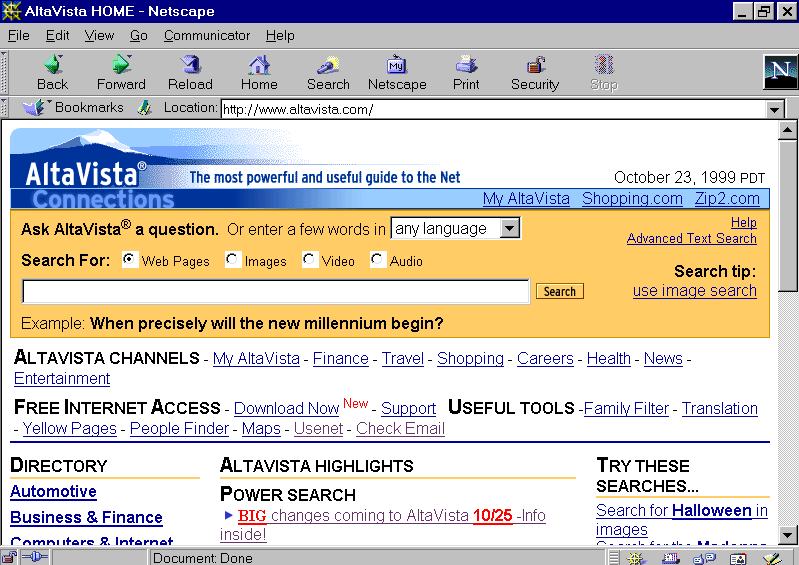
Larry pointed out that Google initially relied on links out of necessity. Back then, there were numerous search engines (Yahoo, AltaVista, etc.) and significantly less search traffic. They needed a method to map the web and differentiate between good and bad websites. Fast forward 15 years, and with billions of daily searches, Google’s reliance on links has diminished. They can leverage the wisdom of crowds and vast data sources that extend beyond links.
A Potential Organic Search Quality Score System
Google invests substantial resources in its ad ranking algorithm. (Ads, of course, are their primary revenue source, but their effectiveness depends on a useful search engine.) So how are ads ranked? Not solely on bids, as this would compromise relevance. To address this, Google developed Quality Score, a system that evaluates ads like content.
AdWords Quality Score primarily hinges on click-through rate (CTR). While Google shrouds the exact calculation in secrecy, our internal research suggests it mainly compares an ad’s CTR at a specific position to the expected CTR for that position. For ads yet to reach the first page, Google can “audition” them and gauge their performance within just 200 impressions.
We believe organic search could benefit from a similar algorithm – one that prioritizes engagement metrics over links. These metrics could include factors like:
- Click-through rate
- Bounce rate
- Time on page
- Social shares
- Number of comments
- Etc.
Google could collect engagement data from various sources, such as Google Analytics, Google Chrome browsers (the most popular mobile browser), and platforms like Google+. While Cutts recently stated that Google doesn’t use Facebook or Twitter social signals in its ranking algorithm, many suspect that part of Google+’s long-term strategy involves leveraging social data for ranking purposes.
Moreover, Quality Score is scalable. Google processes 3 billion daily searches, but it serves 5.6 billion search ads every day (in addition to over 24 billion display ads).
From a marketer’s or business’s perspective, an organic Quality Score system offers several advantages. Instead of constantly trying to generate link-worthy content, you could focus on, for instance, optimizing landing pages for conversions. A well-designed lead generation landing page might effectively serve its purpose and satisfy visitors without attracting any links (who links to a landing page?). The emphasis would still be on quality content, but the objective would shift. You’d be directly catering to your users, many of whom might not have websites or the inclination to link.
“But what about click fraud?” you might ask. Google has already made significant investments in combating click fraud – their AdWords platform would be in jeopardy otherwise. Therefore, couldn’t they apply the same filters to organic content and determine which content naturally attracts clicks and engagement? (They already combat spam on the paid side; they removed 350 million bad ads in 2013 and rejected 3 million publishers.)
Is this a far-fetched idea? Not really – one search engine has already abandoned links. Russian-based Yandex uses user behavior and engagement instead of links has adopted this approach. Google, with its vast data reserves, is well-positioned to implement a similar system and do it even better.
What do you think? Are we on the right track? Is the era of the link coming to an end?