This article was last updated on October 17, 2022. Our editors have revamped it with embedded code examples, the latest data, and adherence to our current editorial guidelines.
Enterprise-level React applications rely heavily on effective state management for a smooth and cohesive user experience.
But it’s not just users who benefit – developers also deal with creating and maintaining state. They need state management solutions that are straightforward, scalable, and modular. React’s introduction of hooks has been a significant step in this direction.
Challenges arise when state needs to be shared across multiple components. This is where engineers must seek out tools and libraries that not only suit their specific needs but also meet the stringent requirements of enterprise-grade applications.
This article delves into a comparative analysis of the leading libraries for React state management, aiming to identify the most suitable option for building robust enterprise-level applications.
Built-in State Management in React
React offers a valuable tool for data propagation across components: Context. Its main purpose is to circumvent prop drilling. Our goal is to identify a user-friendly tool for managing state in various scenarios common in enterprise applications, such as frequent updates, redesigns, and the integration of new features.
The sole advantage of Context is its independence from third-party libraries. However, this doesn’t outweigh the effort required to maintain such an approach.
While Context can theoretically handle these scenarios, it would necessitate a custom solution, demanding time for setup, support, and optimization. The only advantage of Context is its independence from third-party libraries. However, this doesn’t outweigh the effort required to maintain such an approach.
As highlighted by React team member Sebastian Markbage mentioned, the Context API wasn’t designed for high-frequency updates. It’s more suited for infrequent updates like theme changes and authentication management.
Exploring Popular React State Management Libraries
GitHub hosts a plethora of state management tools, including but not limited to Redux, MobX, Akita, Recoil, and Zustand. However, evaluating each one would be an endless endeavor. Therefore, the focus will be on three prominent contenders chosen based on their popularity, usage, and maintainer support.
To ensure a clear comparison, the following quality attributes will be assessed:
- Ease of Use
- Maintainability
- Performance
- Testability
- Scalability (maintaining performance with larger states)
- Modifiability
- Reusability
- Ecosystem (availability of tools for extending functionality)
- Community (size and responsiveness)
- Active Development (frequency of updates and maintenance)
Redux
Created in 2015, Redux quickly gained immense popularity due to several factors:
- Lack of strong alternatives at the time of its release
- Clear separation of state and actions
- Seamless state connection facilitated by react-redux
- Association with Dan Abramov, renowned Facebook developer and React core team member
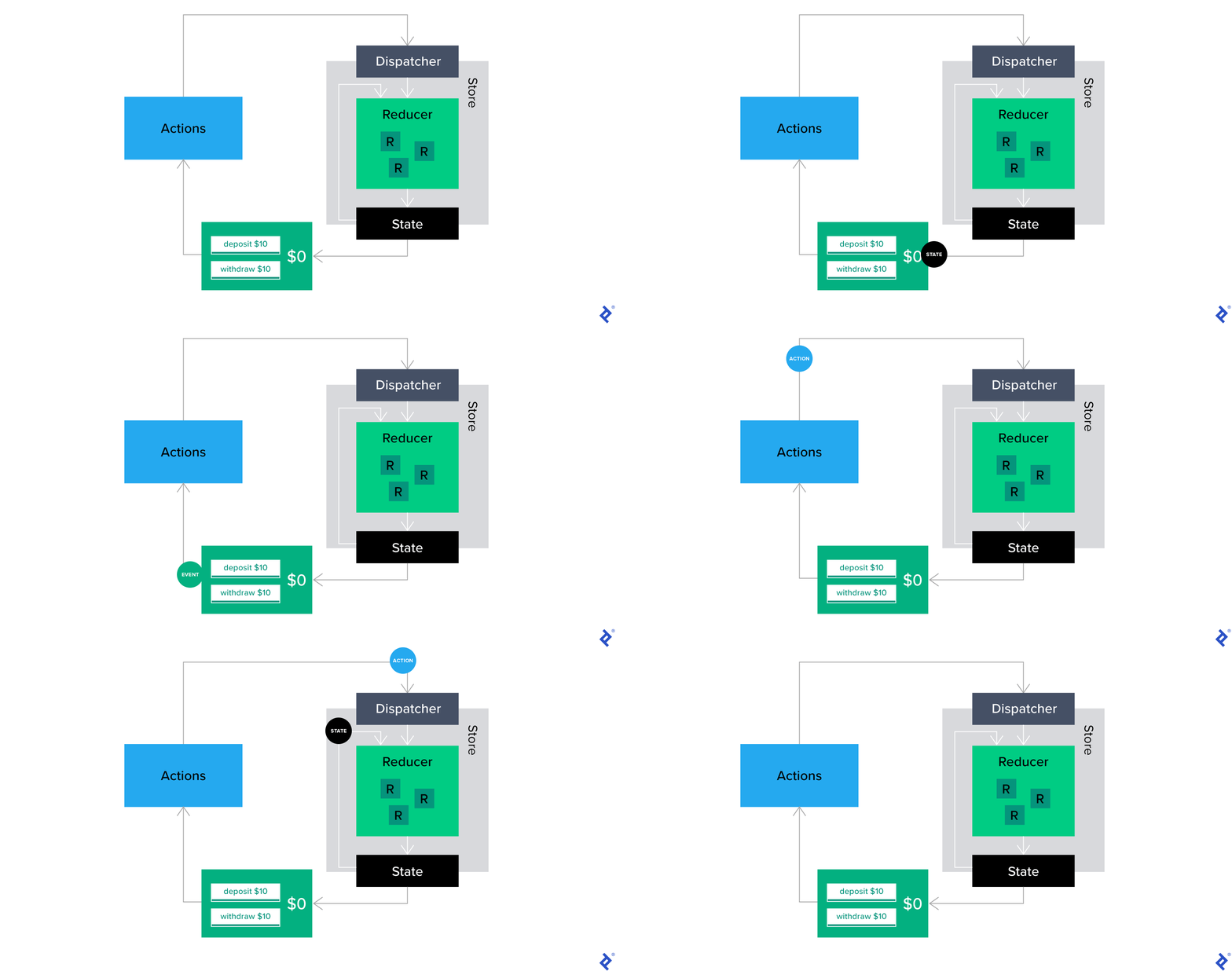
Redux revolves around a global store that houses your application’s data. Updates to the store are triggered by dispatching actions which are then processed by reducers. Reducers immutably update the state based on the type of action received.
To integrate Redux with React, components need to subscribe to store updates using react-redux.
Redux API Illustration
Slices form the cornerstone of Redux, distinguishing it from other tools. They encapsulate the logic for actions and reducers.
| |
Quality Attributes of Redux:
- Usability. Redux has become remarkably user-friendly with the introduction of the official toolkit package](https://redux-toolkit.js.org/). Creating a slice (combining initial state, reducers, and actions), integrating it with the store, and accessing it in components via hooks is now a streamlined process. Redux Toolkit is further enhanced by RTK Query, simplifying standard data querying operations.
- Maintainability. Redux’s simplicity is a key strength. It doesn’t demand deep expertise to understand how to enhance or fix issues within the codebase.
- Performance. Redux performance is heavily influenced by the developer’s skill. As a straightforward tool with minimal internal logic, performance bottlenecks often stem from implementation choices. If slow state updates are encountered, following best practices outlined in the the official guidelines can significantly improve performance.
- Testability. Redux is built upon pure functions (actions and reducers), making it highly amenable to unit testing. Additionally, it provides the mechanism for writing integration tests, ensuring the seamless interaction of the store, actions, and reducers.
- Scalability. Redux’s reliance on a single global state can pose scalability challenges. However, libraries like redux-dynamic-modules address this by enabling the creation of modular reducers and middleware.
- Modifiability. Customizing Redux is straightforward due to its support for middleware.
- Reusability. Being framework-agnostic, Redux excels in reusability.
- Ecosystem. Redux boasts a comprehensive a giant ecosystem encompassing a wide array of helpful add-ons, libraries, and tools.
- Community. As the oldest state management library in this comparison, Redux has cultivated a vast and knowledgeable community. Stack Overflow alone hosts approximately 34,000 questions (with around 26,000 answered) tagged with “redux.”
- Pulse. While Redux development has naturally slowed down as the project has matured, it continues to receive regular updates and maintenance.
MobX
MobX is another well-established library with around 25,800 stars on GitHub. What sets it apart from Redux is its adherence to the OOP paradigm and its use of observables. Originally created by Michel Weststrate, MobX is currently maintained by a dedicated group of open-source contributors, with support from Boston-based Mendix.
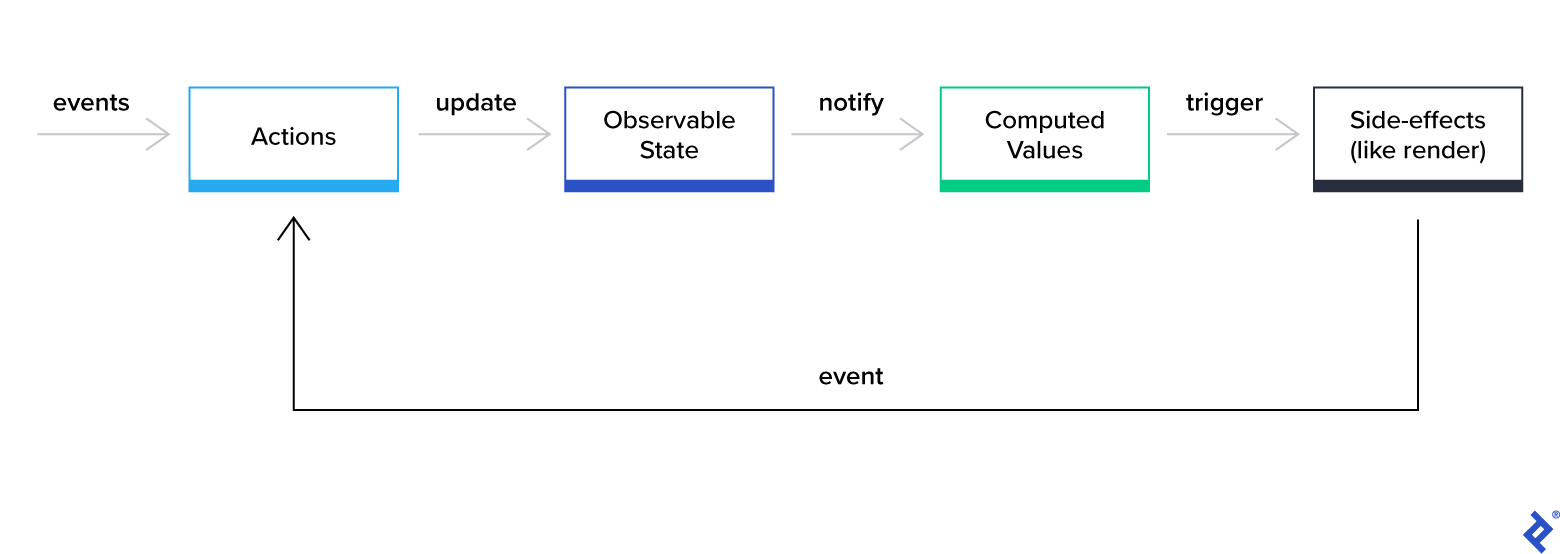
MobX centers around creating a JavaScript class. Within the constructor, a makeObservable call transforms this class into your observable store (decorators like @observable can be used with appropriate loaders). This class then houses properties representing state and methods for actions and computed values. Components subscribe to this observable store to access state, computed values, and trigger actions.
Actions, computed values, and mutability are key features of MobX. Actions encapsulate state changes, computed values derive data from the state, and actions allow for silent state updates to prevent unnecessary side effects.
MobX API Illustration
MobX distinguishes itself by allowing developers to work with near-pure ES6 classes, abstracting away much of the internal complexity. This reduces the amount of library-specific code, allowing developers to focus on application logic.
| |
Quality Attributes of MobX:
- Usability. With the observable store as the central point for state management, MobX offers a simplified development experience.
- Maintainability. Maintainability can be a significant drawback with MobX. Without a firm grasp of the RxJS API, achieving desired results can be challenging. Using MobX within a team lacking sufficient expertise can lead to state inconsistencies and increased development time.
- Performance. MobX excels in performance due to its use of independent stores. Components can subscribe to only the stores they require, minimizing unnecessary re-renders.
- Testability. Observable stores are essentially plain JavaScript objects augmented with reactive capabilities. Testing them mirrors the process of testing regular JavaScript classes.
- Scalability. MobX’s logical separation of state into observable stores contributes to its excellent scalability.
- Modifiability. The ability to create custom observables with tailored behaviors makes MobX highly customizable. Furthermore, reactions allow for modeling automatic side effects, enhancing flexibility.
- Reusability. MobX shares Redux’s framework-agnostic nature, making it highly reusable across different projects and environments.
- Ecosystem. While not as extensive as Redux’s, MobX offers a respectable number of hundreds of extensions.
- Community. MobX has garnered a loyal following. On Stack Overflow, there are around 1,800 questions (with about 1,100 answered) tagged “mobx.”
- Pulse. MobX, much like Redux, enjoys regular updates and maintenance, indicating its stability and maturity.
Recoil
Recoil](https://recoiljs.org/) is a newcomer to the scene, originating from the React team themselves. Its core principle is to provide a simple implementation of features missing in React, such as shared state and derived data.
The inclusion of an experimental library in a discussion about enterprise-level projects might seem unusual. However, Recoil, backed by Facebook and already in use within some of their applications, introduces a novel approach to shared state management in React. Even if Recoil itself were to be deprecated, it’s highly likely that another tool following a similar philosophy, such as Jotai, would gain traction.
Recoil is built upon two fundamental concepts: atoms and selectors. Atoms represent pieces of shared state, and components can subscribe to them to both retrieve and update their values.

A key advantage of this approach is its performance benefit: only subscribed components undergo re-rendering when an atom’s value changes.
Another notable feature is the selector. Selectors compute derived values from one or more atoms (or even other selectors). From a consumer’s perspective, there is no difference between interacting with an atom or a selector – they simply subscribe to the reactive element and use its value.

Any change to an atom or selector triggers a reevaluation of all selectors dependent on it (i.e., subscribed to it).
Recoil API Illustration
Recoil’s code diverges significantly from its counterparts. It leverages React hooks and prioritizes the structure of state over the mechanics of state mutation.
| |
Quality Attributes of Recoil:
- Usability. Recoil is exceptionally easy to use, mirroring the familiar useState hook in React.
- Maintainability. Recoil simplifies maintenance by requiring developers to manage only selectors and hooks within their components. This results in cleaner, more focused code with less boilerplate.
- Performance. Recoil constructs a state tree external to React, allowing for granular subscriptions. This means components only receive updates relevant to them, rather than being forced to re-render on any state change. This, combined with internal optimizations, makes Recoil highly performant.
- Testability. Recoil provides a mechanism for comprehensive testing of atoms and selectors.
- Scalability. The ability to decompose state into independent, manageable pieces makes Recoil inherently scalable.
- Modifiability. Since Recoil focuses solely on storing and aggregating values without imposing a rigid data flow, it offers a high degree of customizability.
- Reusability. Recoil’s reliance on React hinders its reusability in other frameworks or environments.
- Ecosystem. Being a relatively new library, Recoil lacks a mature ecosystem at this point.
- Community. Recoil’s recency means it has a smaller community compared to Redux or MobX. Currently, Stack Overflow shows around 200 questions (with roughly 100 answered) tagged “recoiljs.”
- Pulse. Recoil benefits from frequent updates. Compared to the more mature Redux and MobX, it has a higher number of open issues on GitHub, indicating ongoing active development.
The Verdict: Choosing the Right State Management Tool for React
Each of these React global state management libraries presents a unique set of advantages and drawbacks when considered in the context of enterprise-grade applications.
Recoil, while promising and innovative, currently lacks the robust community support and mature ecosystem necessary for large-scale React applications. Its experimental status further adds to the risk. While it’s not a suitable choice for enterprise projects today, it’s certainly a technology to watch closely.
MobX and Redux, on the other hand, have a proven track record and are widely adopted by industry leaders. The key difference lies in their learning curves. MobX necessitates a basic understanding of reactive programming. If a team lacks this expertise, adopting MobX could lead to code inconsistencies, performance issues, and longer development cycles. However, for teams well-versed in reactive concepts, MobX can be a viable and efficient solution.
Redux also has its challenges, primarily related to scalability and performance. However, unlike MobX, there are well-established solutions and best practices to address these concerns.
After weighing the pros and cons and considering practical experience, Redux emerges as the recommended choice for React enterprise-level applications. Its maturity, extensive community support, and the availability of solutions for common pain points make it the most reliable option for building large-scale, maintainable React applications.