When you deliberately focus on keywords with varying levels of competition, you’ll attract higher-quality traffic to your website.
Think of search keywords as fitting into three main categories:
- “Head” Keywords: These are the popular, highly competitive, and general keywords, usually just one or two words long, like “search marketing.”
- Mid-Tier or “Torso” Keywords: As the name suggests, these are slightly longer phrases with moderate traffic and competition levels.
- “Long Tail” Keywords: These are longer, less common keyword phrases.
Surprisingly, the long tail, as a whole, brings in more traffic and conversions than head keywords. However, managing these longer phrases is challenging, and predicting their performance is nearly impossible. Consider these interesting long-tail statistics:
- 56 percent of buyers use search queries with at least three words, while only 7 percent use a single word or an acronym.
- 20-25% of all Google searches are unique.
- Advertisers using what Google calls long-tail keywords generate half of Google’s revenue.
- People are searching with longer queries.
What does this tell us? While longer keywords are valuable (and becoming more so), they’re tough to manage. How do you target unique queries? Since no one has used these phrases before, how can we build a model to rank for these “new” keywords as they emerge? The strategic answer is to focus heavily on mid-tail keywords while structuring your site to attract long-tail traffic. This series will guide you in planning your:
- Website’s Information Architecture
- Internal Linking Strategy
- Link Building Strategy
- Content Creation & On-Page SEO
This approach helps you rank for mid-tier keywords while attracting long-tail traffic and potentially even ranking for those competitive head keywords over time.
Optimize Your Site’s Navigation & Information Architecture for Mid-Level and Long Tail Keywords
When aiming for rankings from the middle of the long tail keyword graph downwards, begin by building a logical navigation structure or information architecture. Webmaster World offers a helpful visual representation of site architecture:
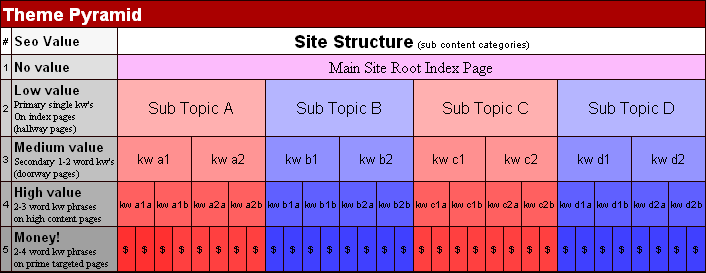
This might seem to contradict our earlier point. The popular stuff sits atop the pyramid, often receiving the most link equity by default from homepage links and top-level, site-wide links.
Why, then, are we suggesting a site architecture that prioritizes broader phrases with link equity and prominence?
Because competitiveness often correlates with value. Keyword research tools make top-level terms widely known, leading to many documents related to these broad topics:

However, more specific queries face significantly less competition:

While the number of competing documents isn’t a perfect measure of keyword competition, it’s a starting point. Let’s see what Google’s keyword tool reveals about the competitiveness of these two phrases:
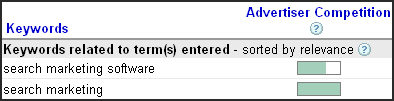
As you can see, “search marketing” attracts considerably more bidders and awareness on Google than “search marketing software,” despite the latter still being a relatively broad term.
By adding a single modifier, we’ve nearly halved the competition from other documents and significantly reduced paid search competition. This allows us to build an architecture where middle-tier terms occupy a central position because ranking for them requires less effort. Moreover, we can adjust our internal linking to target these keywords aggressively.
Interlinking for Rankings on Mid-Tail Keywords
Besides a smart site hierarchy, ensure internal links within your content direct link equity to pages targeting mid-tail phrases.
Wikipedia, often ranking for everything, exemplifies this with its intelligent interlinking and anchor text. Let’s examine what links to their search engine marketing page:
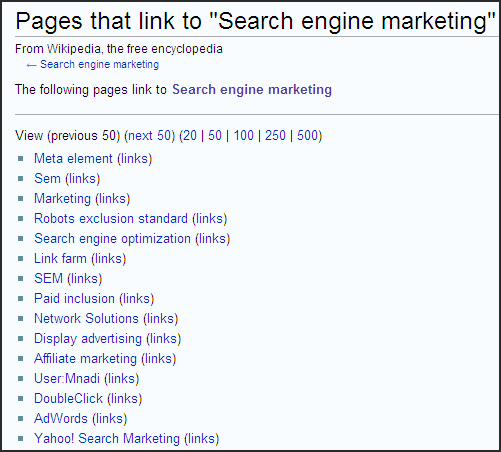
Over five hundred pages link to this single page, all using optimized anchor text.
Here’s an example of “optimized” anchor text:
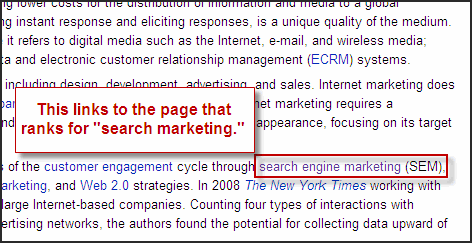
Taken from the Wikipedia page on “Internet Marketing” (http://en.wikipedia.org/wiki/Online_marketing), this text links to their search engine marketing page. As mentioned, over five hundred similar links are spread throughout Wikipedia.
This process can be replicated for your content pages targeting mid-tail keywords. If your site has these pages:
- /search-marketing
- /search-marketing-software
- /best-search-marketing-software
You would point most internal links to the search marketing software page.
From there, ensure you link both upwards and downwards from the search marketing software page, transferring relevance and link equity to the other two. The key is directing most of your site’s relevance and link equity from various pages towards the search marketing software page, aggressively targeting that mid-competition term.
This strategy can then be applied to link building and content creation for both mid-competition and long-tail terms.
On and Off Page SEO for Mid-Level & Long Tail Keywords
Building on the previous points about the value of long-tail keywords and creating a long-tail-friendly navigation structure, this section explains how to build links and create content to help your site rank for both mid and lower competition phrases.
Building Links to Mid-Competition Pages
This expands on the previous principle. The next step involves directing targeted anchor text from external sites to your mid-tail terms.
This is only achievable with links you “control” on other websites. Some suitable options include:
- Directory links
- Profile links (social media, forums, etc.)
- Links from friends (or anyone allowing you to choose the anchor text and target page)
An additional benefit is that linking to mid-tier content often allows for more compelling and distinct anchor text.
Content Creation & On-Site SEO For Mid-Tier Keywords
Here’s where you create a solid foundation for longer-tail queries. You can:
- Optimize for mid-tail terms.
- Include variations of your mid-tail term in sub-headlines (h2s and h3s).
- Create detailed (but well-optimized) content.
First, optimize for both the middle of the graph (your core key phrase) and more specific variations. This means targeting your mid-competition phrase while prominently featuring variations. Using our search marketing example, the page might look like this:
- Title – Search Marketing Software – Streamline Your SEM Efforts
- h1 – What SEM Software Can Do for Your Business
- h2 – The Best Search Marketing Software is Efficient Search Marketing Software
- Etc.
Finally, create longer content. The search marketing Wikipedia page, like many others, contains nearly a thousand words. By creating a long document with natural language and numerous industry-specific terms, Wikipedia positions itself to rank for countless random word combinations.
Consequently, this Wiki article has driven substantial traffic in the first month of 2009:
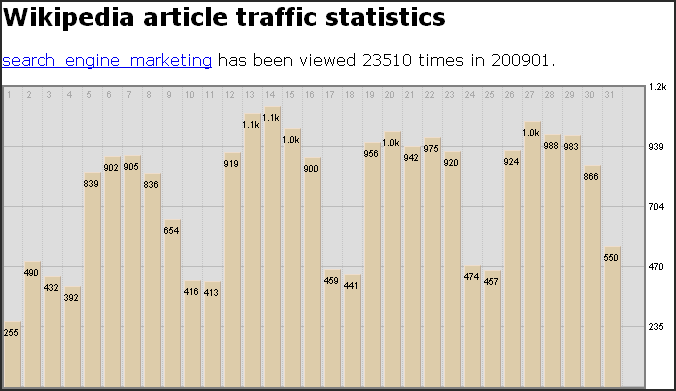
Graph of Wikipedia traffic stats courtesy of http://stats.grok.se.
While much of this traffic stems from the domain’s trust (built through internal links), Wikipedia.org’s content structure and internal linking also play a significant role.
Targeting Mid-Tier Keywords: The Most Profitable Strategy
In essence, we’ve established a method for competing for both mid and long-tail queries, even setting up a system that can rank for keywords yet to be used. Now, all that’s left is building a reputable domain, creating content, and promoting it! (Sounds simple, right?).
Return next week when we delve into the value of keyword discovery and expansion.