There’s been a lot of talk about LinkedIn advertising being ineffective. And while it’s true that, unlike Facebook, LinkedIn isn’t for every business, that doesn’t mean it’s not a valuable tool.
Numerous B2B marketers successfully use LinkedIn advertising to boost brand visibility and generate leads. As the leading platform for business-oriented social networking, LinkedIn advertising is the ideal solution if you’re aiming to connect with c-suite executives, provide marketers with informative content, or simply raise brand awareness.
Before you advertise on LinkedIn, ensure your company has a LinkedIn page to share content. Once that’s set up, you can delve into the details of LinkedIn Ads. And don’t worry – I’m here to guide you through that process.
This comprehensive guide to LinkedIn advertising will cover everything you need to know to get started, including:
- Different types and formats of LinkedIn ads
- How to use LinkedIn advertising for remarketing
- Various targeting options available for LinkedIn advertising
- Best practices for LinkedIn advertising
- Examples of successful LinkedIn advertising campaigns
Types of LinkedIn ads
Similar to other social media advertising platforms, LinkedIn provides a variety of ad types and formats to experiment with. And just like on other platforms, your choice of ad format should align with the specific action you want to encourage. LinkedIn advertising supports brand awareness, website traffic, engagement, video views, lead generation, site conversions, and job applications through its diverse offerings.
LinkedIn sponsored content
Sponsored content ads blend seamlessly with the LinkedIn platform. These ads resemble “boosted” posts from a company’s feed. You can use the ads manager to sponsor a standard post with a headline, image, and link. Alternatively, you can create carousel, video, or lead generation ads that appear in the same “boosted” format.
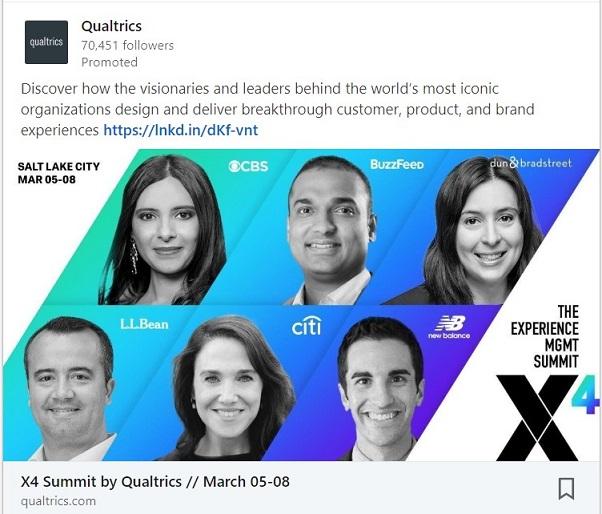
LinkedIn text ads
Among the ad formats on LinkedIn, text ads are the closest you’ll get to Google or Bing search ads. LinkedIn text ads, operating on a familiar pay-per-click or impression basis and appearing in the sidebar. These ads, consisting of a simple text block with a headline and company logo, are admittedly less visually engaging for a social platform.
LinkedIn Sponsored InMail
You know that feeling when you log into LinkedIn and discover 10 new messages? Chances are, some of those are from marketers popping into your inbox through Sponsored InMail. Marketers and sales teams can compile a contact list and send tailored messages to each person. You have considerable freedom when it comes to the content of these messages – you might invite prospects to events or even try to schedule a call.
LinkedIn programmatic display ads
LinkedIn’s entry into the programmatic advertising arena is excellent news for B2B advertisers who often face limited targeting options. With these display ads allowing you to reach the largest professional audience based on intent or personas – but we’ll delve deeper into LinkedIn advertising targeting options later. In terms of ad creative, these are your standard display ads. Marketers can select their preferred demand-side platform or trading desk and purchase ad inventory through open or private auctions.
LinkedIn dynamic ads
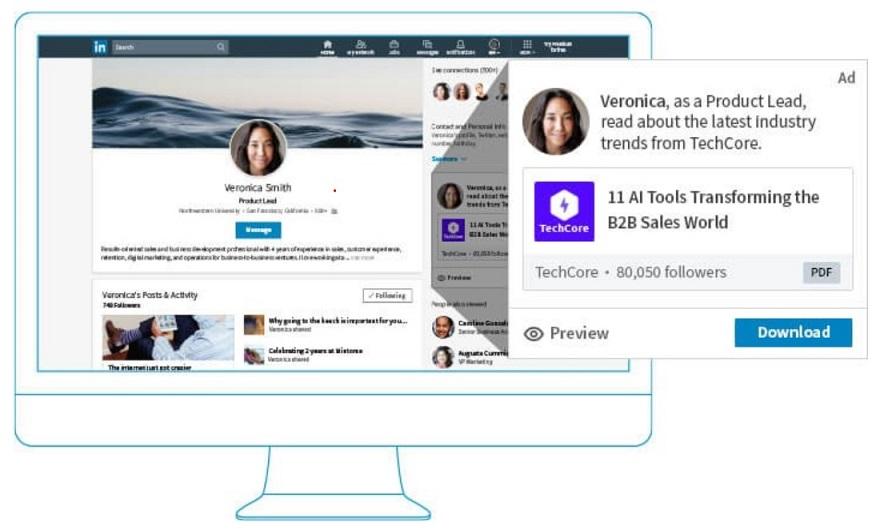
Dynamic ads, allowing for a high level of personalization in your LinkedIn advertising. Advertisers can choose to promote job openings, content downloads, their own company page, or direct traffic to a website through spotlight ads, which also feature on the newsfeed. This ad type comes with pre-designed templates and automatic translation features to simplify the ad customization process.
Bonus: Elevate
Here’s a twist: Elevate isn’t technically Elevate is not an ad, but it functions as a LinkedIn advertising solution. Companies can pay for Elevate to empower their employees to become brand advocates. Essentially, it provides your marketing or sales team with a way to manage or suggest content for employees to share on LinkedIn. Should your employees already be sharing your suggested content? Probably. However, Elevate streamlines the process and yields results – my company attracted three new hires who learned about us through Elevate posts and gained over $20,000 in earned media!
LinkedIn advertising costs
Just like on other platforms, LinkedIn advertising costs depend on your bids and budgets. This means your total ad spending will fluctuate based on your business and objectives, as these factors influence the types of ads you choose for your campaigns and the budgets you allocate.
However, LinkedIn advertising does have minimum spending requirements that all advertisers must meet:
- $10 daily budget for each campaign
- $10 total budget for each campaign (an optional setting for Sponsored Content)
- $2 bid for cost-per-click (CPC) or cost-per-thousand impressions (CPM) on Text Ad campaigns
LinkedIn advertising also has a minimum bid for Sponsored Content campaigns, but the precise amount for this ad type will vary based on your target audience. Which leads us to…
LinkedIn advertising targeting options
This is where LinkedIn advertising truly shines. The targeting capabilities on this platform outshine most others. It’s frequently updated and incredibly comprehensive, thanks to professionals’ tendency to showcase their promotions and achievements. Members provide their job titles, company names, seniority levels, professional interests, and more. With a user base of over 500 million members consisting of 73 million senior-level influencers and 45 million decision makers, it’s highly probable that your LinkedIn ads will reach the right people.
Matched audiences
Start by placing a tag, known as an “Insight Tag” on your website to enable retargeting of your visitors on LinkedIn, similar to how you would set up retargeting on Facebook or Google. The Insight Tag can also be used to generate lookalike audiences. In addition to targeting your website visitors, you can also upload or integrate email lists and execute account-based targeting through LinkedIn.
Don’t have a sufficient number of website visitors or sales prospects to create a substantial campaign audience? No problem! LinkedIn advertising offers an audience option that expands your reach by tapping into their network of publishers. While this is generally a brand-safe approach, be mindful that it can significantly increase your audience size.
Apart from the basic Insight Tag, you can also implement conversion tracking for your LinkedIn advertising campaigns. These triggers are valuable for monitoring unique purchases or other specific actions on your website, especially if you don’t utilize a marketing automation system to create dedicated landing pages and forms.
Audience options
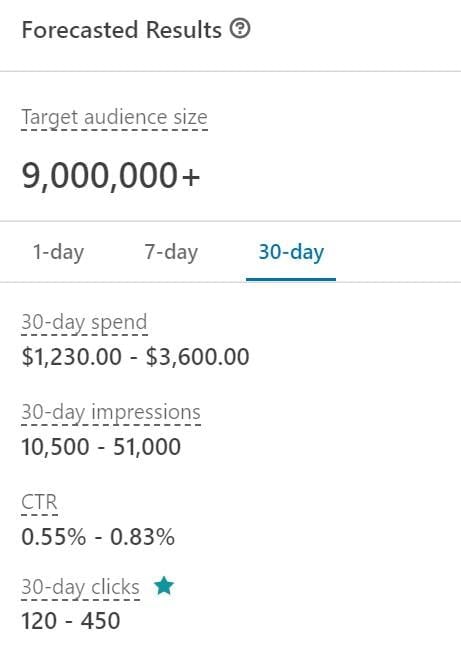
LinkedIn ads provide extensive targeting options, ensuring your ads are shown to the most relevant audience. If you’re interested in evaluating an ad’s performance across different audience segments, you can save your audience as a template for future use.
When setting up your LinkedIn advertising targeting, begin with the fundamentals: language and location. You can choose a permanent geographic location as indicated in user profiles, such as “The Greater New York Area,” or a more temporary location based on their IP address.
After determining the language and location, you can refine your audience further using the targeting options outlined below.
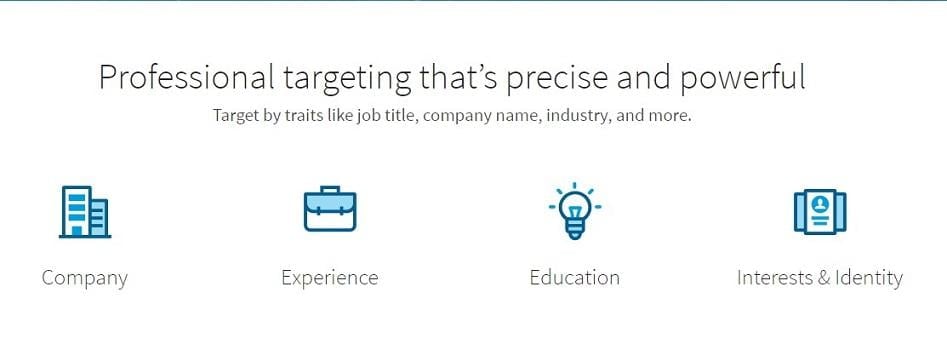
Company
Targeting based on company is particularly beneficial if your sales team has defined target industries. LinkedIn advertising excels in this area, offering more precise company targeting options than other platforms (like Facebook or Twitter), as members are more inclined to keep their employment information current.
Even if targeting specific companies isn’t part of your strategy, this option can still help narrow down your audience.
Company connections: LinkedIn allows you to target first-degree connections of specific companies – provided those companies have over 500 employees.
Company followers: This option lets you reach individuals who follow your company page.
Industries: Reach LinkedIn members employed in specific industries based on the primary industry listed on their company pages.
Names: Target employees based on the company name listed on their profiles.
Size: Reach employees working at companies of a certain size based on the number of employees indicated on a company profile.
Demographic
This is straightforward: Include members of a particular age group or gender in your audience based on inferences from their profiles.
Education
LinkedIn Ads allows you to reach members based on their academic degrees, fields of study (e.g., “Marketing” or “Journalism”), and the institutions they attended.
Job experience
Similar to company-based targeting, LinkedIn stands out when it comes to targeting based on job roles.
Functions or skills: You can construct an audience based on the tasks individuals perform in their current positions or the skills they’ve listed on their profiles. Skills can also be inferred from endorsements received from connections.
Seniorities, titles, or experience: Reach LinkedIn members who have a specific level of seniority, job title, or years of experience listed on their profiles. However, note that any gaps or overlaps in someone’s work history are not factored into the calculation.
Interests
LinkedIn recently introduced interest-based targeting. Now, you can include users who belong to groups centered around certain interests – such as brand marketing or digital advertising – as well as individuals whose interests align with your business.
Keep in mind that if you target specific job titles, companies of a particular size, and followers of your company page, LinkedIn creates the audience based on an “AND” statement. This can significantly reduce your audience size, potentially making it unrealistically small. But don’t worry! You also have the option to exclude certain criteria.
I recommend focusing on one grouping at a time: Create one audience targeted by job function and another targeted by groups. This approach allows for easy assessment of your ads’ effectiveness and facilitates bid adjustments accordingly. LinkedIn Ads prevents you from competing against yourself, so even if there’s overlap – a member belonging to multiple target audiences – you won’t be charged twice for reaching them.
Depending on the size of your audience and the types of ads you run, LinkedIn typically recommends a certain degree of saturation in your advertising strategy. The higher your impression rate, the more likely a prospect is to click on your ad. Is this approach costly? Absolutely. Is it effective? That’s for you to discover!
Quick update: You can now segment your LinkedIn Ad traffic by job function, company, company size, and other factors. To improve your ad performance and create effective audiences, explore the LinkedIn Website Demographics feature.
3 LinkedIn advertising best practices
While understanding the technical aspects of LinkedIn advertising is crucial, all the information shared so far won’t be of much use if you don’t know how to effectively leverage it for building successful campaigns. That, dear readers, is why I want to conclude with some proven LinkedIn advertising best practices. Here are three to keep in mind as you get started!
1. Carefully consider the customer journey
Let’s revisit the ad types we discussed earlier. When starting with LinkedIn advertising, it might be tempting to test all the different products the platform offers. However, this is not advisable because different LinkedIn ad types are appropriate for different stages of the customer journey.
Take Sponsored InMail, for example – the ad type that allows direct communication with your LinkedIn prospects through their inboxes. I have strong feelings about this, so I’ll be blunt: Using Sponsored InMail as the initial touchpoint with your LinkedIn prospects is a terrible idea. Why? Because people generally dislike receiving messages from strangers representing unfamiliar companies. As a marketing tactic, it’s about as invasive, pushy, and ineffective as it gets.

I’m not suggesting you abandon Sponsored InMail altogether in your LinkedIn advertising strategy. What I am recommending is that you use Sponsored InMail judiciously as a means of re-engaging prospects who have previously interacted with your business in meaningful ways. A mid-funnel prospect will be far more receptive to sales messages than a high-funnel prospect.
2. Layer your targeting options (but not excessively)
As we explored earlier, there’s no shortage of LinkedIn advertising targeting options. This is excellent news for digital marketers – more targeting options translate to more valuable opportunities! Let me explain.
Across all digital advertising platforms, the primary purpose of targeting options is to help advertisers reach individuals most likely to convert into customers. LinkedIn is no exception. The more effectively you can target your ideal customer, the less money you’ll waste on impressions and clicks from users who hold no value for your business. Layering multiple LinkedIn targeting options is the only way to achieve this.
For instance, let’s say you’re using LinkedIn advertising to promote a software solution designed to help small restaurants optimize their online presence. If your sole targeting parameter is users working in the food service industry, you’re going to squander a significant amount of your budget. Conversely, if you layer various parameters to target owners of small restaurants specifically, you’ll drive significantly better results!
A word of caution: Don’t go overboard with layering your LinkedIn advertising targeting options. If you get too specific, you’ll end up targeting an excessively narrow audience, potentially missing out on valuable opportunities.
3. Draw insights from other advertising platforms
My apologies to anyone advertising exclusively on LinkedIn – this last best practice is geared towards those of you also utilizing platforms like Google Ads, Bing Ads, and Facebook Ads.
While every digital advertising platform has its unique characteristics – for instance, people use Google actively and Facebook passively – it’s generally advisable to provide your prospects with a relatively consistent experience across all their interactions with your business. From a tactical perspective, this involves repurposing ad copy and targeting parameters that have proven successful on other platforms.
Analyze the Google ads that consistently generate the highest click-through rates and conversion rates. From a copy standpoint, are there any recurring themes across these ads? Any particular words, phrases, or tones that seem to resonate strongly with your prospects? If so, try incorporating those copy elements into your LinkedIn ads.
Now, shift your focus to the Facebook ads that are driving the highest click-through and conversion rates. While you can certainly draw inspiration from the copy itself, I’m particularly interested in the targeting parameters. Are there any custom audiences that respond exceptionally well to your marketing messages? Does it appear that past website visitors are particularly receptive to remarketing? Once again, you might find that these insights are applicable to your LinkedIn advertising campaigns as well.
5 LinkedIn advertising examples to inspire you
While entering your first LinkedIn advertising campaign equipped with several best practices is beneficial, it’s equally crucial to have a clear understanding of what LinkedIn ads actually look like in practice. So, we’ve compiled a brief list of five LinkedIn advertising examples to inspire you.
1. SurveyMonkey
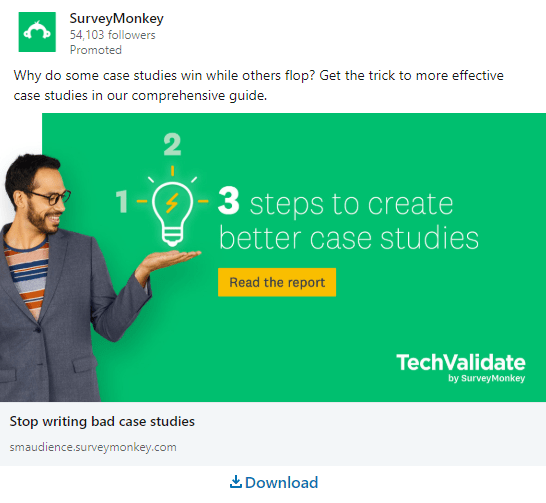
This ad from SurveyMonkey is excellent simply because of how effectively it’s targeted towards me. As a content marketer, I’m frequently tasked with writing case studies – a content type that’s often quite challenging to execute well.
Beyond addressing a pain point shared by many marketers, this ad also does a great job of enticing users to click. The featured image – in addition to being exceptionally well-designed – is effective because it draws users in with the suggestion that the guide being promoted is accessible to everyone: “Don’t worry – the path to writing better case studies involves just three simple steps. You’ve got this.”
2. Instapage
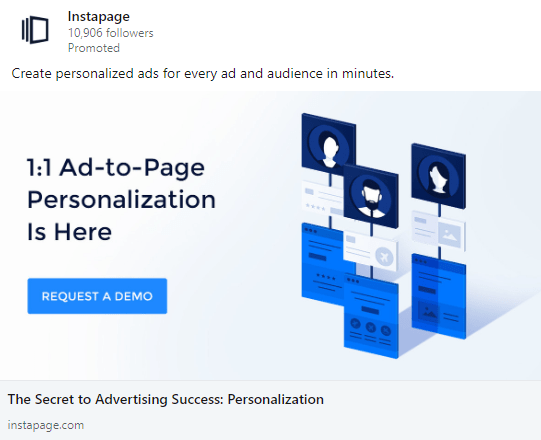
What I find particularly appealing about Instapage’s LinkedIn ad is the simplicity and directness of their value proposition. In a single sentence, Instapage successfully addresses two key pain points: (1) the difficulty of crafting personalized advertising experiences and (2) the amount of time required to build a high-converting landing page. That’s a testament to effective copywriting!
I also appreciate the thoughtful use of contrast in this LinkedIn ad; the blue “Request A Demo” CTA button stands out clearly against the silvery background. If you don’t explicitly direct your prospects’ attention to a CTA, your investment in LinkedIn advertising might as well be nonexistent.
3. Airtable
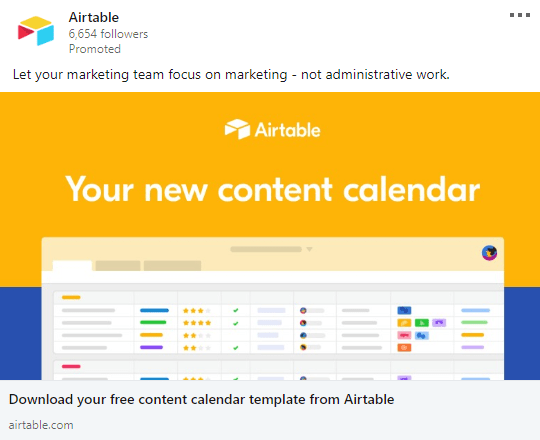
Much like Instapage, Airtable excels in its value proposition – it’s concise, memorable, and well-considered. Even if a particular user doesn’t click on this LinkedIn ad, you can be certain they’ll remember the value Airtable provides to its customers.
Another noteworthy aspect of this ad is the alignment between the offer being presented and the level of familiarity between Airtable and its target audience. This is clearly a top-of-funnel LinkedIn ad – intended to drive awareness rather than immediate sales. Recognizing that the users encountering this ad are relatively unfamiliar with their company, the marketers at Airtable wisely chose to offer something low-stakes – a free content calendar template – that still effectively showcases the company’s value.
4. Verifyed
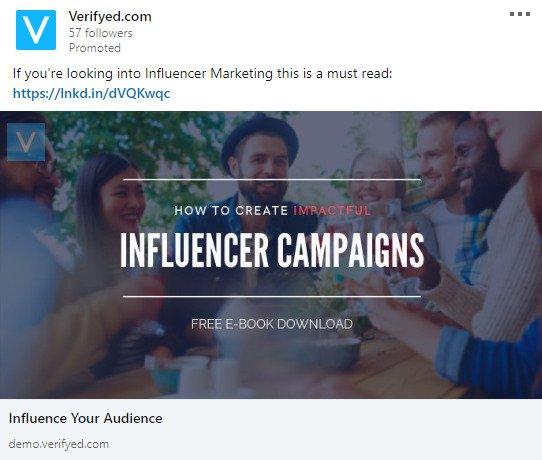
Here we have another prime example of a LinkedIn ad that couldn’t be better targeted towards me. Since a significant portion of my job involves writing about digital marketing trends, this piece of content from Verifyed on influencer marketing is practically irresistible.
But that’s not what truly elevates it to the status of a great LinkedIn ad; what does is the fact that it doesn’t feel like an ad at all. When I first encountered this offer in my LinkedIn feed, I could have sworn it was an organic post. Since people generally tend to trust organic posts more than advertisements, emulating this approach from Verifyed would be a wise move on your part.
5. Music and Arts

Somehow, the marketing team at Music and Arts discovered my deep passion for music. I’m not sure how they did it, but what I do know is that they definitely captured my attention. Talk about a LinkedIn ad that stops you in your tracks!
What I find particularly impressive about this example is its utilization of the carousel format – a type of LinkedIn ad that allows you to share a series of clickable cards. As you can see, this ad gave me the option to scroll through multiple links and select the one that resonated most strongly with me. Regardless of your industry, I highly recommend experimenting with the carousel format and breaking away from the conventional single-image approach!
Take LinkedIn advertising for a test drive
In the early days of LinkedIn advertising, managed accounts meant working with customer service representatives and committing to a fixed budget. Fortunately, LinkedIn advertising has evolved significantly over the past few years, transitioning to a self-service platform that recently received a UX upgrade.
If you’re worried about overspending, the platform makes it easy to set budgets, bid types, and end dates. Of course, it’s still important to stay on top of your campaigns (we’ve got you covered with some solid LinkedIn advertising tips here). But it’s always worthwhile to explore new avenues for reaching your ideal customers.