The United Nations Educational, Scientific and Cultural Organization (UNESCO) committee dedicated to safeguarding intangible cultural heritage convened in Namibia and added 20 new elements to the prestigious Representative List of the Intangible Cultural Heritage of Humanity. This list showcases diverse forms of expression that embody intangible heritage and promotes broader awareness of their significance. Concluding this year’s nomination review, the committee inscribed 23 out of 35 proposed elements.
On December 2nd, the following entries from the Asia Pacific and Middle East regions were formally included on the list:
Azerbaijan - Copper craftsmanship of Lahij
In the Caucasus region, the Lahij community practices the traditional craft of crafting and utilizing copperware, known as Copper craftsmanship of Lahij. The process begins with a copper-smelting master preparing the copper. Subsequently, a coppersmith-hammerer shapes it into thin plates. These plates are then engraved by skilled artisans with designs reflecting their surroundings, traditional wisdom, and values. The copperware produced is purchased by people across Azerbaijan for everyday use. Handed down through generations, from father to son, this practice is a defining characteristic of Lahij’s identity.
Cambodia, Philippines, South Korea and Vietnam – Tugging rituals and games
Tugging rituals and games are integral to the rice-farming cultures of East and Southeast Asia. These practices are performed within communities to invoke bountiful harvests and general prosperity, signifying the start of the agricultural cycle. Participants, divided into teams, pull on opposite ends of a rope. This activity, emphasizing community unity and identity rather than competition, is guided by elders who mentor younger participants.
North Korea - Tradition of kimchi-making in the Democratic People’s Republic of Korea
Kimchi, a staple in Korean cuisine, is made from a variety of vegetables, including wild greens. The ingredients are combined with spices, fruits, meat, fish, or fermented seafood, then undergo a process of lactic fermentation. Kimchi is enjoyed both in daily meals and on special occasions. Women primarily drive this tradition as bearers and practitioners. Notably, when preparing large batches for winter, families, neighbors, and community members contribute, fostering social bonds.
Indonesia - Three genres of traditional dance in Bali
Bali’s traditional dances, performed by both men and women, are deeply symbolic, representing specific traditions, customs, and religious beliefs. The dances feature diverse movements and facial expressions synchronized to the music of the gamelan. Performers, adorned in vibrant costumes with floral and animal patterns, must demonstrate discipline, humility, charisma, and infuse the performance with spiritual energy. These dances are mainly passed down through informal channels to young children.
Kazakhstan, Kyrgyzstan - Aitysh/Aitys, art of improvisation
Aitysh/Aitys is a captivating contest where two individuals engage in poetic improvisation. Set to music played on traditional instruments like the Kazakh dombra, the contestants may choose to speak or sing their verses. The audience actively participates by selecting the topics, and the winner is determined by their musical dexterity, rhythm, creativity, and wit. Deeply embedded in the cultural fabric of Kyrgyzstan and Kazakhstan, Aitysh/Aitys serves as a powerful symbol of identity for the communities that practice it. Performances occur at local celebrations and national events, often addressing significant social concerns. The tradition is passed down organically from older to younger generations.
Saudi Arabia - Alardah Alnajdiyah, dance, drumming and poetry in Saudi Arabia
Alardah, an essential cultural expression in Saudi Arabia, seamlessly blends dance, drumming, and poetic chanting. The performance typically features a poet reciting verses, which are then sung by other performers who move rhythmically to the beat of drums while carrying swords. An integral part of family, local, and national gatherings, Alardah is performed by men, while women play a vital role in designing the costumes. This inclusive tradition transcends age and social class, promoting social unity. Its transmission occurs through various channels, including individuals, schools, troupes, neighborhoods, and provinces.
Turkmenistan - Epic art of Gorogly
The epic art of Gorogly, a vibrant oral tradition, celebrates the legendary hero Gorogly and his forty horsemen. In Turkmenistan, skilled performers specialize in this captivating art form, which incorporates narration, singing, poetry, vocal improvisation, and music. For the communities that carry this tradition, the epic fosters a strong sense of identity, reflecting the Turkmen people’s hopes for a fulfilling life. It also reinforces essential values such as bravery, honesty, friendship, and fairness. The transmission of this art form combines informal teachings from masters with practical experience gained during public performances.
United Arab Emirates, Oman - Al-Razfa, a traditional performing art
Originating as a celebratory performance for victories, Al-Razfa holds a significant place in the cultural heritage of the United Arab Emirates and Oman. Today, it thrives as a beloved form of communal entertainment at festive gatherings. In this dynamic performance, groups of men, holding wooden replicas of rifles, chant verses, often drawing from traditional Nabati poetry, accompanied by music. To engage younger generations, instruments and musical styles have been adapted. Knowledge and skills are passed down informally within families.
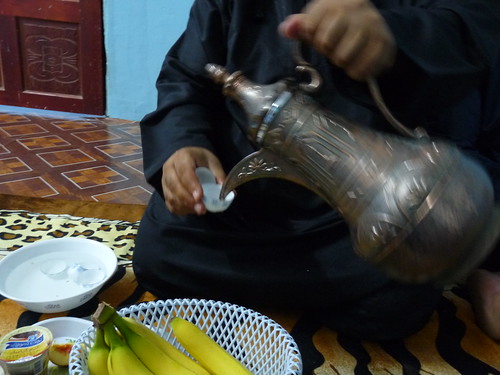
In Oman, the act of serving qahwa, or coffee, in a majlis using a traditional coffee pot. Traditional Chinese teacups are used for serving. Dates, meant to counterbalance the coffee’s bitterness, and fresh fruits are also offered.
UAE, Saudi Arabia, Oman, Qatar - Arabic coffee, a symbol of generosity
The act of serving Arabic coffee is deeply ingrained in the tradition of hospitality within Arab societies. Traditionally, both men and women prepare the coffee in front of guests. It’s also customary for sheikhs and tribal leaders to partake in serving. The process involves roasting the beans, grinding them with a mortar and pestle, and then brewing the coffee in a special pot. The first cup is always presented to the most esteemed or eldest guest. This custom is passed down through generations, with young people accompanying elders to markets to learn the art of selecting the finest beans.
UAE; Saudi Arabia; Oman; Qatar - Majlis, a cultural and social space
Majlis, meaning “sitting places”, are vital community spaces where individuals gather to discuss local matters, resolve disputes, share news, and enjoy each other’s company. They play a critical role in transmitting oral heritage. These spaces are typically spacious, welcoming, and equipped for preparing and serving beverages. Elders, respected for their extensive local knowledge, are often the primary practitioners. At the same time, judges and religious sheikhs lend their expertise to mediate conflicts. Women have their designated Majlis, although prominent female figures may participate in others with a more academic focus. The tradition continues as younger generations accompany older members to these gatherings.
Interested?