I completely agree that the concept of crowdfunding is fundamentally sound. In an ideal world, it would be a powerful engine for innovation, empowering talented and creative minds to transform their visions into reality.
However, our reality is far from perfect, and it’s time for a dose of realism:
Reality /rɪˈalɪti/
noun
- The state of things as they actually exist.
- The graveyard where poorly conceived crowdfunded projects meet their demise.
This issue extends beyond entrepreneurs involved in crowdfunding; it can negatively impact those who are not directly exposed to it:
- We’re allowing deceptive individuals to damage the reputation of crowdfunding and the startup ecosystem.
- These reputational risks can even affect those not directly involved in crowdfunding.
- By neglecting to address the problems in crowdfunding, we indirectly hinder legitimate ideas from accessing funding and support.
- The crowd’s enthusiasm can quickly sour into anger when crowdfunded projects fail spectacularly.

My argument is this: For the collective well-being of our industry, entrepreneurs, developers, and enthusiasts must actively work to eliminate bad actors from the crowdfunding space.
But Crowdfunding Has Produced Great Tech Products!
Absolutely, but my focus here is not on the successes. While there are notable examples like Oculus Rift, for every one of them, there are countless absurd ideas seeking funding.
Unfortunately, people tend to fixate on positive examples while ignoring the rest. The truth is, Oculus Rift is a poor example of crowdfunding because it’s an outlier. The majority of crowdfunding campaigns fail.
How did such a positive concept become synonymous with failure? Several factors contribute:
- Uncritical media coverage
- Social media hype
- Lack of accountability
- Insufficient regulation and oversight
The media should be more discerning. Major news outlets often fail to identify unrealistic ideas, highlighting their inability to provide critical analysis. Many have become platforms for anyone with clickbait material.
Social networks exacerbate this issue, allowing ideas to proliferate rapidly. People perceive outlandish ideas as credible due to their coverage by large media outlets, assuming thorough fact-checking.
Crowdfunding platforms are meant to intervene when campaigns are clearly failing, but their responses are often slow.
There’s a need for proper campaign screening and a more robust regulatory framework for the industry.
Realistic Expectations: Are You The Next Oculus Rift?
The “Why aren’t we funding this?” meme humorously highlights both brilliant and outlandish ideas. It can be applied to many crowdfunding campaigns with a slight alteration:
Why are we funding this?
This is what I appreciate about crowdfunding. Imagine you enjoyed classic games from the eighties. Decades later, these games have a devoted following, but not enough to attract publishers. Crowdfunding offers a way to connect fans globally and port these classics to new platforms.
Crowdfunding excels at uniting niche communities worldwide, enabling the funding of specialized products and services. It’s about expanding niche markets and supporting projects with limited mainstream appeal.
Be wary of campaigns that claim to disrupt mainstream markets.
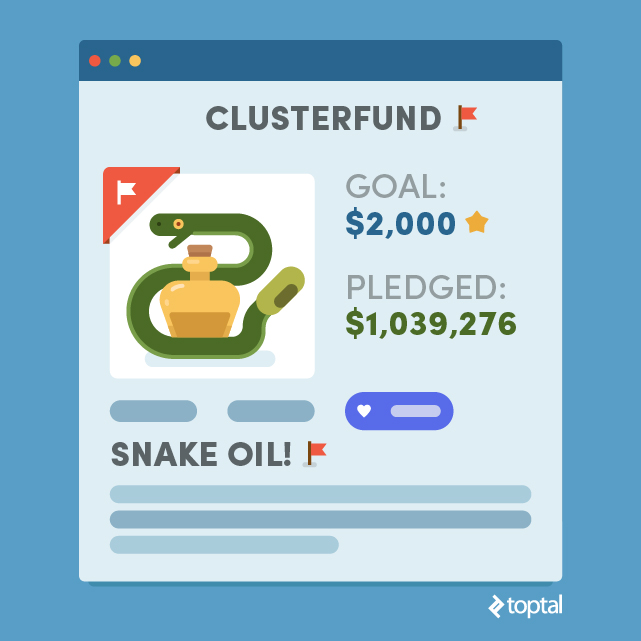
If you have a genuinely exceptional idea with broad market appeal, you shouldn’t need crowdfunding. Reaching out to a few potential investors should suffice.
I’ve chosen not to use failed software projects as examples for two reasons:
- Most people are unfamiliar with software development complexities.
- I want to highlight the dangers of hype with entertaining examples.
Therefore, I’ll focus on two absurd campaigns: the Triton artificial gill and the Fontus self-filling water bottle.
Triton Artificial Gill: A Crowdfunding Cautionary Tale
The Triton, a concept straight out of a James Bond film, claims to allow humans to “breathe” underwater by extracting oxygen. It supposedly achieves this using impossibly efficient filters with “fine threads and holes, smaller than water molecules” and a “micro battery” that’s 30 times more powerful and charges 1,000 times faster than existing batteries.
Sci-Tech Red Flag: If such battery technology existed, why would you need crowdfunding? Tech giants and countless others would be clamoring to acquire it, making you an instant multi-billionaire.
The claims unravel upon closer inspection:
- The required battery technology doesn’t exist.
- The described “filter” is scientifically impossible.
- The device would require an impractical volume of water to extract enough oxygen.
Despite its absurdity, many media organizations treated it as a legitimate project. Fueled by social media hype, it raised nearly $900,000 on Indiegogo in weeks.
Fortunately, they had to refund their backers.
Fontus Self-Filling Water Bottle: A Recipe for Disaster
This idea seems more plausible as it’s technically feasible. However, it’s incredibly inefficient. Generating the necessary temperature differential and cycling enough air to fill a bottle requires a significant amount of energy. Think about how much energy your dehumidifier or AC unit consumes. Considering the Fontus’s size and the energy required, it might produce enough water to sustain a hamster, not a human.
While not as outlandishly impossible as the Triton, it’s worse because it’s still active, and the Indiegogo campaign has already raised about $350,000. More concerning is its coverage by reputable news outlets like Time, HuffPost, The Verge, Mashable, and Engadget—the very entities that should be providing accurate information.
It’s hard to believe that people in arid regions around the world are unaware of this “solution” and haven’t adopted it if it were viable.
Mainstream Appeal Red Flag: A technology efficiently extracting water from air would be revolutionary and wouldn’t require crowdfunding. Water is a fundamental necessity. Governments worldwide would invest billions, bringing clean water to those lacking access.
Successful Failures: Lessons for Tech Entrepreneurs
NASA dubbed the Apollo 13 mission a “successful failure.” Despite not landing on the moon, it showcased resilience in overcoming near-disastrous challenges.
The same can be said for campaigns like the Ouya Android gaming console, the Ubuntu Edge smartphone, and the Kreyos Meteor smartwatch. They highlight the real-world difficulties of launching software/hardware products.
All three were appealing for different reasons:
- Ouya aimed to be a budget-friendly Android gaming and media device.
- Ubuntu Edge envisioned a smartphone-desktop hybrid for Linux enthusiasts.
- Kreyos Meteor promised advanced gesture and voice control for smartwatches.
What led to their downfall?
- Ouya’s hardware, cutting-edge at conception, was outdated by release, leading to low developer interest.
- Ubuntu Edge, while innovative, aimed for a daunting $32 million goal. Smartphone market saturation added to its challenges.
- Kreyos Meteor’s rushed development resulted in a buggy final product, coupled with weak smartwatch demand.
These examples demonstrate that even promising ideas can encounter insurmountable obstacles. Despite attention and funding, they faltered. They were not fraudulent but ultimately unsuccessful.
If industry giants like Microsoft or Samsung release a flawed product, it doesn’t cripple them. They can absorb the loss.
However, most startups lack this luxury. Failure often means the end.
Why Crowdfunding Fails: A Multifaceted Problem
There’s no single explanation for all crowdfunding failures. Some are outright scams highlighting the need for stricter regulations. Others are bad ideas disguised by clever marketing, while some are genuinely good ideas facing the same uncertainties as any other product.

Should we abandon crowdfunding altogether? No, but we must acknowledge that it’s not suitable for every project and that the current landscape needs significant improvement:
- Crowdfunding was intended for smaller projects, not for raising millions.
- Most Kickstarter campaigns remain underfunded, and successful ones typically don’t raise substantial amounts. One-fifth of submissions are rejected, and 10% of fully funded campaigns fail to deliver.
- Even successful crowdfunded products face the ultimate test: The Market.
The lack of scrutiny towards questionable campaigns by some platforms is another concern. Everyone wants a piece of the pie, but few want to share the responsibility.
This lack of accountability makes me pessimistic. I anticipate more spectacular crowdfunding failures in the future.
The Value of Action Over Ideas
Consider this scenario:
An aspiring entrepreneur tells a seasoned one:
“I have this groundbreaking app idea that will disrupt…”
“Hold on,” the experienced entrepreneur interjects. “Do you have a skilled team, funding, a plan?”
“Not yet,” the aspiring one admits, “but…”
“So, you have nothing?”
This humorous exchange illustrates a crucial point: Ideas alone are worthless. Ideas coupled with dedication, research, and a capable team are what drive progress.
Investors are interested in execution, not just ideas. They want to see tangible progress: prototypes, plans, research—not just flashy presentations and promises. If someone is unwilling or unable to take the initial steps, to demonstrate their commitment and ability, no amount of funding will magically lead to success.
Serious investors look for evidence of work, not just aspirations.
Shouldn’t crowdfunding backers expect the same level of commitment and transparency?