In the realm of online marketing, search volume often steals the spotlight, but keyword difficulty holds equal weight. While knowing the monthly search count for a keyword is crucial, understanding the level of competition for that keyword is equally vital. Discovering a high-volume keyword with low difficulty, a task aided by keyword research tools, can lead to a goldmine for your business, whether through PPC advertising or organic content creation (SEO).
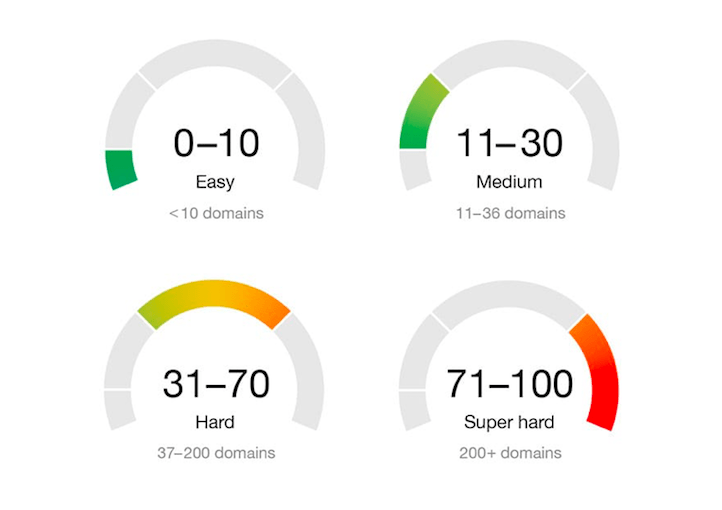
However, a secret ingredient elevates your keyword strategy: intent. Even a high-volume, low-difficulty keyword proves useless if it doesn’t align with your marketing goals. Understanding the “why” behind people’s searches is as crucial as the “what.” Is the keyword relevant enough for a PPC bid or a dedicated blog post?
This guide delves into the significance of keyword difficulty in effective keyword research, particularly its relationship with search volume and intent. We’ll also explore how keyword difficulty plays out differently for PPC and SEO.
What Is Keyword Difficulty?
Keyword difficulty, sometimes referred to as “competition,” indicates how challenging it is to rank for a specific keyword. Assessing this metric helps determine if optimizing an organic page or bidding on that keyword in a Google Ads campaign is worthwhile. Various factors contribute to a keyword’s competitiveness, and understanding these nuances is essential for integrating them into your marketing strategies. Let’s begin with how keyword difficulty can be leveraged for SEO.
Keyword Difficulty: An SEO Perspective
In SEO, keyword difficulty primarily reflects the quantity and quality of backlinks pointing to the top ten search results for that keyword. Essentially, it indicates how tough the competition is based on the strength of their backlink profiles. SEO tools gauge this “competitiveness” by analyzing the domain authorities (or domain ratings) and page authorities (or URL ratings) of the indexed pages.
Feeling lost? Let’s clarify these terms.
Domain Authority, Page Authority, and Link Equity Explained
Similar to “keyword difficulty,” “domain authority” and “page authority” – sometimes called domain rating and URL rating depending on the tool – aren’t official Google terms. These metrics are developed by SEO software providers to estimate the link equity of a page or domain. Consequently, expect variations in these metrics across different tools and their accuracy in reflecting the true strength of the pages analyzed.
The concept of link equity is a good starting point for understanding domain and page authority. An outbound link from a page carries the same link equity as the inbound links (both external and internal) it possesses. So, if we have two pages, Page A and Page B…
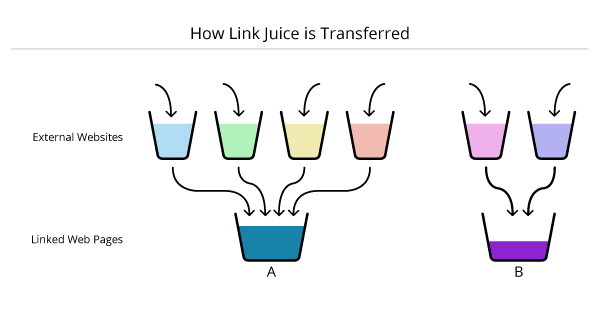
…and Page A receives more inbound external links than Page B, an outbound link from Page A will have higher link equity than one from Page B (assuming the inbound links originate from pages with equal authority). While page authority measures link equity at the page level, domain authority assesses it site-wide. Although domain authority signals the quality of an inbound link, page authority often correlates more directly with Google rankings due to its granular insight into the backlink profiles of indexed pages.
Incorporating Keyword Difficulty
Since keyword difficulty assesses the competitiveness of the top 10 search results for your target keyword, you can estimate the ranking difficulty by examining the domain and page authorities of those listed pages. For instance, if you’re writing about keyword difficulty:
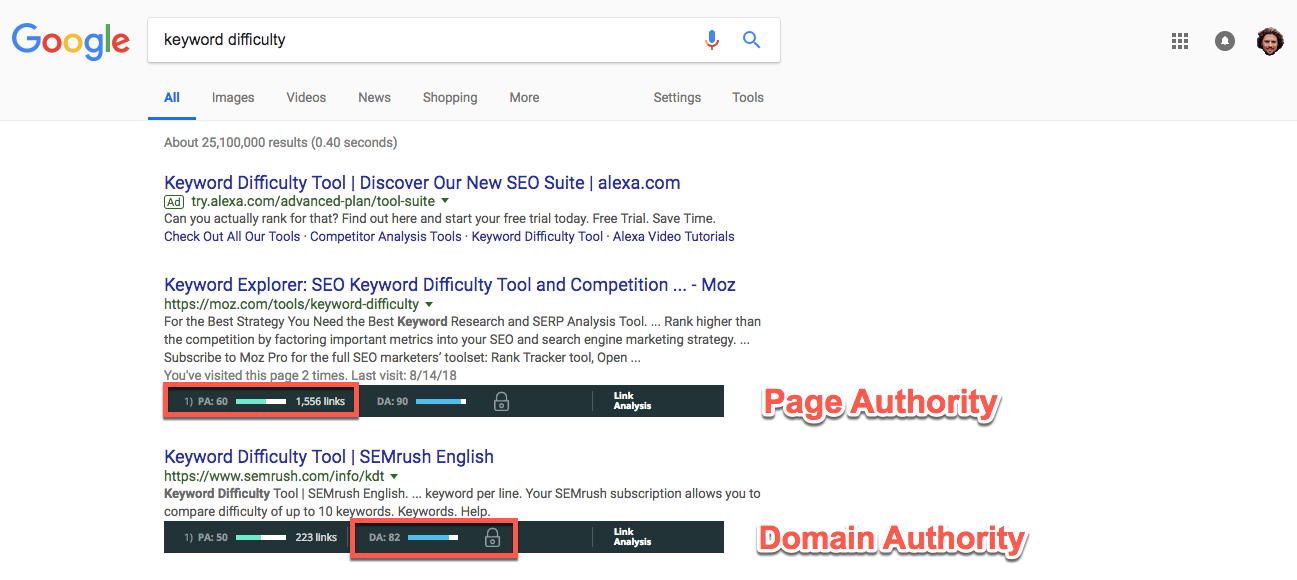
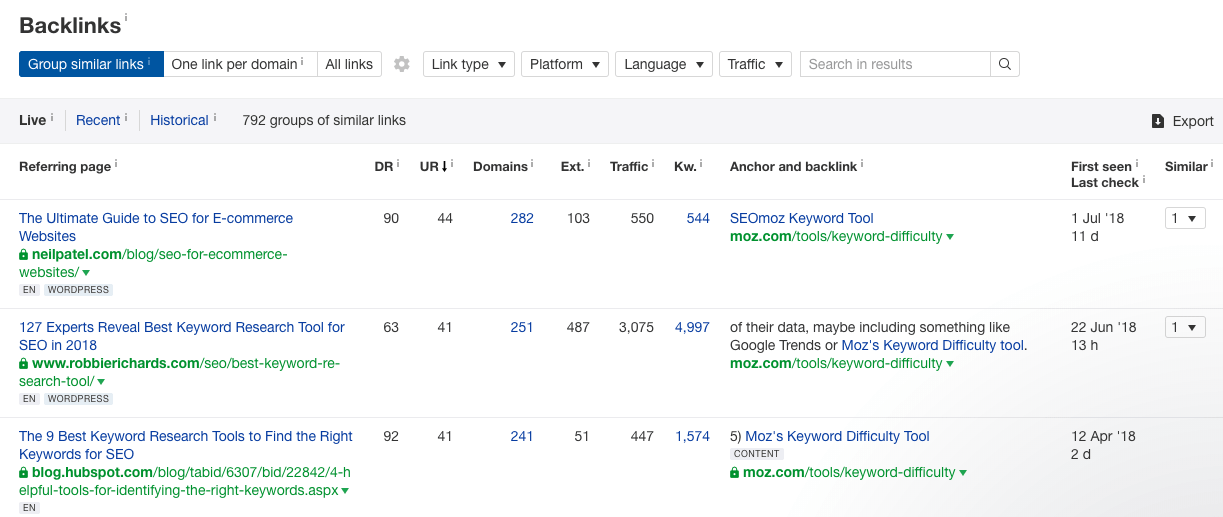
You can perform competitive analysis by examining the strength of your competitors’ backlink profiles for each page. The example above provides a general overview of competitor domain and page authorities using MozBar, a Moz extension. MozBar reveals the number of backlinks for each page but doesn’t disclose their quality. For a more detailed investigation, tools like Ahrefs’ Site Explorer can pinpoint the sources of inbound links for the top-ranking page:
When analyzing keyword difficulty through Ahrefs, you’ll also see the estimated number of referring domains needed to rank for a particular keyword:
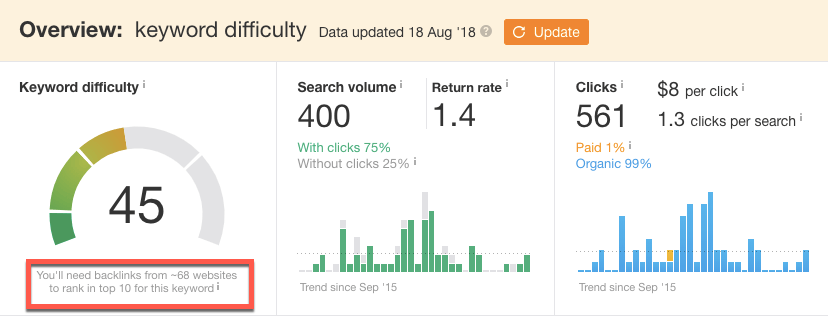
It’s crucial to remember that this metric doesn’t tell the whole story; links from 68 low-quality sites won’t magically land you on page one. However, it’s still a useful indicator, with SEMrush placing referring domains as the fifth most important factor in its list of top ranking factors.
Now, let’s explore these elements in the broader context of identifying the most effective SEO keywords for your content.
Integrating Volume and Intent
As mentioned earlier, effective keyword research involves three key ingredients: keyword difficulty, search volume, and intent. Now that you grasp keyword difficulty from an SEO standpoint, let’s discuss how to combine it with search volume and intent to pinpoint valuable SEO keywords.
Search Volume in SEO
Search volume represents the monthly search count for your keyword. Generally, higher search volume increases the likelihood of a page optimized for that keyword attracting significant traffic to your site. By comparing search volume to pageviews in Google Analytics, you can assess the potential traffic value of a keyword. If your top-performing blog posts average 300 monthly hits, a keyword with a 300 search volume becomes a suitable benchmark for content creation.
Intent in SEO
Search intent typically falls into three categories (we’ll revisit these when discussing PPC):
- Transactional: Searches aimed at making a purchase, such as “buy PPC software.”
- Navigational: Searches intended to reach a specific website, like “nexus-security” to access their homepage.
- Informational: Searches seeking information, such as “best PPC software.”
Note: Some argue for a fourth category, “commercial intent,” representing users on the verge of purchasing. We’ll stick with the three primary types for now.
Optimizing for all three intent types is crucial. Pages closer to your homepage (product pages, about pages, etc.) should prioritize navigational and transactional keywords over those farther away. For instance, someone searching for “men’s fur coats” is closer to buying than someone looking for “how to choose a fur coat.” Therefore, a product page better suits the first query, while a blog post aligns with the second.
Informational intent is more diverse than transactional or navigational intent. Depending on your goals, you can optimize for informational keywords loosely or closely related to your brand. For example, if you sell fur coats and aim to attract top-of-funnel traffic, “coat vs jacket” might not be as low in the funnel as “how to buy a fur coat,” but it offers a favorable volume-to-difficulty ratio:
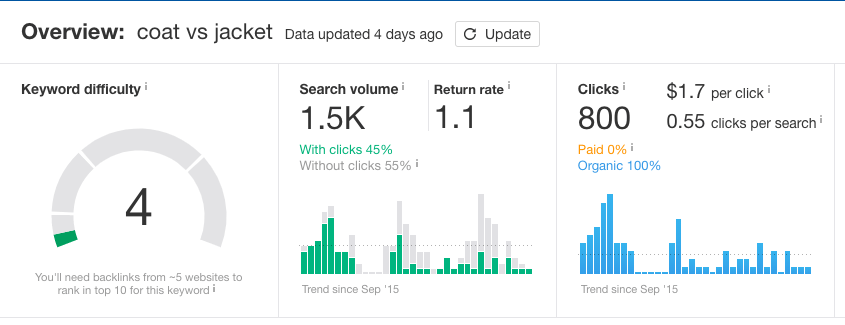
Attracting users seeking general information transforms them into potential customers. They can then explore your product pages, interact with lead forms, or trigger your Facebook pixel for retargeting.
Keyword Difficulty: The Game Changer
Every website wants to rank for high-volume keywords aligning with their goals. This makes keyword difficulty a crucial differentiator. It helps identify high-volume, high-intent keywords easier to rank for than others. This approach saves time and effort by focusing on content with genuine traffic potential, avoiding those overshadowed by fierce competition.
As seen in the previous example, keyword difficulty acts as a filter, helping you pinpoint keywords that meet your volume and intent criteria while considering their competitiveness.
Keyword Difficulty in PPC
Keyword difficulty in PPC differs slightly, particularly in terminology. Here, “competition” takes center stage. It’s usually ranked as Low, Medium, or High, indicating the competition level relative to all keywords. According to Google’s Keyword Planner: “Competition reflects the number of advertisers bidding on each keyword compared to all keywords across Google. This data is specific to your chosen locations and Search Network targeting.”
Similar to SEO, desirable PPC keywords boast a high volume-to-low competition ratio. These keywords hold the potential for significant traffic without breaking the bank. Consequently, competition is vital when deciding whether to bid on a keyword, but as previously discussed, volume and intent remain indispensable.
Search Volume in PPC
Typically, longer keywords have lower search volumes, but this isn’t necessarily detrimental. Consider “marketing” versus “pay per click marketing software.” “Marketing” is a “head” term – a broad, high-volume keyword. However, high volume attracts fierce competition, demanding higher bids and compelling ads.
Conversely, “pay per click marketing software” is a long-tail keyword. While extremely low search volume isn’t ideal, longer keywords tend to be more specific. Finding one with decent search volume and high relevance to your niche can yield valuable clicks at reasonable costs.
Intent in PPC
Let’s recap the traditional search intent types:
- Transactional: Purchase-oriented searches, like “buy PPC software.”
- Navigational: Searches aimed at finding specific websites, like “nexus-security” for their homepage.
- Informational: Information-seeking searches, such as “best PPC software.”
Intent is paramount in PPC, arguably even more so than in SEO. While an irrelevant blog post might only cost you time, an irrelevant search ad wastes ad spend.
Ask yourself: What are your ideal customers searching for? Does the query genuinely align with their needs? Does it trigger irrelevant searches that should be added as negative keywords? These questions are critical for determining whether to bid on a keyword and how aggressive your bidding strategy should be.
An effective way to leverage intent in PPC is by using Remarketing Lists for Search Ads (RSLAs). RSLAs allow campaign customization for previous site visitors, tailoring bids and ads based on their past behavior. When combined with keywords, RSLAs add a granular layer of intent – the user has searched for your target keyword and visited your site – allowing for adjustments to your offer, message, and bidding strategy.
Speaking of maximizing ad spend, proper budgeting is crucial. “Proper” means allocating the majority of your PPC budget towards keywords with the highest conversion potential:
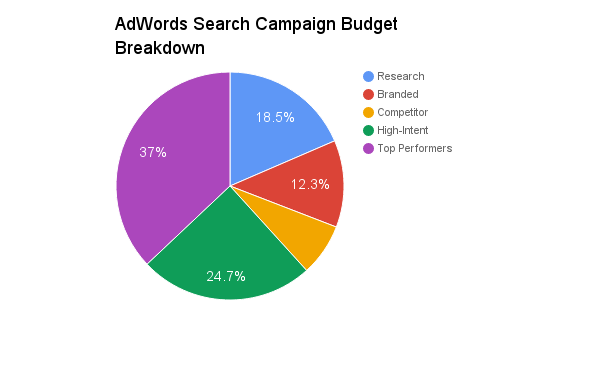
Remember that these numbers are illustrative and not exact.
The key takeaway: Maintain balance, but prioritize keywords with the highest transactional intent.
Balancing Competitiveness with Budget Control
Naturally, lower competition is preferred, but some competitive keywords will align with your campaign goals. Here’s how to avoid overspending in such cases:
- Utilize match types conservatively. Bidding on long-tail keywords with exact or phrase match offers better control over ad serving, minimizing irrelevant impressions. However, note that exact match isn’t as restrictive as it once was.
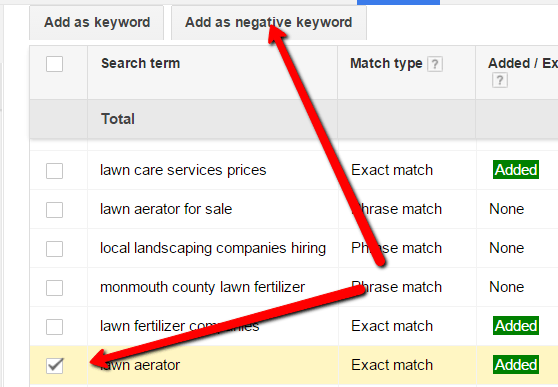
- Conduct negative keyword research. Sometimes, competition stems from related but ultimately irrelevant queries. Identifying and adding negative keywords eliminates these, reduces wasted spend, and enhances your competitive edge.
- Prioritize quality score. Relevant ad copy and optimized landing pages naturally lower costs and improve your ad’s performance in auctions.
- Consider Suggested Bids. This Keyword Planner metric provides an estimated bid amount for securing ad slots for your target keyword. It considers the average cost-per-click (CPC) for that keyword, along with your location and Search Network settings. For budget-conscious advertisers, Suggested Bid helps assess the feasibility of obtaining desired ad positions.
Unveiling Valuable Keywords with Opportunity Score
Navigating through countless keywords while juggling volume, competition, average CPC, and intent can be overwhelming. Wouldn’t it be convenient to assess a keyword’s potential with a single metric that encapsulates all these factors?
nexus-security’s Opportunity Score does just that. Our Free Keyword Tool provides a score for each keyword based on its potential value to your business.
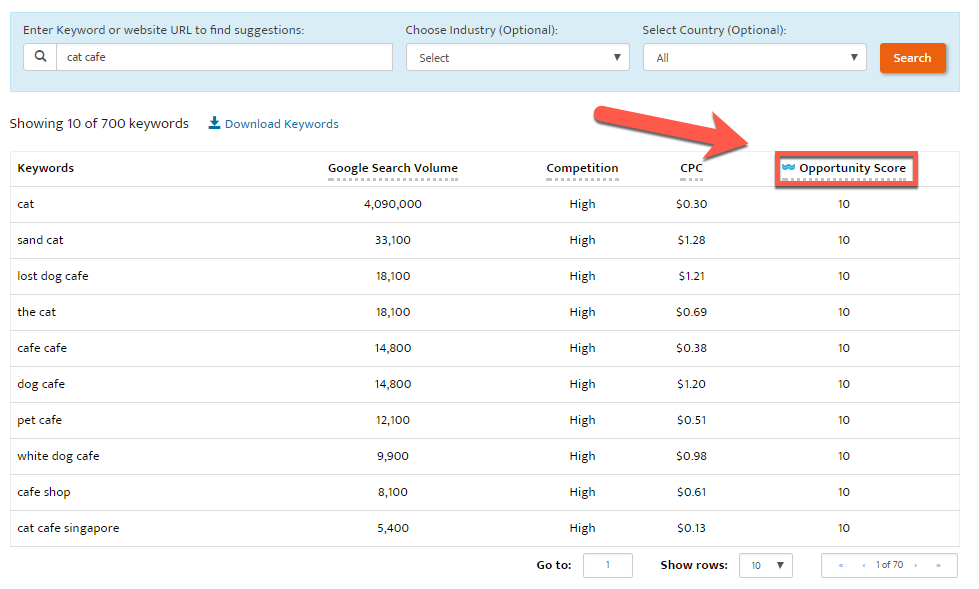
Opportunity Score considers Search Volume, Competition, and Average CPC, assigning each keyword a score from 1 to 10. With the volume-to-competition ratio quantified, you can focus on filtering for intent.
Conclusion
The key to effective keyword research lies in the trifecta of search volume, keyword difficulty (or competition), and intent. Evaluating keywords without considering all three, whether for paid or organic search, is incomplete. By controlling for search volume and intent, keyword difficulty becomes a powerful filter for your research. Understand your budget and campaign goals, identify beatable SERPs, and choose your keywords strategically.
Special thanks to Kristina Simonson, our in-house acquisition expert, for her contributions to this post.