Imagine asking a business owner what they desire most. The answer will likely be “more customers.” Businesses can’t solely depend on their current clientele for growth. They constantly seek fresh leads who have the potential to transform into loyal clients.
This guide delves into how pay-per-click (PPC) advertising, particularly through Google Ads (formerly Google AdWords), can be your secret weapon to attracting more leads and propelling your business growth.
Who Benefits from PPC Lead Generation?
A common myth is that PPC is exclusive to e-commerce websites. This couldn’t be further from the truth. PPC proves highly effective for any website or company engaging in online lead generation.
Lead generation (often shortened to “lead gen”) is crucial for businesses that can’t or choose not to work with just anyone. It usually involves a pre-qualification phase and an exchange of information, allowing both the company and the potential customer to make informed decisions.
Here are some hallmarks of businesses that rely on lead generation:
- Trial periods
- Approval and denial processes
- Extended sales cycles due to the complex nature of their product or service
- Price quotes
For instance, financial services like credit cards and mortgages, various insurance types, and business-to-business software all depend on lead generation or lead capture to thrive. In fact, if you’re reading this, you’ve likely been a lead for a company at some point. As a lead, you were probably categorized (maybe as a “hot lead”) and then marketed to regularly until a specific action occurred, such as signing up, being rejected, choosing inaction, or simply ending up at the bottom of their lead pile for future marketing efforts.
The core purpose of lead generation is to guide potential customers into the lead-tracking system (often visualized as a funnel – see below). This initiates a contact phase where the company delves deeper into your needs and qualifications, while you gain a better understanding of their products and services.
The endgame is to empower a salesperson to seal the deal, converting the lead into a new customer. This journey begins with gathering basic information like name and email address and progresses to obtaining more detailed information about the prospect.
Why PPC Excels in Lead Generation
Visualize a typical lead funnel. It quickly becomes evident that you need a constant influx of leads to keep it brimming.
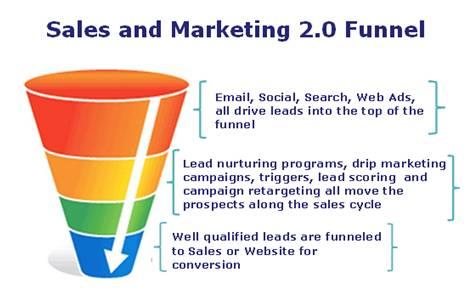
Leads enter the funnel at the top and gradually move down toward conversion. The initial challenge lies in attracting those first leads to feed the top of the funnel. Let’s explore some methods for achieving this and why PPC shines as an exceptional source of leads:
- Blogging: This can be a decent lead source, but it demands consistent new content, hope for substantial blog post sharing, and a sizable subscriber base. This takes time.
- Email: You can repeatedly email your existing subscribers, or you can gamble on renting or purchasing email lists, hoping they contain promising new leads for your business.
- Social media: This can attract new followers and fans, potentially exposing you to new prospects. However, there’s no guarantee that these followers align with your target market or need your product or service.
- Organic search: Ranking high organically is the holy grail. Roughly 85 percent of search clicks go to organic listings on page one, and these clicks are free! The caveat? You’re vying for those coveted positions against thousands of others. You’ll need extensive on-page and off-page SEO efforts, coupled with months, perhaps even years, of patience to reach page one.
- PPC: This allows you to instantly claim your spot on page one, placing you directly in front of individuals actively seeking solutions you offer. More people become aware of your brand and offerings than ever before. Bingo! Indeed, PPC is a paid channel, charged per click. However, it’s crucial to remember that no marketing channel is truly free. Managing social media, crafting blog posts, collaborating with SEO agencies (not free), and sending out emails all require human effort, and people don’t work for free.
Here’s why PPC is a game-changer for Lead Generation:
- Attracts visitors specifically seeking what you offer.
- Delivers immediate keyword rankings and traffic.
- Allows bidding on various stages of the funnel.
- Provides control over the message tailored to each funnel stage.
- Offers insights into what people are searching for, enabling you to customize your message accordingly.
- Provides deeper understanding of your leads and their behavior.
- Offers precise ROI tracking down to the last penny.
- Expands your lead database, allowing for multi-channel marketing.
Lead Generation vs. E-commerce: Understanding the Differences
Let’s revisit our initial point about both e-commerce and lead generation leveraging PPC marketing. The most significant distinction lies in the qualification process: e-commerce typically has none. As long as you have a credit card, you’re considered part of the target market.
Ad Copy: Lead Generation vs. E-commerce
Examining the ad copy itself, you’ll observe variations in messaging and calls to action between e-commerce and lead-gen companies:
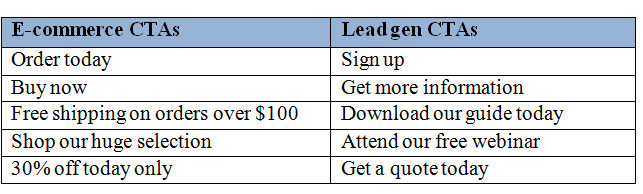
Notice how e-commerce prioritizes instant gratification (and sales!), while lead generation is more discerning. Becoming an immediate customer in lead generation is rare because there’s a process to follow.
Let’s look at real-world examples of how ad copy, CTAs, and landing page experiences differ. For lead generation, we’ll use the keyword “car insurance.”
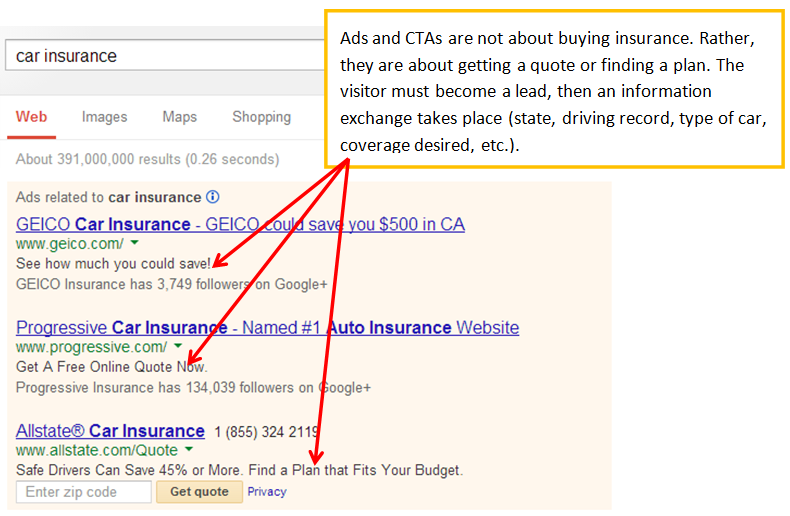
Now, let’s compare this to the e-commerce copy and CTAs used for “asics running shoes”:
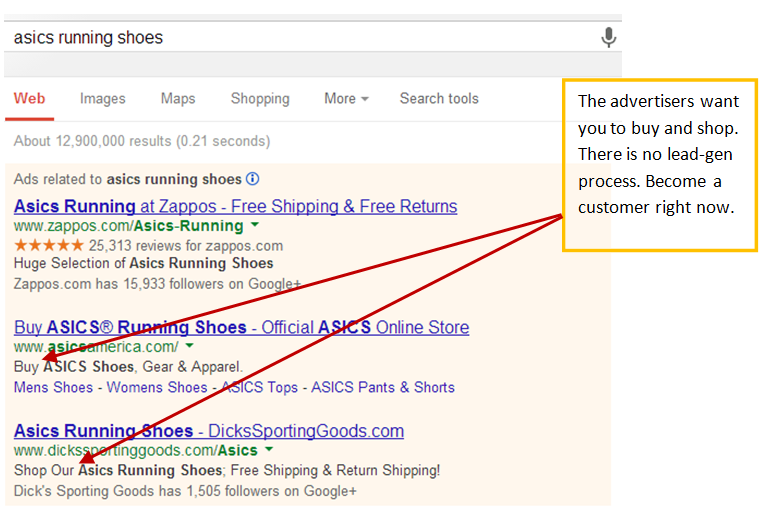
The differences in ad copy and CTAs are subtle. However, the landing pages clearly highlight the distinction between e-commerce and lead generation.
Landing Pages: Lead Generation vs. E-commerce
Here are examples of lead-gen landing pages for PPC:
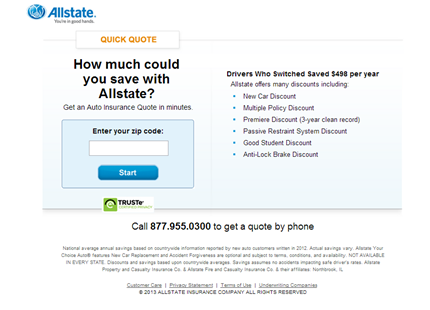
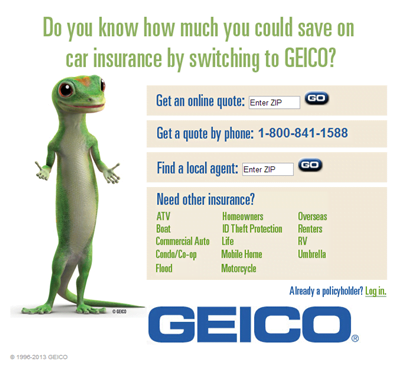
Key observations:
- Minimalistic design with limited distractions.
- Clear structure: headline, benefits, multiple calls to action like “Start,” “Get an online quote,” “Call,” etc.
- Limited choices: initiate a call or provide a zip code.
- Information exchange: Visitors need to provide details so companies can qualify and guide them through the funnel.
E-commerce offers a different landing page experience, granting visitors the freedom to explore and purchase:
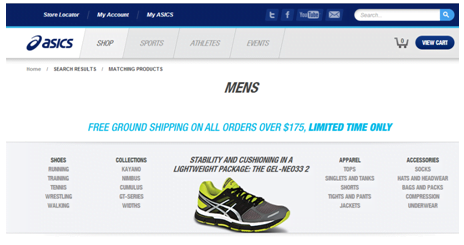
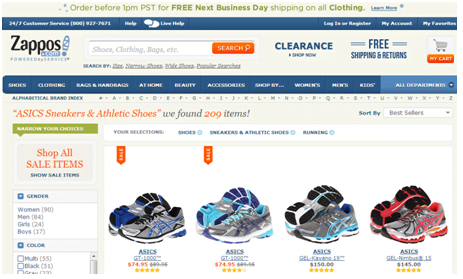
Here’s what we can gather:
- Both landing pages are relevant to the search query and provide links to additional pages.
- The “free ground shipping” offer creates urgency, motivating visitors to make a purchase promptly.
- The overarching theme is “shop now,” encouraging immediate purchases.
Optimizing Your Campaigns for More Leads Through PPC
Optimizing lead-gen campaigns in Google Ads follows similar principles as e-commerce: tightly themed ad groups, A/B testing of ad copy and offers, and diverse keyword usage. The main differences lie in the types of calls to action and the landing pages, as illustrated in the previous examples.
The objective is to maintain a full funnel of qualified leads by gathering visitor information. It’s a numbers game. Not every click converts, so casting a wide net and increasing your chances of attracting qualified leads through PPC is crucial.
Actionable Strategies to Elevate Your Lead-Gen Performance:
Incentivize Visitors with Offers: Offer something valuable (e.g., a free white paper or guide) in exchange for the visitor’s email address, name, and other relevant information. At the very least, provide the option to subscribe to your blog or follow you on social media. While not ideal, these outcomes are better than gaining nothing from a click.
Employ Focused Landing Pages: Reinforce the benefits and reasons why visitors should provide their information. Request only essential information; avoid lengthy forms that might deter engagement. Utilize both primary and secondary CTAs. Test landing page length and form fields. In essence, prioritize a seamless experience.
Example of a successful PPC landing page:
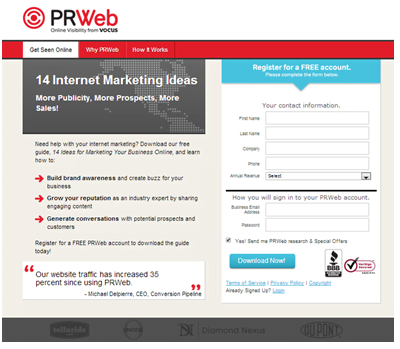
Key takeaways:
- Minimal form fields to encourage responses.
- Concise bullet-point list of benefits.
- Inclusion of testimonials and a brief client list.
- A free offer in exchange for information.
- Elements that build trust and credibility.
Leverage Dynamic Number Insertion (DNI): DNI enables dynamic changes to the phone number displayed in your ads and on landing pages. This ensures your call representatives are aware of the keyword that triggered the call, enabling efficient call routing to the appropriate team members. Reputable DNI providers include ifbyphone and Call Rail.
Invest in a Robust CRM: Tracking leads and maintaining contact can quickly become overwhelming. A Customer Relationship Management (CRM) system helps you organize contact information, interests, and interaction history. This enables lead classification and facilitates targeted engagement via email or phone calls. Popular CRM options include Infusionsoft, Zoho, and Salesforce.
Shift Focus to a New KPI: PPC often revolves around metrics like cost-per-click and conversion rate. In lead generation, however, a pivotal Key Performance Indicator (KPI) is cost-per-lead (CPL), calculated as follows: [Overall cost of PPC campaign / number of leads = CPL]. This metric reveals how much you’re spending per lead, providing valuable insights to guide your decision-making process.