The introduction of the Shield Android gaming console at the Game Developers Conference in San Francisco by Nvidia caught many industry experts off guard. However, categorizing it simply as an Android console wouldn’t do it justice.
Shield boasts impressive hardware, featuring Nvidia’s custom 64-bit Denver CPU cores and 256 GPU cores, all based on their latest Maxwell infrastructure. Nvidia describes the Tegra X1 System-on-Chip (SoC) as a “mobile superchip with the soul of a console,” but it still can’t compete with the latest consoles from Sony and Microsoft. However, the Tegra X1 is comparable to the previous generation of PlayStation and Xbox hardware.
This raises the question: will this allow Android game developers to create more visually stunning games and bring them to the living room in 4K/UHD resolutions? While that’s certainly a possibility, the Shield’s purpose isn’t to bring expensive AAA titles to Android.
Nvidia’s initial Shield products were all about streaming PC games onto Android. Currently, they serve as test platforms, utilizing streaming capabilities to stand out in the crowded Android hardware market.
Android Gaming Consoles: Doomed From the Start?
Before we delve further, we need to analyze the history of Android gaming consoles, both their triumphs and failures. We should also consider the development costs associated with Android games that could actually leverage more powerful hardware. Nvidia Shield has the potential to either bolster or hinder certain aspects of Android game development, and it’s likely to do both.
Speaking of launching new ventures, a few years ago, a group of entrepreneurs initiated a Kickstarter campaign to develop the OUYA Android gaming console, which, interestingly, was also based on Nvidia hardware. The concept of a $99 Android console resonated with many, and investments poured in. Unfortunately, the project ultimately flopped. Last year, Forbes declared the OUYA dead due to its insufficient user base, which discouraged developers from investing their time and resources. There was simply no money to be made.
While the Nvidia Shield gaming tablet is priced at twice the amount ($199 MSRP), its association with Nvidia should make it more appealing to Android developers, right?
Not quite.
The reality is that very few Android developers concentrate on graphically demanding titles. These types of games necessitate significantly more resources, may not appear as visually impressive as dedicated console or PC games, aren’t ideally suited for touch input, and can rapidly deplete a smartphone or tablet’s battery life if they have a lot of visual effects. The most popular games on Android, and indeed on all mobile platforms, are casual games, not the so-called “AAA” titles. Companies like Rovio and King didn’t amass their fortunes by developing intricate games with photorealistic graphics; instead, they focused on casual games playable on virtually any smartphone. These games didn’t strain the SoC or the battery, offering a way to pass the time without draining your phone’s battery life.
Another challenge is thermal throttling. Mobile phones and tablets aren’t designed for efficient heat dissipation. While they might boast impressive performance specifications, when subjected to prolonged periods of heavy workload, the SoC reduces its clock speed to stay within safe operating temperatures, ultimately impacting performance.
Android gaming consoles and set-top boxes don’t face these limitations. Unconstrained by battery life, they can be engineered for superior heat dissipation due to their larger size.
However, this doesn’t guarantee an influx of Android developers eager to create games for these platforms. The user base is so limited that developers would struggle to recoup their investment, particularly since developing visually impressive shooters and action games demands more resources than casual games like Flappy Bird. Conversely, recent studies indicate that over 200 Android games are released daily. The majority of these titles never gain significant traction in this overcrowded market. This scenario suggests that shifting focus towards Android TV or Android consoles might be a logical move for some developers.
What Is Nvidia’s Ultimate Goal?
Nvidia, along with other hardware manufacturers, is acutely aware of this issue. This explains the scarcity of Android gaming consoles and the reluctance of major brands to venture into this territory. The business model simply doesn’t hold much appeal. Sony and Microsoft don’t generate substantial profits from hardware sales; in fact, they often sell new consoles at a loss during the launch phase. Their strategy revolves around controlling the ecosystem and monetizing games rather than consoles. Obviously, this approach doesn’t and can’t apply to Android.
However, Nvidia believes they have found a solution. Why dedicate resources to developing AAA games for Android when PC titles can be utilized? Why render content locally on the device when streaming is a viable option? Why strive to profit from hardware when services offer an alternative revenue stream? This might appear audacious, but Nvidia is confident in its approach and likens GRID Game Streaming to a “Netflix for games.”
What implications does this hold for Nvidia Shield, Android developers, and consumers?
Nvidia Shield has the potential to allow the company to emulate Sony and Microsoft’s strategy by generating revenue through games instead of hardware, but with a significant difference: offering Gaming as a Service (GaaS).
Let’s delve into how this benefits the company:
- Ecosystem — Nvidia gains control over the ecosystem by curating supported games and establishing a closed environment.
- Hardware — With games rendered exclusively on Nvidia GRID servers, the company could transform into its largest hardware customer.
- Longevity — As long as consumers possess hardware capable of streaming GRID content, upgrades become unnecessary – Nvidia handles upgrades on the server side, utilizing more of its hardware.
- Efficiency — Instead of marketing costly graphics cards, Nvidia can sell processing power and optimize hardware utilization more effectively than individual consumers.
- Piracy — The elimination of piracy risk becomes a major selling point for publishers.
Consumers can also reap the benefits of GRID streaming, although certain drawbacks exist:
- Convenience — Consumers are relieved from the hassles of upgrades, patches, updates, and drivers.
- Value — The subscription-based model of GaaS eliminates the need for expensive gaming PCs and regular upgrades, allowing consumers to pay for what they use.
- Choice — A potential drawback is the limited game selection, as Nvidia will only stream specific titles, potentially neglecting niche genres and titles, at least initially.
- Geography — The availability of GRID services might be geographically restricted, as servers need to be in close proximity to users to minimize latency issues.
For Android developers, Nvidia Shield presents a mixed bag of potential advantages and disadvantages:
- Power — If the concept gains traction, Android developers finally have access to more powerful hardware and a larger install base.
- TV — With its focus on bringing Android to the living room in 4K, Shield opens doors for developers to create applications specifically for this purpose, aligning with the rise of next-generation smart TVs.
- Exposure — Focusing on console and TV platforms could provide developers with greater visibility compared to the saturated mobile Android market.
- AAA — Nvidia’s initiative, if successful, could further diminish the viability of high-budget Android games, which are already unprofitable for most publishers.
- Enterprise — Nvidia’s partnership with VMware hints at the potential for Android’s future in enterprise applications. However, this remains a hypothetical scenario that would require time to materialize.
Understanding How Nvidia Shield Works
Delving into the technical intricacies of Nvidia’s GRID technology isn’t necessary for this discussion. However, a concise overview might be helpful for those unfamiliar with the concept. For those interested in the finer details of GRID and its SDKs, comprehensive documentation is readily available on Nvidia’s official website.
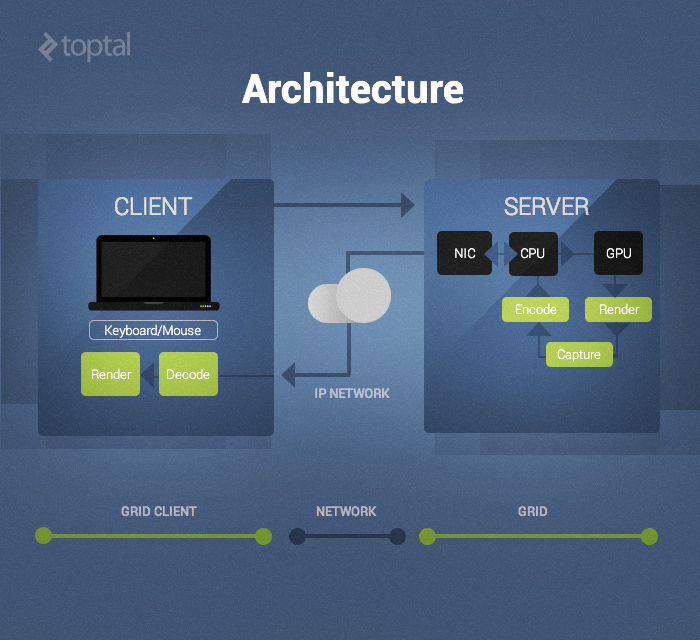
In essence, a GRID server functions as a remote virtual GPU (vGPU) or a virtual gaming machine. The client side sends input commands, which the host interface processes and renders on low-latency hardware. The resulting frame buffer is then encoded by a low-latency hardware decoder and transmitted back to the client as a compressed video stream.
While the initial specification utilized H.264 video, the latest iteration of Nvidia’s SoCs, the Tegra X1, supports 4K H.265 (HEVC) at 60 frames per second, ensuring a smooth, stutter-free streaming experience with fluid frame rates.
But what about latency?
Latency is arguably the most significant hurdle for Nvidia GRID and cloud gaming as a whole. Streaming video content is one thing, but rendering real-time audio and video output based on user input is an entirely different challenge. High latency is unacceptable in gaming. Online multiplayer gaming has been around for years, and Nvidia has dedicated considerable effort to address this issue.
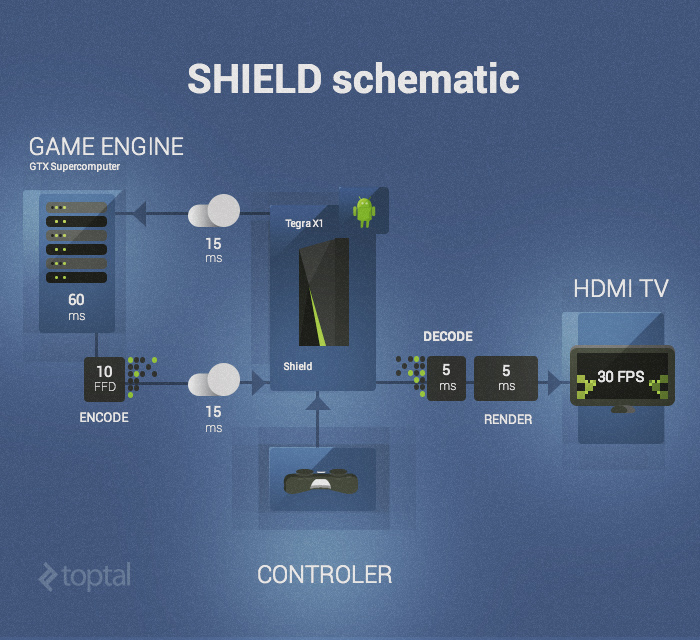
Nvidia estimates server-side latency at 30ms, network latency at 30ms, and client-side latency at under 16ms. The client decode API is optimized for low latency, targeting approximately one frame. Nvidia aims to establish dedicated GRID servers in telecom data centers, strategically “flooding the map” with servers to minimize latency. Furthermore, the company has developed partner middleware solutions on Amazon Web Services (AWS).
Despite Nvidia’s substantial investment in building a robust infrastructure, widespread access to low-latency GRID services might still be some time away.
What Does Nvidia Shield Mean for Android Developers?
Nvidia’s gaming tablet approach presents both opportunities and potential downsides for Android developers. Large studios focused on creating Android equivalents of high-budget AAA games might face increased competition from Nvidia GRID, which has the potential to deliver a vastly superior experience at a premium price point.
Conversely, smaller independent developers concentrating on casual games and other apps have little to worry about. In fact, Nvidia is opening a new door for them — the door to the living room and its large, high-definition screens. Combined with H.265 and VP9 support, Shield offers a range of possibilities. However, the onus is on developers to create a new generation of compelling apps for 4K TVs, whether on Shield or Android TV.
Coincidentally, MediaTek, a Taiwan-based chip manufacturer, will be supplying SoCs for the first generation of Android TVs. Their first chip, the MT5595 SoC, was unveiled at CES 2015, alongside the Tegra X1. This chip, based on 32-bit Cortex-A17 and Cortex-A7 cores, can still handle HEVC, VP9, and 60fps, much like the Tegra X1. While Android TV is a separate topic that warrants its own discussion, it clearly overlaps with developers’ interests.
Developing Android applications for large 4K/UHD displays represents the next significant trend, while Android Wear is, quite literally, the next small thing.
Although it may seem like just another challenge and platform to master, consider the advantages of developing apps specifically for the living room, for Android TV, and devices like Nvidia Shield:
- Fewer software and hardware variations to account for.
- Access to more powerful hardware.
- Power efficiency is no longer a major concern.
- Dealing with only one aspect ratio.
- Apps designed for two primary resolutions (UHD and FHD).
- A more standardized UI layout.
- A nearly identical user experience across various products.
Exploring Alternative Applications
Thus far, the focus has been on Nvidia’s venture into the living room. But what about other potential applications? With the abundance of on-demand processing power provided by GRID, there must be applications beyond gaming.
While this remains speculative territory, certain aspects are already evident. Gaming represents just one facet of Nvidia’s parallel computing endeavors — enterprise virtualization is another, although it has little to do with Android or the living room.
Devices like Nvidia Shield or upcoming Android TV sets have the potential to act as central hubs for other devices. This could empower our smartphones to function as smart remote controls, allow inexpensive tablets with fast wireless capabilities to serve as “second screens,” and offer innovative methods of content distribution and consumption.
Shield differentiates itself through its streaming prowess and impressive processing power. This includes its powerful and programmable CUDA cores, which have applications beyond graphics processing. Nvidia has already showcased that even the mobile GPUs used in their latest Tegra chips can create 3D environmental maps, perform basic motion tracking, and more. This suggests that Android devices could offer Kinect-like functionalities seamlessly integrated with other Android devices in the future. Imagine interactive fitness routines in your living room enhanced by motion tracking and fitness wearables. Or games designed exclusively for large-screen TVs, smart home control hubs, or novel virtual reality (VR) experiences.
VR and augmented reality (AR) could also benefit from such devices, particularly from Nvidia’s GRID technology. Google is reportedly working on Android VR, which will join the ranks of Android Wear, Android TV, and Android Auto in the future. However, details are still limited at this stage. (The potential applications of streaming on VR and AR headsets were discussed in a previous post.) In the meantime, numerous companies have announced new or updated VR products and technologies, particularly at recent events like Mobile World Congress in Barcelona and the Game Developers Conference in San Francisco. Notable players in this field include Valve, Samsung, and AMD.
If streaming can be utilized on home consoles via GRID or locally, why not extend this capability to mobile devices? With most of the processing occurring in the cloud, this approach seems ideal for offloading mobile devices, allowing them to handle other tasks and improving battery life in the process.
Unfortunately, this isn’t feasible at present. Few users require such processing power on their mobile devices, which are already sufficiently capable of handling casual gaming and even some visually impressive titles. Bandwidth and latency pose additional challenges, as 4G/LTE coverage remains inconsistent globally, and speeds may be inadequate in certain situations. Additionally, modern integrated modems are intricate components that often occupy more space on the SoC than the GPU or all CPU cores combined. Continuously running the modem at maximum capacity to decode and display high-resolution content would be inefficient and negatively impact battery life.
Theoretically, this approach could be adapted for specific enterprise applications built on the same infrastructure or for niche devices within certain industries. However, such applications are still far off, and these proprietary technologies hold little relevance for the average Android developer.
So, what should Android developers interested in Nvidia Shield, streaming, and Android TV focus on? While it’s difficult to pinpoint specifics at this stage, the potential market for a new generation of living room apps is vast and shouldn’t be disregarded. Perhaps this very discussion will inspire some readers to explore this emerging market and develop the next killer app. And if that happens, just remember one thing: a bottle of Blue Label would be a lovely gesture of appreciation.