Search engine optimization (SEO) professionals dedicate significant time to understanding complex algorithms like Panda and Penguin, aiming to enhance organic search rankings by deciphering ranking factors. However, paid search often receives less attention, despite relying heavily on Quality Score, an algorithm that influences ad positioning, cost-per-click (CPC), and other crucial factors.
This article delves into Quality Score’s workings, revealing how to leverage Google Ads (formerly AdWords) effectively. The primary focus is on the search network, acknowledging the separate power of display networks, particularly with engaging creative, as a topic for another time.
This article quantifies Quality Score’s impact on CPC and cost-per-conversion, explains its calculation, and provides valuable tips for improvement, ultimately aiming to maximize ROI.
Caution: Data-heavy content ahead. Let’s dive in!
Quality Score’s Influence on Ad Position
Google utilizes Quality Score to assess the relevance of keywords and ads within a Google Ads account. Ranging from 1 to 10 (poor to excellent), it indicates:
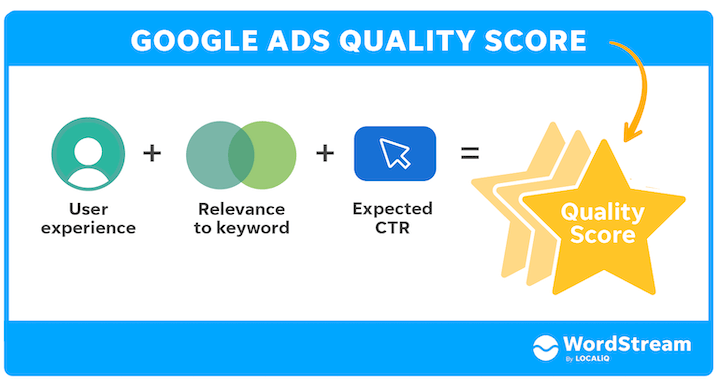
Google prioritizes ad quality to ensure relevant ads reach users on search engine results pages (SERPs) and across its network. Since Google earns revenue from ad clicks, it favors ads likely to be clicked.
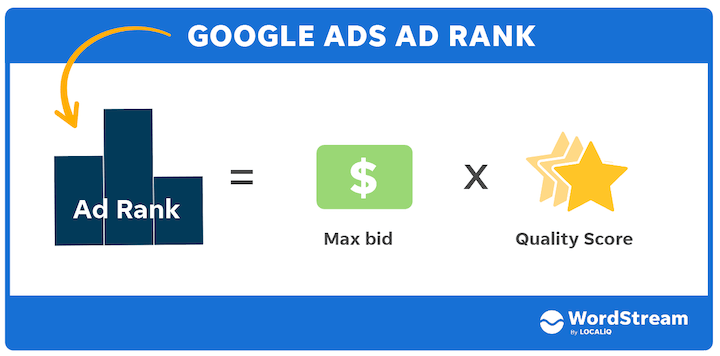
Therefore, higher bids don’t always guarantee higher positions. “Ad Rank” determines ad rank, calculated mainly by multiplying Max Bid and Quality Score, along with other factors.
As illustrated below, Sam achieves the top ad spot with a lower Max CPC Bid ($2) than Mary’s ($4) due to a superior Quality Score.
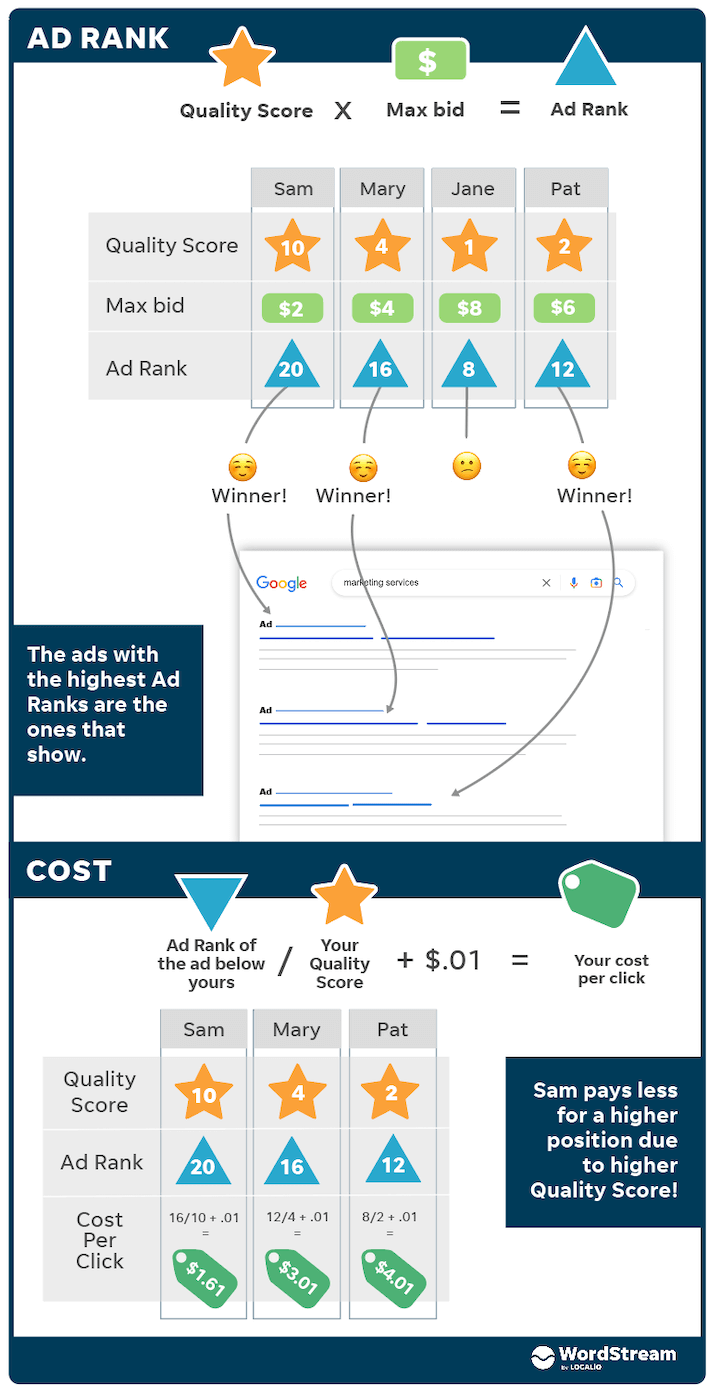
Key Takeaway: Quality Score significantly affects ad visibility, with Google even suppressing low-scoring ads.
Quality Score’s Impact on CPC
Quality Score directly influences cost-per-click. Google’s Chief Economist, Hal Varian, clarified this in a well-known video. The formula: [Ad Rank of the ad below yours / your Quality Score] + $0.01 determines CPC.
Here’s an illustration:
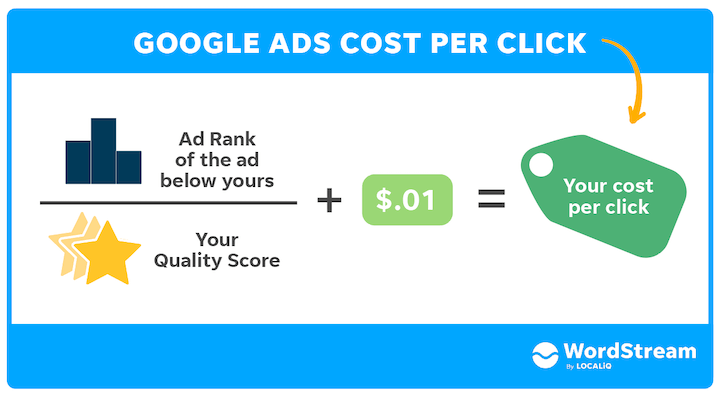
Key Takeaway: Higher Quality Scores translate to greater CPC discounts. Conversely, lower scores lead to increased costs – a penalty for ineffective ads.
Defining a Good Quality Score
Consistently achieving perfect 10s is rare. Most accounts experience a mix. An analysis of several hundred accounts revealed the typical Quality Score distribution in 2013:
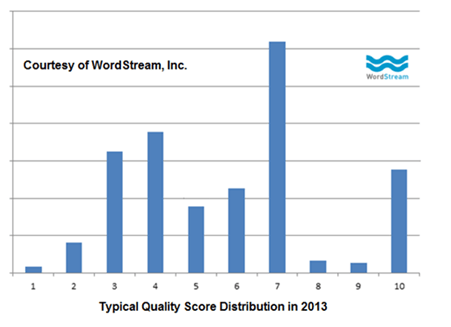
The average Google Ads account has an impression-weighted Quality Score around 5/10. This information, combined with basic calculations and the CPC formula, helps determine the financial advantages of exceeding or falling short of the average Quality Score.
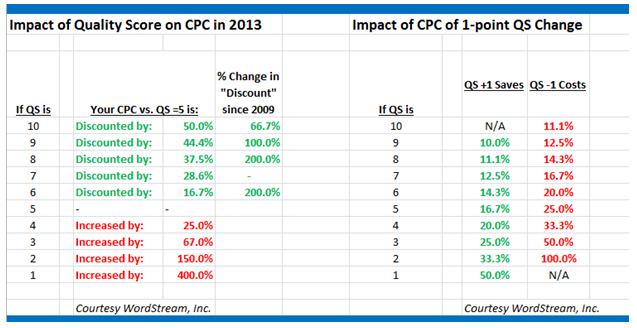
With an average Quality Score of 5/10, achieving a 10/10 translates to a 50% CPC discount. Conversely, a below-average score of 1/10 leads to a 400% CPC increase. The marginal savings or cost increases for every one-point Quality Score change are also provided.
Over the past five years, the average Quality Score has declined from 7/10 in 2009 to 5/10 today. Consequently, above-average scores hold greater value now than before.
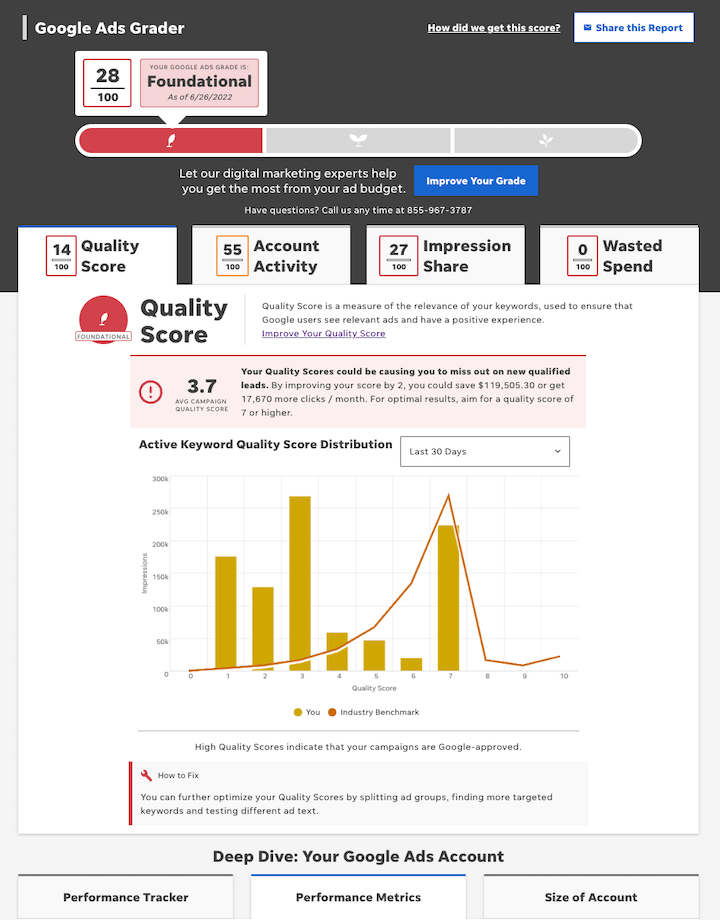
 How does your Quality Score compare to others in your industry?
Find out with the Free Google Ads Performance Grader.
Quality Score’s Influence on Cost Per Acquisition
Pay-per-click advertisers, particularly those in e-commerce or lead generation, prioritize cost-per-acquisition (CPA) over CPC. Generating higher profits with a greater volume of clicks at $50 per click compared to $20 is more appealing.
To establish the correlation between CPA and Quality Score, CPA data from numerous client accounts, totaling approximately $100 million in annual spending, was compiled.
The graph below illustrates the relationship between average cost-per-conversion and average Quality Score for each campaign:
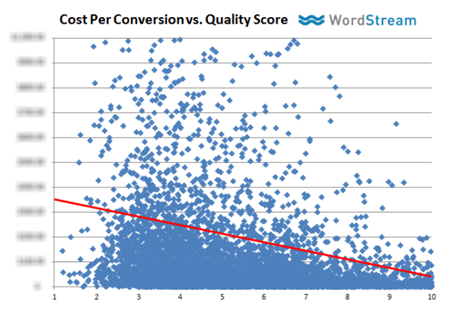
A strong correlation exists between average cost-per-conversion and average Quality Score. Generally, higher Quality Scores correspond to lower CPAs.
This table compares the effect of Quality Score on Cost Per Action (not conversion or acquisition) to the average score of 5/10:
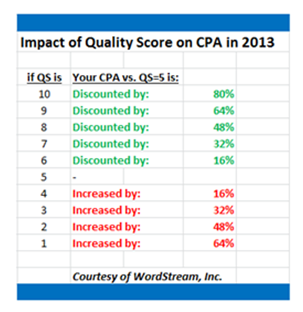
Below-average Quality Scores can lead to penalties, potentially increasing cost-per-conversion by up to 64%. Essentially, each point above the average 5/10 reduces CPA by 16%, while each point below increases it by 16%.
It’s noteworthy that average conversion rates didn’t show significant variation based on Quality Scores. Keywords with high Quality Scores demonstrated only marginally better conversion rates compared to those with low scores.
Key Takeaway: Lower CPAs are primarily driven by lower CPCs, directly influenced by Quality Score.
Short on time? Download the PDF version for offline reading.
Decoding Quality Score Calculation
Given its significant impact on key account metrics, understanding how Google calculates Quality Score is crucial.
A comparison of Quality Score and CTR across numerous campaigns reveals a strong correlation.
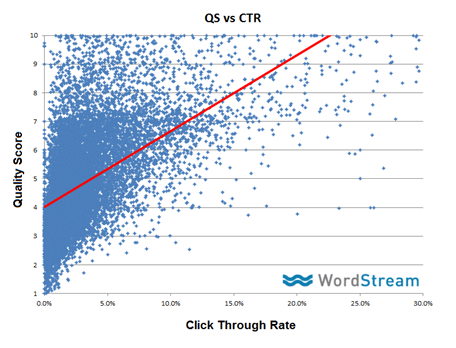
Generally, higher CTRs correspond to higher Quality Scores. However, variations exist due to the influence of average position on CTRs. Higher ad positions naturally attract higher CTRs, while lower positions experience the opposite.
Accounting for ad position variations, the data reveals:
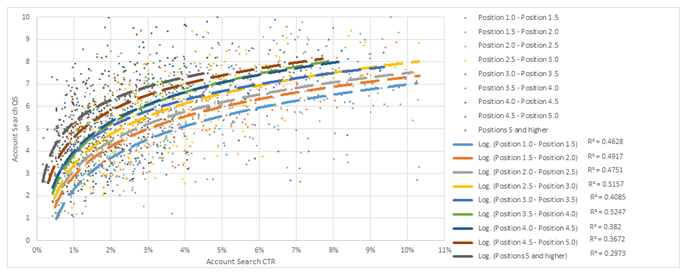
A negative relationship emerges between Average Position and Quality Score at a constant CTR (regressions shift upwards with increasing positions). This suggests that if two ads share the same CTR but occupy different positions, the lower-positioned ad likely possesses higher relevance and, consequently, a higher Quality Score.
As before, CTR and Quality Score exhibit a logarithmic relationship. Improving CTR from 1% to 2% yields a more significant Quality Score increase than from 2% to 3% or 4%.
The graph demonstrates that returns diminish faster for higher positions. Consequently, a 1% to 2% CTR improvement for a third-position ad increases Quality Score by roughly 75%, while the same improvement for a top-position ad only yields a 60% increase.
For the top four positions, CTR significantly influences Quality Score, exhibiting a roughly 50% correlation. This correlation drops to 30-35% for lower positions, implying that factors like landing page or ad relevance contribute more to their lower Quality Scores.
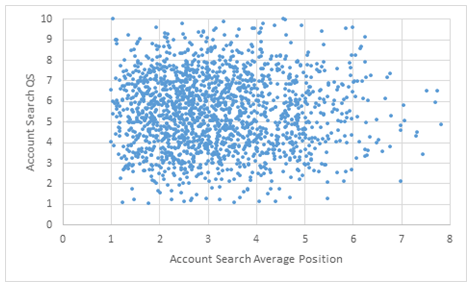
No strong direct relationship between Quality Score and Average Position (R-squared = -.0000005, indicating no correlation) implies that increasing keyword bids alone can’t improve Quality Score.
Key Takeaways:
- Higher CTRs generally lead to higher Quality Scores, but CTRs are affected by ad position, which in turn depends on Quality Score.
- Improving CTRs yields diminishing returns in terms of Quality Score, particularly for higher ad positions.
- CTR significantly influences Quality Score for the top four ad positions.
- Increasing Max Bid alone doesn’t guarantee a higher Quality Score.
Expected CTR and Position’s Influence on Quality Score
CTR and average position have an exponential relationship. By analyzing multiple accounts, an average CTR in paid search, termed “Expected CTR,” can be determined. A basic regression analysis reveals [CTR = .0673e^-.305(Avg. Position)], [R-squared =.2721]:
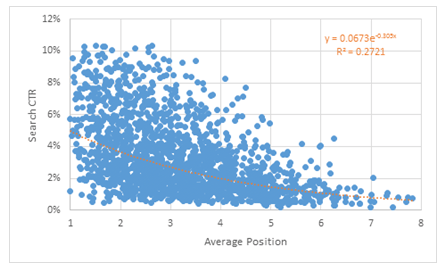
Using this Expected CTR formula, the performance of these accounts relative to peers in similar positions can be evaluated.
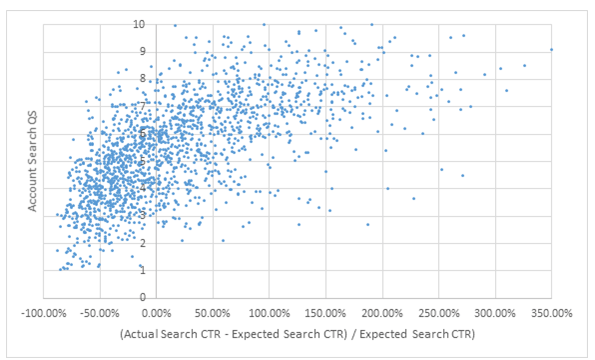
The graph below plots [Actual Search CTR – Expected Search CTR] / [Expected Search CTR vs. QS]. Moving left to right along the x-axis indicates accounts improving their CTRs compared to peers in similar positions, with 0% representing “expected” CTRs for their position.
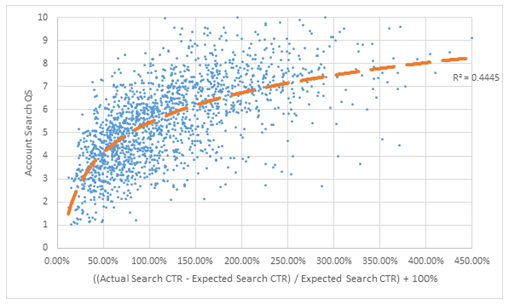
Adding 100% to all x values makes them positive, allowing for logarithmic regression:
Key Takeaways:
- Quality Score is influenced not by position alone but by CTR relative to position. This distinction is crucial, as Google emphasizes CTR driving Quality Score to encourage higher bids. Increasing bids might secure a better position and higher CTR but may not necessarily improve Quality Score.
- Accounts with Expected CTR for their position tend to have average Quality Scores (around 5.5).
- Improving CTR below the Expected CTR significantly boosts Quality Score, while surpassing it yields diminishing returns.
Download the PDF to keep this data-rich article handy.
Practical Steps for Improvement
How can one achieve higher Quality Scores, improved performance, and greater Google Ads ROI? Here are some key tips.
1. Prioritize Quality Score and its Significance
By now, it’s clear that:
- Quality Score is crucial in Google Ads, influencing CPC, Ad Position, and ultimately, cost-per-conversion.
- CTR relative to the expected CTR for your current ad position primarily determines Quality Score.
- Google expects high CTRs for your ads.
CTR is paramount. Analyze Quality Scores from a CTR perspective, focusing on lowering CPC/CPA and improving positioning through enhanced CTRs.
2. Target Commercial Intent Keywords for CTR Improvement
CTRs on PPC ads can range drastically from 0.1% to over 70%. The key differentiator?
Commercial intent. People are more likely to click on ads when looking to make a purchase.
Keywords with high commercial intent, such as branded keywords or specific products and services (e.g., Nikon d800, stainless steel dishwasher, PPC management software), yield higher CTRs than informational keywords (e.g., who won the battle of 1812, how to wash dishes, how to take good pictures). Users searching for information are less likely to click ads as they’re in the early stages of their buying journey (if they’re even considering a purchase) and aren’t ready to be sold to.
Bidding on your own branded terms also helps raise the account’s average Quality Score.
3. Identify Google Ads Jackpots
“Google Ads Jackpots” occur when all paid search ads for a query are identical or similar, as shown below:
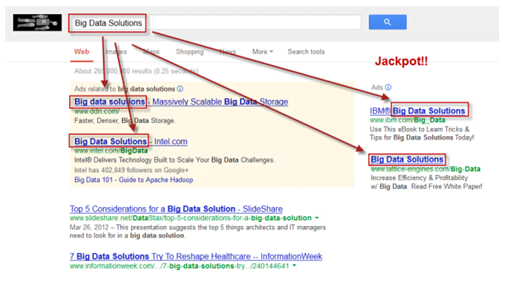
This scenario presents valuable optimization opportunities due to a lack of marketing creativity or excessive use of Dynamic Keyword Insertion.
Capitalize on these opportunities by differentiating your products or services through ad text optimization. Ask yourself:
- Is the offer appealing?
- What are your customers’ fears and desires? Who do they trust? Who are their competitors?
- What is your unique selling proposition?
- What guarantees do you offer?
Standing out in such situations can attract a significant portion of clicks.
4. Allocate Ad Spend Strategically
A common pitfall in Google Ads is underestimating Google’s expected CTR. A 1% CTR might not be as effective as perceived. Moreover, neglecting ad copywriting can hinder performance.
An analysis of account history logs reveals limited activity in typical Google Ads accounts.
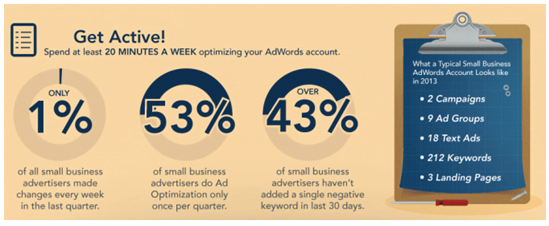
Consistent optimization, including adding negative keywords and testing different ads, is crucial for improving CTRs. Shockingly, only 1% of small businesses made weekly changes to their Google Ads accounts recently. This highlights a substantial opportunity for the remaining 99% to outperform competitors through bid management, ad copywriting, A/B testing, and overall optimization. The good news is that dedicating just 20 minutes per week to PPC over a quarter puts you ahead of 99% of advertisers.
5. Seamlessly Integrate SEO, Content Marketing, and PPC
Google heavily rewards high CTR/Quality Score ads and penalizes those with low CTRs. This presents an opportunity for a hybrid approach: utilize content marketing for informational keywords through SEO and target commercial keywords via PPC.
This strategy is effective as ranking organically for commercial keywords is becoming increasingly challenging due to prominent Product Listing Ads dominating search results. Furthermore, information-rich content aligns perfectly with informational queries.
Conclusion
Google Ads, unlike a simple coin-operated system, demands strategic keyword selection and compelling ad copywriting to maximize ROI. The platform is hackable, empowering advertisers to control their PPC success.
Understanding Quality Score’s mechanics and the profound impact of CTRs on Google Ads performance can be transformative.
Which of these tips resonate most with you? Are you reaping the benefits of high Quality Scores or facing penalties due to low scores? Share your insights below.
Connect on Twitter:
Assess Your Google Ads Performance
Get a free account audit and actionable report with our Google Ads Grader.
[
]