It’s well-established that digital marketers categorize keywords as either brand-related or generic, assuming that brand terms outperform generic ones. Branded keywords are often seen as high achievers, boasting impressive click-through rates and Quality Scores in pay-per-click (PPC) campaigns and securing top rankings in search engine results pages (SERPs) for search engine optimization (SEO). Conversely, non-branded keywords are often perceived as average performers at best.
However, this distinction, while relevant, is too simplistic. Non-branded keywords can perform as effectively as branded ones when brand affinity is strong. Let’s explore why it’s crucial to reassess our understanding of branded and non-branded keywords in both paid and organic search marketing.
Search Capitalizes on Existing Demand
Search marketing aims to connect with users actively seeking products or services like yours. The objective is to convert these searchers into leads and, ultimately, customers. However, the inherent limitation of search marketing, both paid and organic, is its dependence on pre-existing demand. It excels at capturing existing demand but struggles to generate new demand. For search marketing to yield results, users must already know what they’re looking for and have made a purchase decision. They need to have identified their desired product or service. However, the decision of which ads to engage with and ultimately purchase from hinges on other factors beyond the presence or absence of a brand name in the keyword.
Brand Affinity: The Deciding Factor in Search
The likelihood of users clicking on your paid or organic search listings often boils down to pre-existing brand affinity. In simpler terms, users are more inclined to choose your brand if they’ve encountered it before.
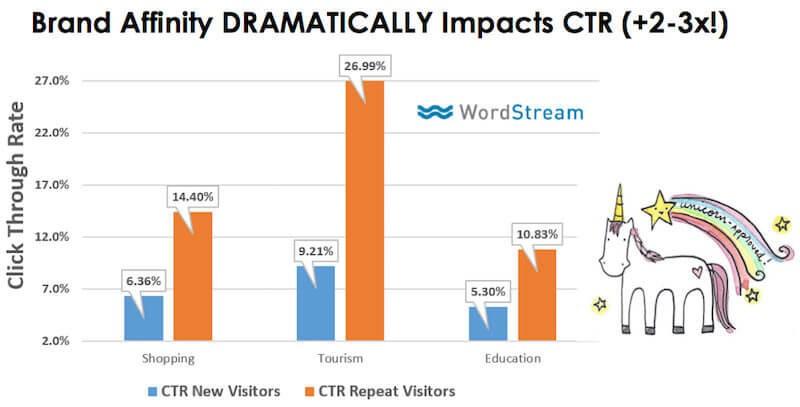
Source: nexus-security customer data This data illustrates the significant impact of brand recognition on paid search performance. As more people become familiar with your brand, they are more likely to search for it and its associated products. These searches inherently become branded, reflecting user preference for familiar and trusted brands. If your non-branded keywords aren’t performing as well as branded ones, it implies those keywords are benefiting your competitors. Search marketing operates within a limited landscape; if you’re not capturing clicks, someone else is. This underscores the importance of brand building. Being overlooked in search results often points to a lack of strong brand affinity among your target audience actively seeking solutions you offer.
Are We Overestimating Our Value Proposition?
Are we, as search marketers, truly the high achievers we perceive ourselves to be? Or are we simply capitalizing on existing demand and brand preferences established through other channels, positioning ourselves at the bottom of the funnel? High performance on non-branded keywords doesn’t always reflect exceptional marketing prowess. It could simply indicate strong pre-existing brand affinity. Conversely, if your branded keywords perform poorly, mirroring non-branded keywords with low click-through and conversion rates, it signals a need for significant improvement.
Users don’t randomly choose paid search listings. Listings don’t have a fixed probability of being clicked. Quantifying brand impact can be challenging. However, with Remarketing Lists for Search Ads (RLSA), we can now target ads specifically to previous visitors, providing insights into brand affinity’s influence on click-through rate. RLSA allows for running identical ads, keywords, bids, and budgets, but with one campaign targeting repeat visitors and another excluding them. This approach reveals the impact of brand recognition. The effectiveness of search campaigns often depends heavily on the existing brand awareness associated with your product, service, or company. People are naturally drawn to brands they recognize and trust. RLSA is a powerful tool that can dramatically improve click-through and conversion rates while significantly reducing cost per click, as demonstrated below:
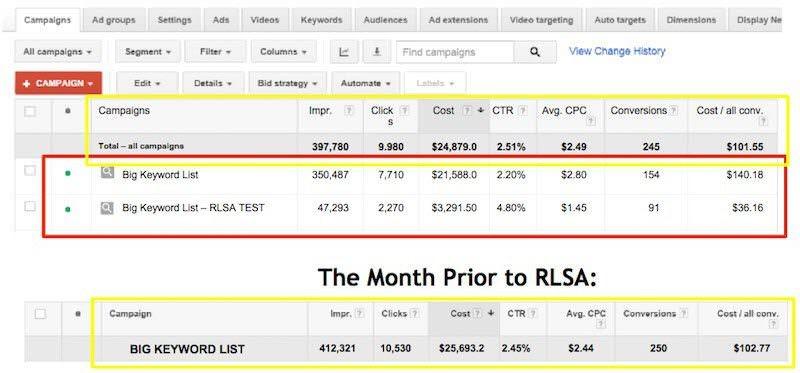
We tend to present ourselves favorably to clients, often attributing success solely to our efforts. This perception is often reinforced by last-click attribution models like Google Analytics. While it’s acceptable to highlight your contributions, it’s crucial to maintain a realistic perspective. Search marketing, particularly for commercial queries, often targets users already at the bottom of the funnel, ready to make a purchase.
The Path Forward
Historically, search served as a viable brand-building avenue. However, with the evolution of Google’s algorithms (RankBrain for organic search and Quality Score for paid search), search results have become more selective, prioritizing established brand preferences. To achieve consistent and predictable business growth, we need a strategy that transcends relying solely on users searching for our offerings. The solution lies in balancing search marketing efforts with brand affinity and demand generation initiatives.
Cultivating Brand Affinity in Organic Search
For SEO, this involves creating content that extends beyond purely commercial keywords. Target informational queries that, while lacking immediate commercial intent, can influence future purchase decisions in favor of your brand. Organic search increasingly reflects brand preferences due to feedback loops. Unfamiliar brands gain visibility when a significant number of users have already interacted with them, leading to higher click-through rates and improved SERP rankings. This feedback loop has always existed in paid search due to Quality Score. Established brands benefit significantly from brand affinity, as users naturally gravitate towards familiar names. Now, a similar phenomenon is occurring in organic search. The prominence of brands in search results now correlates more closely with their overall popularity.
Building Brand Affinity in Paid Search
Replicating this strategy in paid search is more challenging due to the Quality Score algorithm. While rewarding high click-through rates, it penalizes low ones by limiting ad visibility and increasing costs. The challenge lies in the disparity between user behavior on commercial and informational queries. Users actively seeking to purchase are more likely to click on ads, while those seeking information are less inclined to do so. Google applies the same Quality Score criteria to keywords within the same category, regardless of their commercial intent. Informational keywords don’t receive preferential treatment. Consequently, informational queries often result in lower click-through rates and Quality Scores compared to commercial ones. So, what’s the solution? Leverage display and social media advertising alongside traditional brand-building channels like radio and TV to generate demand before users even initiate a search.
In Conclusion
A significant disparity between your branded and non-branded keyword performance highlights the need to prioritize brand affinity. Focus on engaging users before they even consider searching for your products or services. The effectiveness of campaigns targeting non-branded queries is largely contingent upon the existing brand awareness and affinity associated with your offerings. Shift away from the dichotomy of branded versus non-branded keywords. Focus instead on user awareness and the level of brand recognition you’ve cultivated. The presence or absence of a brand term in a search query was always merely an indicator of existing brand affinity. Once you’ve successfully established brand affinity, you’ll observe that non-branded queries begin to perform similarly to branded ones in terms of click-through and conversion rates. This article was originally published on Search Engine Land and is republished with permission.