The release of the Apple Watch earlier this month has left many wondering about its impact on the industry. Although Apple’s smartwatch is outselling Android Wear devices significantly, it’s premature to declare it an undisputed victory.
Hold on a minute.
The Apple Watch is poised to be a financial triumph for Apple and its investors, but tech experts remain unconvinced about smartwatches’ ability to dominate the market, at least for now. This raises questions for Apple developers and has implications for other platforms and the companies backing them. To understand the current state of the smartwatch and wearable market, let’s start with some industry data and projections.
Market research company IDC predicts global wearable shipments will reach 45.7 million units this year, up from 19.6 million in 2014. By 2020, IDC anticipates shipments exceeding 126.1 million units. While this appears substantial, it pales in comparison to the firm’s projected 1.4 billion smartphone shipments for 2015.
Is This Another Apple Triumph?
On its first day, the Apple Watch received nearly a million orders in the US alone, surpassing total sales of all Android Wear devices combined in a single market, on a single day. One out of every 300 Americans placed an order right when it became available. This should give developers pause about Google’s platform, but there’s more to the story.
Consider these post-launch revelations:
- The Apple Watch received lukewarm reviews.
- The entry-level Sport edition dominated initial orders.
- The larger 42mm version outsold the smaller one.
- Certain demographics, particularly teenagers, show declining interest.
- Most orders came from loyal Apple customers.
- Underwhelmed analysts have lowered their projections.
The product’s debut is promising, but it could have been stronger. Let’s explore the reasons behind this.
- Critics cited poor battery life and limited practical uses, particularly the lack of a “killer app.” Battery concerns also explain the preference for the 42mm model with its larger battery.
- Weak demand for high-end models suggests overpriced offerings, making them less appealing to younger consumers.
- The Apple Watch exclusively targets iPhone users, limiting its global reach outside of Apple’s dominant US market share.
- First-generation third-party apps suffer from slow loading times and unresponsiveness.
The takeaway? Don’t believe anyone claiming Apple will dominate the smartwatch market and crush the competition. While Apple will outsell Android Wear vendors in the short term, it will also reach market saturation faster. The closed ecosystem and premium pricing restrict growth potential.
Should you develop apps for the Apple Watch? Absolutely. Despite its lackluster 1.0 version, the Apple Watch won’t fail. The current and future generations will adorn millions of wrists. For a detailed guide to Apple Watch development, refer to Toptal iOS developer Antonio Bello’s comprehensive tutorial.
Android Wear – Held Back By Google
Android Wear debuted over a year ago in March 2014, with devices shipping a few months later. However, the first generation failed to impress. The late 2014 arrival of high-end designs like the Moto 360 and LG G Watch R did little to help.
An estimated 720,000 Android Wear devices shipped in 2014. Apple sold more watches in a day than all of Google’s partners combined in nearly a year.
What went wrong?
Google often shoulders the blame for the underwhelming launch, and rightfully so. The company rushed Android Wear to market before it was ready. Several colleagues who tested the 1.0 version and early hardware described it as a beta release, with one tech journalist calling it “more like 0.8.”
Hardware wasn’t the issue; the average Android Wear watch matches the Apple Watch’s capabilities. However, this potential remains untapped. Critics highlight several areas where Google faltered:
- Lack of polish – the OS felt unfinished.
- Missing features – Google omitted key functionalities in the initial release.
- Inefficiency and poor battery life – later updates significantly improved battery performance on certain devices.
- No customization – unlike customizable Android phone interfaces, Android Wear lacks this feature.
- No killer app.
To their credit, Google addressed some of these issues over the past year. However, the platform’s tarnished reputation might take time to recover. The failure of Google Glass further disillusioned developers who embraced Google’s latest offerings, only to see them abandoned before commercialization. Developers burned by Google Glass might hesitate before investing in Android Wear.
The good news for Google and interested developers is Android Wear’s growth potential. Unlike the Apple Watch, it boasts a wider array of designs from major manufacturers. The latest update addresses several initial problems and introduces new features like WiFi support. Lower prices and a larger potential user base – Android Wear will work with the newest Android versions, and rumors suggest Google is exploring iOS compatibility – are also advantages. If these rumors hold true, Android Wear could get iOS support by mid-2015.
Android Wear smartwatch development is straightforward, and Google is making it even simpler. However, iOS support implementation remains unclear. While technically achievable, business-wise, Apple has a vested interest in keeping Android Wear devices less competitive. While unlikely to resort to an outright ban, Apple might limit functionality. In a few months, you might use an Android Wear watch with your iPhone, but expect less integration and functionality compared to an Apple Watch.
Many users might accept this trade-off. The Apple Watch offers few unique features, so they wouldn’t lose much. Limited functionality probably won’t deter budget-conscious consumers from choosing a cheaper alternative.
No Killer App Means A Huge Opportunity For Developers
While analysts and stakeholders fret over the lack of compelling use cases and killer apps for smartwatches, this presents a golden opportunity for developers. You could create the next big thing and leave your mark on this nascent market.
As mentioned, long-term projections are promising. Although still in its early stages, smartwatch development is worth exploring. It’s no riskier than traditional mobile app development.
As the market matures and the user base expands, market forces will address the lack of use-cases and killer apps. It might take time, but we could see a shift from a dearth of smartwatch apps to a new tech bubble within a few years.
Apple Watch and Android Wear smartwatch development will be significant in the coming years, perhaps not as massive as smartphone apps, but significant nonetheless.
It’s not just about standalone smartwatch apps; the real challenge lies in integrating existing apps with smartwatches. With a small user base, this aspect is often neglected due to cost and time constraints. However, it will become increasingly relevant. Apple and Google aim to simplify the process, but familiarizing yourself with the technology beforehand is advisable.
But what about the other issues? The ones developers can’t fix?
Smartwatch Pricing And Market Segmentation
Pricing will remain a challenge, but Android Wear devices should become commoditized quickly. Entry-level models will become cheaper, and we’ll see more market stratification. Not everyone needs a premium wearable, and with their disposable nature, most consumers won’t splurge on them. Apple’s launch figures confirm this.
This process will be faster in the Android ecosystem. Currently, Android Wear hardware offers similar specs across a single tier. Going forward, expect cheaper designs – rubber and polycarbonate watches for teens, premium stainless steel models for formal occasions, ruggedized sports models, and so on.
Modular designs offer intriguing possibilities. Manufacturers could standardize casings and bands, adopting a few form factors for square and round screens. They could then offer a range of interchangeable housings and modules.
Why spend $1,000-$2,000 on a premium smartwatch when a modular design allows users to retain the luxurious titanium or steel body and simply swap out the watch module? The same module could be used with a $30 rubberized body or a $200 stainless steel design.
It’s also crucial to remember that Apple Watch and Android Wear aren’t the only smartwatch platforms, a point we’ll revisit later.
Battery Life
Developers can’t do much about battery life, and neither can manufacturers, unfortunately. Most smartwatches are essentially miniaturized phones. Android Wear utilizes Qualcomm’s Snapdragon 410 System on Chip (SoC), while Apple uses its proprietary S1 module (with limited publicly available specs).
Smartwatches are constrained by ~400mAh batteries expected to power both SoCs and screens. This simply isn’t enough, resulting in reported battery life of 24-36 hours for most Apple and Android Wear devices. Even with more efficient next-generation SoCs on 14nm/16nm FinFET nodes, screens remain a bottleneck. Designers can’t just slap on a larger screen and create a new form factor to accommodate a bigger battery.
For developers, limited battery life means prioritizing efficiency. While Bluetooth 4.0 LE and other components are efficient, optimization is paramount.
This limitation prevents us from fully utilizing smartwatch hardware capabilities. UI elements like fancy transitions, animated wallpapers, and other visually intensive features are impractical.
Resource management takes center stage:
- Streamline the notification system, offering adjustable intervals.
- Avoid memory-intensive UIs or those demanding significant GPU processing power.
- Schedule as many processes as possible to run while charging.
- Minimize awake times, implement efficient wake-up systems.
- Provide users with extensive efficiency-related options.
- Monitor battery status, create an ultra-efficient mode independent of system power management.
- Prioritize performance issue identification.
While seemingly obvious, these tips are crucial. Many uninstall smartphone apps due to poor optimization; this problem is magnified on smartwatches.
Are There Viable Alternative Platforms?
The current generation of Apple and Android smartwatches is overpriced and plagued by poor battery life. While affordable for consumers in developed markets, their pricing limits their appeal in emerging markets like Latin America, China, and India.
Android Wear prices will decrease, but there’s a limit. Sub-$100 devices are unlikely this year and probably not in 2016 either. Apple isn’t known for price cuts, so don’t expect the entry-level Apple Watch to retail below $250-$300 next year. This opens the door for alternative smartwatch platforms. Billions of people can’t afford expensive smartwatches.
But can these alternatives compete? Many can, but it’s crucial to note that affordability isn’t everyone’s goal. LG’s new WebOS-powered smartwatch, designed for Audi, targets a higher tier than its Android Wear offerings. Samsung’s Tizen-based watches also aim for the premium segment.
Personally, I find budget alternatives more interesting, not just for their broader appeal, but also for their focus on battery life.
Asus’ recently announced VivoWatch, a fitness-oriented smartwatch with a monochrome display, boasts a 10-day battery life, outperforming Apple and Android offerings. Several vendors are pursuing similar strategies, developing simpler, cheaper devices with superior battery performance.
This trend is driven more by chipmakers than gadget makers. Companies like MediaTek and Intel are investing heavily in these platforms, indicating extensive market research. Their findings align with many observers: there’s a demand for affordable, disposable devices with long battery life, including low-end smartwatches, smart wristbands, and other wearables.
Reaching Billions with MediaTek Labs
MediaTek, the world’s second-largest smartphone chip supplier, launched MediaTek Labs last year alongside products targeting this market segment. The company is developing both Android Wear chips, like the MT2601, and more energy-efficient chipsets like the Aster MT2502. The first products based on the latter are hitting the market, and the platform shows promise.
The MT2502 utilizes a tiny ARM7 EJ-S core clocked at 260MHz, significantly less powerful than Android Wear devices. However, that’s the point. MediaTek prioritizes affordability and battery life. The first watches using this platform offer 5-7 days of battery life, typically featuring lower-resolution color screens (240x240px) and running MediaTek LinkIt, essentially an MCU operating system.
As a relatively new platform, MediaTek actively seeks software and hardware partners through MediaTek Labs. The company offers extensive support to those interested in its platforms, including HDKs, dev boards, APIs, SDKs, and Eclipse integration. MediaTek aims to bring wearables to billions, a goal currently out of reach for Apple and Google’s platforms.
The first smartwatches powered by MediaTek’s platform debuted a few months ago. Despite their low $60-$80 price range, they offer considerable functionality, including heart rate monitoring, notification display, caller ID, media player syncing, phone dialer integration, and acting as a smartphone camera viewfinder.
Which Platform Should Developers Choose?
There’s no easy answer. Each platform has its strengths and weaknesses. Let’s examine the pros and cons of each from a developer’s perspective.
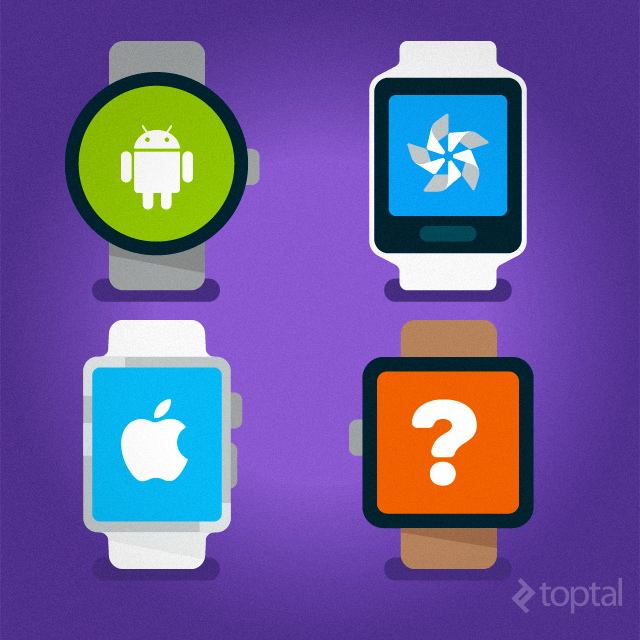
Apple Watch Pros and Cons
Pros:
- It’s Apple; it will sell.
- Single, non-fragmented platform.
- Potentially more profitable than competitors, especially in the short term.
Cons:
- Limited user base and long-term growth potential.
- Prohibitively expensive in many markets.
Android Wear Pros and Cons
Pros:
- Potentially larger long-term user base than Apple.
- Wide variety of designs.
- Easy to integrate with existing Android apps.
Cons:
- Fragmentation (although less severe than Android phones).
- Round and rectangular form factors to consider.
- Google needs to improve the platform further.
Alternative Smartwatch Platforms Pros and Cons
Pros:
- Affordable pricing with global appeal.
- Significant long-term growth potential.
- Leaner OS; superior battery life.
- Potential for cross-platform compatibility with other IoT devices.
Cons:
- Nearly nonexistent user base and limited product availability.
- Limited functionality.
- Uncertain market performance.
Compatibility and interoperability will remain concerns due to the diverse hardware and software platforms. Unlike other Bluetooth accessories, smartwatches might not be cross-compatible despite their higher price compared to headsets or speakers.
Dismissing any platform prematurely is unwise. Each will evolve to cater to different niches and price points. However, it will take time for a clear picture of the smartwatch market to emerge.