Don’t panic! Google Ads Quality Score hasn’t vanished from your accounts. But is it still something you should care about?
Quality Score has always been a mysterious metric in Google Ads. With Google’s increasing automation, we haven’t heard much about it lately, especially about how to manually control it. Does this mean it’s no longer important? I decided to explore opinions within the PPC community (I have my own, of course) and was quite surprised by what I found. So, let’s see if Google Quality Score still holds any weight in 2024! But first, a quick recap.
Table of contents
- What is Quality Score?
- How does Quality Score work?
- Perspective #1: Google Ads Quality Score does not matter
- Perspective #2: Google Ads Quality Score does still matter
- How to improve your Google Ads Quality Score
- Is Quality Score going away?
- Is Quality Score still relevant?
What is Google Ads Quality Score?
Before diving into Quality Score predictions, let’s revisit what constitutes a good score. Applicable only to the keyword level in standard search campaigns, Quality Score has three main elements:
- Ad relevance: how well your ad aligns with the search term. Google checks if your ad copy includes your target keywords. This is often the easiest way to boost your Quality Score since you have control over your ad copy.
- Expected click-through rate (ECTR): Google’s prediction of how likely someone is to click your ad based on factors like query intent matching and your historical CTR data. This is arguably the hardest aspect to influence, as it relies on Google’s prediction, leaving you with little direct control.
- Landing page experience: how user-friendly and pertinent your landing page is to the searcher. Google evaluates page speed, keyword relevance, and other factors. Depending on your capabilities, this can be relatively easy to enhance by optimizing your website. Google combines these factors to generate a score from 1 to 10 (1 being the lowest, 10 the highest). Typically, scores of 7 and above are considered excellent, 4-6 decent, and anything below 4 needing improvement.
How does Quality Score work?
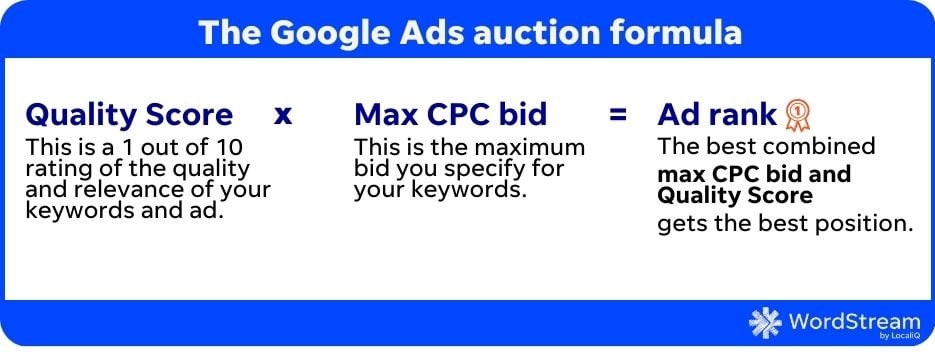
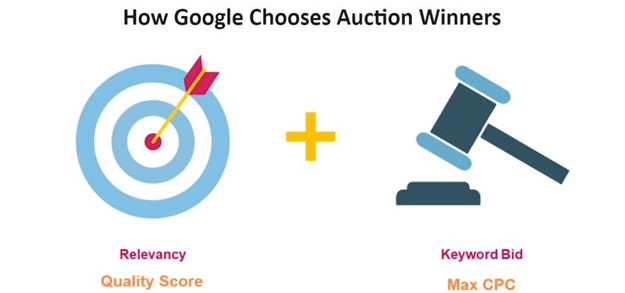
Quality Score is important because it influences your ad rank. Your ad rank is calculated by multiplying your Max CPC bid by your Quality Score. So, if you’re bidding aggressively but still experience low top and absolute top impression rate or impression share due to ranking issues, a low Quality Score could be the culprit.
Does Quality Score matter? Two perspectives
There are two main schools of thought regarding Quality Score. Let’s delve into both.
Perspective #1: Google Ads Quality Score does not matter
I must admit, as a PPC Consultant, I enjoy playing devil’s advocate. Personally, I’m not a fan of Quality Score for a few reasons:
1. Lack of Actionable Insights
It’s hard to control and enhance because it’s based on Google’s algorithms, and we receive limited feedback on what needs improvement in our ads or landing pages.
2. Limited Applicability
Quality Score applies exclusively to standard search campaigns. Why should only search keywords be subject to this KPI? With Google’s advancements, search campaigns are just one piece of a much larger puzzle that includes media-rich formats like Performance Max, display, or video. This suggests gaps in our understanding of what drives Google’s algorithm when evaluating other campaign types.
3. Inconsistent Correlation with Performance
I’ve witnessed instances where accounts perform exceptionally well despite low Quality Scores. If you’re achieving your conversion and cost goals, does a low score really matter? You wouldn’t want to disrupt successful campaigns by chasing an arbitrary metric. Here are real-world examples supporting my points: Missing data The screenshot below shows keywords with similar performance metrics but inconsistent Quality Score data. Differentiating between a six and a seven becomes a guessing game.
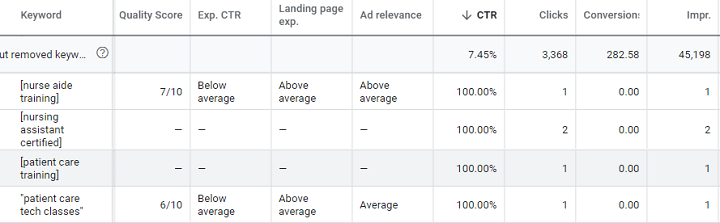
Inconsistent scores These three keywords are practically identical, leading to the same landing page, yet they receive vastly different scores, with only one flagged for low quality.
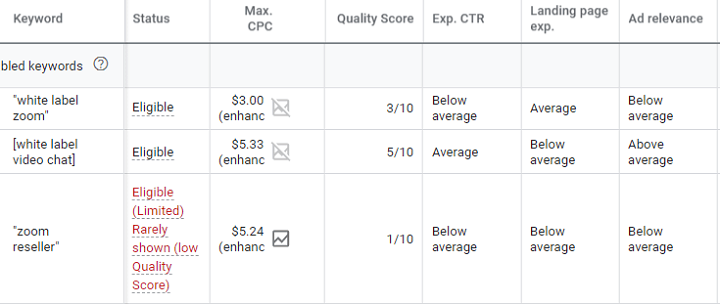
Score-performance mismatch This high-converting keyword has only an average score.

4. I’m not alone in my skepticism
Aaron Babaa, Google Ads Manager at Above All PPC, shares my view on this arguably arbitrary metric. In his article Quality Score Is Dead!, he highlights two points: Bot-driven scores are imperfect Aaron argues, “Relevancy and landing page experience are assessed by bots. We rely entirely on Google’s bots to determine if our ads are relevant and if our landing pages are satisfactory. This system is flawed. We know this because we’ve seen ads with low Quality Scores perform well and vice versa.” More score-performance discrepancies Like me, Aaron has encountered high-performing campaigns with low Quality Scores: “Optimizing for Quality Score is often a futile pursuit. We’ve seen accounts with exceptional CTRs, highly relevant ads, and well-designed, keyword-optimized landing pages… but with terrible Quality Scores. We’ve even seen accounts where branded keywords (keywords that are just the company name) have a Quality Score of 3. The system is clearly imperfect.”
Lastly, Quality Score isn’t even a default column in Google Ads.
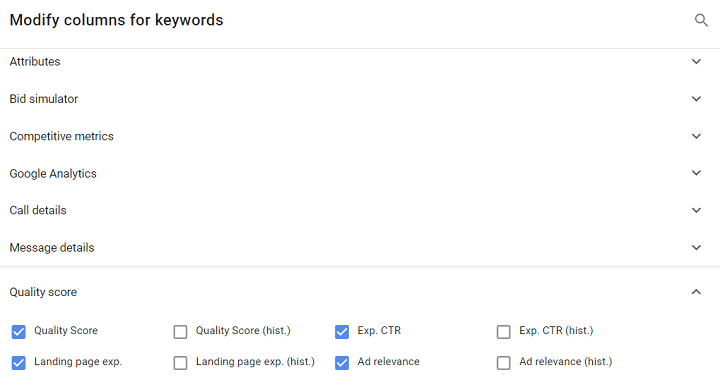
Perspective #2: Google Ads Quality Score does still matter
Working as a PPC consultant has taught me that it’s important to remain objective. When I spoke with Mark Irvine (PPC expert and Director of Paid Media at SearchLab) about this, he expressed strong pro-Quality Score sentiments. He began by stating: “Is Quality Score dead? Absolutely not.” Here’s why he believes Quality Score remains relevant:
1. Unchanged impact
Mark emphasizes that Quality Score’s role hasn’t changed. “It’s still a key factor in ad rank, which dictates your visibility on the SERP. A poor Quality Score compared to your competitors will put you at a disadvantage, while a high score will benefit you. The underlying math remains the same as it was in 2013.”

2. Evolving keyword intent
Mark points out that while Quality Score hasn’t changed since 2013, everything else has: “In the past, with only 90 characters for ad text, it was easy to create a bad, irrelevant, low-quality ad. Quality Score was a simple metric to evaluate ad quality and guide advertisers towards aligning with search intent. Today, Google has tripled ad lengths, introduced customizable extensions, new formats, and responsive ads for large-scale testing. The question is no longer ‘Does this ad match the search intent for one keyword signal?’ but rather ‘Does it align with this specific searcher’s intent across thousands of signals, including keyword, device, operating system, time of day, demographics, [and more]?”
3. Higher bar for “quality”
Expanding on his previous point, Mark notes, “Previously, many advertisers created subpar ads, making it relatively easy to stand out with a good Quality Score. Now, Google has made it simpler to create decent ads. This is positive for searchers and new advertisers but raises the bar for everyone aiming for a high Quality Score. Quality Score still matters, it’s not the magic solution it once was.”
How to improve Quality Score
One area of agreement regarding Quality Score is how to improve it. Mark’s final point aligns with mine about Google’s lack of transparency regarding specific actions needed to improve Quality Scores. “Quality Score remains important, and efforts to enhance it will continue to yield incremental benefits. However, advertisers today prioritize PPC strategy over tactics, which is encouraging. Improving your Quality Score might boost your PPC results by 10%, but refining your strategy could 10x them.”
Improving your Quality Score might improve your PPC results by 10%, but improving your PPC strategy might 10x them. nexus-security by LocaliQ Associate Director of Managed Services Holly Niemiec encapsulates this well: “I view Quality Score as a ‘check engine light’ for campaigns. While it impacts performance, it’s not the be-all and end-all. Keywords with low Quality Scores can still perform well, even surpassing those with higher scores. Competitor keywords often have lower scores but can still convert. Focus on ensuring ad copy and keyword relevance, along with a fast-loading landing page. These factors are more critical than obsessing over raising your Quality Score from a 5 to a 7.”
Is Google Quality Score going away?
To reiterate: no! As mentioned earlier and reinforced by Mark, Quality Score is still present and functions the same way it always has. This article isn’t prompted by any announcements from Google (their silence on the matter over the past decade raises questions…). It stems from my own curiosity and the realization that others are also pondering the significance of Quality Score in the evolving landscape of Google Ads.
So is Google Ads Quality Score still relevant?
You’ve now heard both sides. The decision of whether to prioritize Quality Score is up to you. If you’re struggling with ad visibility, improving it can help. Conversely, if you’re content with your account’s performance, you might choose to leave it as is. However, Google Marketing Live 2023 highlighted the rapid evolution of search advertising. Advertisers now have numerous options beyond standard search campaigns. While your approach to Quality Score depends on your account’s needs, embrace other strategies like AI-powered ads to optimize for success beyond a single metric!