Leading a team of engineers might seem fairly simple at first glance. After all, engineers are generally logical, bright, and tend to respond well to clear directions and feedback.
However, the reality of managing engineers is much more nuanced. While engineers excel at applying logic and reason to their tasks and interactions, some struggle with empathy and social skills. This can lead to feedback being perceived as critical or uncooperative, as these engineers find it difficult to process feedback objectively and without emotional involvement.
Without the ability to understand and interpret social cues, engineers might appear overly sensitive or even irritable while performing their duties.
To address these challenges, managers can employ a technique called Radical Candor. This approach empowers managers to leverage strong personal connections with their team members to deliver honest guidance and feedback on both tasks and overall performance.
Radical Candor relies on specific principles and actions from the manager. When combined with other management strategies, it can transform managing engineers into a consistent practice that yields impressive results. Let’s explore the concept of Radical Candor.
Visualizing Radical Candor: The Matrix
The dynamics of Radical Candor are best illustrated by analyzing the interactions between a manager and a subordinate, encompassing both daily exchanges and responses to specific tasks. These interactions are shaped by the manager’s chosen approaches in establishing both a personal and professional bond with the engineer.
The concept of Radical Candor can be visualized as quadrants within a matrix. Radical Candor itself represents the sweet spot: demonstrating genuine care for the subordinate as a person, while also conveying constructive criticism and guidance objectively, without resorting to personal judgments.
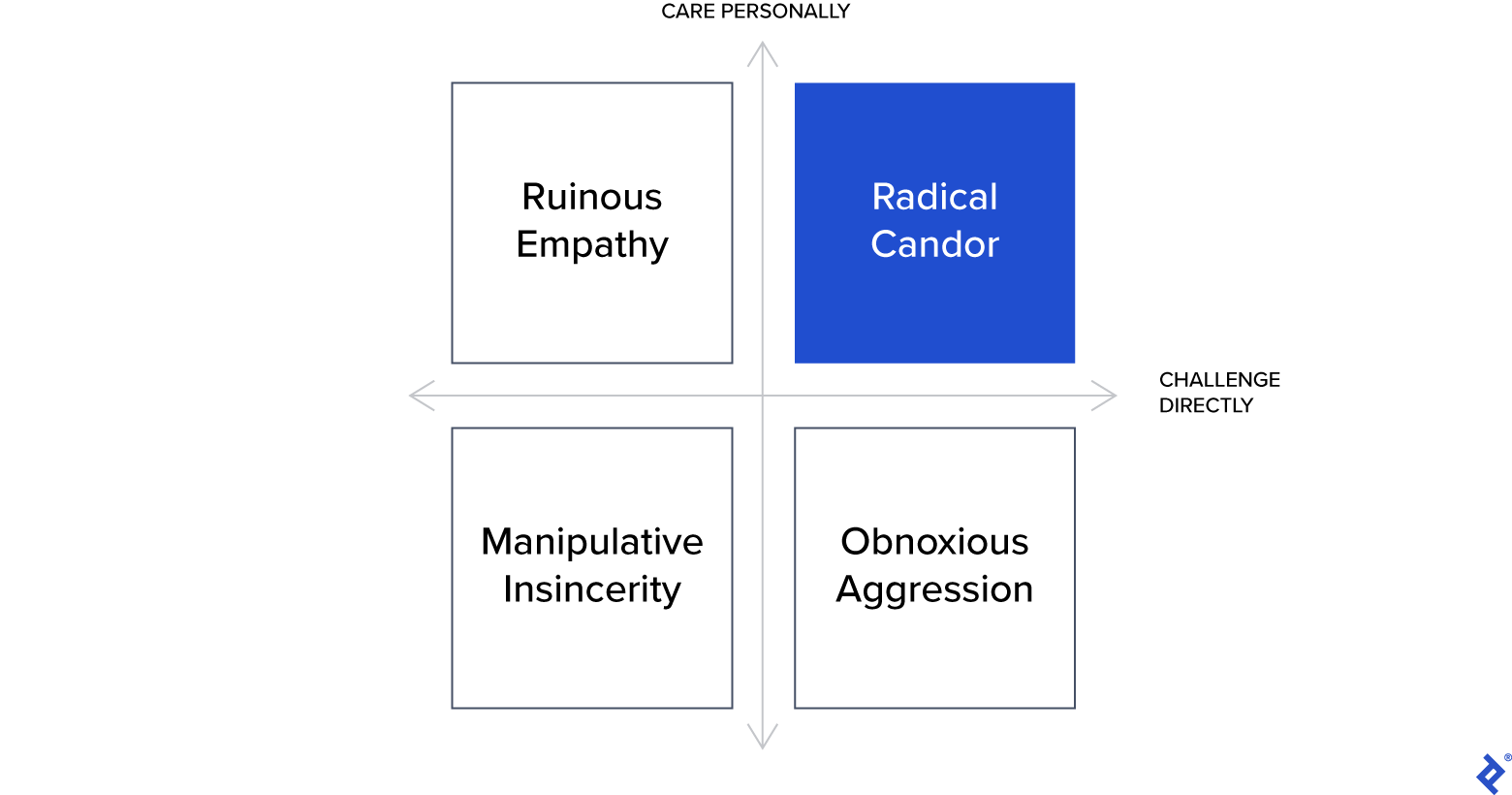
The matrix’s horizontal axis gauges the intensity of professional interaction between the manager and subordinate, ranging from silence to direct challenge. Silence signifies a complete absence of professional engagement with the subordinate, while direct challenge denotes uninhibited and often forceful interaction. The vertical axis quantifies empathy and emotional investment, spanning from genuine personal concern for the subordinate to a noticeable disregard for their emotional well-being.
A manager employing Radical Candor nurtures a strong personal connection with the engineer, creating a space for open and honest communication— practicing candor in feedback and guidance. The feedback, even when negative (as long as it’s constructive), is well-received and acted upon by the subordinate due to the pre-existing strong bond between them.
Navigating the Challenges: A Delicate Balance
Two intermediary categories, ruinous empathy and manipulative insincerity, pose significant risks. Ruinous empathy occurs when a manager prioritizes the personal relationship and care for the subordinate but shies away from providing direct and objective feedback. Consequently, the subordinate might miss out on crucial feedback necessary for understanding expectations and making necessary adjustments.
Conversely, manipulative insincerity presents the opposite scenario. It involves delivering relatively candid feedback but without the foundation of a strong personal relationship. This approach is detrimental because while the feedback might be perceived as disingenuous or passive-aggressive, the subordinate struggles to trust it due to the lack of a genuine human connection.
There also exists an approach devoid of both empathy and honesty, aptly termed obnoxious aggression. As the name suggests, it speaks for itself. A manager displaying obnoxious aggression towards a subordinate lacks both a genuine connection and the capacity to effectively guide and lead.
This matrix serves as a valuable tool for modeling manager-engineer interactions, encompassing a spectrum from minimal engagement to complete investment and respect. A manager who has successfully cultivated Radical Candor with a subordinate demonstrates full engagement in both the personal well-being and professional growth of that individual.
Cultivating Radical Candor: A Step-by-Step Guide
Establishing Radical Candor necessitates the manager’s ability to foster the right environment and follow through with concrete actions. Here’s a breakdown of the steps involved in building a thriving Radical Candor program:
- Building a Personal Connection: It’s crucial for the manager to prioritize establishing a personal connection. It’s important to note that this doesn’t necessarily translate to forging a close friendship. In fact, a genuine friendship could inadvertently shift the Candor matrix towards ruinous empathy, where the manager prioritizes personal feelings over task accomplishment and constructive feedback. Instead, the manager should strive to cultivate a safe space where the subordinate feels comfortable interacting with authority and following instructions. While this space should primarily revolve around work, it can extend to interpersonal dynamics as well.
- Transitioning to Honest Feedback: Only after establishing this safe space can the manager progress towards providing honest and objective feedback. This step requires a delicate approach, often involving the subordinate in self-reflection to guide them in the desired direction.
- Normalizing Feedback: Once the subordinate becomes accustomed to reflecting on and responding positively to feedback, the manager can comfortably offer constructive criticism without apprehension about misunderstandings or hurt feelings.
The Genesis of Radical Candor
Radical Candor emerged from the work of Kim Scott, a highly successful manager at Google who later contributed her expertise to Apple, developing and delivering a course on effective management. Through her consulting endeavors, she identified three fundamental principles for cultivating stronger relationships with employees: Make it personal, get stuff done, and understand why it matters.
Delving into these principles, “making it personal” emphasizes the importance of nurturing genuine personal connections between individuals. While the formal structure of a working relationship might suggest an artificiality to the connection, it can still foster genuine feelings of care and respect. Some managers and employees may hesitate to get personal, but that’s not the right approach. On the contrary, respect and honesty can serve as the bedrock of a robust working relationship.
The second principle, “get stuff done,” advocates for leveraging this foundation of respect and connection to build trust and mutual reliance in task execution. Once a strong personal bond is established between manager and subordinate, it naturally extends to the professional realm. Trust at a personal level seamlessly translates into trust within the professional relationship, simplifying and enhancing work collaboration.
The final principle, “understanding why it matters,” encompasses two key aspects. Firstly, talented and capable individuals thrive on the motivation that stems from perceiving their work as significant and impactful within the bigger picture. This motivates them to excel and genuinely care about the outcomes.
Secondly, engaging in meaningful work empowers team members to recognize their contributions to broader team and organizational goals. This instills a sense of fulfillment stemming from both individual achievement and meaningful team participation.
Not a Panacea, but a Powerful Tool
It’s crucial to acknowledge that implementing Radical Candor in isolation won’t magically resolve all challenges in managing engineering teams. However, it holds the potential to elevate relationships between managers and individual contributors. At the very least, it can pave the way for a heightened level of respect between managers and subordinates, and among team members in general.
At its best, Radical Candor can yield numerous benefits for managers, subordinates, and teams as a whole. Firstly, it can enhance the quality of individual engineers’ work. Secondly, it can foster stronger team cohesion as individuals become more receptive to feedback from one another.
However, achieving Radical Candor demands emotional intelligence and effort. Managers need to embody composure and level-headedness in their interactions with every team member and stakeholder. Simultaneously, they must effectively communicate these qualities to their subordinates and, most importantly, consistently embody them.
Individual engineers, in turn, must embrace self-awareness, objectively assessing their work and personalities. They need to commit to collaborating effectively with both colleagues and managers to cultivate the necessary objectivity. It’s also vital to remember that Radical Candor is not a standalone solution. While the emotions and actions involved are genuine, they won’t yield results in an organizational vacuum; they must be integrated into a supportive and conducive work environment.