For many companies, advertising across an entire city or region is simply not targeted enough.
Just like detectives on TV shows who use (sometimes unreliable) technology to pinpoint a suspect’s location using their phone signal, some advertisers zoom in on very small areas, sometimes just a few blocks, to find their ideal customers.
These “hyperlocal” advertisers aren’t limiting themselves by focusing on such a small area. They’re actually being very strategic by reaching potential customers where they are: at home, at work, or shopping in their local neighborhood.
This post will delve into the world of hyperlocal marketing. We’ll explore what it is, why it can be so effective, and most importantly, how you can use it in your paid search and social media campaigns.
What Is Hyperlocal Marketing?
Hyperlocal marketing involves targeting potential customers within a very specific, geographically limited area, often as small as a few blocks. This strategy commonly aims to reach people using “near me” searches on their smartphones.
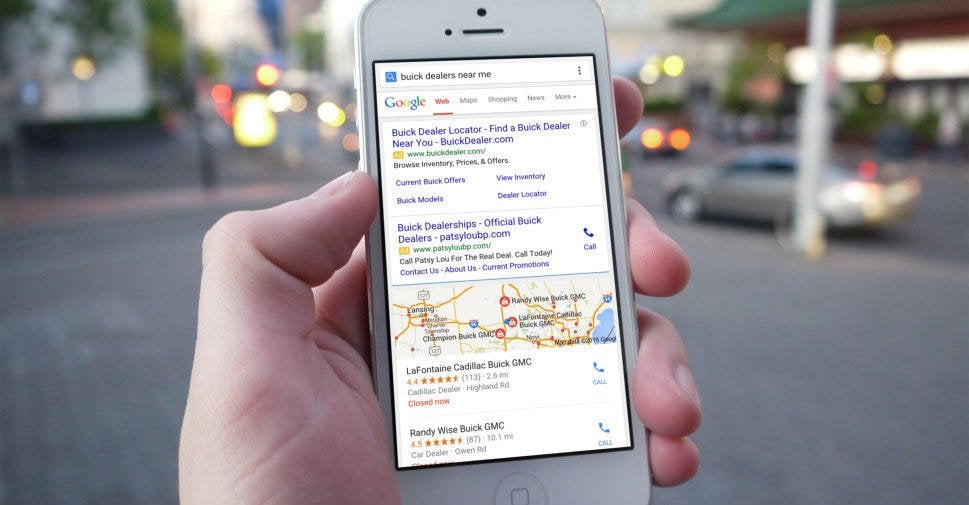
If you’ve ever searched for a particular type of business while you were out and about, you’ve likely already used a hyperlocal search.
Let’s say you’re looking for a specific new book. You go to the closest bookstore, but they’re sold out. What do you do? You pull out your phone and search for “bookstores near me.” You’ve already spent 20 minutes finding parking, so you don’t want to drive far—you want a bookstore within walking distance.
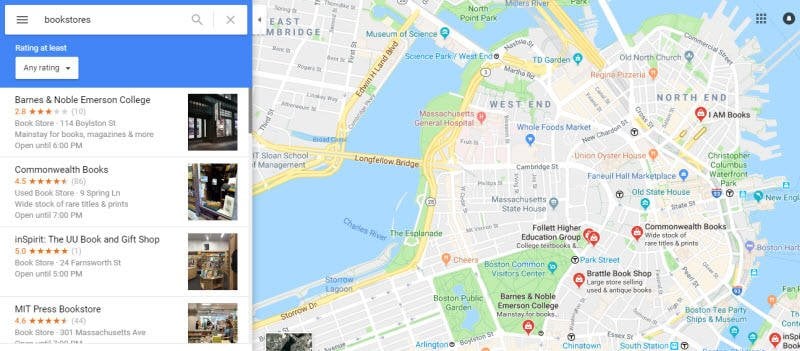
That’s hyperlocal marketing in action.
Why Launch a Hyperlocal Marketing Campaign?
The main goal of hyperlocal marketing is to get people to visit physical stores and take advantage of “near me” searches, which show a strong intent to buy.
Searches using “near me” have exploded in recent years. Google data shows that between 2014 and 2015 alone, the volume of “near me” searches increased by 130%. Since then, people have been using this phrase to find everything from post offices to New Year’s Eve fireworks displays.
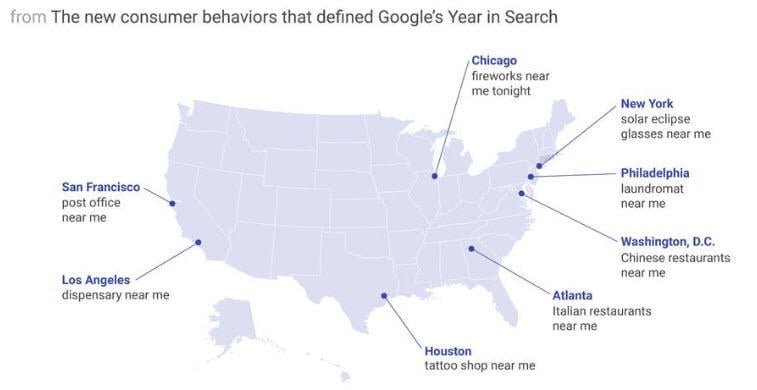
Image via Think With Google
While “near me” searches remain common, changes in search engine technology are influencing how people search for nearby businesses.
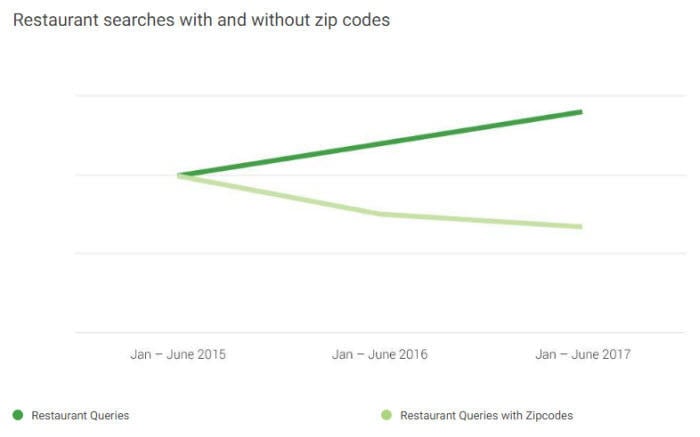
Many users now anticipate local search results to be prioritized even if they don’t specifically include location-based keywords. Data from Google suggests that local searches without “near me” or other location identifiers (like zip codes or city names) have increased 150% faster than searches that do include “near me,” indicating that many users now assume Google will automatically factor in their location.
The graph below illustrates this trend. It displays the search volume for restaurant-related searches between 2015 and 2017. Notice how the total search volume for these terms increased, but searches including zip codes actually decreased during the same period:
Image/data via Google
This might seem insignificant at first, but it signifies a major shift in how consumers feel about real-time location tracking and how location data can be used to deliver more relevant, accurate search results. Not only has interest in local search grown significantly, but more people now expect their location to influence their search results by default.
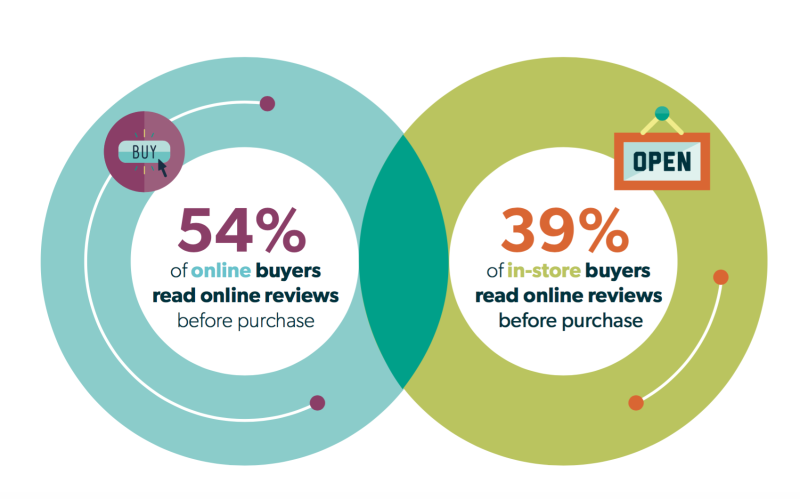
Just as search technology is changing how we find and interact with local businesses online, consumer behavior is also shaping this technology. The trend of “research online, purchase offline” (ROPO) was identified as a significant e-commerce trend, and this is likely to further fuel the demand for locally focused search results.
The growing use of “near me” searches over the past few years has gone hand-in-hand with the rise of hyperlocal marketing. However, the increased use of mobile devices isn’t the only factor driving interest in location-based search results.
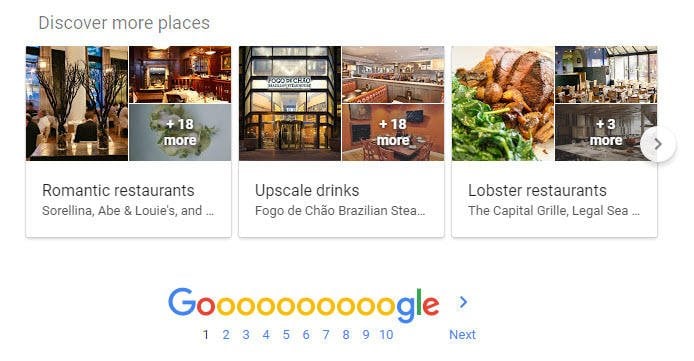
Google itself has been deliberately shaping local search for some time now. The company has been prioritizing a smaller number of high-quality Google Maps results for “near me” searches and suggesting “near me” additions in the “Searches related to…” section at the bottom of search results pages. On some results pages – including desktop searches as of last year – Google has even started showing more results in a “Discover more places” section, a feature previously exclusive to Maps results on mobile.
This combination of widespread mobile device use and Google’s increased focus on local search has made hyperlocal marketing a highly effective strategy for attracting customers to physical stores.
What Ranking Signals Matter Most for Hyperlocal Search Results?
As with many aspects of SEO, there are very few certainties about the ranking signals for hyperlocal searches. We do, however, know that certain factors are particularly important.
A Comprehensive Google My Business Listing
If you want to maximize your visibility in local search results, creating a comprehensive Google My Business listing is crucial.
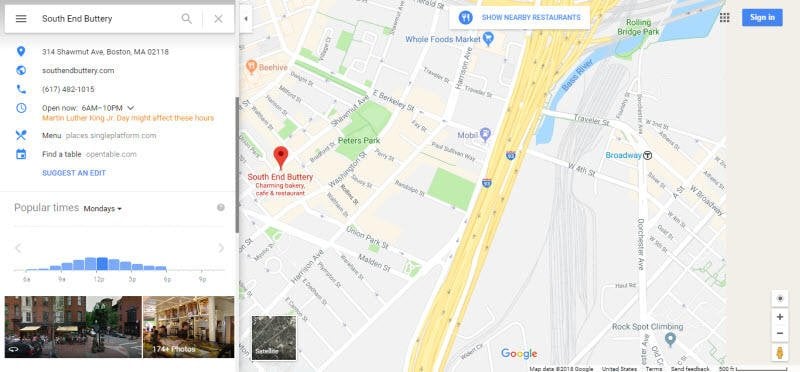
Google My Business listings (formerly Google Places) are where Google gets most of the information it shows to users in local searches and Google Maps results. This includes details displayed in listings of individual businesses within Maps results, like opening hours and addresses, as well as those helpful Knowledge Graph-style snippets such as peak business hours.
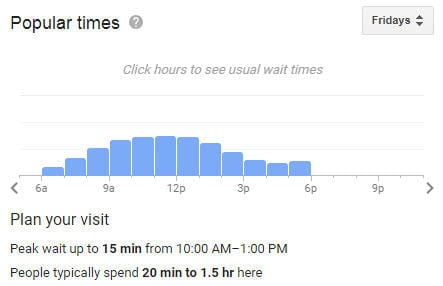
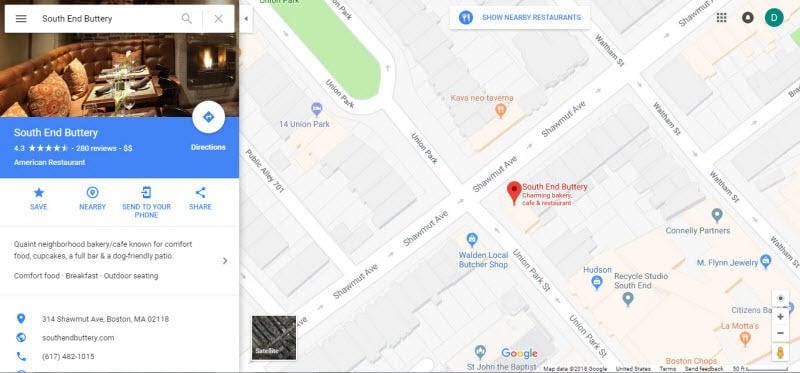
If your website uses third-party services like OpenTable for reservations or SinglePlatform for menu listings, this information will also be shown here, as you can see in the listing for South End Buttery, a lovely café:
For more guidance on optimizing your Google My Business listing, take a look at this guide to Google Maps marketing, which covers everything you need to know about maximizing your listing.
 Are your listings optimized for local search?
Find out with our Free Business Listings Grader!
Customer Reviews
Many small business owners understand the power of word-of-mouth marketing. In the world of hyperlocal marketing, reviews and customer testimonials can be some of your most valuable tools.
Think about the last time you searched for a local business. Did you check the reviews after your initial search? Many people do, especially when looking for a new restaurant or takeout place. If you’re checking reviews before deciding where to spend your money, you can be sure your customers are doing the same.

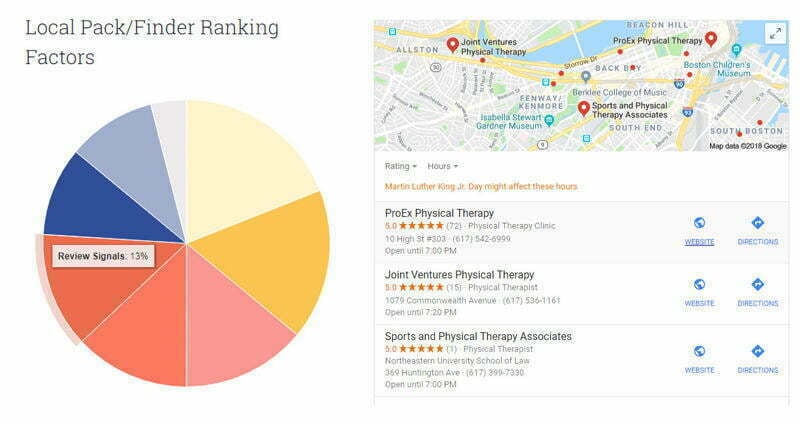
Customer reviews are believed to be a major ranking signal in local SEO, making them even more critical for hyperlocal strategies.
According to Moz’s 2017 Local Search Ranking Factors report, review signals likely account for around 13% of how Google determines which local search results to show in the “Local Pack,” the small list of businesses that appears below the map in some searches:
Data via Moz 2017 Local Search Ranking Factors report
Distance
It’s safe to assume that distance is a strong ranking factor for hyperlocal SEO, and in most cases, you’d be right.
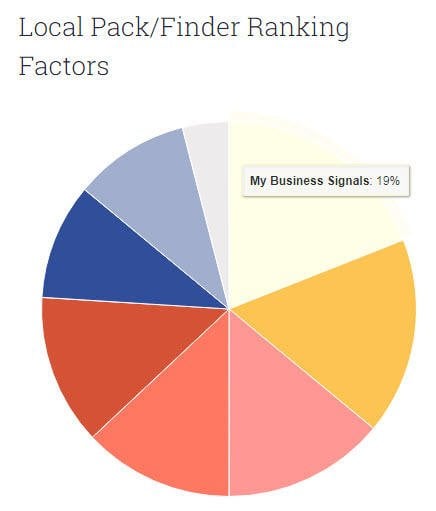
Looking back at Moz’s data, we see that My Business signals (ranking signals collected by analyzing a Google My Business listing for information such as category, keyword relevance, and user reviews) make up almost 20% of how Google prioritizes local search results:
Image/data via Moz
Keep in mind that proximity (the distance between the user and a local business) is also considered a My Business ranking signal. This is where things get a little tricky.
Research suggests that Google sometimes prefers to display local results in groups, even if other relevant businesses are closer to the user’s location, as discovered by Darren Shaw in a fascinating blog post for Moz.
However, this isn’t always the case. As Darren and his team noted, Google sometimes displays a shorter “local pack” with only two businesses instead of three if a relevant business is deemed too far from the user, even if there are other businesses closer by.
This raises questions about how proximity interacts with other ranking signals (like the quality of a business’s My Business listing). This can become even more complex when considering factors like individual search history, social signals such as share count, past purchase behavior, and potentially many other elements.
Then there’s Google’s this patent, filed quietly in January 2017. This appears to describe a system that judges the quality of a location-based search result based on distance and estimated travel time, hinting at the possibility of placing even greater emphasis on proximity in local searches.
In short, proximity is likely to remain a key ranking signal in hyperlocal SEO. However, as with anything related to outsmarting Google, your results may vary.
How Do I Set Up a Hyperlocal Marketing Campaign?
Since hyperlocal marketing involves restricting ads to a specific geographic area, geolocation settings are paramount. We’ll also look at keywords and options for hyperlocal social media marketing.
Hyperlocal Marketing in Google Ads
To start using hyperlocal marketing in Google Ads (previously Google AdWords), ensure your geolocation settings are accurate.
Go to the “Campaigns” tab in your Google Ads account, choose the campaign you want to edit, and click “Settings.” Then, click the downward arrow in the “Locations” tab and select “Advanced search.”
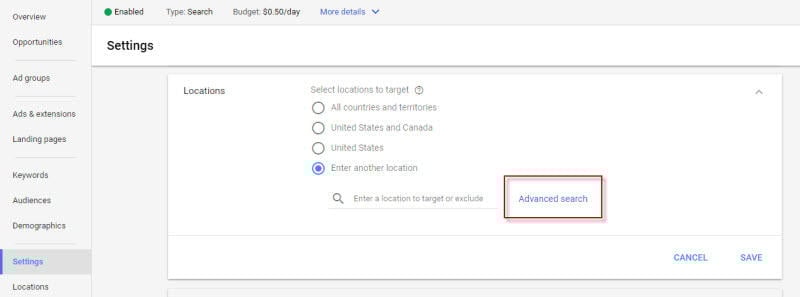
Next, click “Radius targeting”:
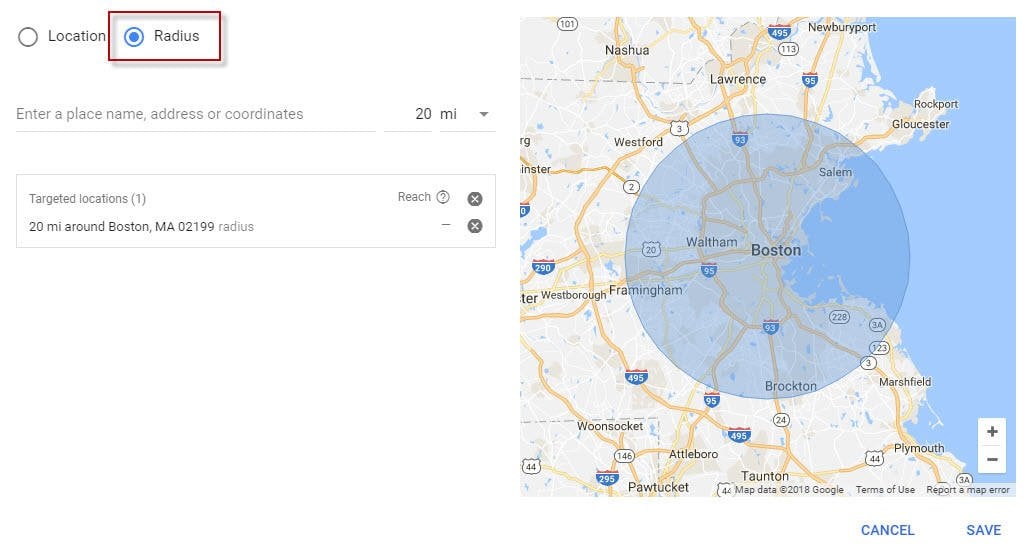
Now, choose the central point for your radius targeting. Most businesses use their store’s physical location. You can do this by typing the address directly into the search bar within the radius targeting box.
In this example, the zip code for our office was entered as the center of the radius, keeping the default distance of 20 miles.
While this might work for some, it’s not precise enough for a hyperlocal campaign. We need to be much more specific—let’s try a one-mile radius around the office.
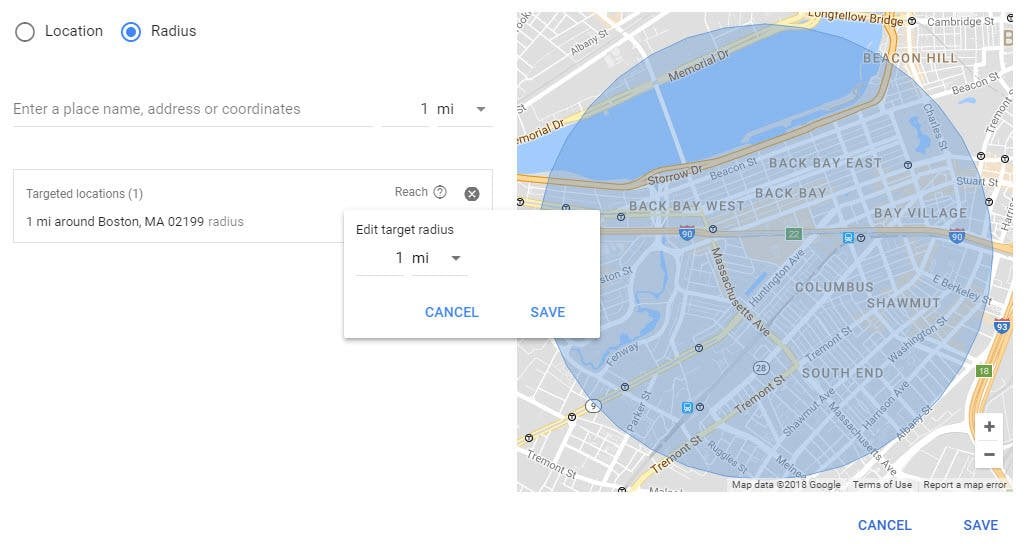
To change the radius, hover over a targeted location in the list, click the pencil icon, edit the radius, and save your changes.
Our example now shows a significantly smaller target area. This is much better!
We could shrink the radius even further by using kilometers instead of miles:
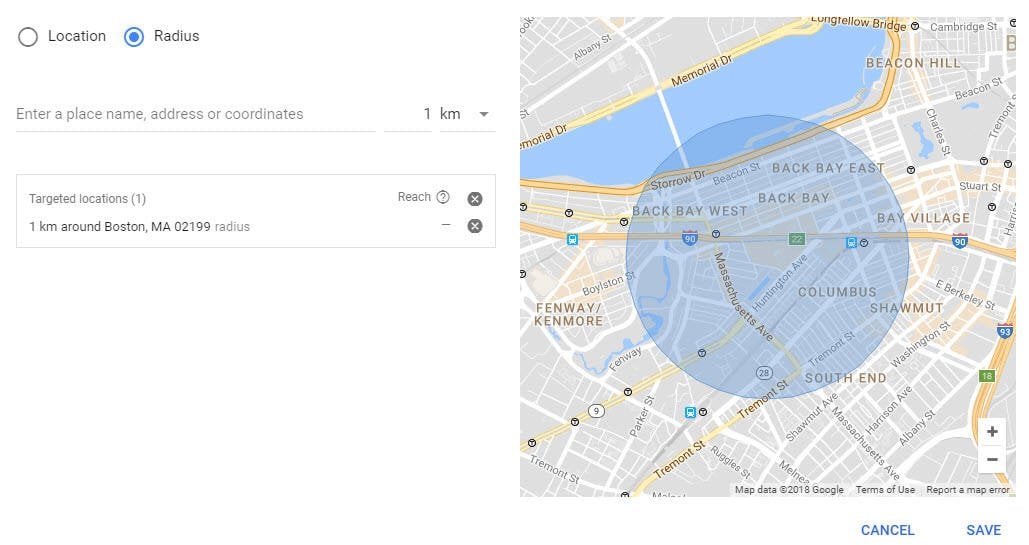
Our tightly targeted geolocation radius is a great start, but it’s not enough. You also need to consider your keywords and the intent of people searching for products or services like yours.
Using our location radius example, we’re now targeting specific neighborhoods rather than entire cities or regions. This gives us a starting point for our keyword research. For instance, a plumber running a hyperlocal campaign might bid on keywords like “plumber [neighborhood name]” or “emergency plumber [neighborhood name]” to attract more business from those areas.
Conversely, this approach helps you identify negative keywords to exclude. If our plumber was using the 1-kilometer radius, bidding on keywords like “plumber [distant neighborhood]” or “24 hour plumber [distant neighborhood]” wouldn’t make sense, as those areas are outside the campaign’s reach.
You’ll want to target relevant keywords including “near me” in your hyperlocal campaign, but this should be in addition to locally focused keywords.
As with any campaign, use keyword research tools to uncover new keywords that could be suitable for “near me” searches.
Hyperlocal Marketing in Facebook Ads
While there are no strict rules for hyperlocal social media marketing (HyLoSo?), you can do several things to refine your Facebook ad targeting and reach motivated prospects actively seeking businesses like yours.
Local Awareness Ads
One easy and effective way to target potential customers is through Facebook’s Local Awareness ads. Launched in 2014, this ad format is specifically designed for local businesses wanting to increase awareness of their physical location and drive foot traffic.
Creating a Local Awareness ad is simple. Select this format from the list in the Ads Create tool, and enter your business address. (You won’t need to enter this manually if it’s already on your official business Page.)
You’ll see a visual representation of your ad’s coverage area, which can be adjusted by selecting the desired radius from the drop-down menu:
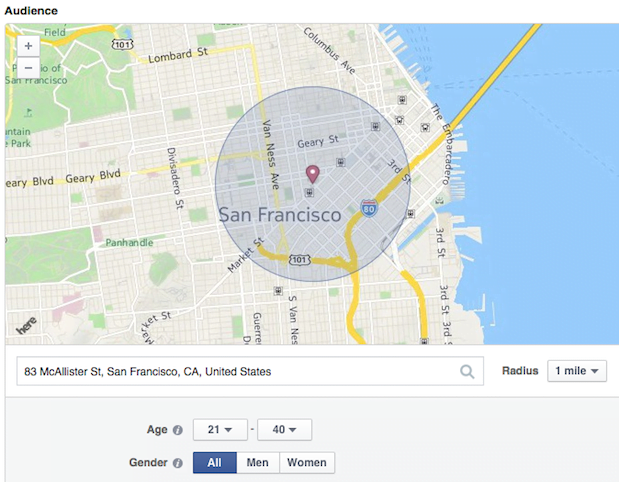
Image via Facebook
You can adjust other settings in this box, including the target audience’s age range and gender. This is also where you’ll set your daily budget and ad duration. Once complete, Facebook will estimate your potential reach.
Local Insights
One of the most valuable tools Facebook offers hyperlocal advertisers is Local Insights. This data can be incredibly useful, as it connects crucial aspects of a hyperlocal campaign: whether the right people in the right location are seeing the right ads at the right time.
Accessed from the Page Insights report, Local Insights provides advertisers with valuable information about their local ad performance.
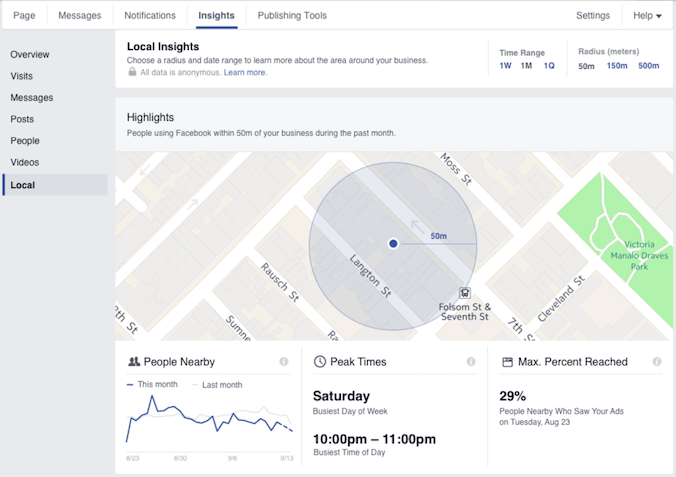
Image via Facebook
You can customize your Local Insights settings to get more detailed campaign information. You can adjust the time range (one week, one month, or one quarter) and specify a distance (50 meters, 150 meters, or 500 meters) to establish a baseline for your report, which is displayed below the map.
Local Insights keeps things clear and concise. You can see a graph showing the number of people near your business (any Facebook user who entered the specified radius) and the busiest day and time. You’re also shown the percentage of people near your location who saw your ad.
Like Google Analytics, Facebook’s Local Insights doesn’t offer precise figures; it only shows generalized, anonymized data. Additionally, Local Insights only collects data on users who have Location Services enabled in the Facebook app (found under Privacy > Location Services). While useful, it’s not perfectly accurate or necessarily representative of your entire target audience.
Refining Audience Segmentation by Location
Our final tip for hyperlocal Facebook ad campaigns focuses on Facebook’s incredibly detailed targeting options—specifically those related to Location.
Let’s say you’re running a hyperlocal campaign using the Store Visits objective. You want to reach people within a certain distance of your store, so you’ll use Business Location targeting. This lets you target custom audience segments around your chosen location. You can enter your address manually or drop a pin on the map.
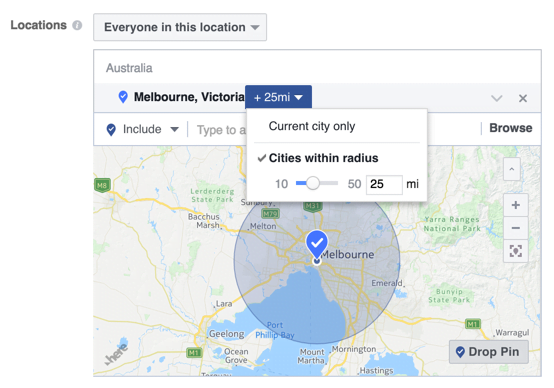
Now you can fine-tune your settings. You can adjust the radius around your location using numerical values or the slider. You can also choose whether to include neighboring cities or target only the city where your business is located. This helps keep your ad copy consistent and relevant across broader areas.
There are a few things to remember about radius targeting in Facebook Ads. First, it doesn’t cross country borders. So, if you’re targeting a 10-mile radius around a city near a border, you’ll need to create a separate targeting radius for prospects across the border or accept that your targeting will only cover your home country.
Second, the minimum and maximum targeting radius varies depending on the location type. Sometimes you can set a radius as small as one mile, while other times, you may need to cast a wider net.
Finally, you can’t use radius targeting for specific zip or postal codes. To target users within certain zip codes, Facebook will represent your target area with a polygon on the map rather than a circular radius. You can adjust this shape to include specific streets within a zip code.
Refining Audience Segmentation by Individual
After defining the perimeter of your Facebook hyperlocal campaign, you need to decide who you want to target within that area. Facebook provides several broad options:
Everyone in that location: This targets every eligible Facebook user within your radius, including those who update their status at that location (even entire cities) and users Facebook determines are within range based on device location data.
People who live in a location: Ideal for businesses attracting local customers, this option targets users based on their profile information and those deemed to be living in a specific area based on data such as device location.
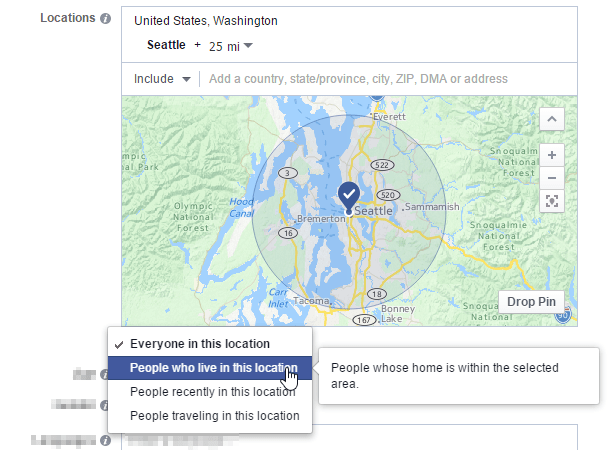
People who recently visited a location: This includes any eligible user whose most recent location falls within your target area, including residents, visitors, and tourists.
People traveling to and within a location: This targets users at least 125 miles from their home city or location (based on their profile data) who are currently within your specified location.
By combining these audience segmentation options with radius targeting, you can focus on specific neighborhoods and reach new customers with your products and services.
What hyperlocal marketing techniques have been successful for your business?