Let’s explore the world of Google Ads!
Google has expanded its Ads Transparency Center, often called the Google Ads Library. This means there’s a searchable library for Google Ads, similar to Meta and TikTok. This is a significant and welcome development for Google Ads professionals because we can quickly find text, image, and video ad inspiration for campaigns.
And, of course, see what the competition is doing.
Table of contents
- How to use the Google Ads library
- How to use the Google Ads library to find your competitors’ ads
- Another way to use the Google Ads Transparency Center to find ad information
- Google Ads library and advertiser verification: What you need to know
How to use the Google Ads library
It’s important to note that the Google Ads library isn’t actually called that. You can find all active ads through the Google Ads Transparency Center.
Searching for ads in the Google Ads library
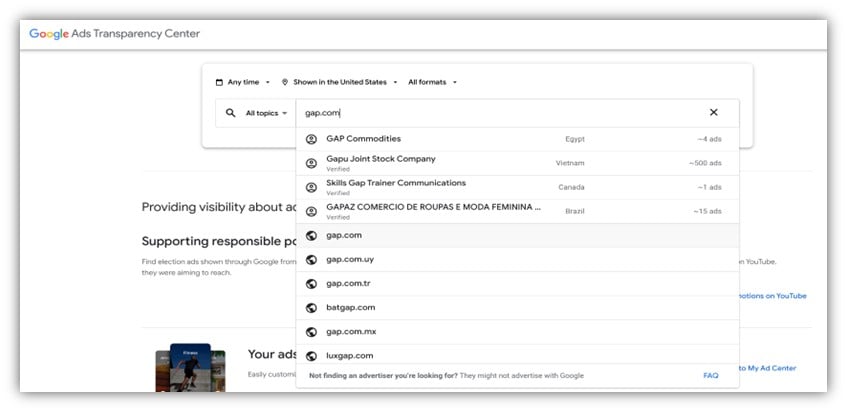
You can search by advertiser name or website URL when looking for ads. Using the website URL is much simpler and more accurate than sorting through advertiser names because many businesses verify through a parent company or agency.
For instance, if you search for ads for the clothing retailer Gap, you’ll get a long list of businesses with “Gap” in their name, but not the Gap.
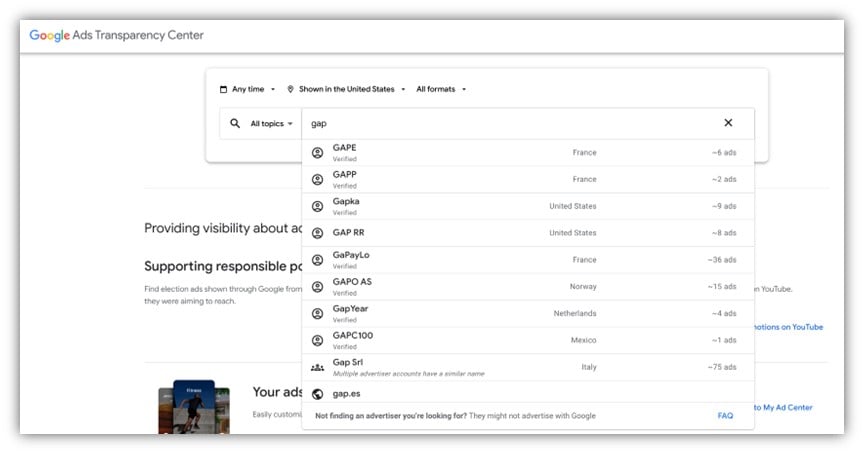 When you add “.com,” it becomes obvious which one is the Gap clothing company. When you search by website URL, different domain suffixes, such as.com,.co.uk, and.ca, will appear separately.
 Our free Google Ads Grader can help you stay ahead of the competition!
Filter Google Ads library results
You can use four filters in the Google Ads library to find what you’re looking for: date range, geography, format, and all topics vs. political ads.
When looking for ad inspiration, I recommend using the date range filter to look at the last 30 days rather than “Any time.” The exception would be if you had a particular reason to go back in time. For example, you might want to get ideas for your Valentine’s Day ads by looking at ads that ran last Valentine’s Day.
Then there’s a country filter. The Google Ads Transparency Center will default to showing results for ads that ran in your country, so make sure to change this if necessary. For example, I am in Canada and frequently want to see what US advertisers are up to.
The third filter allows you to search by ad format: image, text, or video. Because I’ve found this feature to be a little buggy, I recommend sticking with the default setting of all formats.
The final filter, all topics vs. political ads, functions similarly to the Meta Ads library. Unless you’re running some sort of political or cause-based campaign, you’ll probably want to keep that one on all topics.
How to use the Google Ads library to find your competitors’ ads
Let’s use the luxury athleisure company Lululemon as an example to demonstrate how to use the Google Ads library to find your competitors (and learn from their successes and failures!).
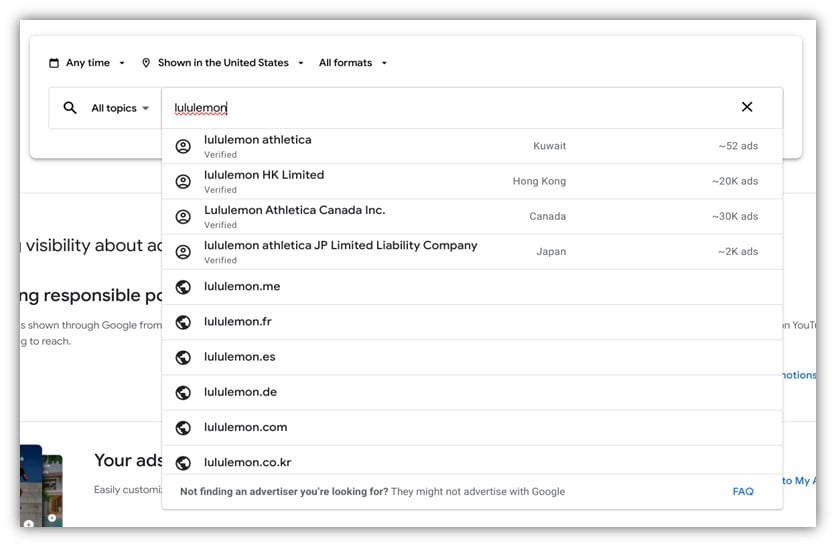 You’ll see that typing in Lululemon brings up a slew of verified advertisers and domains. This reflects how the company presented itself to Google in order to be verified.
Because I’m interested in ads for the US market, I’m going to choose the Lululemon.com domain. I could have also used trial and error to figure out that the Canadian company “Lululemon Athletica Canada Inc.” is in charge of the company’s US operations.
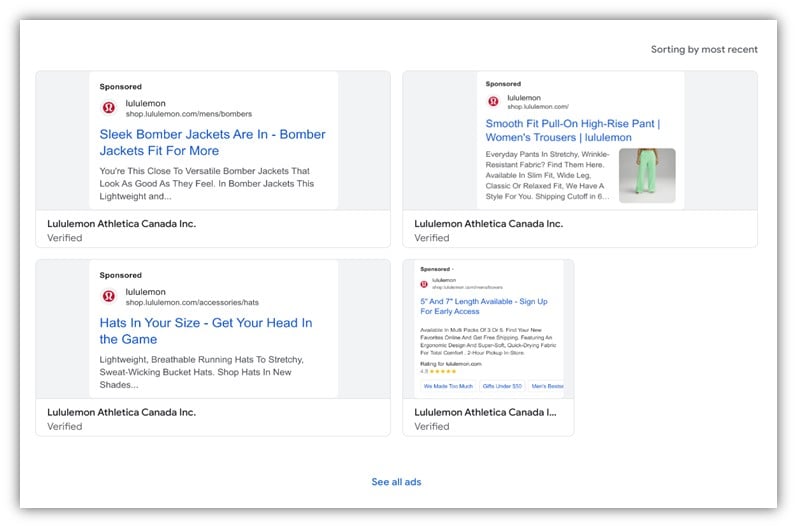 When you select an advertiser, only a few ads appear at first, but we can already learn a lot about this Google Ads account. For example, we now know that Lululemon employs a variety of assets: sitelinks, logo, business name, image, and ratings.
We can also observe that they are promoting a variety of product lines for both men and women.
By clicking “See all ads,” we can begin to see thousands of examples of how Lululemon is currently advertising on Google.
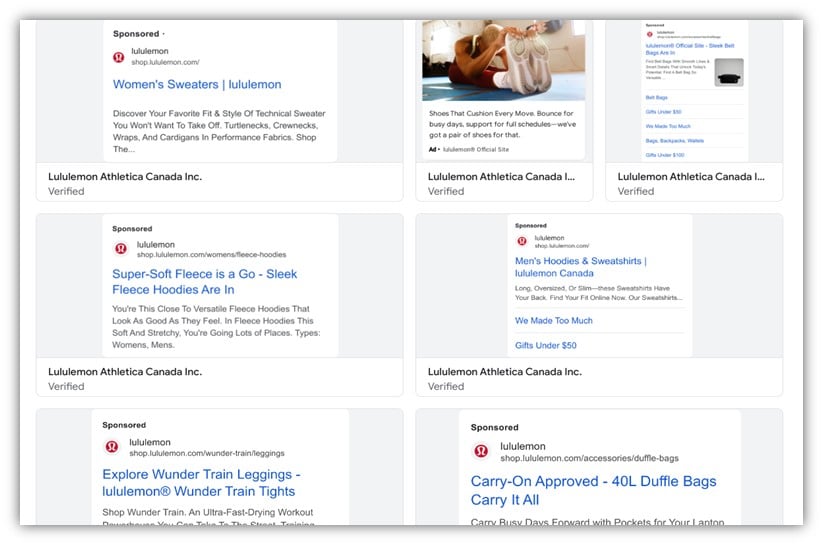 That image of someone stretching is a Discovery ad, implying that Lululemon is running either Performance Max or Demand Gen campaigns.
According to Google’s internal research, showing a human in the center of the picture using the product is an effective way to use imagery in Google Ads; this outperforms static “ecommerce-style” images in Discovery placements via Performance Max and Demand Gen.
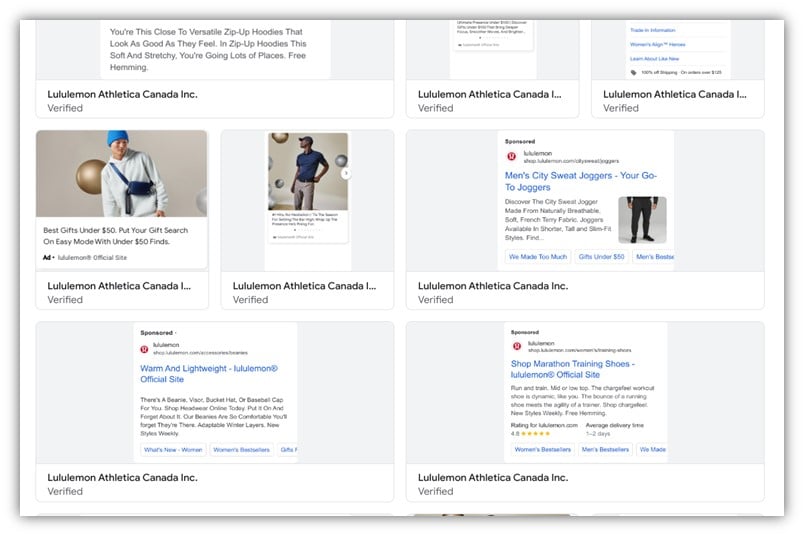 As we scroll down through the active ads, we see more examples of Search and Discovery placements, including a promotion asset and a Discovery carousel.
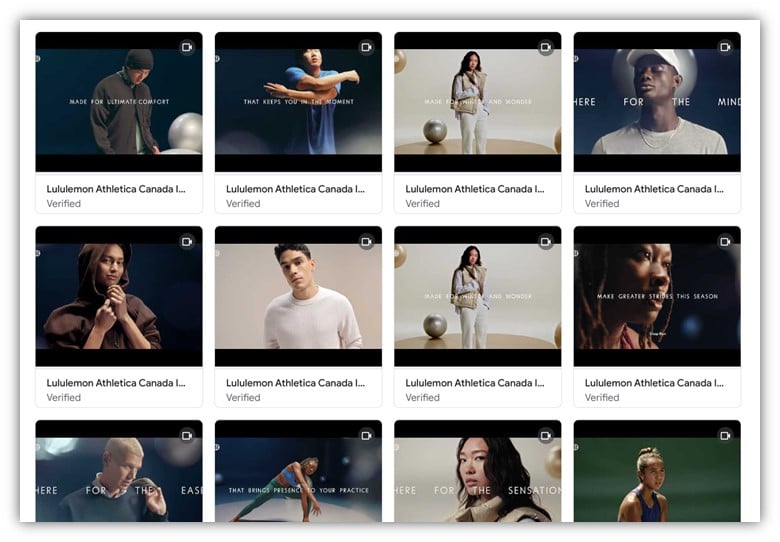
Next, I’m curious if Lululemon incorporates video into their Google Ads strategy, so I enable the video filter, and voila! Every video from their current brand campaigns is right there, and I can click on any of them to get ideas.
 For example, the video ad below has four variations in both Display and YouTube placements, implying that it is most likely being used as an asset in a Performance Max campaign.
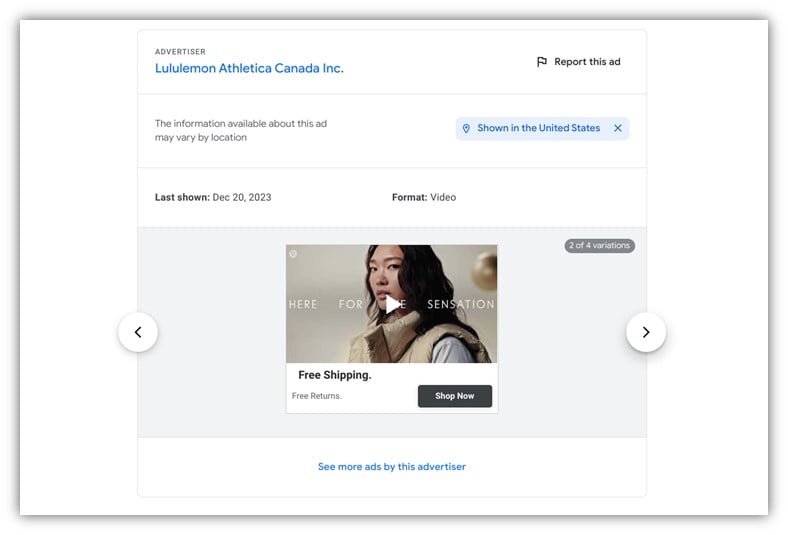 We can learn a lot about any advertiser’s Google Ads strategy by looking at their active ads and combining that information with our understanding of how Google Ads works.
 Our free Growth Strategy Guide can help your business grow faster than the competition!
Another way to find ad information on the Google Ads Transparency Center
While a searchable Google Ads library is a PPC practitioner’s dream come true, you can find out even more about a company’s ads when you see them as a user. This is my favorite method for getting a glimpse not only at what ads are running, but also at how various businesses are targeting their ads.
When you see an ad on Google, whether it’s on Search, YouTube, or Discovery, tap the three dots in the upper right-hand corner to access My Ad Center.
Scroll down to “Why you’re seeing this ad” and make a note of the targeting options. Among the options are:
- The time of day
- Your age
- Your current search terms
- Your general location (like your country or city)
- Google’s estimation of your approximate current location
- Google’s estimation of your areas of interest, based on your activity
- Information you gave to the advertiser, which the advertiser provided to Google
- Your similarity to groups of people the advertiser is trying to reach, according to your activity while you were signed in to Google This is an excellent way to keep your Google Ads skills sharp. While browsing the web, look into “why you’re seeing this ad” and try to figure out the advertiser’s targeting settings and, if possible, campaign strategy.
For example, I recently saw this Discovery ad for a company called Synthesis on my phone. I’d never heard of them before.
 My Ad Center informs me that Google believes I am interested in “tutoring services” (I am not), and the “Why you’re seeing this ad” section states that my age, location, and areas of interest were used to target this ad.
I’m the mother of a five-year-old and a baby, and I was recently looking into swimming lessons, gymnastics classes, and summer camps for my eldest. Yes, I used Google Search. These activities most likely marked me as a prime candidate for online activities for my school-aged child, though “tutoring services” is a bit of a stretch.
Personally, I find the headline “your child’s superhuman tutor” off-putting rather than enticing, but hey—the algorithm will learn because I didn’t interact with this ad.
The next ad I see, as I scroll down a little, is for a special offer to subscribe to The Times of London newspaper.
 Because my husband is British and subscribes to The Guardian, I’m curious if some signals in our household targeting got crossed. Let’s look at My Ad Center to see what’s going on.
Apparently, Google believes I am interested in newspapers (correct) and a company called News UK.
I’m seeing this ad because of my location, interests, and—aha!—similarity to the advertiser’s target audience.
Because we know that similar segments have been deprecated for some time, this advertiser is most likely running this ad through a Demand Gen campaign, which includes a Lookalike targeting option. It would make sense for an English newspaper looking for new subscribers abroad to target people who are similar to their current international subscribers.
Because the number 12 appears everywhere in this ad, it’s clear that they believe the “value” message is sufficient to convert cold traffic. Time will tell if I decide to subscribe! However, I did not click on this advertisement either.
Advertiser verification and the Google Ads library: What you need to know
No discussion of the Google Ads library or the Google Ads Transparency Center would be complete without mentioning Google Ads advertiser verification.
If you manage a Google Ads account, you’re probably familiar with the notification emails that remind you to verify your account. It is usually a simple process, and you should complete the steps as soon as possible to avoid having your account suspended.
The Google Ads library only displays ads from Google Ads accounts that have completed advertiser verification. This means that if the accounts running those ads have not yet completed the verification process, you may not see them.
Gain insight (and a competitive edge) with the Google Ads library
The Google Ads library is a goldmine of information about advertisements in your industry. You can use this tool to predict what types of Google Ads your competitors are using, and you can gain even more insights by using My Ad Center. In this guide to spying on your competitors, you’ll learn even more tricks. And if you discover that your ads aren’t keeping up with what’s hot in the Google Ads library, our solutions can help you get the most out of your company’s Google Ads strategy!