The New England region offers amazing opportunities for adventure. Recently, I spent a weekend kayaking on the open ocean, exploring different islands near the coast of Portland, Maine. Kayaking in such conditions can be quite challenging. Sudden gusts of wind, unexpected large waves from passing boats, and the inherent instability of the kayak can make for a difficult experience. However, our tandem kayak had an additional control feature: a rudder. This small addition allowed us to easily maneuver the entire vessel with just slight adjustments to its pedals. This enabled us to quickly react to approaching waves, smoothly approach the shore, and ultimately reach our desired destinations efficiently.

By now, you’ve probably realized I’m drawing an analogy here, so let’s get straight to it. PPC advertising has its own “ocean” to navigate, and that’s bidding. Just like a rudder, the feature in your account that provides similar control is Manual Bidding. Just as you’d want to be in control of a kayak on the open water, most experienced advertisers prefer manual control over their bidding strategies. It offers the same level of precise control as the rudder in our analogy, but in this context, the benefits translate to managing your cost-per-acquisition (CPA), implementing tiered bidding strategies, controlling costs for low-converting keywords, and boosting your Impression Share.
Many advertisers starting out opt for Automatic Bidding to save time and simplify account management. While it works for some, many others require more control to prioritize important keywords and optimize their CPA to a satisfactory level. When faced with an underperforming account, many advertisers seek to gain this control by switching to Manual Bidding. When making this change, consider a few key points to ensure a seamless transition:
Implement Gradually - One Campaign at a Time

Initially, this process can be time-consuming, especially in the first few weeks as you try to determine the optimal bids for each keyword. To avoid feeling overwhelmed, start with one campaign at a time. A good starting point would be a campaign with a moderate volume of clicks and impressions compared to others in your account. It’s best not to start with your top-performing or highest-volume campaign in case the results are not as expected. By testing and refining your approach on smaller campaigns, you can identify any necessary adjustments and ensure a smoother transition when you eventually apply these changes to your primary campaigns. Focusing on one campaign at a time allows you to manage adjustments effectively and identify any trends or improvements that you can apply to subsequent campaigns.
Begin with Average CPC
The Average Cost-Per-Click (CPC) is arguably the most crucial metric when determining your initial bids for Manual Bidding. It reveals the average amount you’ve been paying for each click on a specific keyword, which is incredibly valuable information. Essentially, it provides a concrete starting point for your bids.
However, it’s important to consider how you enter the bidding process and how your CPC is calculated. Your actual Bid is the maximum CPC you’re willing to pay for a click, so naturally, your Average CPC will be lower than this maximum bid. Therefore, instead of bidding the exact Average CPC amount, you’ll want to bid slightly higher to maintain a competitive ad rank and avoid a drop in ad position.
Generally, depending on your risk tolerance, I recommend setting your Maximum CPC 8% to 10% higher than the Average CPC as a starting point. In the following weeks, monitor these bids closely and adjust them individually, either higher or lower, as needed. While it does involve some calculated guesswork, using the Average CPC as a baseline can get you very close to your ideal Maximum CPC.
Utilize First Page Bid Estimates as a Guide
To borrow an analogy from a colleague, the First Page Bid Estimate is more like a general indicator than a precise measurement. This means it’s not always perfect; your ad might be appearing on the first page even if your account shows an alert stating that your bid is below the First Page Bid Estimate. However, you can use this estimate to gauge whether you need to increase your bid to gain more impressions.
If you’re receiving very few or no impressions for a specific keyword and see an alert indicating that your bid is below the First Page Bid Estimate, it’s a strong signal that your ad is not getting traffic because it’s positioned too low, likely below the first page of search results. If the estimate seems too high, gradually increase your Maximum CPC until you start seeing impressions. Increase your bids incrementally, either weekly or even every other day if time is limited. Once your ad position reaches position six or higher (ideally within the top five positions), you can be confident that your ad is on the first page.
Leverage Impression Share
Impression share represents the percentage of times your ads are shown compared to how often they are eligible to appear. Eligibility depends on factors like your targeted keywords, their match types, your Quality Score, your budget, and of course, your bidding strategy.
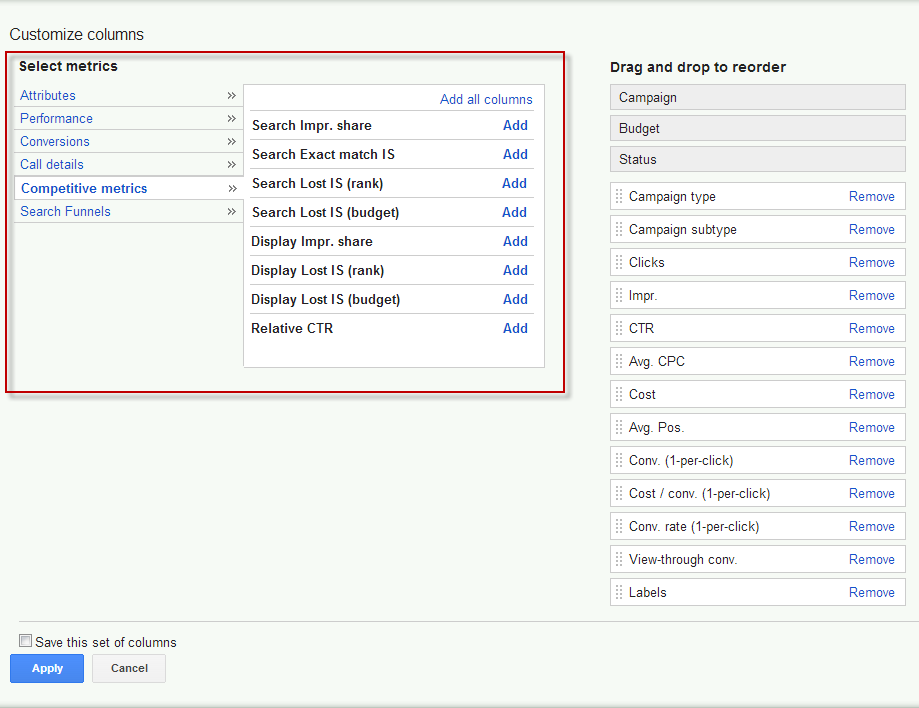
The most straightforward way to increase your impression share (assuming budget isn’t a constraint) is by raising your bids. When transitioning to Manual Bidding, analyze the current impression share of your individual keywords. If you have essential keywords with a low impression share, there’s room to grow their visibility. You might consider bidding more aggressively on these keywords compared to others in your account to increase the exposure of your ads.
Prioritize Conversion Tracking
While this might seem obvious to any advertiser, the execution of this concept deserves further explanation. Pay close attention to the keywords and search queries that are generating the most conversions in your account. When switching to Manual Bidding, it’s crucial to ensure that these valuable keywords have sufficient bids. If, for any reason, they end up with a low default bid, you could experience a significant decline in both clicks and conversions. Give these high-converting keywords the attention they deserve to ensure the smoothest possible transition.
This point directly connects to the previous discussion about Impression Share. If these high-converting keywords have the potential to gain more impressions, consider bidding on them more aggressively than other keywords to potentially boost your conversion rate. Similarly, if you identify keywords that are driving up costs without generating conversions, you can confidently lower their bids to save money.
If It’s Working, Don’t Change It
This article focuses on making a successful switch from Automatic to Manual Bidding, but it’s primarily aimed at advertisers who are struggling with Automatic Bidding. If your account is already performing well and you have a satisfactory CPA, there’s no need to switch to Manual Bidding just for the sake of it. If you’ve found something that works, consider yourself lucky and avoid making unnecessary changes to your Google Ads campaigns (previously known as Google AdWords). There’s no guarantee that you’ll see the same level of success after switching, as with any significant changes in Google Ads, so in some situations, transitioning might not be the ideal choice.
In Conclusion
Before making the switch, carefully consider your overall account goals. If your campaigns are significantly underperforming, it might be time to take more control by switching to Manual Bidding. However, if you’re content with your current performance, it might be best to stick with Automatic Bidding and utilize Bid Adjustments and Enhanced CPC for further optimization.
Are you currently using Automatic Bidding? How is it working out for you? If you’ve recently made the switch or are thinking about it, share your thoughts or concerns in the comments below!