A frequent grievance about Google’s Keyword Planner, the successor to the old Google Keyword Tool and Traffic Estimator, is its inability to provide traffic data for broad and phrase match keywords. Despite appearances when using the tool, Google only furnishes data for exact match traffic. This article will unveil several strategies to regain access to your phrase and broad match traffic data.
Google’s Stance on Search Volume in Keyword Planner
Google advises inputting keywords with standard match type formatting to obtain volume based on keyword match type:
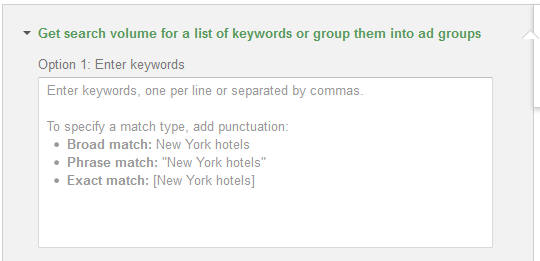
Logically, an SEO professional would experiment with all three formats for a given keyword to compare traffic volume:
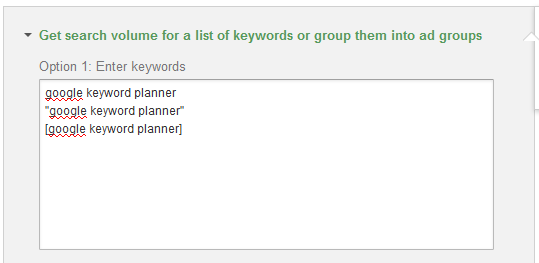
Let’s examine the results displayed on Google Keyword Planner for these match type variants:
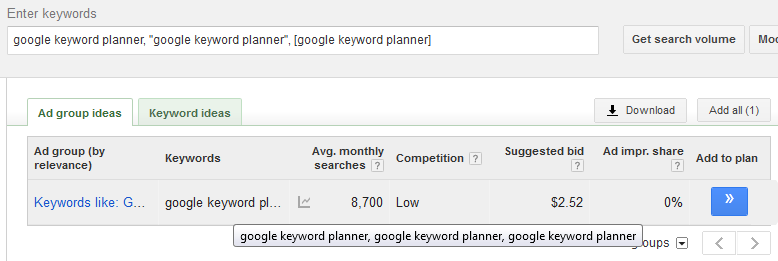
However, upon downloading the data, you’ll encounter this:

What Transpired?
Google processes all three searches as exact match searches. Moreover, it combines the three exact match traffic figures, as AdWords generates an ad group traffic estimate. Essentially, it’s an ad group composed of 3 exact match keywords, potentially signifying a bug. Here’s Google’s definition of Avg. monthly searches (emphasis mine): “The average number of times users have searched for this specific keyword according to your chosen targeting settings. About the number: We compute the 12-month average search count for this exact keyword based on your selected location and Search Network targeting settings (excluding language settings) …. Note: Insufficient data will be indicated by a dash (-). Average monthly searches disregard your selected keyword match types. To view traffic for different match types, consult your click and cost estimates on the review page.” In essence, Google transforms your broad and phrase match keyword searches into exact match searches. As evident, the “average monthly searches” for the three match types are identical, and Google recommends running an AdWords estimate to determine traffic for different match types.
Three Methods to Approximate Broad Match and Phrase Match Keyword Volume
Fortunately, exact match forms the basis for phrase match and broad match, enabling their reconstruction. We present three approaches to achieve this. For preliminary keyword opportunity and trend analysis, method #1 is preferable.
Method #1: Estimating Match Type Traffic via AdWords Impressions Traffic Estimate
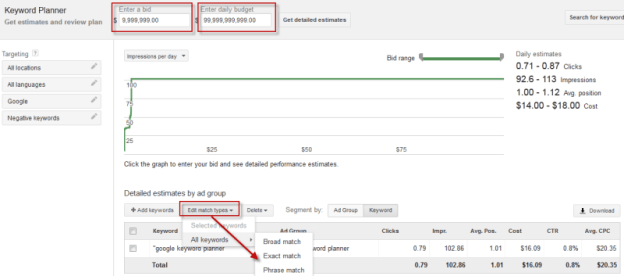
Imagine yourself as Google. An advertiser approaches, offering $1 million per click on their ad for a specific keyword, armed with an unlimited PPC budget. Where would you position their ad? Naturally, you’d prioritize displaying the ad on the first page of SERPs for their chosen keyword – and that’s precisely how we’ll leverage the Keyword Planner to extrapolate phrase or broad match traffic. AdWords’ daily estimate of maximum impressions serves as the closest approximation to an organic search for your keyword. In the example provided, “google keyword planner” on phrase match would yield an estimated traffic volume of 102.86*365/12 = 3,129 searches per month. Disclaimer: While a search query precedes an ad impression, a single query can trigger multiple impressions of the same ad. Your results will fluctuate depending on the day of your test due to daily variations in AdWords statistics.
Method #2: Analyzing the Impressions & Impression Share Report
For those who concur that Google’s keyword tool was never accurate to begin with, you’re welcome to test method #1 with a live AdWords ad for your research keyword. Ensure a sufficiently high daily budget, deactivated ad scheduling, and location targeting aligned with your keyword research objectives. After a day or month of data acquisition, depending on your desired accuracy, you can extrapolate keyword search volume using the formula: (Impressions/Search Impression Share) / (1 – Search Lost IS (rank))
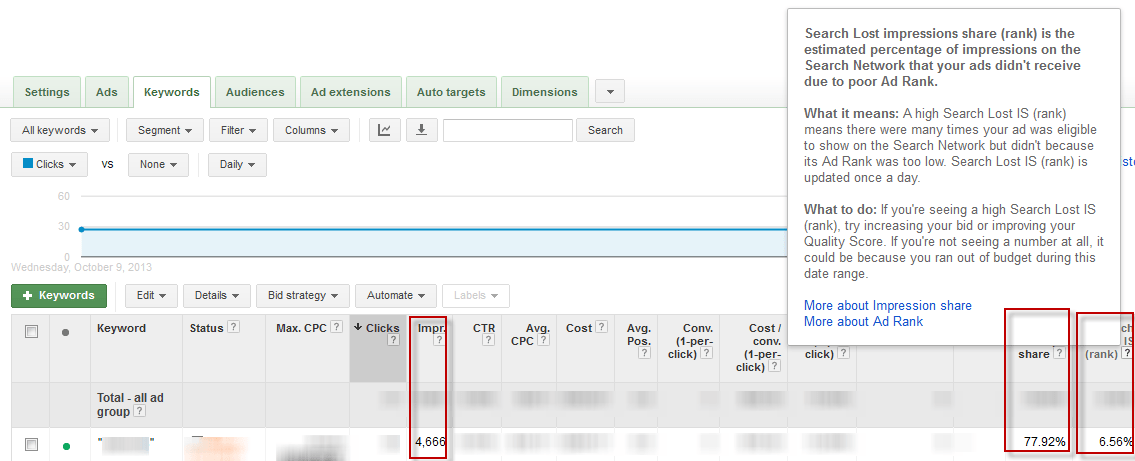
Disclaimer: The image provided is purely illustrative and not from an actual test on the keyword “google keyword planner.” Expect this estimate to exceed the actual keyword search volume.
Method #3: Keyword Scraping
Lastly, you can reconstruct phrase match using numerous exact match queries. A basic keyword tool like ubbersuggest or ScrapeBox can provide ample keyword variations for input into the Keyword Planner or another tool of your choice. Beware of duplicate keywords, as Google will count them twice!
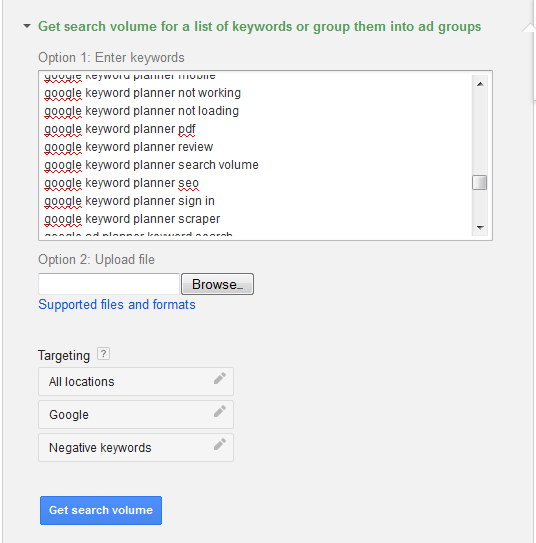
All that remains is obtaining the search volume!
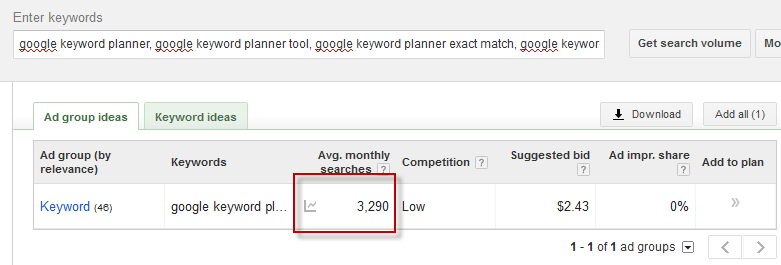
Disclaimer: This method’s margin of error is significantly higher due to Google’s rounding for each input keyword. While it may yield a larger “phrase match” estimate, the Keyword Planner might not fully capture the long tail.
Conclusions
No flawless keyword tool exists, nor a perfect replacement for Google’s phrase and broad match data. For a swift estimate, leveraging AdWords traffic estimates is among the top free methods available. Achieving precise keyword traffic figures requires investment in time and resources within AdWords. A comprehensive assessment of a keyword’s categorical value necessitates the utilization of multiple keyword tools. Experiment and determine which method best suits your needs! Caution: As of 10/16/2013 4:50PM EST, Google updated their search volume estimates for the keyword “google keyword planner” – your results will deviate due to this data refresh! Gratitude to @LauraLeeSEO from WebMD for their input. Victor Pan is nexus-security’s resident search samurai. When he’s not busy gathering and analyzing web data, he’s legitimately practicing the way of the sword, kendo.