Software as a Service (SaaS) companies are always searching for the most effective ways to enhance their customer acquisition through advertising. Numerous guides and case studies promise fast and guaranteed results. However, the reality is that not all advertising strategies will yield positive outcomes for every SaaS company. The SaaS industry requires unique and tailored approaches to advertising techniques that have proven effective.
At Chanty, as a SaaS startup, we explored various user acquisition methods, including SEO, content marketing, guest blogging, and social networking. Eventually, we decided to experiment with Facebook Ads.
Initially, we were uncertain about Facebook’s suitability as an advertising channel for SaaS products. We were unsure about the best methods to market our messenger product. Nevertheless, our marketing team was eager to give it a try.
Many people view Facebook as a platform to connect with friends and family, catch up on news, and enjoy entertaining content. Consequently, there’s a common misconception among SaaS companies that advertising on Facebook is futile. Facebook is often perceived as a valuable tool primarily for B2C businesses, where advertisers can offer discounts, promote sales, and showcase new products. These tactics are generally not relevant for SaaS companies.
However, it’s essential to remember that the decision-makers you want to reach with your SaaS product are also active on Facebook. Facebook Ads, with their powerful targeting options, present an excellent opportunity to connect with them based on their industry and job titles.
In essence, there’s no compelling reason to avoid promoting a SaaS product on Facebook. This article delves into our experience of marketing our SaaS product online using a simple Google Form survey. This straightforward yet highly effective strategy enabled us to identify our potential customers, implement highly targeted Facebook advertising, and triple our click-through rate (CTR) on Facebook.
Initial Challenges and Mistakes in Our SaaS Facebook Ad Campaign
Improving your ad campaign’s performance and reducing costs require in-depth audience research. Investing in poorly targeted ads leads to wasted resources and time. Begin by ensuring that your ads are reaching your ideal customers.
You are likely familiar with the fundamental demographic factors such as age, gender, and location. Utilizing this data helps filter out individuals who are not your target audience. However, even after this initial filtering, your audience might still be too broad. You might consider adding a few interests, such as brands your prospects follow. However, the targeted audience might remain too extensive. This was our initial approach to advertising on Facebook, and in retrospect, it wasn’t the most effective strategy.
Audience segmentation is crucial for successful Facebook ad campaigns. Poorly targeted promotions are the primary reason for low CTRs in SaaS Facebook campaigns. The true power of Facebook advertising lies in laser-focusing on a very specific audience. This can be achieved by creating detailed buyer personas and tailoring your ad copy to resonate with each persona. However, putting this into practice can be more challenging than it seems.
Eventually, we arrived at a seemingly obvious solution – directly asking our target audience about the value they sought in our app. This approach allowed us to refine our targeting options based on their responses, leading to a threefold increase in our CTR. Our primary tool for achieving this was Google Forms.
Analyzing an Example from Our Initial Facebook Campaign
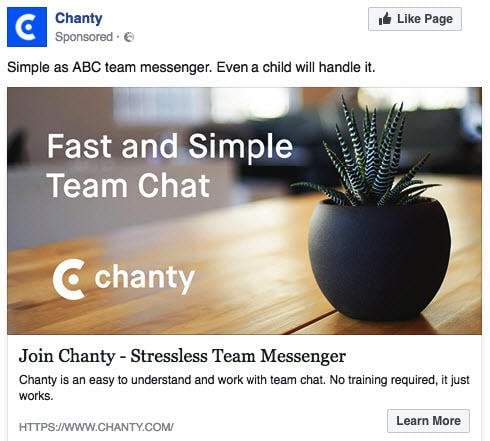
- Cost Per Click (CPC): $2.50
- Click Through Rate (CTR): 0.05%
This example illustrates an ineffective and low-performing Facebook ad from our initial attempts at SaaS advertising on the platform. Here’s a breakdown of common Facebook ad mistakes we made:
- Unclear Value Proposition: The headline lacks impact, and the ad copy is unengaging.
- Generic Stock Image: The image used is forgettable and irrelevant to our product.
- Overly Broad Targeting: As a competitor to Slack, our targeting was limited to “Interests > Additional Interests > Slack (software).”
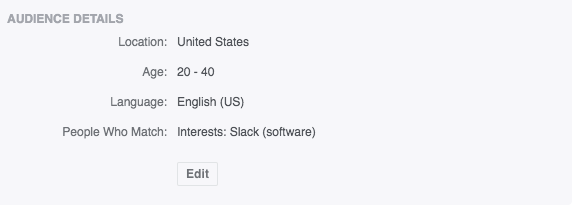
The results were self-evident. Our CPC was over $2.50, and our CTR was significantly below expectations at 0.05%.
Read on to learn how we dramatically improved these results.
Utilizing a Survey for SaaS Marketing Insights
Like many businesses, we had conducted a SWOT competitor analysis. However, this analysis didn’t provide answers to more complex questions, such as:
- Who is most likely to initiate the use of a team messenger within a company?
- What is the typical size of a company that uses a team messenger?
- What team messenger features are most sought after by users?
- In which industry are team messengers most prevalent?
- What types of companies are willing to pay for team messengers?
To address these questions, we created a Google Form survey and chose LinkedIn as our distribution channel. Our process involved the following steps:
- Connecting with LinkedIn members who fit our customer profile.
- Inquiring whether our product interested those who accepted our connection requests.
- Inviting interested individuals to participate in a short survey.
- Sending the survey link with an explanation of its importance.
- Expressing sincere gratitude for their participation and assuring them of data privacy.
We received over 500 completed surveys, providing invaluable insights into our prospects’ pain points and requirements. These findings influenced various aspects of our product development, including pricing, onboarding, and features.

Furthermore, the survey helped us identify the questions our website should answer to improve conversions, leading to adjustments in our content marketing strategy and a 30% increase in on-page conversions. The value derived from a simple Google Form survey was remarkable.
Optimizing Your SaaS Facebook Ad Campaign
Analyzing the survey responses provided a clear understanding of our prospects and their needs, which we could address with our product. We found answers to critical questions such as:
- What are the biggest frustrations for users of competitor X’s team messenger?
- What would motivate users of competitor Y’s team messenger to switch to an alternative with specific features?
- What prevents non-paying users of competitor Z’s messenger from subscribing to a paid plan?
- What are the typical roles of individuals involved in choosing team communication tools?
The survey provided a wealth of information that proved instrumental in crafting a highly effective Facebook campaign. Here are actionable steps to enhance your SaaS Facebook campaign performance:
Refining Your Targeting:
Interests:
The “Interests” targeting option on Facebook is potent. It helps reach users based on pages they’ve liked, content shared, ads clicked, and more.
Target users who have liked Facebook pages of brands relevant to your offerings. For instance, if you target marketers, include brands like Sprout Social and Hootsuite.
Tip: Leverage your competitors’ brand names as interests to target users potentially interested in your offering. To prevent your competitors’ employees from seeing your ads, exclude users associated with them.
Behavior:
Target users exhibiting online behavior indicative of small business owners.
Employer:
Utilize this option to reach employees of specific companies you want to target.
Job Title:
Most people proudly display their job titles, making this an effective targeting method. Craft tailored ads for groups with specific job titles. If CEOs are decision-makers in your industry, target them specifically.
Company Size:
Reach users based on the size of the companies they work for or own.
Optimizing Ad Copy and Creatives:
Start with a captivating headline, as it’s the first element people notice. Next, clearly explain your offer in the text above the image. Provide more detailed information in the description below the headline. Maintain message consistency across all three components.
Highlighting Product Benefits Based on Target Audience Segmentation
When crafting your headline, experiment with highlighting specific product or service benefits that resonate with different buyer personas identified through your survey data.
Additional Optimization Tips:
- Separate Mobile and Desktop Campaigns: Create distinct ad sets for mobile and desktop to track CTR based on the device, as performance may vary.
- Test Bidding Strategies: Explore different bidding methods to identify the one that minimizes CPC while maintaining sufficient reach.
- Experiment with Scheduling: Ad scheduling can impact performance, with significant differences often observed between weekdays and weekends. Additionally, performance may fluctuate throughout the day.
It’s important to note that there’s no one-size-fits-all approach to Facebook ad copy, imagery, targeting, or bidding. The optimal strategy is discovered through A/B testing and continuous refinement.
The most valuable takeaway from our experience is the power of experimentation. Here are the results we achieved after refining our Facebook ads based on insights from our Google Form survey:
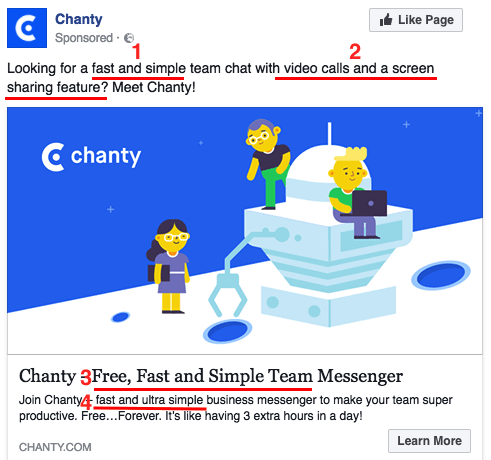
- Cost Per Click: $1.40
- Click Through Rate: 1.5%
Our survey revealed that many Slack users found the platform increasingly complex. We incorporated this feedback into our ad copy, emphasizing Chanty’s simplicity and user-friendliness.
Furthermore, survey participants expressed a need for video calls and screen sharing, features Slack lacked at the time. We prioritized the development of these features and highlighted them in our ad copy.
We implemented more granular targeting based on survey data, including:
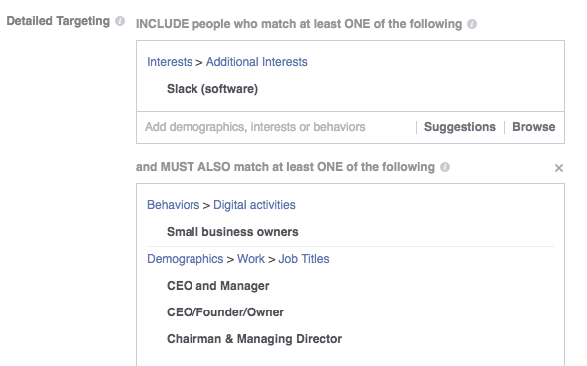
- Behaviors > Digital Activities > Small business owners
- Demographics > Work > Job Titles > CEO, Founder, Owner, Chairman, Director, etc.
As evident from the results, the ad performance was significantly better than our initial attempt. Encouraged by this success, we decided to continue optimizing.
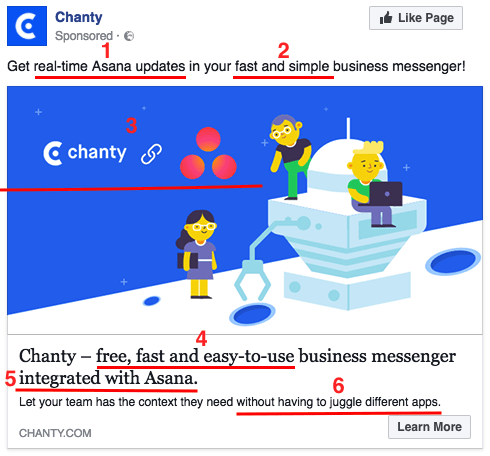
- Cost Per Click: $1.10
- Click Through Rate: 2.2%
In this iteration, we targeted Asana users and tailored the ad copy based on their pain points identified in the survey.
It’s generally accepted that a reasonable Newsfeed CTR ranges from 0.5% to 2%, depending on the industry. For instance, e-commerce enjoys higher CTRs (1.5-2%) compared to games/mobile apps (around 1%).
The average CTR for SaaS ads is around 0.78%, with an average Cost Per Click of $2.52.
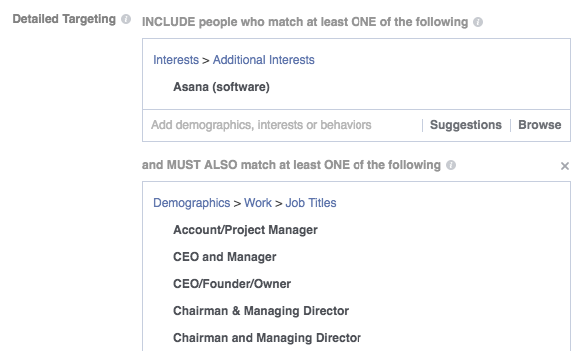
The results clearly demonstrate the effectiveness of our survey-based approach in significantly improving our SaaS ad campaigns, tripling the CTR, and reducing the CPC.
Leveraging Surveys for SaaS Marketing on Facebook
1. Activating New Users
Facebook ads can effectively engage recent free signups to drive growth. Set up a retargeting campaign triggered when someone lands on a thank you page after signing up. This type of campaign should educate new users about your software’s benefits.
2. Promoting Paid Plans and Upgrades
Facebook retargeting is also valuable for converting free trial users to paying customers. Focus on reaching current free users who are actively engaged with your software.
Conclusion
Venturing into paid SaaS advertising opens up a world of opportunities and challenges, requiring specific strategies for success. Outperforming competitors often involves experimenting with innovative and unconventional methods to refine your Facebook ads.
Our Google Form survey proved to be a highly effective method, providing valuable market insights, increasing our CTR, and enabling us to scale our Facebook advertising efforts effectively.
It’s important to remember that CTR is not the sole measure of success for your SaaS business. While it’s a useful metric for comparing ad performance, it doesn’t reflect the return on investment (ROI). ROI is a crucial metric for SaaS marketing, but it often requires time and data to measure accurately. Focus on improving CTR and ad positions initially to gather sufficient data for evaluating campaign ROI effectively.