Have you ever encountered the saying “turnover is vanity, profit is sanity”? This adage holds particularly true for ecommerce advertisers who might be focusing on revenue figures or conversion rates rather than the crucial factor: the actual profitability of their PPC campaigns.

It’s natural to assume that more sales automatically translate to higher revenue. However, this isn’t always the case. In this guide, we’ll explore how to optimize the profitability of your ecommerce business’s PPC campaigns in two ways: the conventional method of adjusting bids and the less conventional approach of strategically reducing sales.
Enhancing PPC Profitability: The Traditional Approach
If your ROI isn’t meeting expectations, the most straightforward method to enhance paid advertising profitability is to be more strategic with your bids and bid adjustments. This approach allows you to amplify the impact of your advertising budget without increasing spending.
Fine-tuning Bids for Profit Maximization
One strategy for maximizing your ad expenditure involves modifying your bids to enhance profits. By deducting all expenses (product cost, administrative cost, staff cost, shipping cost, etc.) from the selling price of a product, you determine the raw profit generated per sale. The majority of our clients allocate 30-50% of this raw profit towards advertising the product. This means the ad cost is deducted from the total raw profit generated from the sale, resulting in the following profitability equation:
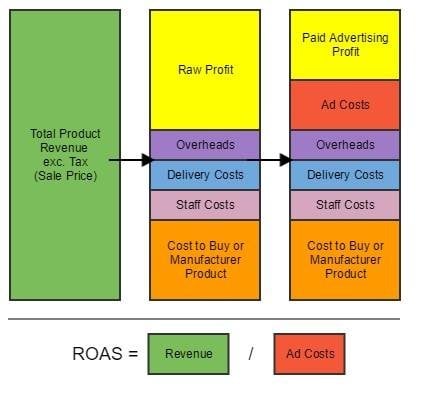
This formula enables advertisers to calculate a target return on ad spend (ROAS) for a product by dividing the revenue generated per sale by the advertising cost. When establishing bids for search or shopping campaigns, advertisers can adjust bids up or down to achieve a target ROAS or even reverse-engineer CPCs to find an ideal Maximum CPC bid.
Modifying Bid Adjustments for Profit Enhancement
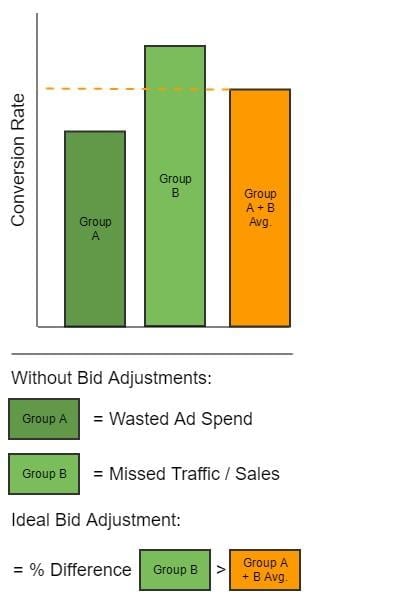
Ecommerce website visitors can be unpredictable in their behavior; some convert better at specific times of day, certain demographics might have higher average conversion rates than others, and user behavior often varies significantly depending on the device they’re using. Without implementing bid adjustments, you’re forced to group high-converting users with low-converting ones, aiming for an average performance level that falls short of optimal. However, by segmenting your audience and utilizing bid adjustments, you can increase bids for high converters (boosting valuable traffic) and decrease bids for low converters (minimizing wasted ad spend). The net result is more conversions while maintaining the same level of profitability per conversion (consistent ROAS):
Boosting PPC Profitability: The “Less is More” Strategy
In certain scenarios, solely adjusting bids might not be sufficient for your business. In such cases, consider the counterintuitive approach of decreasing your sales volume. While this might sound illogical, the idea is to enhance the profitability of each sale significantly, requiring fewer sales to achieve higher overall profits and ROAS. There are two primary methods to strategically reduce sales while simultaneously increasing overall profitability. Remember, turnover is about quantity, but profit is about efficiency!
Elevating Product Prices for Profit Growth
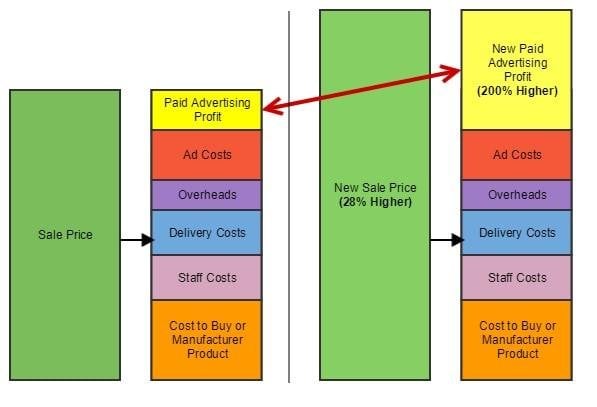
While it might seem evident to some advertisers and alarmingly risky to others, increasing product prices can actually lead to higher profitability when executed strategically. One of our ecommerce clients, facing overwhelming demand for their flagship product (luxury coats), resorted to halting sales of certain colors and sizes due to manufacturing constraints. We advised a 70% price increase, resulting in a sales decline of just under 43% – a substantial improvement to their overall bottom line. Clearly, raising prices generates higher profit per sale, but factoring in other costs, a modest price increase can potentially triple profitability:
Naturally, increasing prices negatively impacts overall sales volume, creating an inverse relationship between profit and price:
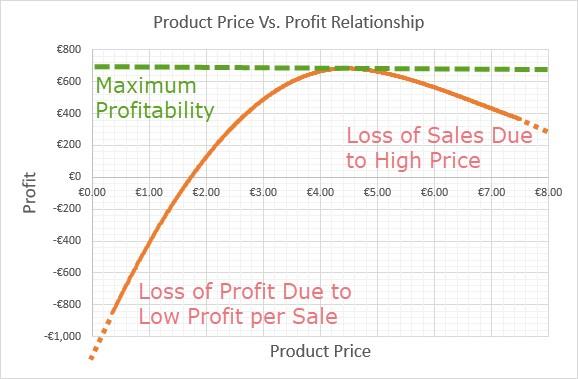
Setting prices too high will eliminate sales altogether, while overly low prices might result in advertising and other expenses exceeding actual revenue. The goal is to find the optimal balance between price profitability and conversion rate, represented by the highest point on the CPC vs. profit curve. Therefore, adjusting prices is a powerful optimization strategy for individual products, as seen in the dynamic pricing models employed by industries like airlines, hotels, and ride-hailing apps.
Increasing Average Order Values for Profit Enhancement
For some large-scale manufacturers, B2B product suppliers, or bulk drop-shippers, Google and Bing Shopping platforms present a dilemma:
- Openly selling products on your website enables shopping campaigns, but requires displaying product prices, potentially attracting smaller orders from the general public.
- Restricting sales to registered or approved users hides prices and allows setting minimum order values, but disqualifies you from running shopping campaigns (which require public pricing). Our client sought the best of both worlds: maximum visibility and traffic from Google and Bing Shopping, while discouraging small, unprofitable orders. In their case, product delivery costs remained relatively consistent regardless of order size, making single-item orders financially unviable. The solution involved increasing the average order value (AOV) by reducing bids on keywords, ad groups, and shopping product groups that fell below a certain threshold:
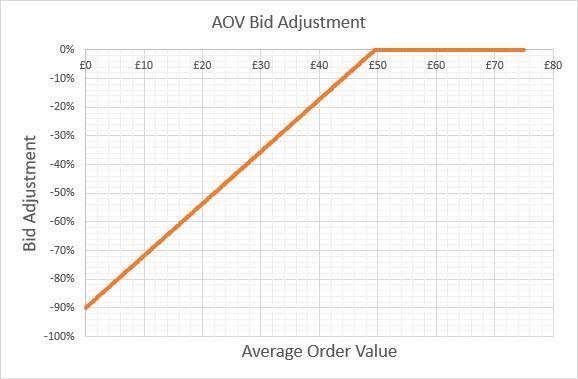
Bid adjustments were not implemented for AOVs exceeding a highly profitable threshold (£50 in this instance), and were applied negatively and linearly for values below the threshold. A minimum bid adjustment of -80% was set to maintain ad visibility within the first page of search results and avoid completely eliminating product bids. This approach yielded impressive results for our client:
- Reduced delivery frequency, lowering internal delivery costs
- Decreased administrative workload, improving efficiency and speed
- Faster delivery times, leading to an increase in positive customer reviews
- Increased average order value, boosting the average return on ad spend
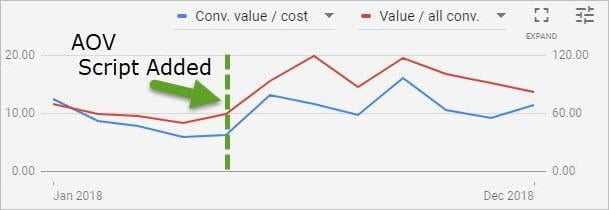
The Power of “Less is More”
When designing and optimizing your PPC campaigns, it’s crucial to define your primary objective. Are you pursuing traffic and sales volume, or are you seeking genuine improvements in business profitability? In most cases, prioritizing profitability yields superior outcomes for your ecommerce business. In addition to best practices like calculating optimal CPCs and implementing bid adjustments, you can surprisingly enhance profitability by simply raising product prices or discouraging small orders to increase the average order value.