
This scroll says 生意興隆/生意兴隆 (sheng yi xing long), which translates to “may the business thrive greatly.”
The celebratory atmosphere in mainland China, Taiwan, Hong Kong, and Singapore is palpable this time of year. Everywhere you look, lucky red and gold decorations are for sale, along with symbols of the upcoming year’s zodiac animal. Chinese New Year falls on February 8th in 2016, and well-wishes in the form of traditional greetings will be exchanged from the very first day.
The most popular greetings you’ll encounter are 新年快乐 (xin nian kuai le), meaning “Happy New Year,” and 恭喜发财 (gong xi fa cai), which translates to “Congratulations on receiving riches and prosperity.”
Prosperity is a central theme in Chinese culture, especially during the New Year period. Greetings focusing on good fortune for businesses include 财源广进 (cai yuan guang jin), signifying “May riches flow in abundantly,” and 生意興隆/生意兴隆 (sheng yi xing long), meaning “May the business flourish.” Phrases like 年年有餘/年年有馀 (nian nian you yu), “May there be surpluses every year,” 大吉大利 (da ji da li), “Much fortune and profit,” and 马到成功 (ma dao cheng gong), “Instant success,” are appropriate for both businesses and individuals.
马到成功 is particularly fitting in the Year of the Horse (most recently, 2014), as the character for horse, 马, begins the phrase. However, it can be used at any time. There are specific Lunar New Year greetings, such as x年大吉 (x nian da ji), meaning “Great fortune in the year of the x,” and x年行大運/x年行大运, “Great luck in the year of the x.” Simply substitute the underlined “x” with the corresponding animal. For example, 2016 is the Year of the Monkey, and 2017 will be the Year of the Rooster.
In addition to these customary greetings, some are more work-related. Phrases like 新年进步 (xin nian jin bu), “Making progress in the new year,” 心想事成 (xin xiang shi cheng), “May your wishes be fulfilled,” and the straightforward 工作顺利 (gong zuo shun li), “May your work go smoothly,” are always well-received. 事业有成 (shi ye you cheng), “Success in your endeavors,” and 平步青云 (ping bu qing yun), “A smooth and rapid rise to success,” are similarly auspicious. Another greeting using the character 步 (step) is 步步高升 (bu bu gao sheng), “Rising higher with each step taken.”
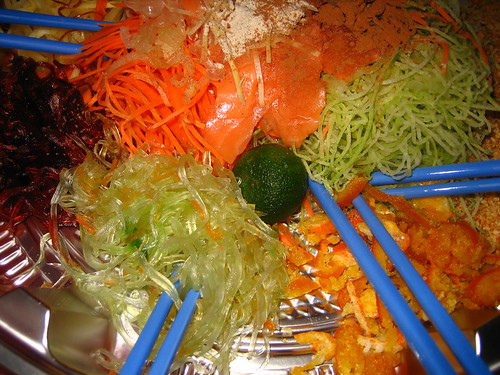
Pictured above: Preparations for Lohei.
These greetings are also shared during traditional Chinese New Year banquets in Malaysia and Singapore, specifically during the lohei (撈起) portion that precedes the main meal. Lohei involves the preparation of yusheng (鱼生), a raw fish* salad. Traditionally, each ingredient is added individually, accompanied by an auspicious saying. Afterward, diners toss (lo) the salad together with chopsticks while expressing the same greetings as hopes for the year ahead. The higher the salad is tossed (hei), the greater the luck in the coming year.
If you’re worried about remembering all the greetings, don’t fret—a simple “xin nian kuai le” or “Happy New Year in the year of the [animal]” is perfectly acceptable. The main idea is to begin the year on a positive note, with traditional hopes for fortune, prosperity, and success. 万事如意 (wan shi ru yi) – “May everything go your way”!
This article is an updated version of a post that originally appeared on WorkSmartSG, a blog that is no longer active.
As of 2016, raw freshwater fish is no longer used in Singaporean yusheng due to the risk of group B streptococcus infection. It is typically replaced with raw salmon, abalone, or top shell.