Worried about upcoming changes to Google search pages? It’s understandable, especially with Google’s announcement that recently announced their AI-powered Search Generative Experience (SGE), now known as AI Overviews, is set to revolutionize SERPs.
Many questions arise: Will AI-generated responses decrease website visits? How will search ads be affected on SGE pages? While definitive answers are still developing as SGE is an opt-in experiment , Google assures its focus remains on directing traffic to websites and integrating search ads seamlessly within SGE.
Let’s explore how Google plans to fulfill these promises and the implications of SGE for marketers and advertisers of all sizes.
Understanding Google’s Search Generative Experience
AI Overviews, formerly SGE, is an experimental version of Google’s search engine leveraging artificial intelligence to provide comprehensive answers to complex questions.
SGE enhances the search experience using AI in three key ways:
- AI snapshot: Provides a concise summary for certain longer search queries.
- Conversational mode: Allows follow-up questions while retaining the context of the initial search.
- Vertical experiences: Offers a curated list of features and detailed product information in commercial searches.
We’ll delve into each of these aspects in more detail below.
Deconstructing Google’s Search Generative Experience
These features aim to streamline the process of finding relevant answers while encouraging the exploration of online content.
AI snapshot
Imagine asking Google about the annual visitor count at Bryce Canyon National Park, and it instantly displays a reliable source stating 1.5 million. Follow up by asking which park, Bryce Canyon or Arches, is better suited for families with young children and a dog, and you’ll receive links addressing different aspects of your question.
SGE uses AI to generate a unique response, called a snapshot, by combining information from multiple sources to address multifaceted queries.
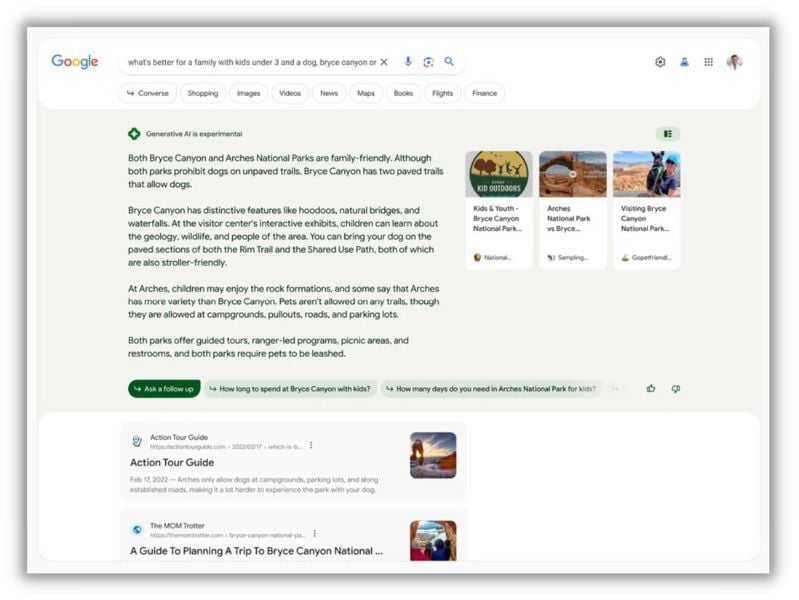
The snapshot aims to provide concise answers to highly specific questions like “best restaurant for a family with peanut allergies near the Empire State Building with minimal wait time.”
However, SGE’s purpose extends beyond merely answering questions; Google says it prioritizes directing users to relevant web content. Google emphasizes its commitment to sending valuable traffic to websites as AI is integrated into search. This is a positive sign for businesses reliant on paid or organic search traffic.
To maintain this flow, Google prominently displays three links with thumbnails alongside each snapshot.
Additionally, there’s the “bear claw” icon above these links. Clicking on it expands the snapshot, revealing the sources supporting each statement.
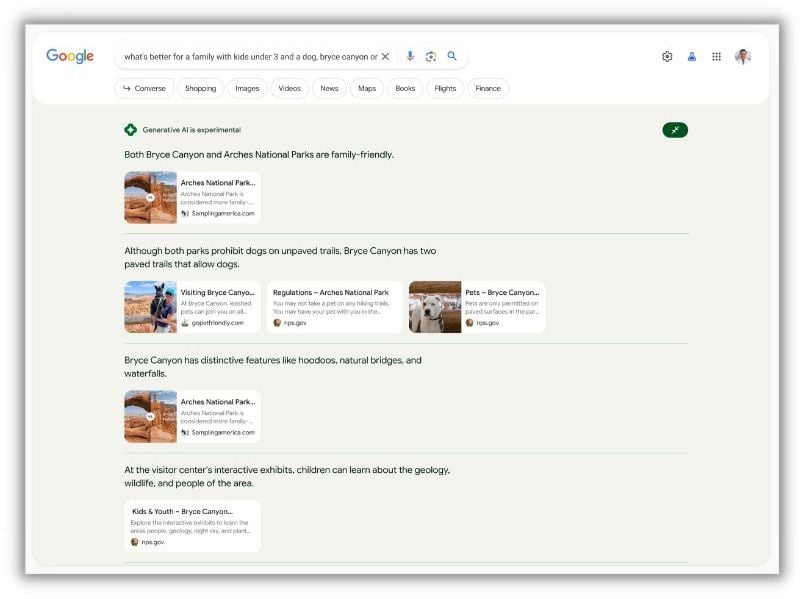
This transparency fosters trust by verifying each sentence with external sources. This is crucial given the concerns about the accuracy of other AI tools like Bard don’t have the best reputation.
It’s worth noting that SGE may not always offer a snapshot. For instance, if there’s insufficient information or for sensitive queries related to finance or healthcare (categorized as YMYL topics), AI-generated answers won’t be displayed.
In essence: SGE introduces a novel search experience. This evolving SERP can lead to fluctuations in paid and organic search results, impacting rankings, traffic, and advertising costs.
 What do Google Ads costs look like for businesses like yours? Download our latest report:
Search Advertising Benchmarks for 20+ Industries
What do Google Ads costs look like for businesses like yours? Download our latest report:
Search Advertising Benchmarks for 20+ IndustriesConversational mode
Google searches often involve multiple queries. SGE’s conversational mode addresses this by answering follow-up questions while retaining the context of the original search.
Conversational mode is activated by clicking “ask a follow-up” or one of the suggested steps below the snapshot.
Kathy Edwards from Google recently demonstrated this feature during Google I/O. After searching “why do whales like to sing,” Edwards typed “plush ones for kids under $40.”

A standard search wouldn’t link this query to whale stuffed animals. However, SGE’s AI, understanding the context, presented links to stores selling various plush whale toys.
The takeaway: The appearance of product links within this conversational search hints at significant opportunities for businesses. Optimizing content for such searches could attract more qualified traffic. So how can this be achieved? Currently, Google prioritizes “high-quality online sources,” according to Barry Schwartz on Search Engine Land. He highlights Google’s reliance on established signals used for decades to assess information quality, underscoring the importance of content aligned with E-EAT principles to build site credibility.
From a paid advertising perspective, adjustments are needed for these conversational searches. Mark Irvine, Director of Paid Media at SearchLab, emphasizes the need to actively utilize phrase and broad match keywords to capture these new searches. He further stresses the importance of monitoring search terms and incorporating negative keywords as these long-tail searches become more prevalent.
 Are you taking advantage of all that Google Ads has to offer?
Find opportunities to optimize your account with the Free Google Ads Performance Grader.
Are you taking advantage of all that Google Ads has to offer?
Find opportunities to optimize your account with the Free Google Ads Performance Grader.Vertical experiences
SGE is also transforming vertical searches, such as shopping and local business searches, particularly those involving multiple criteria. This is where things become particularly intriguing for businesses engaged in online advertising and sales.
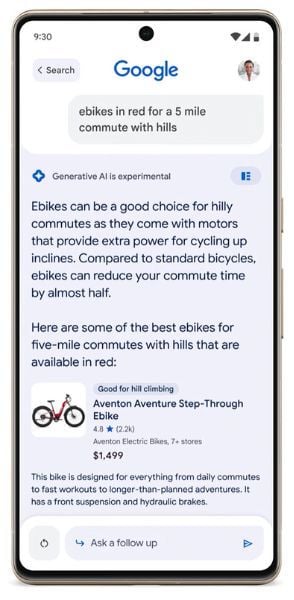
Let’s consider an example. You decide to switch to cycling to work. However, you require a bike suitable for a five-mile hilly commute. SGE, understanding these parameters, analyzes the 38 million products within Google’s Shopping Graph and provides the following results.
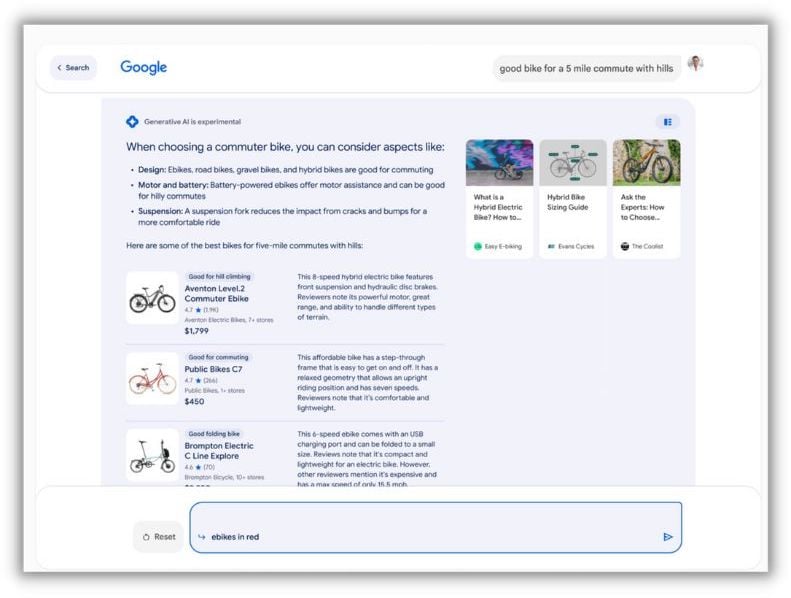
Similar to the vacation search, SGE generates an informative summary. In this instance, it outlines aspects to consider for your new bike. Refining the search for red bikes that meet your needs can be achieved through a follow-up question.
Given the commercial nature of the search, SGE presents a list of relevant products. Each option includes an AI-generated description, reviews, prices, and a thumbnail. Selecting an option displays a larger image, stores selling that bike with their respective prices, and additional details like stock availability.
The takeaway: While shopping suggestions aren’t new to Google, their integration with the AI snapshot is noteworthy.
Mark points out Google’s emphasis on the role of Performance Max and shopping feeds in this evolving search landscape. He advises other advertisers to adapt to more visual searches by incorporating image extensions into their ads.
Implications of Google’s Search Generative Experience for Businesses
Google acknowledges ongoing testing and evolution of the ad experience as they gather more insights regarding SGE.
For now, let’s explore some implications of SGE for businesses.
A new platform for displaying ads…
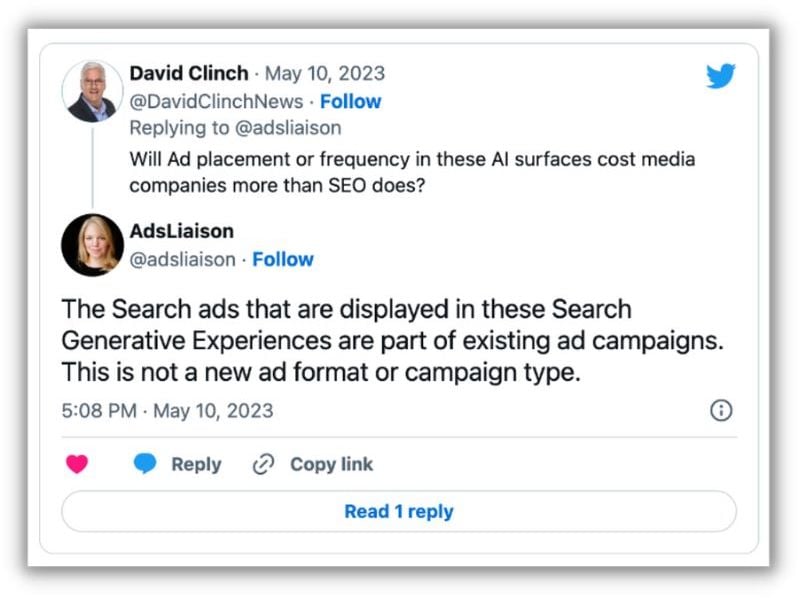
While Google only states that “ads will continue to appear in dedicated ad slots throughout the page,” a commercial query result provides a glimpse into ad placement. In this instance, ads are positioned at the top, preceding the generative AI snapshot.
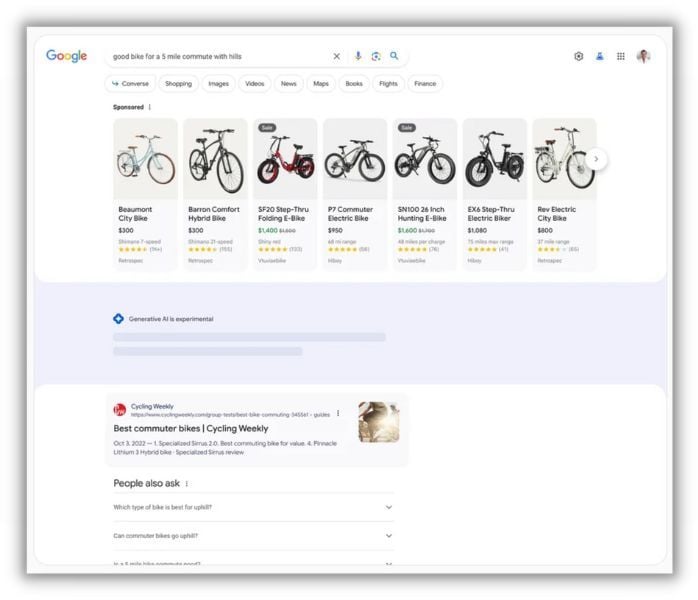
These links are transparently labeled as “Sponsored.”
It’s important to note that these are not new ad placements but rather existing campaigns, and advertisers currently lack the option to opt-out.
…But without a way to measure their performance
Tracking ad performance remains a challenge. As mentioned earlier, opting out of SGE results isn’t possible, and there’s no separate reporting for SGE SERPs. All data is aggregated.
Potential decrease in organic traffic
There’s a possibility of reduced organic traffic as the new interface might prioritize AI-generated answers. The AI snapshot occupies a significant portion of mobile screens, requiring users to scroll down to access the traditional ten blue links.
While source links might drive some drive some traffic, their effectiveness is uncertain. Furthermore, details regarding ranking in these new features are still unknown.
Additionally, as Google aims to make SGE handle the “heavy lifting” for users, there’s a concern that users might rely on consolidated results from multiple sources presented by Google rather than visiting source websites.
Alex Kantrowitz, writing for CMSWire, suggests that by taking on this responsibility, Google could marginalize primary sources.
AI-qualified traffic
On a positive note, SGE has the potential to improve conversion rates for both SEO and paid traffic. If shoppers can refine their search and gather information before clicking, they are more likely to be higher-intent buyers when they reach your website. In this sense, SGE acts as a pre-qualifier, similar to a sales assistant in a physical store.
Google assures continuous monitoring of SGE’s impact on ad traffic and adjustments as needed. Given that search ads account for 80% of Alphabet’s revenue, it’s reasonable to assume their commitment to ensuring advertiser success.
Related: How to Harness the Power of Generative AI in Digital Marketing Responsibly & Effectively
Preparing for SGE: Actionable Steps
Currently, the most effective approach is to sign up for Search Labs and join the SGE waitlist. This allows you to identify if significant fluctuations in campaign performance are related to keywords receiving the SGE treatment. Stay informed through resources like the nexus-security blog and newsletter for updates on SGE’s evolution.
Learn more about the potential impact of AI on PPC here.