On September 1st, Google revealed that its Google Ads search terms report would undergo a significant change. Going forward, the report will only display search terms that meet a certain volume threshold. This shift, which took effect in September 2020, has sparked considerable anxiety among advertisers and agencies who depend on the report’s data to fine-tune their Google Ads campaigns and maximize performance.
Many questions surround this change: What does it truly mean? Why is Google implementing it? How can advertisers maintain their PPC returns in light of this reduced visibility? This article aims to address these questions, drawing upon insights from PPC industry experts. Here’s what we’ll cover:
- A quick overview of the search terms report in Google Ads
- Details of the changes made to the search terms report and their implications
- Reactions from PPC experts
- PLUS practical suggestions for adapting to this change
Understanding the Search Terms Report
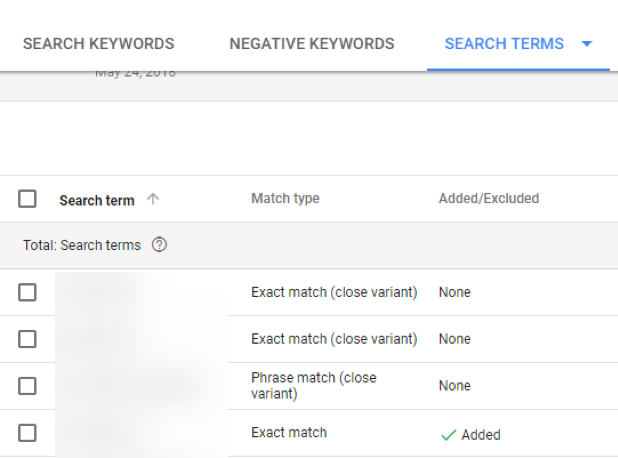
The search terms report, found within your Google Ads account, provides a detailed view of the search terms that triggered your ads. It shows you the exact terms users entered, even if they differ from your targeted keywords, and illustrates how closely these terms align with your ad’s keywords.
For instance, if your ad targets the keyword “farmhouse furniture” and a user searches for “farmhouse dining table,” the latter phrase will appear in your search terms report. The example below illustrates this:
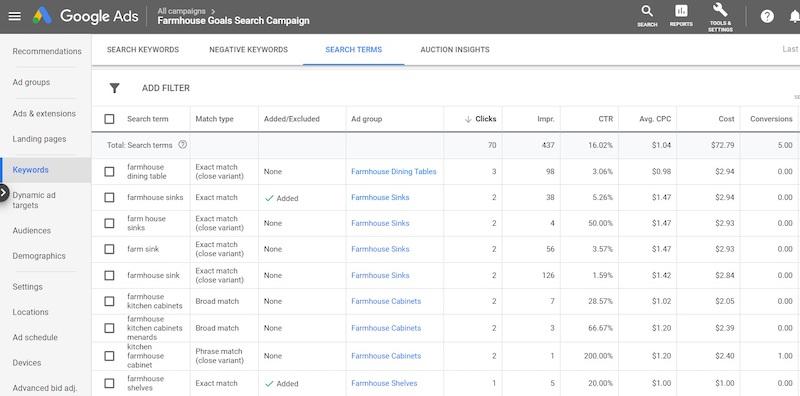
Source: Surfside PPC Advertisers and agencies rely heavily on this report for optimizing their Google Ads campaigns. Here’s how they utilize the data:
- Discovering new, relevant search terms to expand their keyword lists.
- Creating comprehensive negative keyword lists to prevent irrelevant ad displays.
- Determining the most effective match type for specific keywords.
These actions help ensure efficient budget allocation and prevent wasted ad spend on uninterested audiences and low-performing keywords.
Decoding the Search Terms Report Changes
On September 1, 2020, Google announced that the search terms report would only include search terms that a “significant number of users” had used. This change was implemented in September 2020, and the official announcement states:
“Starting September 2020, the search terms report only includes terms that a significant number of users searched for, even if a term received a click. You may now see fewer terms in your report.”
This means advertisers no longer have a complete view of all the search terms that trigger their ads. The report now hides low-volume search terms. The Google Ads support page with the announcement can be found here:
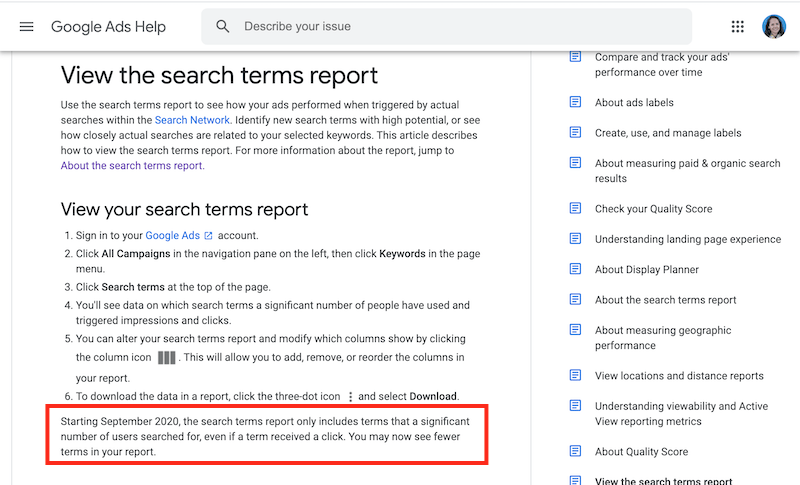
Source: Google
The Implications of the Search Terms Report (STR) Change
While it might seem that low-volume, irrelevant keywords are inconsequential, each irrelevant click represents wasted ad spend, and these small amounts can quickly accumulate.
The decreased visibility into search queries has understandably caused concern among advertisers, as this report played a vital role in Google Ads optimization. Here’s why:
- It limits the ability to make small, proactive adjustments that could prevent substantial budget leaks from irrelevant clicks.
- It complicates keyword research and renders broad match ineffective.
- It can lead to lower bids and, consequently, reduced conversion rates.
- It hinders the creation of highly focused single-keyword ad groups.
PPC Expert Opinions on the Change
The limitations imposed by the change have been met with disappointment from PPC professionals. A look at the Twitter #PPCchat hashtag reveals widespread frustration and even anger within the community.
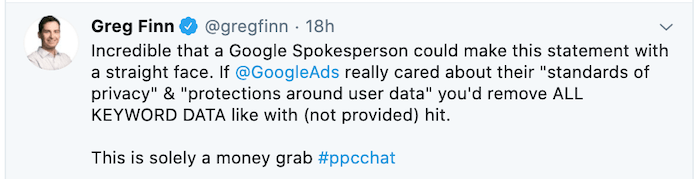
Source: @GregFinn on Twitter
Here’s a summary of the prevailing sentiments:
- Many advertisers believe that Google’s claim of this change being motivated by privacy concerns is a smokescreen for a move that ultimately benefits Google itself.
- This change is viewed as part of a series of actions by Google to reduce transparency and control for advertisers.
- The resulting push towards automated bidding, automated ads, and keyword-less bidding suggests an attempt by Google to give advertisers less control over their campaigns. Brett McHale, a paid media marketing specialist and the founder of Empiric Marketing, echoes this sentiment: “Google is continuing its pattern of reducing transparency for its own financial gain. Not only have they broadened match types across the board, but now they’re limiting our ability to see how our money is being spent. Advertisers will need to rely more on exact match variations to ensure their ads appear for the most relevant queries—unless they’re comfortable with significant spending just to get a grasp on optimization opportunities from broad and phrase match. This all appears to be a tactic for Google to increase its revenue while simultaneously limiting advertisers’ control and aggressively promoting automated bidding.”
Adapting to the Search Terms Report Changes: Expert Advice and Recommendations
While we can’t prevent Google from implementing these changes, we also can’t simply abandon PPC advertising. So how can we maintain strong PPC results for our businesses and clients? We sought insights from Mark Irvine, a leading PPC expert and the Director of Paid Media at SearchLab, who shared his perspective and offered guidance on navigating this shift.
Acknowledging the Loss for Advertisers
“Every day, out of the more than 3.5 billion searches conducted on Google, 15% of them are entirely new. That translates to 1 billion unique searches occurring on Google daily. This is not a trivial number. If Google limits reporting to search terms with a ‘significant’ volume, we risk losing access to a massive amount of data. Losing potentially over 15% of the information we depend on for campaign optimization is substantial, regardless of how it’s framed.”
The Importance of Continued Optimization
Irvine emphasizes that this data loss should not discourage advertisers from optimizing their campaigns: “Even with the absence of many unique search terms, the data Google continues to provide is still invaluable for making meaningful campaign improvements. Identifying one new negative keyword that eliminates 100 irrelevant clicks holds the same value as finding 100 keywords that would waste one click each—with significantly less effort. Surprisingly, many advertisers aren’t consistently implementing these optimizations. Don’t allow the loss of some data to prevent you from maximizing what you still have access to, especially since it’s likely the most valuable data.”
Don’t let the loss of some data prevent you from still working with what you still have, particularly if what you have is the most valuable data.
Leveraging Bing’s Search Query Report
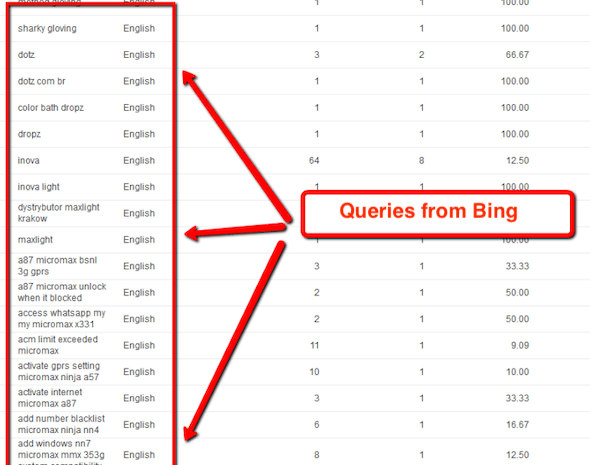
Irvine offers recommendations for established accounts and experienced PPC managers who will feel the impact of this change most acutely. His first suggestion is to utilize Microsoft Advertising tools: “Google and Bing often reflect similar search trends, and your campaigns will uncover new search terms in Bing as well. By regularly reviewing your search queries in Microsoft Advertising, you can not only optimize your Bing campaigns but also unearth new traffic sources that Google’s search query report no longer reveals. Bing’s search query report can become a valuable resource for uncovering new keywords and negative keywords for your Google campaigns.”
Utilizing Dynamic Search Ads for Keyword Discovery
Irvine’s next recommendation focuses on leveraging Dynamic Search Ads: “Dynamic search ads excel at aligning your ads with the content of your landing pages. This can help you reach audiences searching for terms not explicitly covered by your existing keywords. By implementing DSAs, you not only ensure broader coverage but can also gain insights from their search query reports, identifying potential gaps in your traditional search campaigns’ keyword strategy.”
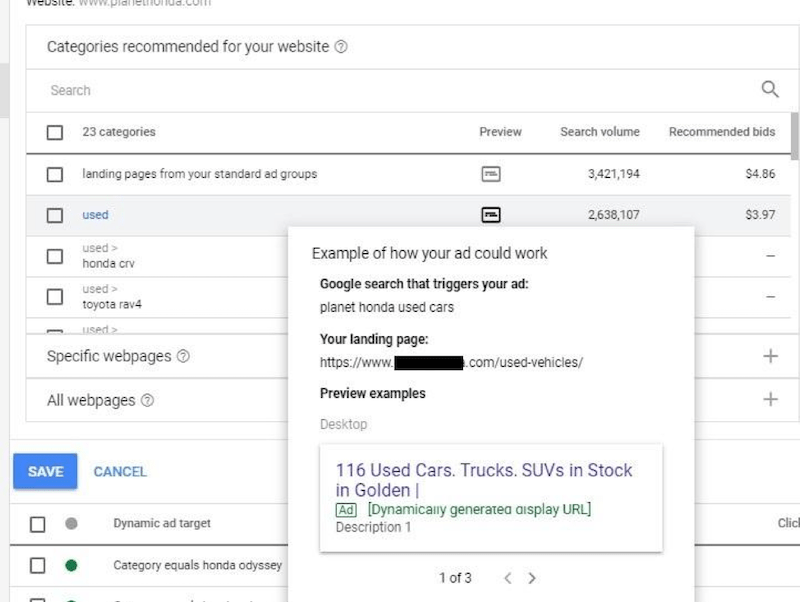
Dynamic Search Ads can help you identify keywords you may have missed.
Optimizing for “Hidden” Search Terms with Smart Bidding
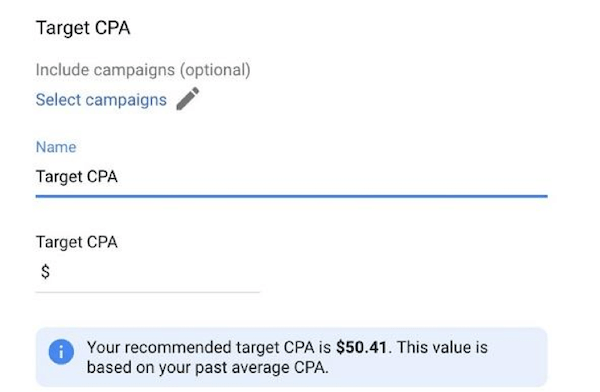
While we may not see the hidden data, Google still uses it to power its automated bidding features. Irvine notes: “Just like numerous other signals Google withholds from advertisers (browser, iOS, search history, search partner data, etc.), if we want to leverage this hidden information, we need to allow Google to optimize for it through smart bidding strategies like enhanced CPC or target CPA.”
Expanding Your Skillset
As a final point, Irvine suggests that if your focus has been primarily on search engine advertising, this might be a good time to explore other digital marketing skills for business growth. This includes areas like social media advertising, data analytics, SEO, email marketing, website conversion rate optimization (CRO), and more. There are numerous free online courses available to help you acquire these skills.
Exploring Microsoft Advertising Intelligence
This tool is a valuable asset and is featured on our list of eight innovative PPC strategies for navigating today’s challenging landscape. You might be amazed by the number of new keywords you can discover. To learn more about keyword research using Microsoft Advertising Intelligence, click here.
Navigating the Google Ads Search Terms Report Change: Actionable Steps
The changes to the Google Ads search terms report leave us with several unanswered questions. What constitutes a “significant” volume? How will this impact paid search trends in the long term? Are further changes on the horizon? We’ll continue to monitor developments and provide updates to help you adapt effectively.
In the meantime, we encourage you to implement the recommendations outlined in this article:
- Persist with campaign optimization, making the most of the data still available.
- Leverage Bing’s search query report as a supplementary source of keyword data.
- Explore Dynamic Search Ads to expand your reach and uncover new keywords.
- Consider using Smart Bidding strategies to allow Google to optimize for hidden search term data.
- Broaden your digital marketing skillset to stay ahead of industry changes.
Onwards and upwards with PPC! Our sincere thanks to Mark Irvine and Brett McHale for their valuable insights and perspectives.