Although many businesses only require domestic WAN connections, a growing number are seeking global connectivity, particularly with European markets for financial trading, sales, and support. This raises the question of how US-based companies can establish cost-effective connections with Europe.
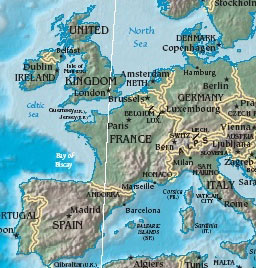
Fortunately, several carriers offer transatlantic connectivity to major European cities. Some US carriers have partnerships for traffic handover to European data centers, as illustrated by AboveNet’s recent agreement with ancotel GmbH in Frankfurt, Germany.
This collaboration provides AboveNet access to Kleyer 90, a data center connected to over 430 service providers across 63 countries. These providers offer a range of services, including bandwidth, VoIP, hosting, content delivery, and cloud networking. Notably, approximately 75% of the Frankfurt data center’s traffic originates from or is destined for locations outside of Germany.
Frankfurt is a significant European financial center, and AboveNet specializes in low-latency connections for high-speed trading. Their Gigabit Ethernet service between New York and London offers the minimal latency required for algorithmic trading and secure financial transactions. This service extends to key financial districts in London (Slough, The City, Docklands) and the New York metro area (Manhattan, Newark, Weehawken, Secaucus, Carteret, Clifton) with sub-millisecond latency.
Level 3 Communications is another carrier with a global presence, boasting multiple fiber optic connections from the New York metro area to England, France, Ireland, Denmark, and the Netherlands. Their network further extends to Germany, Spain, Italy, Norway, Sweden, Finland, and other European locations. Their extensive North American network ensures on-net traffic even for businesses outside the East Coast.
Global Telecom and Technology (GTT) also maintains a wide network across the United States and Europe, with access to over 100,000 points of presence (POPs) globally and experience in over 80 countries. GTT offers both international WAN connectivity and International Dedicated Internet Access (DIA).
International connectivity options typically include point-to-point telecom connections via fiber optic undersea cables. Lower-bandwidth options include T1 lines (1.5 Mbps) in the US and E1 lines (2 Mbps) in Europe. Higher-speed services utilize SONET/SDH fiber optic connections, ranging from OC-3 (155 Mbps) to OC-192 (10 Gbps), with potential for OC-768 (40 Gbps). Network cores are being upgraded to support 100 Gbps. Carrier Ethernet offers an alternative with speeds from 10 Mbps to 10 Gbps, configurable as point-to-point or point-to-multipoint connections.
MPLS networks are gaining popularity for international connections, enabling the interconnection of domestic business locations with a mesh network that can be extended to include European or global sites. MPLS offers high performance, security, and cost savings compared to multiple point-to-point connections.
Businesses with European sales, distribution, manufacturing, or specialized requirements like high bandwidth or ultra-low latency for financial services can find telecom services to meet their needs. In many cases, multiple competitive bids for international network connections are available, allowing businesses to select their preferred carrier.

