Google has just dropped big news: a new Google Ads Upgraded URLs format designed to boost efficiency and expand advertisers’ capabilities. With this change, advertisers will no longer be bogged down by cumbersome URL tracking updates, experience speedier crawl and load times, enjoy new tracking parameters, and finally (in most cases), say goodbye to ad disapprovals for editorial review when tweaking tracking criteria.
It’s a mandatory shift, but one that’s been a long time coming. The previous system was far from ideal, causing advertisers to lose valuable tracking history and Quality Scores whenever tracking parameters were adjusted. Many, including our own clients, were paralyzed by the fear of jeopardizing high-performing ads and avoided making changes altogether.
This upgrade is a welcome breath of fresh air. So, let’s dive in and explore the ins and outs of Upgraded URLs.
Decoding Destination URLs
In simple terms, a Destination URL is the web address users land on after clicking your ad. Previously, both your Google ad and keyword tracking were tied to this Destination URL, which was a combination of the landing page URL and tracking parameters.
Any adjustment to your tracking meant altering the Destination URL, triggering an editorial review that paused your ads and wiped out any data associated with the old URL.
A New Era for URLs
This update streamlines the process by decoupling the Destination URL. Now, you can input your landing page URL and tracking information separately, simplifying management significantly.
Modifying tracking parameters at any level, except the ad level itself, no longer triggers a review, meaning uninterrupted ad display and continuous data collection, even when updating tracking at the account, campaign, or ad group level.
A Final Farewell to the Destination Option
Remember this?
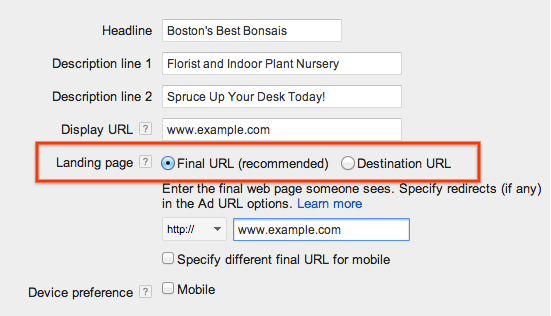
Previously, the landing page field allowed you to set a Destination URL. This option is being phased out, leaving Final URL as the sole landing page choice.
Keep in mind that your Final URL must share the same domain as your display URL to avoid ad disapproval. Google clarifies that redirects within the same domain are still permissible within your final URL.
Managing your tracking and redirect information is now handled through URL options.
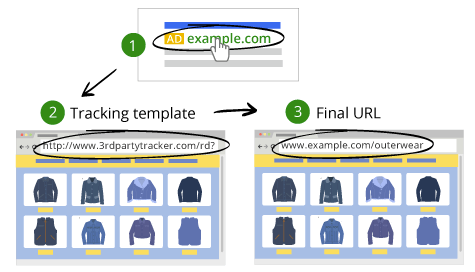
This update empowers you to define URL options across various levels: account, campaign, ad group, ad, keyword, auto target, and sitelink.
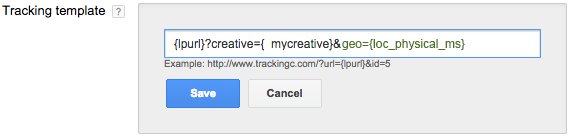
tracking template can be used (optional) to consolidate your tracking and landing page information, particularly when dealing with additional tracking parameters or redirects.
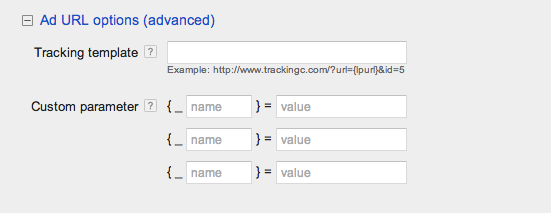
This tracking template generates a new address that users click through, ultimately directing them to your website.
Location Tracking Joins the ValueTrack Parameter Family
ValueTrack is a system that appends tracking values to your landing page URLs, recording details about your ad for analysis in Google Analytics or other analytics platforms. This allows advertisers to pinpoint traffic sources and identify high-performing ads or keywords.
While ValueTrack itself isn’t new, this URL upgrade brings valuable additions, including a location-tracking parameter:
For a complete list of ValueTrack parameters, refer to Google.
Bidding Adieu to the {copy} ValueTrack Parameter
The {copy} ValueTrack parameter is being phased out and won’t be compatible with Upgraded URLs.
If you’ve been using it, consider creating a new tracking template and custom parameter, or simply a custom parameter. Learn more about these options here.
Why the Change?
The previous system was cumbersome and inconvenient for advertisers. While Google’s official statement was more diplomatic, the upgrade aims to provide “an easier and faster way to manage and track important information about each click on your Google ads*.” (*Note: This refers to other targeting options available for Search Network, Display Network, and Shopping.)
The Timeline
Google is currently rolling out the upgrade, giving advertisers a chance to explore the new system.
The mandatory migration kicks off in July 2015. Around this time, your Destination URLs will automatically transition into Final URLs.
Navigating the Transition
Manual migration of your Destination URLs is possible now. However, be aware that upgrading at the ad level today will reset your performance stats and trigger an editorial review, similar to creating new ads.
To facilitate a smooth transition, Google has introduced a URL upgrade guide to help you determine your advertiser type (categorized by activities and tracking methods) and guide you to the appropriate upgrade path.
Embracing the Future of URLs
Change within Google Ads can be unsettling, especially when things are running smoothly. However, this upgrade directly addresses a significant pain point in the previous system, making it a change worth embracing.
By removing barriers to ROI tracking, Google empowers advertisers to optimize their campaigns effectively. Take the time to familiarize yourself with Upgraded URLs and prepare for the transition – your future campaigns will thank you.