Would a rose by any other name still smell as sweet if said rose was synonymous with an entire industry and accounted for the bulk of the revenue generated by the world’s most popular search engine? We’re about to find out. Google has decided to simplify its vast array of ad products by consolidating them into three new brands: Google Ads, Google Marketing Platform, and Google Ads Manager. New logos are here!
But change inevitably brings casualties. In this case, we’re bidding farewell to the digital marketing world’s favorite mouthful: AdWords. You read that right. Google is indeed retiring the AdWords brand, though its functionality remains. This major announcement was likely driven by the rise of mobile and the shift towards audience-focused marketing. Centralizing all solutions simplifies the process of reaching more people across various channels. These changes, along with others like further consolidation and Smart Campaigns, were announced by Google’s Senior VP of Ads and Commerce, Sridhar Ramaswamy, just before Google Marketing Next, where more details will be revealed. This article will clarify the announcement and explain:
- The timing of the rebrand
- The future of keywords with Google Ads
- Whether Smart Campaigns are right for you Before examining the impact of Google’s brand revamp on advertisers and agencies, let’s delve into the specifics of the changes.
Introducing Google Ads…
The most significant aspect of this announcement is the replacement of the AdWords brand with Google Ads.
According to Google, Google Ads “encompasses the complete range of advertising capabilities [they] offer today… enabling marketers to connect with billions of people searching on Search, watching videos on YouTube, discovering places on Google Maps, finding apps on Google Play, browsing websites, and more.” For a while now, AdWords has housed various channels, formats, and placements, including the Google Display Network (GDN), YouTube, and Shopping (many acquired rather than built in-house). However, AdWords is closely associated with search, causing confusion for years as other channels were integrated. Many clients are unaware that their video, banner, and search ads are managed on the same platform. Google hopes this simpler name will improve understanding and facilitate the addition of new advertising options without creating confusion.
… and Google Marketing Platform
Small businesses can likely skip this section… Say goodbye to DoubleClick and Analytics 360!
The second new brand, Google Marketing Platform, is built upon the existing integration between previously separate platforms. It allows enterprise marketers and their agencies to manage ad creative and analytics in one place, simplifying the process of “planning, buying, measuring, and optimizing digital media and customer experiences.” Google Marketing Platform also includes a new feature called Display & Video 360, which enables “creative, agency, and media teams to collaborate and execute ad campaigns from start to finish within a single platform.” This collaborative space resembles Facebook’s Creative Hub and appears incredibly useful. In essence, it’s a great tool if you need it (but unless you’re Adidas, La Croix, or a luxury SUV brand, it’s likely irrelevant).
… and Google Ad Manager
Finally, we have Ad Manager, Google’s new programmatic platform.
A fusion of DoubleClick for Publishers and DoubleClick Ad Exchange (complete with a trendy new logo!), Google Ad Manager is touted as “a complete and unified programmatic platform,” designed to “help [Google’s] partners earn more revenue, more efficiently, regardless of where users are watching videos, playing games, consuming content, or how advertisers want to connect with them.”
Simplifying Brand Architecture for Clarity
These rebranding efforts address the increasing need for simplicity in online advertising. Consider this… AdWords was designed for a desktop-first world, where people browsed the web from home after work. Younger readers may not even remember those times. Today, we live in a mobile-first world, where initial searches happen on phones, research continues on multiple screens at work, product videos are watched on YouTube, and purchases are made through voice-activated AI. Google can help advertisers reach potential customers at every stage, but the name “AdWords” doesn’t reflect that. Google Ads, on the other hand…

Google Ads (and all three new names) is both concise enough to communicate the platform’s value proposition and broad enough to accommodate future acquisitions without causing confusion. A win-win situation. This focus on simplicity extends beyond names. A prime example is the new Smart Campaigns feature.
Are “Smart Campaigns” Really Smart?
Building upon the technology of AdWords Express, Smart Campaigns are ideal for busy small business owners with limited paid search knowledge and time. This feature enables them to “create ads quickly and achieve tangible results—like generating calls, driving website leads, or attracting in-store customers.” It sounds promising, but will it deliver? While fast, AdWords Express wasn’t always effective for many businesses because it prioritized machine learning over advertiser control. Smart Campaigns operate on the assumption that most small businesses primarily want calls, visits, and conversions and lack the time or expertise to master AdWords (now Google Ads). Therefore, why not entrust your budget to Google’s machine learning? It’s undoubtedly fast, but it doesn’t guarantee an understanding of your specific business needs, which is a concern.
However… Ultimately, the question is whether the time saved and results from this simplified product benefit your business. If you have a limited ad budget, Smart Campaigns might be suitable. But for larger budgets, it’s a different story.
Prioritizing Audiences over Keywords
The complexity of Google’s advertising platforms has created a need for simplification. There has been speculation about Google shifting from keywords to audience-based targeting, similar to platforms like Facebook and LinkedIn.
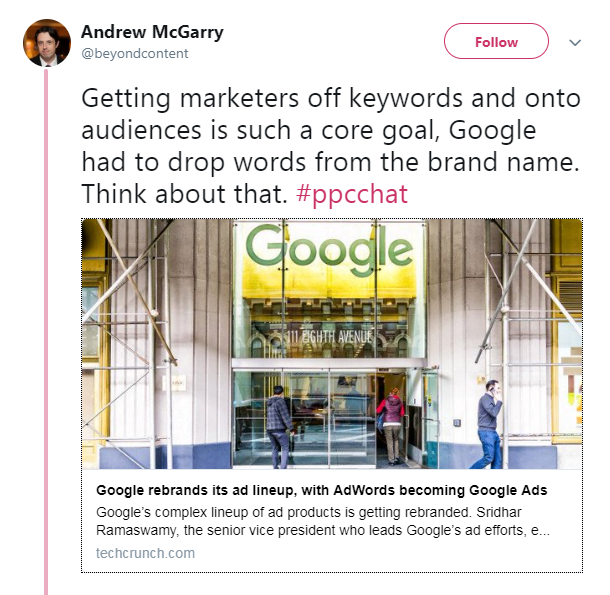
By removing “words” from its ad platform’s name, Google might be signaling a shift in advertiser perception away from keyword intent (the power behind search queries as an advertising tool) and toward audiences. While search advertising will likely remain keyword-dependent due to its intent-driven nature (enhanced by audience tools like RLSA, in-market, etc.), Google Ads might make a holistic advertising approach (investing in channels beyond direct conversions) more appealing to small businesses.
Implications for Agencies and SaaS Companies
Agencies and in-house SaaS marketers should be aware of certain changes. For instance, paid and organic strategies relying on the keyword “adwords” or related terms will need adjustments. Agencies offering AdWords services will need to guide clients through these changes. Fortunately, “adwords” as a term and concept isn’t disappearing overnight, and campaigns using it won’t vanish instantly. However, monitoring paid and organic search volumes for “google ads” and “adwords” is advisable when updating pages and adjusting bids.
Google Ads: A New Era?
So, what exactly is changing? Should you expect major campaign overhauls? Likely not. Google’s new brands will be rolled out over the next month. Given their commitment to transparency, daily campaign operations should remain relatively consistent. Essentially, Google has simplified its ad and marketing experience—a welcome change in the increasingly complex world of digital marketing.