It’s not about obsessing over semicolons or serial commas in your writing, because their use isn’t really that critical.

Take, for instance, the case of Oakhurst Dairy—they would certainly disagree disagree, and rightfully so. A missing serial comma in a Maine state law last year resulted in a $5 million settlement for drivers due to ambiguity over who qualified for overtime pay. However, in content marketing, the stakes aren’t quite as dramatic. The crucial factor is establishing consistency by deciding whether to use these punctuation marks and adhering to that decision throughout your content. Grammatical errors and inconsistent formatting disrupt the reader’s flow, negatively impacting engagement. A style guide helps maintain uniformity in grammar, tone, and formatting for your written content, minimizing these errors. The best part? Creating your own guide to enhance your content marketing can be achieved in six easy steps. But first, let’s delve into why a style guide is essential for elevating your content marketing strategy.
The Importance of a Content Style Guide
The answer is straightforward: consistency. While you’re likely aware of consistency’s role in brand building, maintaining it across all written content, especially with multiple writers, is challenging. Minor variations in spelling or style can be misconstrued as mistakes. Worse, the absence of documented formatting rules increases the likelihood of genuine errors, potentially harming your brand’s credibility. A style guide mitigates these risks by establishing clear standards for grammar, formatting, tone, and more, consolidating them in one accessible location. This consistency also streamlines content creation and review. With a style guide as a reference point, you eliminate the need to cross-check previous blog posts for heading capitalization or Slack your team about em dashes versus en dashes. Your content style guide becomes the ultimate resource for every content creator in your company. Here’s a step-by-step guide to crafting your content style guide.
Step #1: Selecting Your Foundation
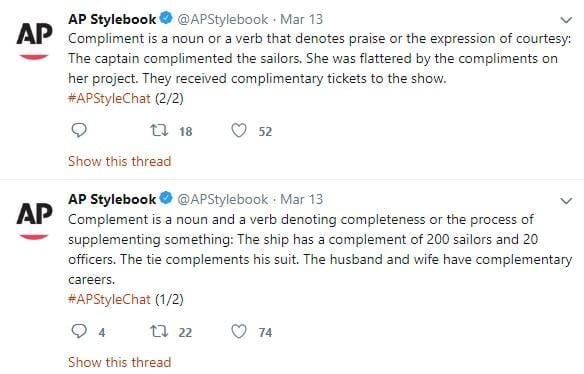
There’s no need to start from scratch. Leverage existing style manuals that offer established grammar and formatting guidelines as excellent starting points. The first step involves choosing the most suitable manual for your brand. For general marketing content, AP Style is a logical choice. The Associated Press introduced the first AP Stylebook in the 1950s as the standard for journalism, with annual updates to the stylebook encompassing formatting rules, grammar guidelines, and clarifications on commonly misspelled words.
However, if your target audience is accustomed to a specific style manual within your niche, prioritize their preference.
Step #2: Defining Your Exceptions
If adhering strictly to a single style manual sufficed, creating a separate content style guide would be unnecessary. You could simply distribute copies of your chosen stylebook and instruct everyone to brush up on block quotes and dangling modifiers.
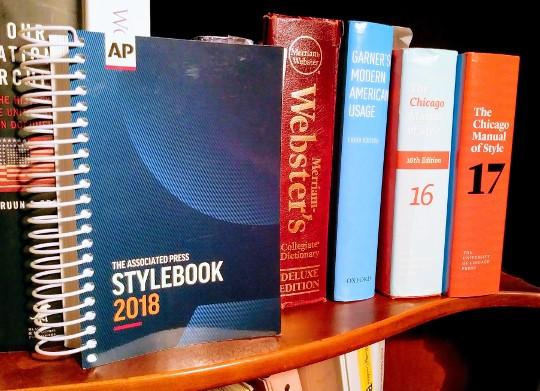
Side note: Those stacks of books could double as makeshift dividers in your open office. However, rigidly following an external style guide isn’t always optimal for conveying your brand’s voice or resonating with your audience. Once you’ve determined your primary style manual, identify instances where deviations are necessary. Consider the purpose and target audience of your content. What are your goals for the blog post, white paper, or email? Utilize customer personas if available, focusing on their expectations and how your content can best serve them. For example, at nexus-security, we (respectfully) depart from AP’s standard for writing percentages. (Notice the “100%” above? Not AP style.) While AP dictates writing out “percent,” we find that using the symbol provides greater clarity in our blog, a digital platform targeting marketers.
Step #3: Establishing Your Voice
We’ve emphasized this before: A consistent brand voice is paramount for high-quality content. Your style guide aims to establish consistency across your brand’s content. While this involves mechanical aspects like heading capitalization and date formatting, it should also define your brand’s voice and tone for all content creators. Utilize the style guide to outline tone expectations for each content type, including blog posts, white papers, social media posts, email campaigns, case studies, press releases, and any other written material you produce.

Step #4: Compiling a Word List
Again, avoid reinventing the wheel. Instead of creating a full-fledged dictionary, compile a list of terms with potential variations in spelling or style to establish a consistent standard. Most industries have standardized terms and abbreviations for clarity, but these aren’t always universally consistent. Does CPA stand for cost per action or cost per acquisition? Is CPC cost per click or cost per conversion? Include such abbreviations in your word list to avoid reader confusion. The spelling and styling of certain words also vary. Is it ebook, e-book, or eBook? E-commerce, eCommerce, or ecommerce? The choice is yours. Define these standards in your style guide to ensure consistent styling throughout your content, improving searchability and preventing perceptions of carelessness. Mailchimp takes this further by including a list of words to avoid:
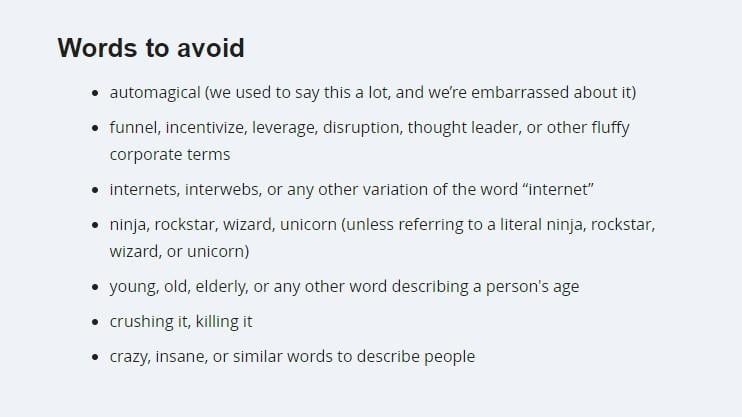
This effectively defines what’s off-limits in your content, preventing imprecise or biased language. Ban clichés or, like Mailchimp, take a stand against “fluffy corporate jargon.” While explaining your reasoning is optional (though Mailchimp’s humility is commendable), simply listing these terms provides a clear reference for all writers.
Step #5: Defining Your Company/Brand
Your style guide should not only standardize how your company writes but also how it’s written about. Dedicate a section to company information for easy reference. If your company name has specific styling (like the camel case in nexus-security), clearly outline it. List product names and any usage guidelines. Include your boilerplate for press releases.

Centralizing this information sets clear expectations for writing about your company, fostering a cohesive brand experience and simplifying onboarding for new writers. Speaking of new writers…
Step #6: Sharing Your Masterpiece
With your style guide complete, it’s time to share it! As a reference tool for all content creators, ensure its accessibility to your team or the public. Create a dedicated page on your website or use a Google Doc. Avoid static formats like PDFs to facilitate regular updates with new terms, company information, or stylistic changes. Your content strategy should be adaptable, and your style guide, as a tool for improvement, should reflect that.