If you haven’t attended clown college (and kudos to you if you have!), you likely find it challenging to master the marketing “juggling act” for your business.

Marketing your business can sometimes feel overwhelming.
But achieving success across various marketing efforts doesn’t have to feel like a circus act. This guide will demonstrate how to optimize your business marketing without the unnecessary acrobatics. The key lies in cross-channel marketing. Now, this term might spark some questions – which I’ll address, such as:
Let’s dive right in!
Cross-channel marketing guide table of contents
- What is cross-channel marketing?
- The difference between cross-channel and multi-channel marketing.
- How to know if cross-channel marketing is right for you.
- Benefits of cross-channel marketing.
- The right number of channels in cross-channel marketing.
- How to implement your own cross-channel marketing strategy.
What is cross-channel marketing?
Before delving into cross-channel marketing, let’s define marketing channels. These encompass all the online and offline platforms where you can promote your business. You might be utilizing more channels than you realize, as every interaction with your target audience presents a branding opportunity. This includes avenues like radio ads, website live chat, social media, online search ads, and more. Cross-channel marketing entails utilizing multiple platforms, channels, or communication methods to promote your brand seamlessly throughout your sales funnel. It centers around the customer journey, tailoring offers on each channel based on their funnel stage. It elevates your marketing by not only employing multiple channels but also ensuring their alignment to provide a cohesive, customer-centric experience.
What’s the difference between cross-channel and multi-channel marketing?
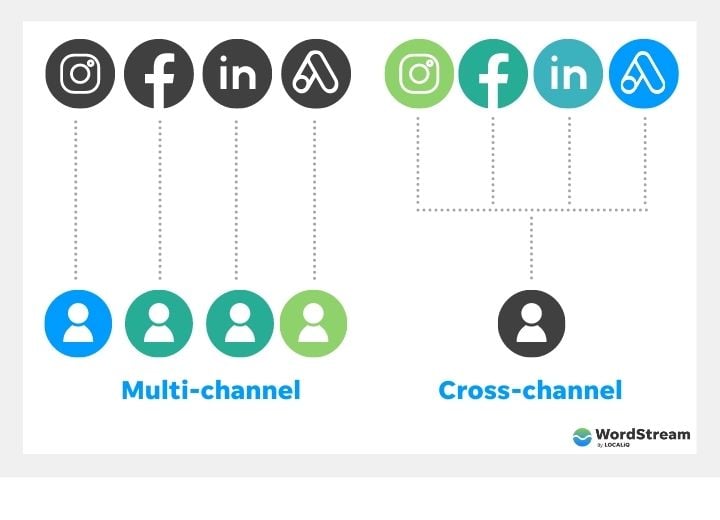
Cross-channel and multi-channel marketing are often confused, so here’s a concise explanation: Multi-channel marketing involves reaching customers through multiple channels, but these channels don’t exchange information. While you might be maintaining brand consistency across platforms, your offers may not always correspond to the customer’s position in their journey.
Example
Let’s say you’re an IT provider. A person searches on Google for cloud migration and sees a search ad for your services. They click it and go to your site but exit. Later, they go on Facebook where they see an ad for your services, but they don’t click it. The following week, they go on LinkedIn where they see an ad to download your enterprise benchmarks report.
In contrast,** cross-channel marketing** enables information sharing between channels. Consequently, the offers presented to a person on a specific channel depend on their prior interactions with your business on any other channel.
Example
So, let’s redo the IT provider example in a cross-channel setting. A person searches on Google for cloud migration and sees a search ad for your services. They click it and go to your site but exit. Later, when they go on Facebook, they see a lead ad for a guide on cloud migration, which they download. In the lead form, they indicate their company size . The following week, when they’re on LinkedIn, they see an ad for a webinar on 10 IT mistakes small businesses make. They register and when they attend, they sign up for a consult.
Notice the distinction? A cross-channel approach utilizes curated content that meets your customers’ needs throughout the customer’s journey. This means that, while a multi-channel marketing strategy is valuable, ideally some of those channels should contribute to a cross-channel system.
Is cross-channel marketing right for you?
Just as marketing on a single channel is superior to none, and multi-channel surpasses single-channel, cross-channel marketing ultimately outperforms multi-channel. It’s suitable for you if… You aim for maximum results. By personalizing offers based on a person’s funnel stage, cross-channel marketing increases conversion potential at each touchpoint. This personalized touch enhances brand recall and improves prospect-to-customer conversion rates. Time is of the essence. Surprisingly, cross-channel marketing can be a time-saver. By unifying efforts across platforms, tasks like content creation and reporting become streamlined. You have budget constraints. Don’t put all your eggs in one basket. With a tight budget, it’s crucial to maximize opportunities across platforms instead of concentrating solely on one that might yield no results. You have an active audience. With people constantly navigating the web, cross-channel marketing enables you to connect with your audience at every stage of the sales funnel.
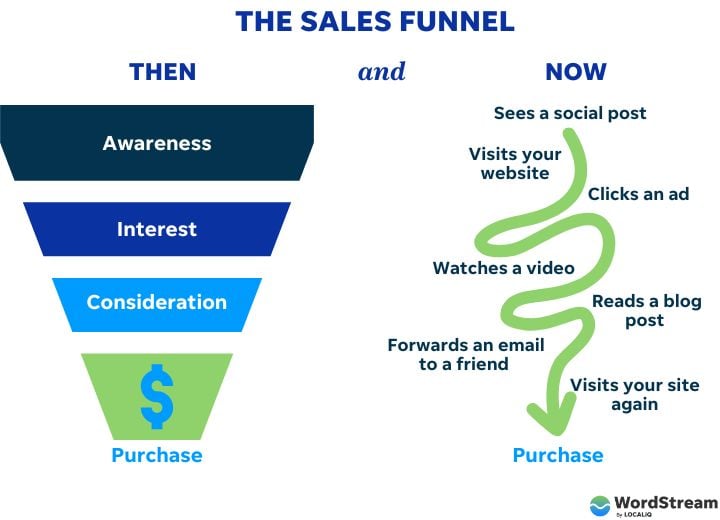 Cross-channel marketing helps you adapt to the ever-evolving sales funnel.
Benefits of cross-channel marketing
To further illustrate the advantages of cross-channel marketing, consider these statistics:
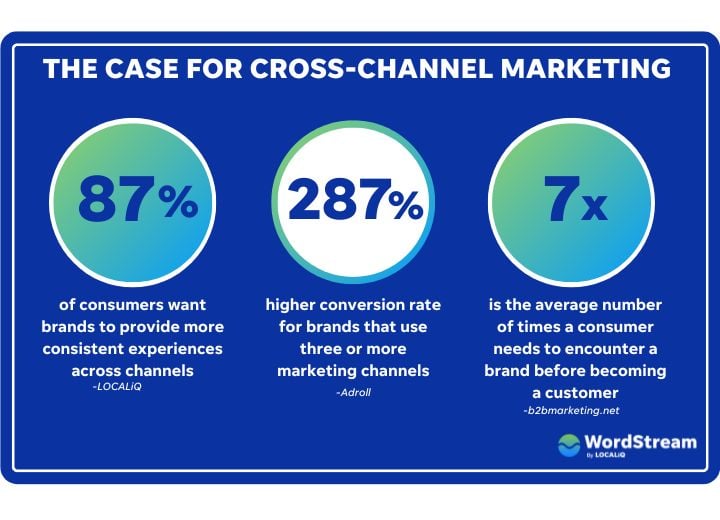
- On average, a consumer needs at least seven times brand interactions before converting. Cross-channel marketing makes each interaction highly relevant, potentially even reducing the required number of touchpoints.
- 87% of consumers desire consistent brand experiences. Multi-channel marketing isolates content for each platform, while cross-channel marketing delivers a seamless brand experience throughout the buyer’s journey.
- Brands employing three or more marketing channels witness a 287% higher conversion rate.
- Businesses engaging with customers across multiple channels experience a return rate of nearly 90%. This signifies that cross-channel marketing can foster brand loyalty over time. Clearly, cross-channel marketing is indispensable for achieving your marketing objectives.
How many channels should your cross-channel marketing include?
A common question is, “What constitutes a sufficient number of channels?” It’s a valid concern, as businesses strive to optimize limited resources. However, there’s no universal answer. Providing a fixed number for all business types is impractical, as each organization has unique goals and hurdles. The critical factor is your ability to connect and integrate those channels within your marketing framework. Moreover, multi-channel efforts can coexist with cross-channel strategies, as connecting every single channel and endeavor might not be feasible. If you’re unsure about the number of ad channels, consider these factors:
Budget
Your marketing budget dictates how much you can allocate to each desired channel. This doesn’t imply that substantial budgets necessitate utilizing as many channels as possible, or that smaller budgets limit channel options. It’s about strategic budget distribution based on your needs. If you require assistance with calculations, resources like this post on creating your marketing budget are available. However, a general guideline is to allocate 5-10% of your revenue towards marketing, potentially increasing to 14% or higher for larger enterprises.
Audience
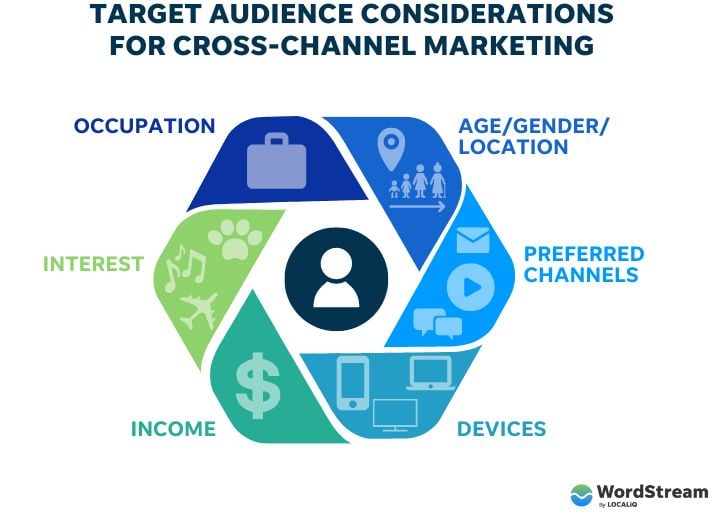
When selecting channels, envision your ideal customer. How many platforms do they frequent? What does their daily routine look like? Where do they reside, and what is their age demographic? Asking these probing questions about your audience provides insights into the number of channels required to effectively reach them at every stage.
Goals
Your business’s marketing goals also influence channel selection. For instance, if you aim to increase your online presence, incorporating social media as a new channel might be necessary, even if you haven’t ventured into it before.
Resources
Time is a constraint, as individuals and teams have limited capacity. However, tools can simplify cross-channel management. Explore options for consolidated reporting across channels or platforms that facilitate simultaneous multi-asset marketing. These time-saving solutions help you achieve more with less.
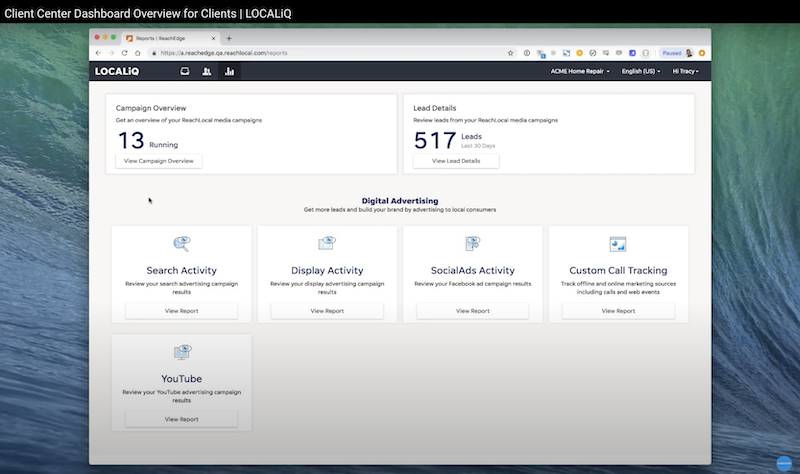 CRMs like LOCALiQ’s Client Center streamline reporting from multiple platforms into a single dashboard.
Naturally, the answers to these considerations will vary. If you’re uncertain about the starting point, begin with your top three channels. This allows you to experiment and observe what resonates, as opposed to limiting yourself to one or two, with the option to expand later.
CRMs like LOCALiQ’s Client Center streamline reporting from multiple platforms into a single dashboard.
Naturally, the answers to these considerations will vary. If you’re uncertain about the starting point, begin with your top three channels. This allows you to experiment and observe what resonates, as opposed to limiting yourself to one or two, with the option to expand later.
How to create a cross-channel marketing strategy
You might be wondering about the complexity of implementing cross-channel marketing. The short answer is it’s achievable! Here are ten tips for cross-channel marketing success:
1. Map out your customer journey
Before diving into cross-channel marketing, visualize your sales funnel from a broader perspective. Comprehending customer behavior at each buyer journey stage is crucial for aligning offers. Analyze historical data and insights into past customer conversions. Leverage audience analysis to step into your customers’ shoes and brainstorm their potential journey toward committing to your business. This exercise not only helps tailor your cross-channel marketing to specific scenarios but also aids in identifying the most effective channels (more on this later).
2. Have an offer funnel
Aligning offers with each funnel stage is paramount in cross-channel marketing. Someone at the top of the funnel is more likely to engage with a general guide than a product demo. Even within guide categories, a high-level overview might resonate better than a technical deep dive. Therefore, map different offers and topics to your customer journey stages. While this varies for every business, here’s a general example:
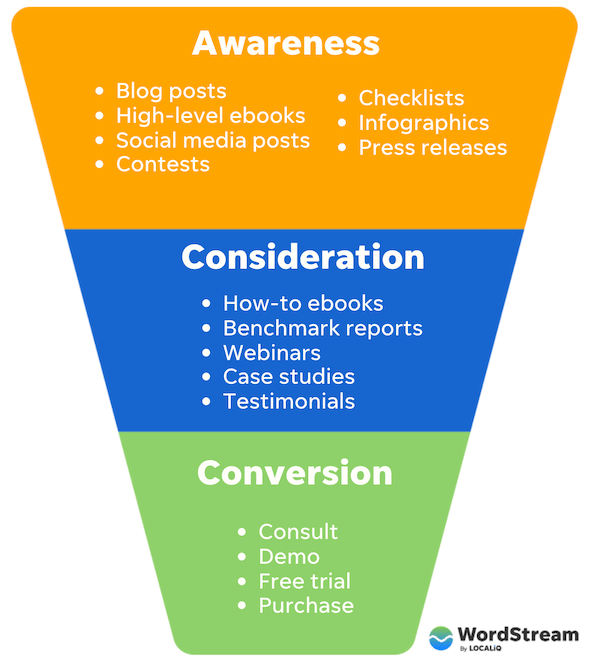
3. Choose your channels
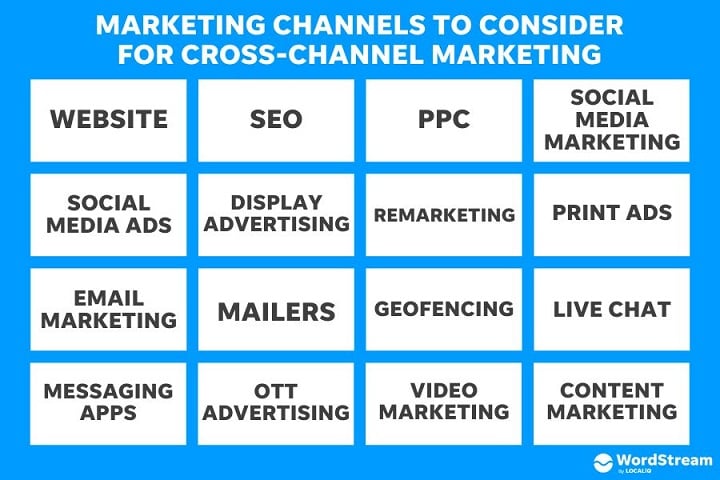
The previous guidelines helped determine the number of channels; now it’s about selecting the specific channels. At nexus-security, we believe in working smarter, not harder. Prioritize channels that complement each other for maximum impact. For instance, search marketing and social media marketing work well together. Seeing your social media posts can prompt users to search for you later. Consider your ideal buyer persona and their most frequented channels to identify the most effective ones for your business. Here are some potential channels to consider:
- Website
- SEO
- PPC
- Social media marketing
- Social media advertising
- Display advertising
- Remarketing
- Print ads
- Email marketing
- Mailers
- Geofencing
- Live chat
- Messaging apps
- OTT advertising
- Video marketing
- Content marketing
4. Take inventory of your costs
Flexibility is key when implementing cross-channel marketing. As channel performance fluctuates, budget reallocation might be necessary. To gauge channel spending, utilize industry benchmarks for cost estimation. Regularly review these reports to adjust your spending or compare your business’s performance.
Using industry benchmarks like these can help you keep your cross-channel budget in check.
5. Have a set of overarching goals
While each channel might have distinct objectives, having a few “big picture” goals helps unify your efforts. It’s easy to get lost in the intricate details of individual channel performance. Overarching goals ensure your channels remain aligned for overall success.
6. Use a CRM
A customer relationship management (CRM) tool can be invaluable for cross-channel marketing. As your prospects’ behavior evolves, a CRM tracks changes and identifies broader trends in the customer journey, facilitating audience segmentation for customized offers. CRMs also simplify major cross-channel initiatives like retargeting.
7. Use retargeting
Retargeting is crucial for any cross-channel marketing strategy. Experiment with different retargeting audiences. For instance, run a retargeting Facebook ad for a product left in a cart or offer a special promotion to loyal customers.
8. Button up your tracking
Implement tracking parameters across all channels in your cross-channel marketing strategy. This allows you to monitor individual channel, offer, and placement performance and establish rules for marketing automation. For example, if someone downloads guide X, direct them to thank you page A with offer B. Your tracking naming convention is flexible; the key is a consistent and easy way to assess cross-channel performance. Furthermore, address any conversion tracking issues for search engine marketing, as these can significantly impact your campaigns.
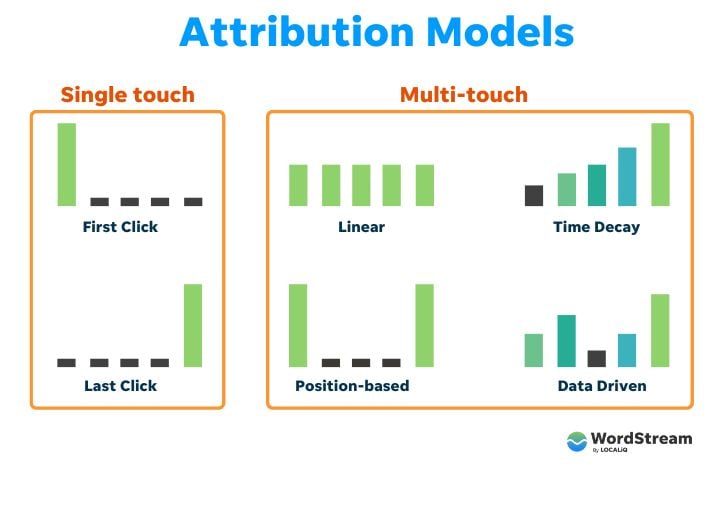
9. Use multi-touch attribution
Attribution modeling determines how credit is assigned to different channels involved in a customer’s journey. For cross-channel marketing, opt for a model under the multi-touch attribution umbrella. Since you encourage specific actions across channels, understanding the campaign impact on the entire customer journey is crucial. Multi-touch attribution modeling utilizes cross-channel data to assign weighted credit to actions.
10. Keep your reporting all in one place
Centralize reporting for manageable and effective cross-channel marketing. Utilize free tools like Google Analytics for a unified platform performance overview. This saves time and provides insights into individual channel performance and their interplay.
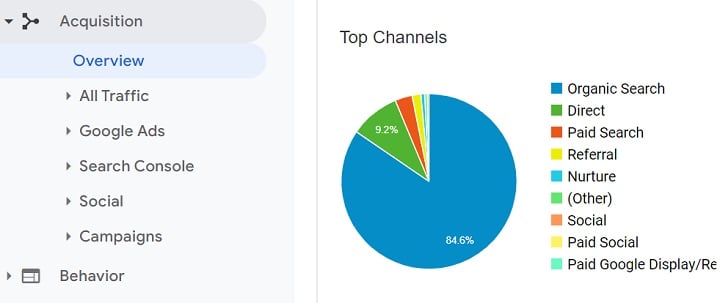 Here is one example of how Google Analytics displays success by channel in multiple different ways.
11. Try nurture email campaigns
While cross-channel materials guide customers along their journey, some require an extra nudge. Targeted email marketing is ideal for this scenario, as it allows for list segmentation and tailored offers. Automate emails to trigger upon specific funnel stage completion. This is a simple yet effective strategy to enhance cross-channel marketing and maintain customer engagement.
12. Be patient
Patience is key in cross-channel marketing. Some channels yield faster results than others, highlighting the importance of channel diversification. Channels like PPC advertising might deliver short-term wins, while others like local SEO provide long-term gains. Approaching cross-channel marketing as an evolving, ongoing project helps set realistic expectations and maximize results throughout the journey.
Cross-channel marketing is easier than you think
Many businesses perceive successful cross-channel marketing as unattainable. However, this comprehensive guide demonstrates its viability for everyone. With self-assessment, patience, and the right tools and platforms, your cross-channel marketing strategy can attract and retain customers, fostering sustainable business growth. Here’s a recap of effective cross-channel marketing implementation:
- Map out your customer journey
- Choose your channels
- Prep your content ahead of time
- Take inventory of your costs
- Have a set of overarching goals
- Use a CRM
- Use retargeting
- Button up your tracking
- Use multi-touch attribution
- Keep your reporting all in one place
- Try nurture email campaigns
- Be patient