It’s widely known that Magento is the go-to eCommerce platform for serious businesses. Since you’re serious about yours, Magento seems like the logical choice.
But are you prepared for what’s to come?
Magento is incredibly powerful. I’ve seen it compared to a Leatherman for its versatility. Personally, I think of it as one of those massive universal remotes with countless buttons, each controlling a different aspect of your media center.
It can do pretty much anything, but only if you’re willing to invest the necessary time and resources. While Magento is fantastic, it’s also complex. Are you prepared to guide your clients through Magento’s powerful admin panel (or are they tech-savvy enough to figure it out)? If not, exploring other options might be wise.
Think of Magento like professional-grade software like Adobe Photoshop or Illustrator. It rewards expertise but demands a steep learning curve. While the initial learning phase can be tough, mastering it unlocks immense potential.
For your business, this translates to pricier hosting (think $300 monthly for AWS), higher development costs, and a significant upfront time investment to understand the admin features. However, once these hurdles are cleared, you gain access to a platform with unparalleled scalability and expansion capabilities.
Thanks to Magento’s flexibility and scalability, your business won’t outgrow it anytime soon. And if it does, your success will likely equip you to handle the next phase of eCommerce evolution.
Magento: The Leading eCommerce Platform, Commanding Roughly 30% Market Share.
Magento shines (and might be your only alternative besides a custom-built web application) if you:
- Manage a large, intricate inventory.
- Require the ability to represent complicated product types.
- Have content that doesn’t change very often.
- Want to run multiple online stores from a single CMS back-end.
- Need an extremely powerful and adaptable admin panel.
Other noteworthy advantages include:
- Active development and robust security due to Magento’s extensive user base and commercial support. Security updates are released promptly and frequently.
- Support for a wide range of payment gateways.
- Availability of Magento extensions catering to everything from auctions to data import/export.
- SEO-friendliness.
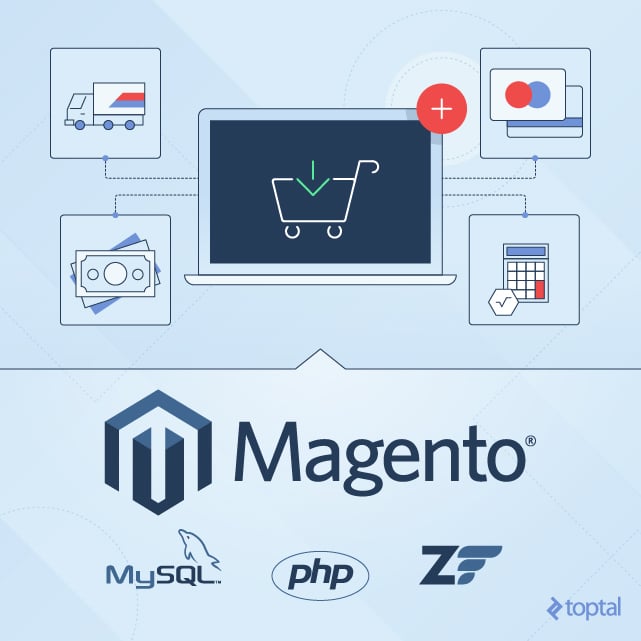
Magento, an open-source platform built specifically for eCommerce, is a PHP framework loosely based on the Zend Framework](https://framework.zend.com/) and uses a MySQL database. Its modular templating system, organized in a hierarchical folder structure, allows [Magento developers and designers to override core and theme files without directly modifying them. This approach prevents unnecessary conflicts with future updates.
However, its open-source nature is both a blessing and a curse.
While the Magento ecosystem probably wouldn’t exist without it, it has resulted in a vast, intricate codebase that often lacks proper documentation and relies on confusingly named functions. It sometimes feels like Magento is full of exceptions to the rule, often requiring modifications across numerous files to implement a single feature change.
This complexity contributes to the high cost of eCommerce website development services. Experts have invested significant time, effort, and resources into understanding and mastering this complex system – attending classes, debugging code, obtaining certifications – and rightfully expect fair compensation for their hard-earned expertise.
Caching: A Potential Hurdle in Magento.
When correctly configured on a professional hosting platform, Magento delivers excellent scalability and lightning-fast performance. However, on an underpowered provider with poor configuration, even loading basic pages can take an eternity. Caching is the solution: PHP opcode caching, database back-end caching, and full-page caching.
While opcode caching has become standard with PHP (though you might need to tweak the php.ini file), a Redis back-end cache is crucial. For the absolute best performance, a full-page cache solution like Varnish is strongly recommended.
These requirements demand a hosting provider that supports these features and a Magento development team proficient in configuring them. Discount hosting providers like Bluehost and GoDaddy won’t cut it for Magento.
You’ll need to invest in an Amazon EC2, Digital Ocean instance, or a managed hosting provider specializing in Magento with these features pre-configured.
But what exactly are all these caches?
In essence, a cache is a temporary storage area for data retrieved from the hard drive or generated through computations.
It’s like the computer saying, “I’ve gone through the effort of fetching or generating this data, so I’ll hold onto it for a bit in case someone else needs it.”
Since caches typically reside in volatile memory, retrieving data from them is significantly faster than recalculating it or reading it from the disk.
Each cache operates at a different level within the framework.
The opcode cache works at the PHP code compilation level, storing compiled code chunks for later use. A back-end cache enhances Magento’s file caching system. Displaying a page in Magento can involve processing hundreds of PHP and XML files, which is slow.
Since page content often remains static between user requests, Magento saves the rendered page output to a file system cache.
This is faster than re-rendering but still involves relatively slow disk reads. Utilizing Redis as an in-memory cache to store these rendered blocks and pages, along with session data, significantly speeds things up.
Varnish, the third cache, functions as a full-page cache.
Operating independently from Magento (usually on a separate server), it acts as a caching HTTP reverse proxy, intercepting requests between your website and users, storing entire pages, and associating them with their corresponding URLs.
Caching sounds fantastic, right? It is, but it introduces another layer of complexity.
Consider this: you’ve incorporated a Redis database, managed configuration file updates, and potentially added a dedicated server for your Varnish cache.
Now, what happens when a page’s content changes? How does the cache know not to serve the outdated version? That’s a potential problem.
While solutions like cache invalidation exist, they add another layer of complexity and potential issues.
Furthermore, a truly professional development team will insist on a dedicated testing environment alongside the production environment, along with a Git repository on GitHub for version control (and if they’re not using version control, you should seriously consider finding a different developer!).
An Alternative to Consider: WordPress with WooCommerce.
Comparing Magento to one of its primary competitors, WordPress with the WooCommerce plugin, can be helpful.
Recently, I worked with a Denver-based company boasting a fantastic Magento website and hosting setup. They had separate Amazon EC2 instances for their production and testing environments. My role was to enhance performance and assist with a complete website redesign.
I implemented a Redis back-end cache for near-instant page loads and collaborated with the designer to transform Photoshop mockups into a functional website.
After several weeks, the website looked stunning. However, as our collaboration continued, I noticed a disparity between their hosting and development expenses and their budget.
As their branding evolved, they desired further website modifications and custom module integrations. They were paying me thousands of dollars for design and redesign work. The catch? They only had around six products. Additionally, they inquired about incorporating dynamic content and a blog.
Taking into account their needs, business stage, and hosting/development expenses, we concluded that Magento wasn’t the ideal solution.
After extensive research, they opted for a new WordPress/WooCommerce website.
Essentially, I persuaded them to choose a different path, even though it meant losing a client. My priority was their best interest. The reality is, if a client doesn’t fully grasp the implications of using Magento, doesn’t truly need its extensive features, and lacks the budget to sustain it, everyone involved will face challenges.
For businesses with a relatively limited product range that fits a standard business model, WordPress/WooCommerce presents a compelling option.
WordPress developers are typically more affordable than Magento developers. The WordPress community is thriving, and the platform boasts comprehensive documentation and a well-structured codebase. It’s a lightweight, fast solution that runs smoothly on practically any hosting provider, including budget-friendly options.
If this combination aligns with your requirements, it can lead to substantial savings in development and hosting costs. If you’re handling your website independently without hiring external developers, steering clear of Magento and considering WordPress/WooCommerce is advisable.
Another reason to explore WordPress/WooCommerce is its robust blogging capabilities. While Magento allows client-managed dynamic content updates, it lacks the polish and user-friendliness of WordPress in this regard.
However, WordPress/WooCommerce doesn’t offer the same level of sophistication as Magento for product configuration, discount management, and handling extensive inventories. (It’s not that it can’t – it has excellent features and is constantly evolving – but this is where Magento truly excels.)
WordPress/WooCommerce might start to feel cumbersome once your product catalog surpasses a few hundred items, when you need to create complex, grouped products with numerous custom attributes, or when you want to implement advanced discount scheduling, targeted rebates for specific customer groups, cross-selling, up-selling, gift options, and so on.
Choosing the Right Solution: It Depends.
Like any technology, Magento offers distinct advantages and drawbacks.
Key benefits include:
- Open-source nature
- Specifically designed for eCommerce
- Robust discount system
- Seamless payment gateway integration
- Flexibility and customization options
- Extremely powerful admin panel
- High scalability
- Excellent performance once optimized (Varnish, database optimizations, Redis caching, opcode caching)
- Multi-tenancy support
- SEO-friendliness
- Large user base, active development, and robust security
Known issues include:
- A sprawling, somewhat unwieldy codebase inherited from its open-source history, offering extensive customization possibilities but potentially overwhelming for some users
- Documentation that’s not as comprehensive as other platforms
- High development costs, partly due to its complexity and partly due to its popularity
- Essential features often locked behind commercial modules of varying quality, sometimes requiring additional third-party integration support
- Demanding server requirements
Carefully evaluate all these factors on a case-by-case basis, ideally before selecting an eCommerce website development partner, to determine if Magento is the right fit for you or your client.
Don’t Be Afraid of Magento.
By now, you might be feeling apprehensive about Magento, but I hope not.
Does this sound like you?
You run a successful store with 2,000 products and need to create complex, configurable products with numerous options. You also need to easily bundle these products into groups and offer various discounts and promotions to your customers.
You have the budget and the desire to invest in a truly professional, open-source, SEO-friendly, highly scalable solution that delivers exceptional performance when properly optimized and hosted.
If so, give Magento a closer look. If you’re prepared to invest the time and resources, it can be a robust and long-lasting eCommerce solution for your business.