E-commerce platforms have a distinct advantage over traditional businesses that rely on salespeople for every transaction. Measuring AdWords ROI is significantly simpler when you can track online purchases with clear values. While online stores can easily implement e-commerce tracking through Google Analytics to identify high-performing ads, offline sales involving salespeople seem to obscure keyword and ad data. But don’t be fooled! There’s a way to bridge this gap.
Measuring Offline Transactions: A Challenge
Imagine you sell electric fences. Customers often need guidance on the right type and size for their needs. This is where your product specialists (salespeople) shine. They contact potential customers, gather project details, offer solutions, and ultimately, close deals. At first glance, linking ad campaigns to valuable offline sales might seem impossible. However, let’s explore some possibilities. In this case, your sales funnel looks like this:
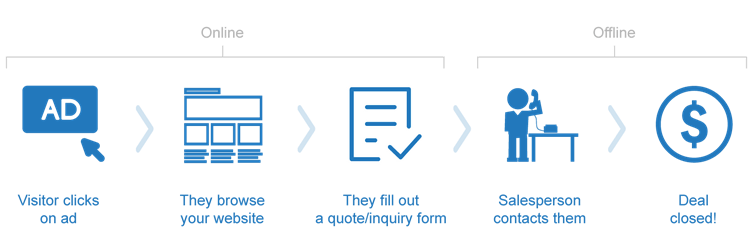
While we can track ad campaigns that lead to form submissions (conversions), identifying those resulting in actual sales requires a different approach.
The Solution: Marketing Automation or CRM with AdWords Integration
Marketing automation delivers tailored communication to prospects based on their website, email, and ad interactions. Features include dynamic website content, targeted email sequences (drip campaigns), visitor tracking, landing page creation, A/B testing, workflow automation, call tracking, and in-depth analytics. CRMs, which can be independent or integrated with marketing automation platforms, manage customer relationships. A simple Google search of “marketing automation” search reveals countless options. The magic lies in their ability to track visitor and lead journeys from their first website interaction to becoming a customer. What we need is seamless AdWords integration, linking ad costs with specific leads and providing a comprehensive overview of ad ROI.
Measuring Offline ROI with Marketing Automation
The process is simple: When someone clicks your AdWords ad, marketing automation captures their ad data. Once they convert into a lead (by submitting a form), the system connects this data with their identity. As your salesperson guides the lead towards a sale, be it tomorrow or a month later, the sale details (value, quantity, etc.) are entered into your CRM or marketing automation system. The system then links this sale back to the specific ad and cost-per-click that originally led the customer to your website. Not using marketing automation yet? Popular options with AdWords integration include Marketo and SharpSpring. Explore these platforms to see if they fit your needs.
Unveiling Actionable Insights
Essentially, you enhance traditional ad campaign performance metrics by factoring in sales volume and cost. This transforms your perspective:

Into this:

Linking leads to specific ad campaigns is valuable, but the aggregate view offers a broader understanding of ad campaign ROI. Now, you can answer critical questions like:
- Which ad campaigns primarily drive website visits versus those that convert visitors into paying customers?
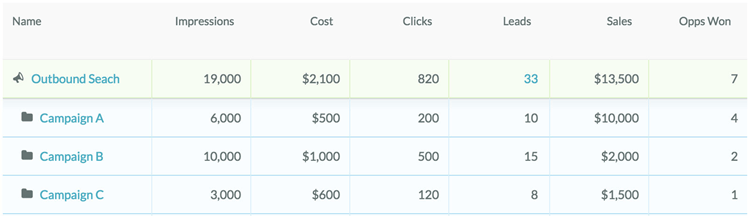
- Which campaigns attract higher-paying customers compared to those attracting lower-paying ones? Here’s a sample report from a leading marketing automation system demonstrating ad-level ROI:
Calculating Ad Campaign ROI
Utilize this formula to calculate your ad campaign’s ROI:

For instance, Campaign A cost $500 and generated $10,000 in new sales, while Campaign B cost $1,000 and generated $2,000 in new sales. Campaign A ROI = ($10,000 - $500) / $500 = 19 = 1,900% Campaign B ROI = ($2,000 - $1,000) / $1,000 = 1 = 100% Clearly, Campaign A delivers significantly higher dollar-value sales and a much greater AdWords ROI than Campaign B. Armed with this knowledge, you can make strategic decisions:
- Invest further in Campaign A
- Optimize Campaign B for improved performance
Beyond Impressions and Clicks: Real Business Value
Ad agencies and marketers often prioritize impressions and clicks. However, ultimately, ad spending must translate into tangible business results (revenue) to justify its existence. While measuring ad campaign ROI for online transactions is straightforward, offline sales involving salespeople pose a unique challenge. Marketing automation might not be a universal solution, but it offers immense value by centralizing online and offline activity tracking. This provides clear insights into campaign performance, allowing you to identify and invest in high-performing campaigns while phasing out underperformers. If you haven’t explored marketing automation yet, I highly recommend researching available options. And if you’re already utilizing it, leverage its AdWords integration if available on your platform! Happy advertising!