The Evolution of Inbound Marketing: Why PPC Deserves a Seat at the Table
The marketing world is buzzing about Rand Fishkin’s latest announcement that SEOmoz is relaunching and rebranding as simply Moz. Moving away from their SEO roots, they are now presenting themselves as a broader marketing solutions provider, focusing on “inbound marketing.” This term, popularized by Boston-based HubSpot and others, is causing quite a stir. What caught my eye was Rand’s updated diagram on inbound marketing in his blog post. The new visual, which differentiates inbound from “interruption marketing,” is shown below:
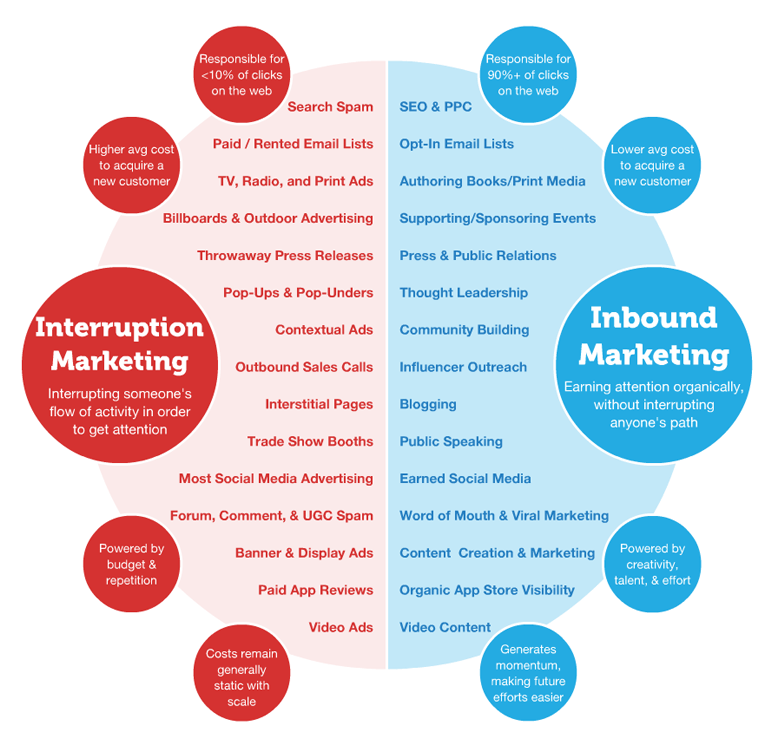
Inbound Marketing vs. Interruption Marketing (via SEOmoz) Let’s compare this with his previous diagram from Rand’s March 2011 blog post:
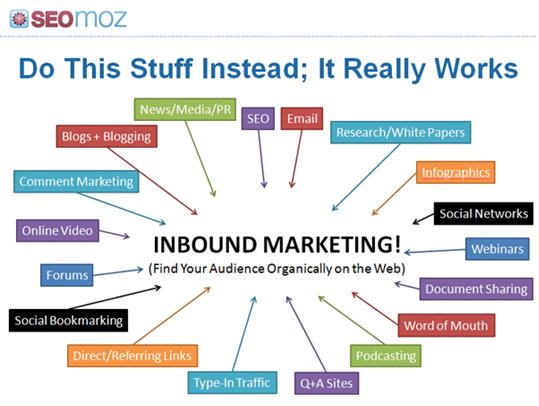
Inbound Marketing! (via SEOmoz)
The glaring omission? PPC! In the updated version, PPC is prominently placed alongside SEO, and rightfully so! What prompted this shift?
Demystifying Inbound Marketing
Earlier this year, a heated discussion unfolded on Inbound.org, ignited by Victor Pan, who petitioned for a PPC category on the site. Tad Chef countered, stating that “buying ads is outbound”:
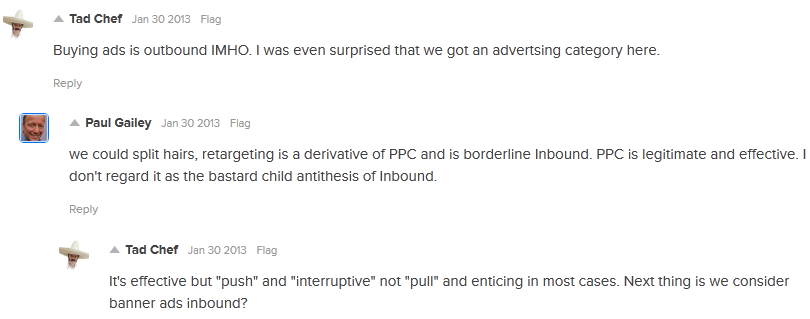
Enjoy this heavy-weight tete-a-tete
Ian Howells chimed in, arguing, “Not that I hate on paid search, but erm… the site is called inbound.org. PPC is paid media, which is the polar opposite.”
The debate continued on Martin McDonald’s blog, sparked by his post titled “WTF is Inbound Marketing, Anyway?”. Challenging Tad and Ian’s viewpoints, Martin wrote:
Now frankly, I’m in disagreement with both of the above. PPC is absolutely a part of inbound marketing by my standards. My definition of inbound revolves around being somewhere with the answer when someone is looking for it, NOT sticking an advert for a product or service in front of their faces. That absolutely includes PPC!
This ignited another thread at Inbound.org, as opinions clashed over whether PPC, a form of paid media, truly fits within the inbound framework.
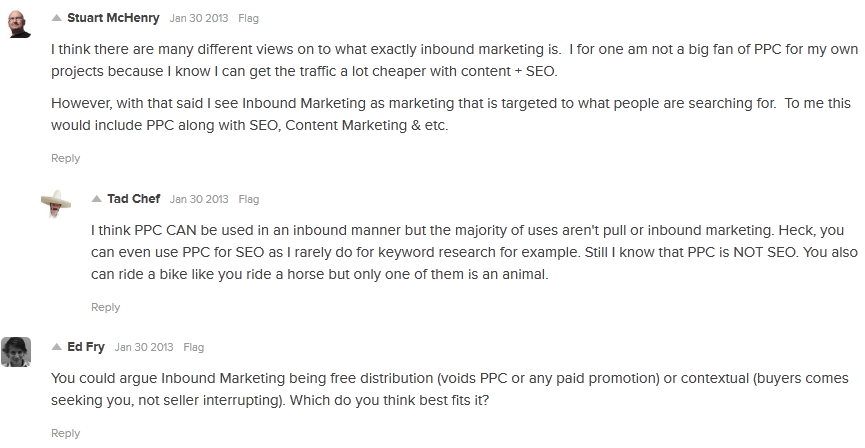
Ed Fry hops unsolicited into the fray As Ed Fry aptly points out, the answer hinges on how we define inbound marketing. Is it about the cost or the context?
Free vs. Paid, Interruption vs. Flow
Some argue that PPC shouldn’t fall under “inbound marketing” because it involves paying for visibility. However, we see it differently. Inbound marketing is about connecting with potential customers when they are actively searching for solutions. The essence of “inbound marketing” is to move beyond the simplistic “free vs. paid” dichotomy. Savvy marketers understand that no marketing is truly “free.” Companies like HubSpot and the newly rebranded Moz, offering tools for managing inbound campaigns, know that labeling their offerings – essentially platforms for blogging and SEO – as “free marketing” would be misleading. While you can implement inbound strategies without specialized software, it still requires resources – either financial investments in a team (bloggers, social media managers, SEO specialists, etc.) or your own valuable time. For many business owners, time spent on marketing is time taken away from other crucial activities. Therefore, “free marketing” is a misnomer.
It’s more accurate to view “inbound marketing” as the antithesis of “outbound marketing” or “interruption marketing,” rather than contrasting it with the illusory concept of “free marketing.” This definition positions inbound marketing as any form of marketing that connects with customers precisely when they are seeking solutions.
Consider this: imagine you run a local pizzeria. Blanketing your neighborhood with flyers and menus under windshield wipers or rubber-banding them to doorknobs is intrusive, outbound marketing. You are interrupting people without knowing if they even enjoy pizza. Conversely, if someone in your vicinity searches for “pizza” on their phone around dinnertime and encounters your business through an organic listing or a mobile PPC ad, it’s contextual. Both options seamlessly integrate with their current needs, providing information they were already looking for. PPC, similar to SEO, is context-driven and triggered by user queries, making it inherently inbound. It seems Rand and the Moz team have recognized this, contributing to their evolving perspective.

No Free Passes in Marketing
All marketing channels require investment. Achieving SEO success demands considerable effort. While countless websites are launched daily, the coveted first page of search results remains finite. In fact, with the rise of mobile search, the SERP is becoming more competitive. This means securing a top spot on Google is increasingly challenging.
As Ian Lurie recently highlighted, SEO is a zero-sum game. The first page only accommodates 10 organic listings, and that’s if you’re fortunate. If competitors claim those positions, you’re left out!
I’m encouraged that more marketers, including Rand Fishkin and myself, acknowledge that PPC is a sustainable and effective form of inbound marketing. Hopefully, this understanding will continue to spread.
Are you convinced? If not, let’s discuss why! Connect with me on Twitter: Follow @larrykim
