There’s this awesome Twitter feed called @AvoidComments that basically exists to remind everyone to just ignore internet comments:
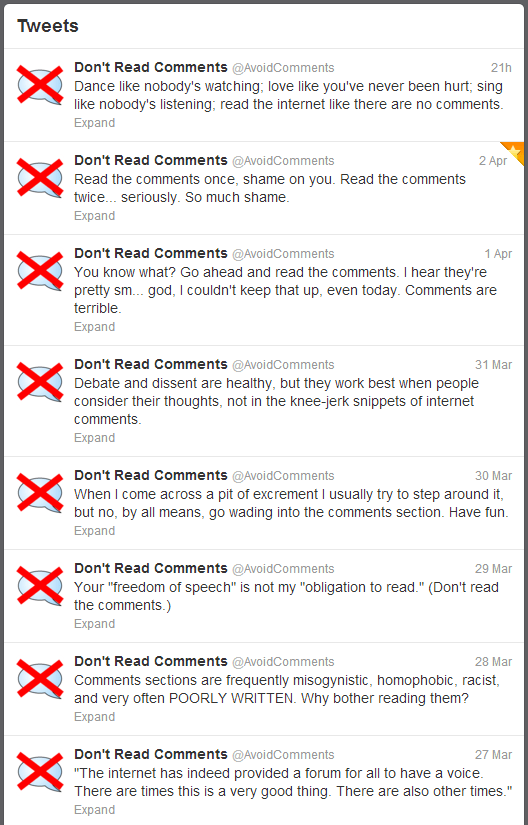
And it’s spot-on, especially for sites like Salon, which seems to be a magnet for negativity. And even Justin Bieber knows not to read the comments on YouTube: “Staying away from YouTube comments is a good idea because those can really bring you down.”

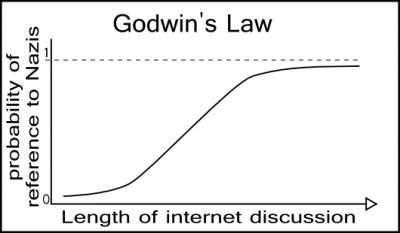
But honestly, I have a complicated relationship with comment sections. They can be great or terrible, depending on the environment the blog owners create. Sites with upvote systems that highlight the best comments and encourage discussion are my favorite – like SEOmoz, Reddit, and XOJane – I’ve spent countless hours on those, fascinated by the conversations. However, even the best sites can’t escape ridiculous comments. When you let anyone share their thoughts, some will inevitably be stupid or offensive. Like a breeding ground for bad ideas, comment sections often devolve into pointless and annoying arguments. That’s why we have Godwin’s Law, which observes that “The longer an online discussion goes on, the more likely someone will bring up Nazis or Hitler."
Before jumping into any online debate, it’s helpful to understand common logical fallacies – those sneaky errors in thinking we’re all susceptible to. Knowing these fallacies helps you identify when someone’s argument falls apart, especially in comment sections where people seem extra prone to illogical thinking. (Okay, maybe not a scientific fact, but you know what I mean.) So, here are 10 logical fallacies (or should we say “blogical” fallacies?) to watch out for, often spotted in a comment section near you.
#1: Appeal to Authority
This fallacy relies on the blind faith that important people are always right. Remember when you were a kid and thought your mom was a genius who could solve any problem? Then you grow up and realize that’s not always the case. The appeal to authority often pops up when criticizing someone in a position of power – like a famous author or a CEO. Take this comment on Larry’s post about eBay’s ineffective paid search strategy:

Just because eBay is a big company with money to spend on marketing doesn’t mean the person running their PPC campaigns knows what they’re doing. Big companies, even huge ones, fail all the time. History is full of failures. Being in charge doesn’t make you competent.
#2: Argumentum ad Hominem
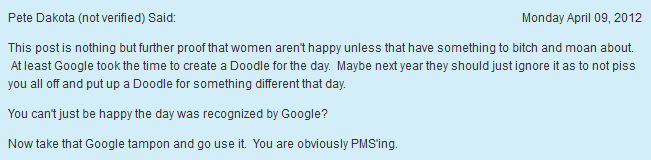
This is when someone gets personal in a debate, essentially resorting to name-calling. See the examples below – both, coincidentally, on posts where I discussed sexism. When I criticized the Google Doodle for International Women’s Day, one commenter suggested I was just PMS’ing:
Then there was this gem I “bitched and moaned” about a literary journal that only published men:

Apparently, the journal editor didn’t appreciate my post or my forehead. (I’ve cleaned up some of the language in these comments.) Pro tip for commenters: Keep your comments focused on the argument, not personal attacks, and you’ll appear much more credible.
#3: Ignoratio Elenchi
Love that Latin, right? This one means irrelevant conclusion or missing the point. People who love the sound of their own voice (or their words in print) are particularly susceptible to this, posting comments completely unrelated to the topic. A special kind of this fallacy is the irrelevant spam comment – years ago, I wrote a sarcastic post called “How to Start an SEO Business in 3 Ridiculously, Impossibly Easy Steps,” mocking a silly eHow article. To this day, people still comment without reading the post, thanking me for helping them start their SEO business. For instance:

(I removed the link and approved the comment to highlight the absurdity.)
#4: The Thought-Terminating Cliché
Borrowed from Robert Jay Lifton’s book on brainwashing, Thought Reform and the Psychology of Totalism, this refers to using a cliché to shut down discussion and avoid confronting different viewpoints. While the phrase itself might be valid in some contexts, using it to dismiss dissent or justify flawed logic is what makes it a thought-terminating cliché. Basically, as a Wikipedia editor aptly put it, “end the debate with a cliché—not a point.” “It is what it is” perfectly embodies this fallacy. It adds nothing to the conversation. Don’t waste your time on commenters who refuse to engage meaningfully.
#5: Appeal to Tradition
Also known as “argumentum ad antiquitam,” this fallacy insists on sticking to the old ways simply because that’s how it’s always been done. Tradition! It’s often used by those who resist change and has historically been used to justify terrible things like slavery and war crimes.
#6: The Just-World Hypothesis
This is the tendency to believe the world is inherently fair and people are inherently good. So when you point out injustice or evil, it challenges their worldview, making them defensive. They might say things like, “Oh come on, things aren’t that bad!” or “Nobody is intentionally trying to hurt you.” This fallacy also rationalizes bad things happening – like some SEOs assuming a website must have done something wrong if it gets penalized by Google. We can call this the “Just-Google Hypothesis.” However, sometimes bad things happen to good people, and websites can be unfairly penalized for no reason. “It is what it is,” right?
#7: The Google Effect
More of a cognitive bias than a logical fallacy, the Google effect describes our tendency to forget information readily available online. Similarly, the cell phone effect makes people forget their spouse’s phone number. This effect appears in comments when someone asks a question that:
- Is already addressed in the post they’re commenting on, meaning they didn’t bother reading carefully, or
- Could be answered with a quick Google search, cutting out the middleman. This is precisely why the acronym LMGTFY exists.
#8: Fallacy of Composition
This one involves assuming something true for a part of something must be true for the whole. You see this when people say things like, “My friend works at Amazon, and he’s great, so they can’t possibly be bad for small businesses!” Or when someone has a bad experience with one “SEO” firm and concludes that all SEO professionals are scammers. Just because some people in the “industry” are unethical doesn’t mean SEO isn’t a legitimate field.
#9: The Chiller-Than-Thou Fallacy
I might have made this one up, but I see it everywhere. These commenters are always telling you to relax, chill out, calm down, be cool, etc. Case in point, this gem directed at my friend Carrie Murphy:
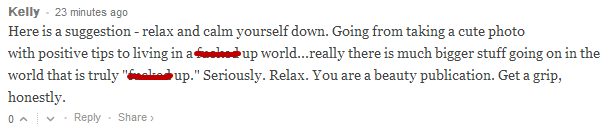
The irony is, the chiller-than-thou commenter always ends up looking very unchill. I mean, if they were truly relaxed and calm, wouldn’t they just close the tab instead of leaving aggressive comments? Would a truly chill person even bother commenting? I doubt it.
#10: The Dunning-Kruger Effect
The Dunning-Kruger Effect describes the phenomenon where incompetent people don’t recognize their incompetence because they lack the ability to differentiate between competence and incompetence. It’s part of being incompetent! In the context of blog comments, the worst commenters don’t realize they’re the worst because their poor commenting skills prevent them from distinguishing good comments from bad ones. Hence, the endless stream of bad comments. This leads to a disturbing conclusion: Some trolls are completely unaware they’re trolls. Scary, right? Join the fun – tell me what logical fallacies you’re tired of seeing in blog comments. Or better yet, leave a comment with a blatant fallacy, intentional or unintentional, for some self-referential humor! See also: