For those who follow this blog, the fundamentals of the Google Ads (formerly AdWords) auction are likely familiar: a bid is placed, a page position is secured, and higher positions usually attract more clicks. So…

… correct? Incorrect. Small businesses operating with limited budgets need a more strategic approach. Let’s illustrate this with a straightforward example. Related: Utilizing Flexible Bid Strategies in Google Ads
Increased Bids, Decreased Traffic?
Imagine a scenario representing all potential impressions aligned with your criteria: the relevant search terms, location, language, and time.

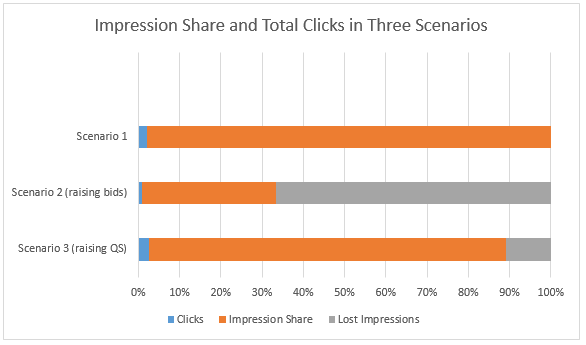
Let’s establish some baseline performance assumptions: Current Bid: $1.25 Current Average Position: 4 Expected Click-Through Rate: 2% Expected Clicks: 100 (2% of 5000) Expected Actual Cost-Per-Click: $1 (80% of your bid, for simplicity) Expected Total Cost: $100 ($1 x 100 clicks) Budget: $100 Budget / Expected Total Cost = 100% Percentage of Auctions: 100% Actual Impressions: 5000 (100% of 5000) Actual Clicks: 100 (2% of 5000) Ideally, your budget covers every anticipated click at the projected cost. Google, aiming for you to receive 2% of clicks at $1 each, will enter you into every auction, expecting a $100 bill.

However, dissatisfaction with traffic and a low average position might prompt a bid increase. Let’s analyze the impact: Current Bid: $2.50 Average Position Rises To: 3 Expected Click-Through-Rate Rises To: 3% Expected Clicks Rise To: 150 Expected Actual Cost-Per-Click Rises To: $2 Expected Total Cost Rises To: $300 Budget: $100 Budget / Expected Total Cost Drops To: 33% Percentage of Auctions: 33% Actual Impressions: 1667 (33% of 5000) Actual Clicks: 50 (3% of 1667) Without a budget adjustment, you can only afford one-third of the anticipated clicks at the new cost. Consequently, Google limits your auction participation to one-third, causing a decrease in actual clicks despite the higher CTR.

Math – it can have unexpected consequences. Google provides this data in the “Search Lost IS (Budget)” column, a percentage indicating missed auction entries due to potential click costs exceeding your budget.
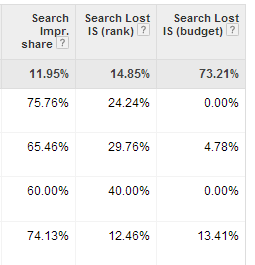
Example impression share columns Note: Search Lost IS (rank) represents the percentage of potential impressions where you participated but didn’t win.
Key Takeaway
Bid and budget adjustments should go hand-in-hand: Increased bids are ineffective without covering the cost of those pricier clicks. Budget accordingly if raising bids is deemed necessary.
Enhancing Ad Rank via Quality Score
Let’s revisit the example, but this time, the advertiser focuses on Quality Score. They ensure high relevance between their text ads and a specific set of keywords, earning them a larger discount from Google. Current Bid: $1.25 Average Position Rises To: 3 Expected Click-Through-Rate Rises To: 3% Expected Clicks Rise To: 150 Expected Actual Cost-Per-Click Drops To: $.75 Expected Total Cost Drops To: $112.50 Budget: $100 Budget / Expected Total Cost Rises To: 89% Percentage of Auctions: 89% Actual Impressions: 4450 (89% of 5000) Actual Clicks: 133 (3% of 4450)

Budget limitations persist, resulting in some lost impression share. However, traffic increases in this scenario. Here’s a comparison of the three situations:
Key Takeaway
Prioritize Quality Score over bid increases: Improved Quality Scores lead to more clicks without requiring bid or budget adjustments.
Understanding Lost Impression Share
While the example emphasized increasing website traffic (clicks), some might find the lost impression share concerning. Both perspectives are valid, depending on your objectives. Is the goal ad visibility (branding), website visits (consideration), or conversions?
Key Takeaway
Define your goals: This issue might be irrelevant if your focus lies on metrics like ROI.
Leveraging Extensions for Ad Position
For those focused on page position, Ad Extensions offer another solution. Since October 2013, the AdRank formula has factored in the “expected lift” from extensions. Without extensions, your expected lift is zero. (Implementing them results in an infinite percentage increase – more math!) If already implemented, A/B testing and optimization alongside text ads are recommended. Similar to Quality Score improvements, this likely increases clicks but decreases Impression Share.
Key Takeaway
Incorporate or enhance Sitelinks and other extensions within your campaigns: These additions, like Quality Score, can generate more clicks without requiring bid or budget modifications.
In Conclusion…
The effectiveness of your spending is paramount in optimizing your account. In theory, any expenditure yielding a profit is worthwhile. However, real-world limitations exist, especially for small businesses where marketing investments carry calculated risks. Hopefully, this provides a clearer understanding of the implications of bid adjustments. Exploring “free” avenues for extra clicks might be more beneficial for your business.