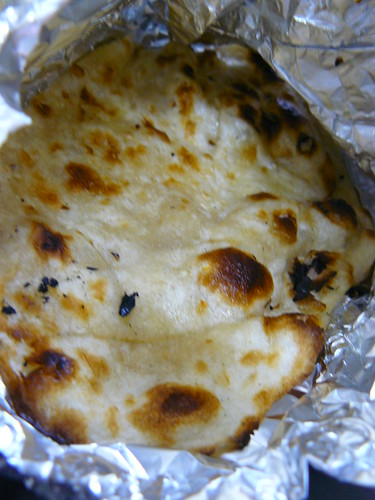
Naan wrapped in aluminum foil.
Concerns about aluminum in our diets have been rising since the mid-1960s when it was linked to Alzheimer’s disease. We encounter this metal from various sources, including cookware and clay dishes used for cooking or storing food, aluminum packaging, and even naturally occurring aluminum in foods like tea. Additionally, some foods contain aluminum-based additives, such as those found in baked goods.
Indeed, everyday foods like cake and tea can contribute to your daily aluminum intake. Research indicates that unprocessed foods typically have low aluminum levels, below 1 ppm and rarely exceeding 10 ppm. However, tea leaves present a different story. A study identifying rich sources of aluminum in Chinese food from Harbin highlighted tea leaves, Sichuan pepper, and mustard as significant contributors. Another study focusing on teas in Sichuan discovered that brick teas, primarily made from older leaves, contain the highest aluminum concentrations among tea types.
However, simply drinking tea might not be a significant source of dietary aluminum. Studies reveal that blood plasma and urine show minimal increases in aluminum levels after consuming black or green tea, even with milk or lemon juice.
What about aluminum leaching from pots, pans, dishes, or packaging? A 1992 study from Food Additives and Contaminants investigated this and found minimal or undetectable aluminum leaching from containers into food. However, the study emphasized that this can vary depending on the specific circumstances.
A 1993 study in Harbin, published in the Chinese Journal of Preventive Medicine (Zhonghua Yu Fang Yi Xue Za Zhi), concluded that people in Harbin consume an average of 4 to 15 mg of aluminum daily, rarely exceeding 20 mg. The study highlighted that tea leaves can contain 300 to 1,800 ppm of aluminum, with 16% to 20% of it being extractable. They added that food processing and handling could result in 10 to 30 ppm of aluminum in our food.
However, foods containing aluminum-based additives exhibit particularly high aluminum levels. These additives can include E523 (aluminum ammonium sulfate) used in industrial baking powder, or E541 (sodium aluminum phosphates), utilized in various products such as baked goods, cheese, confectionery, frozen fish, minced meat, and stews. Other additives include, but are not limited to, E554 (sodium aluminosilicate), E556 (calcium aluminum silicate), and E559 (aluminum silicate). According to researchers in China, consuming foods with these additives could lead to an intake of over 100 mg of aluminum daily.
A 1997 Indian study published in The Science of the Total Environment supports these findings, emphasizing baking powder as a significant aluminum source. They noted that a kilogram of cake made with one to three teaspoons of baking powder could contain 2 to 12.7 mg of aluminum per 25g serving.
The crucial question is: what constitutes excessive aluminum intake? The Agency for Toxic Substances and Disease Registry, part of the US Department of Health and Human Services, provides a toxicological profile for aluminum, setting minimum risk levels for exposure. It advises limiting oral exposure to a maximum of 1 mg of aluminum per kilogram of body weight daily. By avoiding baked goods and medications containing aluminum, we likely stay within safe limits. However, based on current knowledge, minimizing aluminum intake further can provide an added safety margin.
A 2003 study from Hong Kong, published in Environmental Geochemistry and Health, offers advice on reducing aluminum consumption from tea:
- Choose younger tea leaves.
- Indian tea varieties grown in the same region as Chinese varieties tend to have lower aluminum content.
- Opt for green tea over black tea as it contains less aluminum.
- Steep tea directly in the pot. The repeated infusion method (emptying and refilling the teapot with fresh boiling water) releases more aluminum than continuous infusion (leaving the tea to steep).
Regarding cooking:
- Boiling neutral (non-alkali and non-acidic) porridge in aluminum pans is safe as it doesn’t lead to aluminum migration.
- Milk causes minimal aluminum leaching, ranging from 0.2 to 0.8 mg/kg.
- Avoid prolonged boiling of tap water in aluminum pans. Boiling water in these pans can increase aluminum levels to 0.54 to 4.3 mg/l. This concentration rises with extended boiling time, reaching 6.3-17 mg/l. This could explain why adding more boiling water to tea also elevates aluminum levels. Another study indicated a more precise rise to 2.6 mg/l after 15 minutes of boiling water in aluminum pans.
- Exercise caution when cooking acidic foods in aluminum cookware. Foods containing acidic fruit juices and cooked in aluminum pans showed aluminum levels between 2.9 and 35 mg/kg. The highest recorded concentration, 170 mg/kg, was found in rhubarb juice prepared in a steaming vessel. Tomato sauce made from mashed tomatoes and cooked in uncoated aluminum pans for an hour contained 10-15 mg/kg of aluminum.
When storing food and liquids in aluminum containers:
- Coffee appears to be safe, exhibiting lower aluminum levels than the tap water used in its preparation.
- Coca-Cola stored in internally lacquered aluminum cans releases minimal aluminum (below 0.25 mg/l).
- Avoid storing acidic liquids in aluminum. Lime blossom tea with lemon juice, stored in uncoated aluminum camping bottles for five days, showed aluminum levels up to 7 mg/l.
Editor’s note: The reported aluminum content is directly from research papers, using various units like parts per million (ppm), mg/l, and mg/kg, making direct comparisons challenging. However, for water, mg/l and mg/kg are equivalent as 1 g of water equals 1 ml.
These figures are from a 1993 study conducted in Harbin, published in the Chinese Journal of Preventive Medicine (Zhonghua Yu Fang Yi Xue Za Zhi).
*_Some of these additives are banned in certain countries.
*__These figures are from a 1992 study in Food Additives and Contaminants.
*___These figures come from a 1993 study published in Zeitschrift für Lebensmittel-Untersuchung und -Forschung.