After a short break from posting on the Beolover Blog, I’m starting a new restoration project. An owner sent me two Beomaster 1900 receivers, which I completely understand as a Bang & Olufsen collector who owns multiple units of the same component.
Both Beomaster 1900 units appear to be in good cosmetic condition.


Let’s begin with the first one.
As previously mentioned, the Beomaster 1900’s exterior looks quite good. However, there are a few common issues present. Almost all Beomaster 1900 and BM2400 receivers exhibit deterioration in the cabinet feet, control panel lid bumper pads, and veneer peeling on the cabinet trim.
This particular unit has problems in all three of those areas.




As with previous Beomaster 1900/2400 projects, I have replacement cabinet feet on hand. I’ll need to create new lid bumper pads. To address the veneer issues, I’ll glue and clamp the affected sections.
Prior to opening the cabinet, I briefly powered on the Beomaster to determine which lamps are functional.


As you can see, the Treble and Balance indicator lamps are not illuminated.


It seems that only those two lamps have burned out.
Now, let’s disassemble the cabinet to assess the internal condition.
We’ll start with the top of the cabinet. Two screws secure the Beomaster control panel to the frame. The photo of these screws also reveals the deteriorated lid bumper pads.

Four screws on the back of the Beomaster 1900 need to be removed.

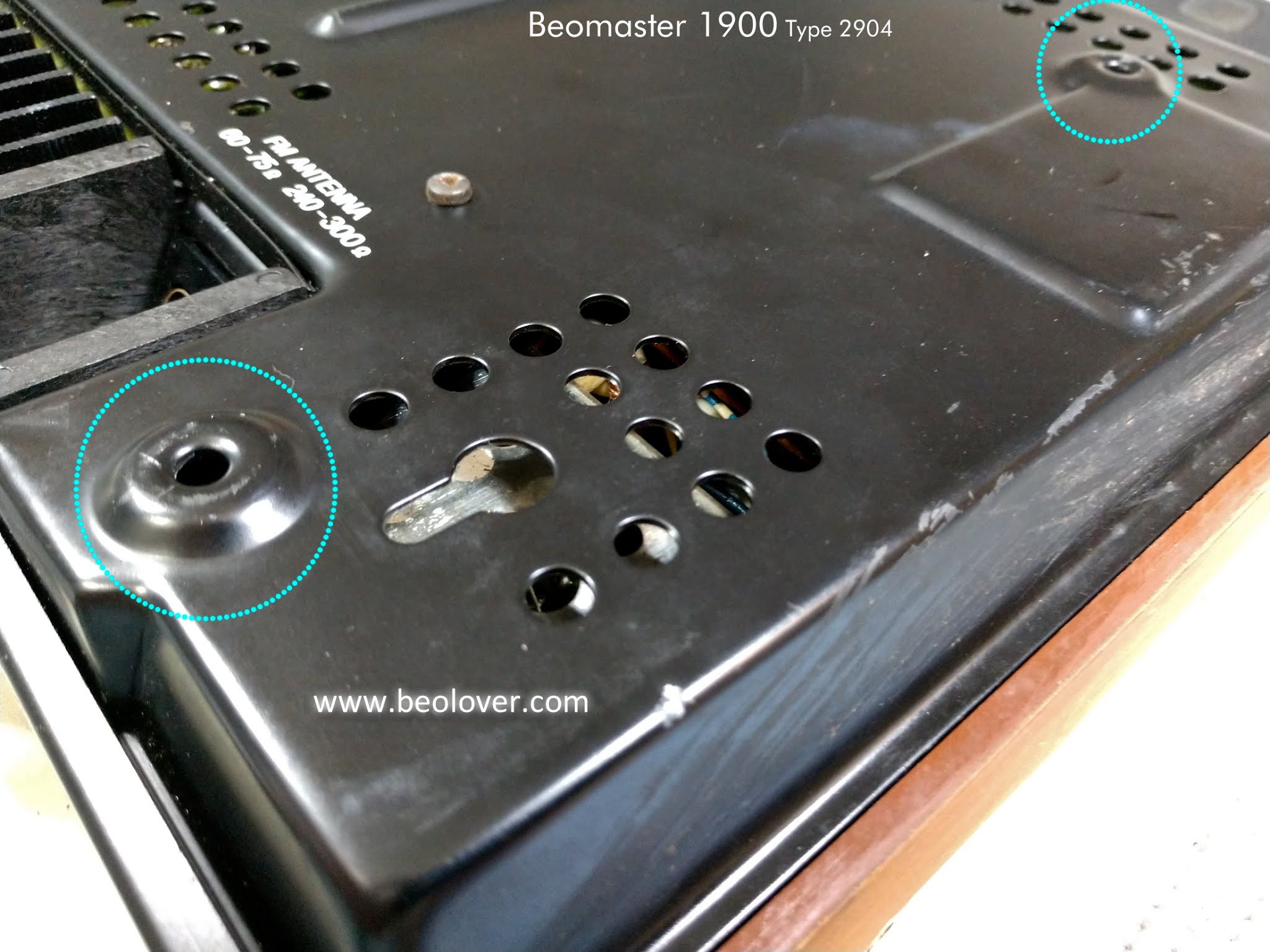
The cabinet’s bottom plate is secured by five or six screws, potentially depending on the serial number. Later Beomaster 1900 and Beomaster 2400 models have a longer screw located in the speaker/source connector cavity, which these early Beomaster 1900 units lack.
Additionally, this Beomaster unit’s cabinet base plate is missing a screw in the front left corner.

However, it does have the smaller, coarse-threaded screw with the lock washer.


Five screws need to be removed to access the button and display panel.


The two longer panel mounting screws on this early Beomaster 1900 model are simple slotted screws. Other Beomaster 1900 and 2400 units I’ve restored used identical brass-colored Phillips screws, similar to the shorter one in the picture. Since both sides of the cabinet are like this, I believe these screws are original. However, the brass screws on the front corners are missing washers.
With the panels removed, I can inspect the tone control and FM tuner select board located beneath the control panel and lid.


Interestingly, the Bass and Treble slide controls use a flat bar design for the plastic contact bridge, while the Balance control has a round metal slide bar.
I believe the Balance control’s style was a later design used in the Beomaster 2400 receiver. My previous Beomaster 2400 restoration project had this slider type for all three controls. These newer sliders seem less prone to the failures experienced by the flat bar versions. However, I’ve encountered Beomaster 2400 units with the flat bar design, so perhaps the Balance slider here was a previous repair.
Regardless, these three controls appear to be in good condition based on my initial visual assessment. I’ll examine them more thoroughly during the restoration process.
A visual inspection of the electrical components indicates that the electrolytic capacitors in this Beomaster are long overdue for replacement.
There’s evidence of a past repair on this Beomaster. Judging by the black residue on the main board, it appears the original rectifier bridge failed.
It has been replaced with a new bridge rectifier constructed from individual diodes. While functional, I’ll replace it with a proper, single-component bridge rectifier.
At least three capacitors near the bridge rectifier are not original and were likely replaced during the repair after the rectifier’s failure. The replacements appear to be of good quality.

Examining the underside (trace side) of the tone and FM tuning control board, I see that the board connectors are consistent with early Beomaster 1900 units.
These connectors are essentially small circuit boards with pins that plug into receptacles on the tone control board.
While functional, these require extra care when handling.
[![](https://blogger.googleusercontent.com/img/b/R29v