For those who are unfamiliar with Google Ads (previously AdWords) or are trying to finally master their Google Ads account, one of the initial challenges is figuring out how to effectively use the search and display networks. While the Search network can be effective for capturing customers actively seeking your offerings, emerging and specialized businesses may struggle to connect with individuals who aren’t yet familiar with their products and might not be actively searching for them on Google. Display advertising is a great option for advertisers aiming to generate that early interest in their product, allowing them to reach the most promising potential customers at a minimal expense.
AdWords advertisers will be pleased to know that the Google Display Network possesses by far the largest reach of any display network globally. GDN reaches 90% of internet users worldwide, encompassing 94% of all US internet users – with 64% reached daily – and 89% of US smartphone users. Utilizing the Google Display network provides a rapid means to showcase your ad on 120 of the top 200 most visited websites, including prominent platforms like YouTube (video), Blogger (blogging), Gmail (email), and access to a vast audience of 50 billion app downloads through Google Play. The Google Display Network delivers an impressive 2+ trillion ad impressions monthly to 2.5 billion internet users spanning over 2+ million websites.
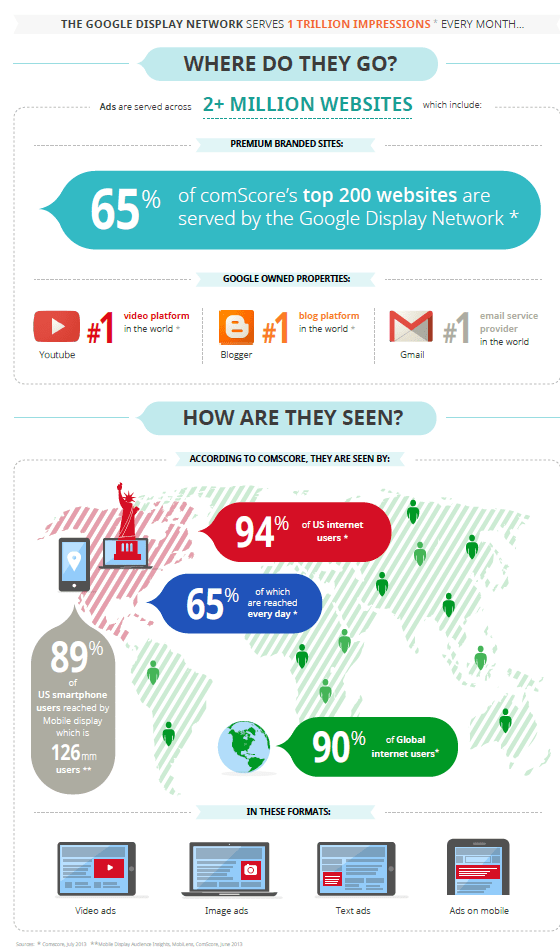
Source: Think With Google / Data: Comscore, 2013
Targeting Audiences on the Google Display Network
With literally millions of targeting options at their disposal, advertisers can find new customers on the Google Display Network; however, initially selecting the appropriate targets for your display campaign can feel daunting. Each targeting method can be broadly categorized into one of two groups:
- Website-focused: This approach targets a collection of websites based on specific parameters and displays ads to every user browsing those sites.
- User-focused targets: This method targets a specific group of users based on certain criteria, displaying ads to them across all the sites they visit within the Google Display Network.
Website-Based Audience Targeting Choices
Managed Placements: Managed placements offer the most straightforward way to target a specific website. You simply choose the website(s) or webpage(s) where you want your ads to appear. The Display Planner Tool can be used to obtain traffic and cost projections for a particular domain, discover which ad formats the site supports, and gather suggestions for other similar placements.
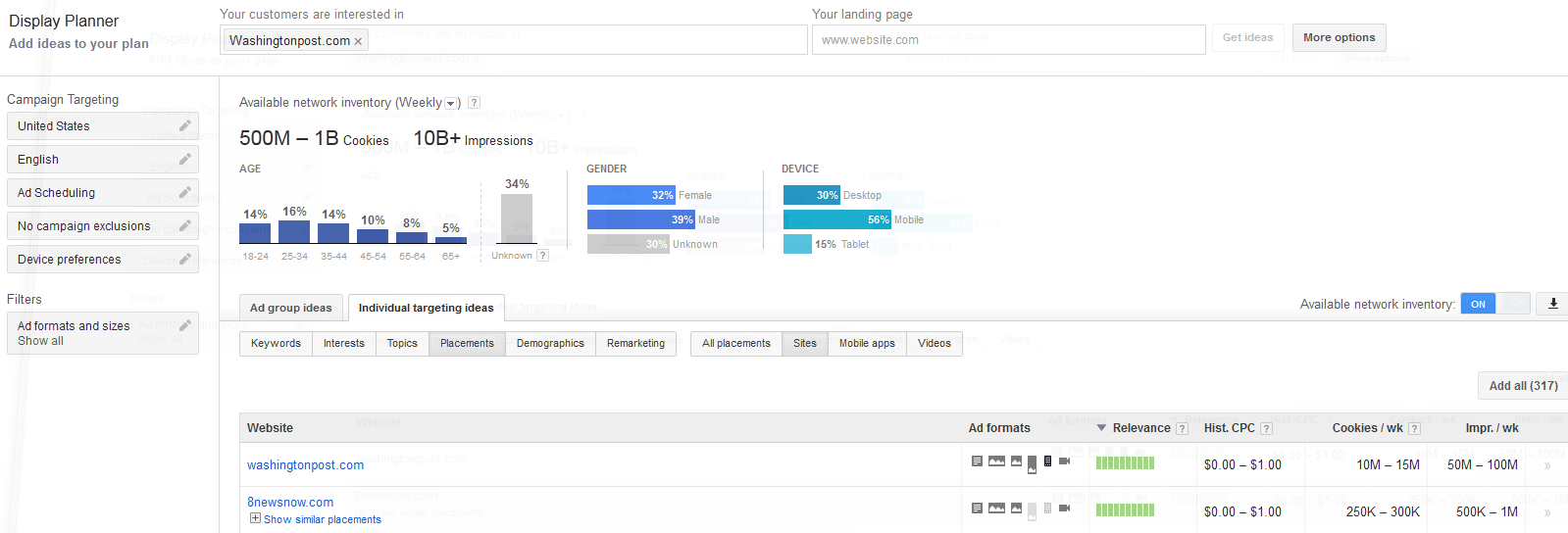
Topic Targeting: Topic targeting on the Google Display Network allows you to target every site and page related to a specific predefined subject. While similar to managed placements, topic targeting is considerably broader in scope, allowing advertisers to connect with a wider audience than they could through managed placements alone.
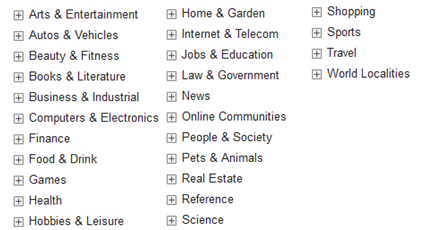
Main topic targeting categories offered on GDN; subcategories can be more specialized. Keyword Contextual Targeting: This form of targeting on GDN shares similarities with topic targeting but offers even more flexibility. It’s an excellent option if the topic you’re targeting isn’t among the many predefined topics offered by Google. By generating a list of keywords, your ads will be matched to pages containing contextually relevant content.
User-Based Audience Targeting Choices:
As previously mentioned, this method focuses on targeting specific users, displaying ads to them on all the sites they visit within the Google Display Network. Remarketing: One of the most effective targeting tools available on GDN, Google display remarketing allows you to present ads to past visitors of your site as they explore the web. This keeps your product and brand at the forefront of their minds even after leaving your website. Remarketing also allows for differentiated engagement with high-value visitors, such as those who have previously made purchases, viewed crucial pages (like product or pricing pages), or demonstrated significant interaction with your site, compared to those who haven’t. Note: As of June 2020, you can create remarketing lists based on email addresses due to Google Ads extending Customer Match to the GDN. Similar Audiences: Similar audience targeting helps attract new users to your site who exhibit browsing and search patterns similar to those already on your remarketing lists. This form of targeting is an ideal next step for advertisers who have found success with remarketing and are seeking to identify their next best audience. In-Market Audiences: In-market audience targeting focuses on displaying your ad to users whose online search and browsing behaviors suggest they might be actively considering purchasing a particular product or service. For instance, a user who frequently searches for “Temp Jobs” and starts visiting relevant job postings on platforms like Monster.com could be identified as “in-market” for a temporary or seasonal position. In-market audience targeting works best for products or services with longer research and purchase cycles. Interests: This type of targeting aligns your ads with users who have recently begun exploring websites related to a particular topic. It’s a great strategy for connecting with potential customers who are just starting to develop an interest in something. For these casual users, think about customizing your offer and highlighting products or services suitable for beginners or novices.
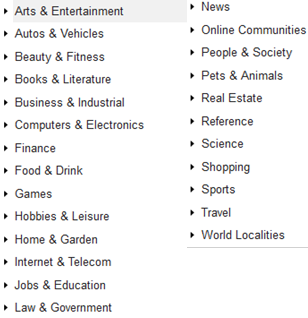
Primary interest categories on GDN; subcategories can be more specific. Affinity: While similar to interest targeting, affinity targeting matches your ads with users who consistently visit sites related to a particular topic. Consider these users as having long-term interests - they are your dedicated and experienced users. For these seasoned individuals, tailor your offer and promote more advanced or specialized products and services.
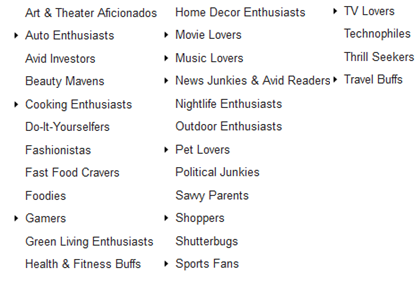
Main affinity targets on GDN.
Demographic Targeting on the Google Display Network
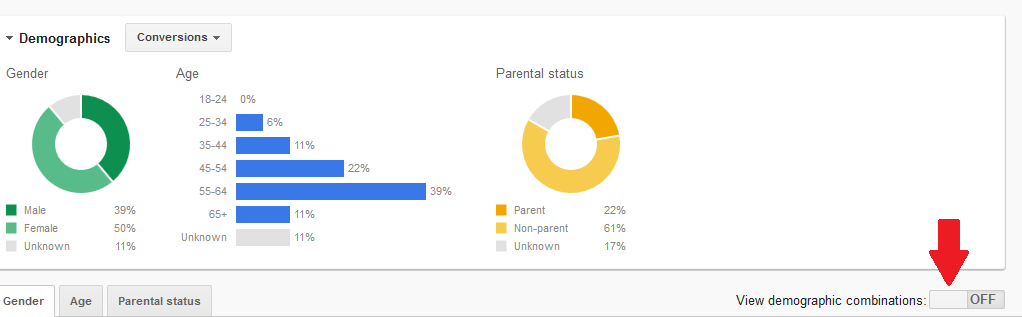
In addition to the numerous website- and user-based targeting strategies, demographic targets based on a user’s gender, age group, and parental status can be incorporated. Advertisers can either exclude or establish customized bid adjustments for users based on these demographics. The implications for certain advertisers catering to a specific and homogenous key demographic are evident. If your industry heavily relies on a particular gender, age range, or parental status (e.g., women’s apparel, retirement planning, or baby products), demographic targeting could be a potent tool for you to employ.
The Google Display Network is a valuable platform for showcasing your brand to a wide spectrum of new users who may not yet be actively searching for your product on Google. Its advanced website and user-based targeting options, coupled with layered demographic targeting, provide ample opportunities to experiment and discover your target audience, regardless of how niche it may be. Planning ahead is essential, however. The Google Display Network offers over 3,000 predefined targeting options, with more being introduced continuously. To help you effectively plan your display endeavors and uncover new successful targeting strategies, we’ve compiled the latest comprehensive list of GDN targets, which you can download here.