Bidding on competitors’ branded keywords in Google Ads is a common tactic but can be pricey. Imagine you’re a CRM company targeting competitor keywords in the US; you might pay anywhere from $7.17 to a hefty $69.61!
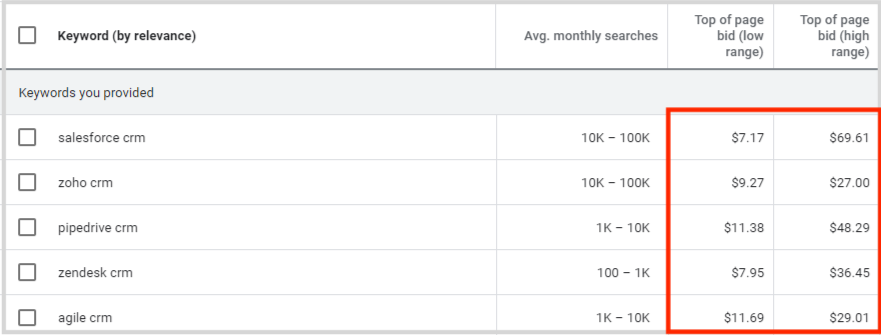 Luckily, the Search Network isn’t your only option.
9 budget-friendly ways to reach competitor audiences
While audience targeting varies across platforms and search ad intent differs from social media, you can still connect with potential customers interested in your competitors.
- Use competitor keywords in custom audiences
- Create custom audiences using competitor website addresses
- Run YouTube ads on competitor videos
1. Use competitor keywords in custom audiences
Google Ads now combines custom intent and custom affinity audiences into one feature, allowing for more targeted outreach and competitive advertising based on campaign goals.
How it works
This approach displays your Video and Discovery campaigns to users who’ve searched for competitor-related terms.
How to set it up
Navigate to Tools & Settings > Shared Library > Audience Manager to build your custom audience. Select the option to reach “People who searched for any of these terms on Google."
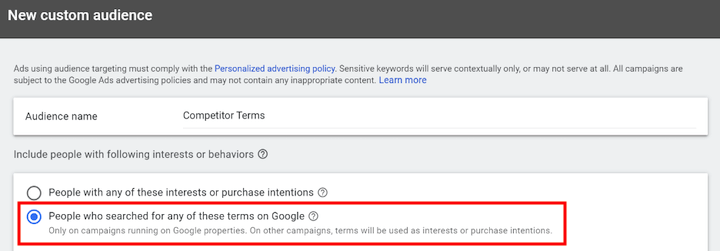
“On Google” is crucial, as it signifies targeting individuals who’ve used specific terms within Google’s network, like YouTube and Google.com. Yes, you read that right! Here’s Google’s explanation: “Enter search terms your ideal customer is using on Google. Your ads will reach people who search for those and similar terms only on campaigns running on Google properties. On other campaigns, the terms will be used as interests or purchase intentions.” Now, input your competitor keywords into your new Custom Audience. For instance, if you sell laptops and compete with Asus, you might add: asus laptop reviews, asus laptop issues, asus i5 laptop, best asus gaming laptop, and similar terms.
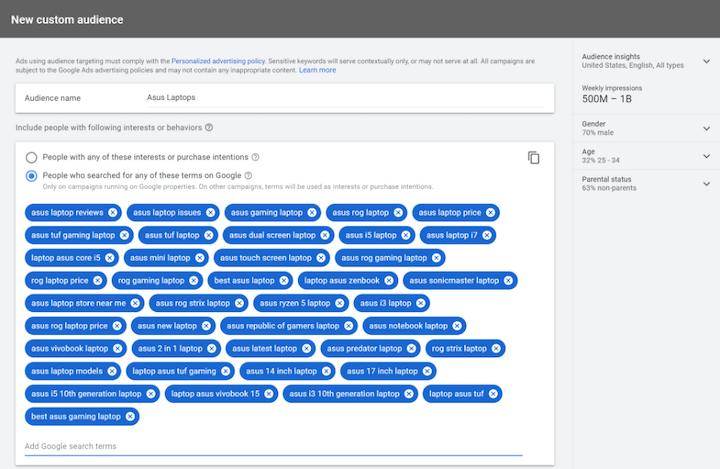
Searching for these terms on Google and YouTube indicates stronger intent than a general awareness audience. Custom audiences, while broader than bidding directly on competitor brand names in Search, allow you to engage a highly relevant audience and potentially sway their purchasing decisions in your favor.
Considerations
Remember the last part of Google’s quote: “On other campaigns, the terms will be used as interests or purchase intentions.” This implies that the setting applies to YouTube and Discovery campaigns (which include Gmail placements) since they’re Google Properties. While Custom Audiences can be used for Display campaigns, Display placements aren’t Google properties. Experiment with them for your Video and Discovery campaigns to reach your competitors’ audience differently. RELATED: How to Do Competitor Keyword Analysis in 5 Steps (+Free Template!)
2. Create custom audiences using competitor website addresses
Custom Audiences also allow targeting based on competitor URLs, a tactic I favored during the Custom Affinity days.
How it works
This method uses your competitors’ web addresses to create an audience.
How to set it up
Create a new custom audience and select “Include people with the following interests or behaviors." Under that, click “Expand audience by also including:” and choose “People who browse types of websites.”
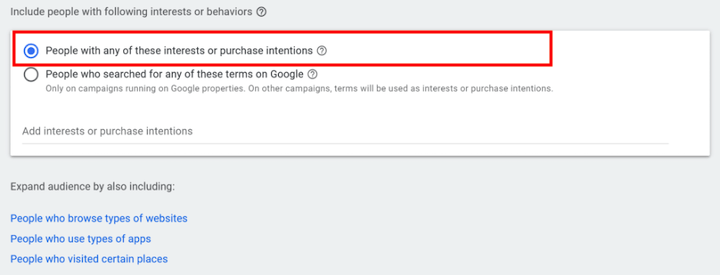
Next, select “People who browse websites similar to” and you’ll see a space to add as many competitor web pages as needed. In my laptop seller example, I’d add URLs like www.dell.com/en-us, www.asus.com/us/, store.acer.com/en-us/laptops, and so on.
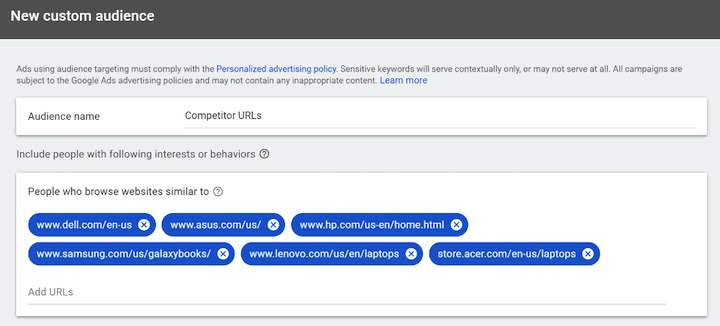
While less precise than targeting past search terms, this focuses on user behavior if your competitors share similar websites. Use this for a higher-funnel approach to introduce your brand to potentially interested users.
Considerations
This targeting differs from using search terms. You’re not targeting individuals who visited the specific URLs entered (that requires your tag on their sites), nor is this placement targeting for the Display Network. Instead, it instructs Google to target your ads to users who visit sites similar to those listed.
3. Place YouTube ads on competitor videos
This strategy leverages placement targeting specifically for YouTube, allowing you to reach your competitors’ audience directly on their videos. One of the most satisfying parts of my job is showing clients the placement report, revealing the awareness, views, and conversions driven by ads on their competitors’ YouTube videos or YouTube channel.
How it works
This paid media strategy puts your message in front of those watching your competitors’ YouTube content.
How to set it up
Go to your YouTube ad placement options.
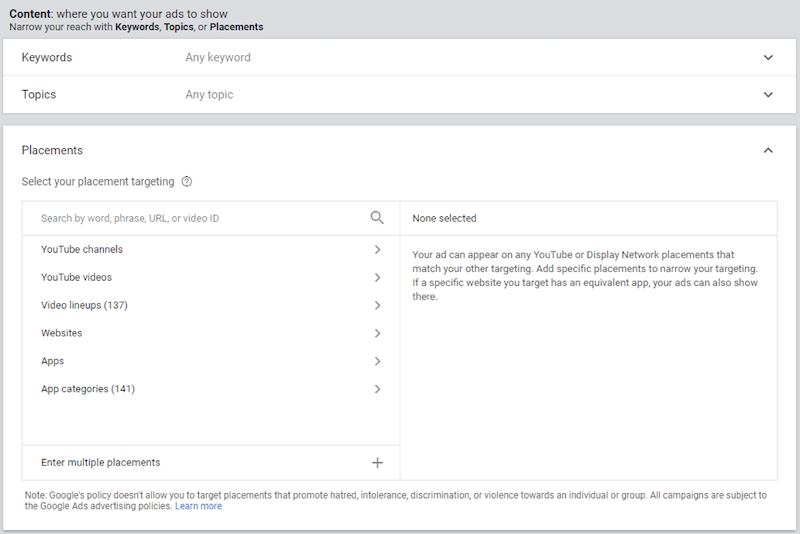
Sticking with the laptop example, I typed in hewlett packard.
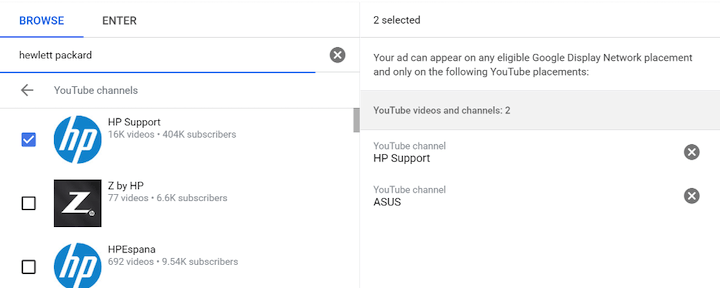
You can choose to target specific videos or an entire channel if it aligns with your strategy.
Considerations
When using managed placement ad groups on YouTube or the Display Network, note that your ads become eligible to run on both. Regularly check your placement reports to ensure your ads appear where intended.
4. YouTube search results
Initially, In-feed video ads (formerly TrueView Discovery) were the only YouTube placement where advertisers could target search result pages solely. This has evolved with responsive video ads, but the setup remains similar. Remember, YouTube is the second largest search engine behind Google.com. In-feed video ads can secure the top spot on YouTube search results.
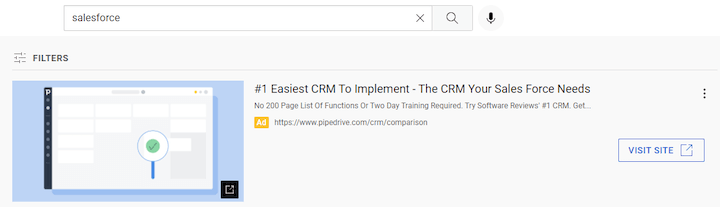 While the example above isn’t a video ad, they can appear at the top. Other CRM companies could show up when users search for Salesforce videos, claiming that prime position. It’s simple: when setting up your video campaign in Google Ads, go to Networks and choose to target YouTube search results exclusively.
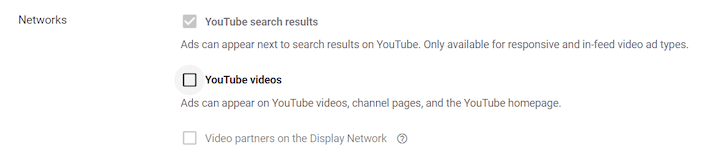 You don’t always have to limit yourself, but it’s an option. When I do, it’s the only time I use keyword targeting for video campaigns. Volume might be lower without audience targeting, but results are more focused.
I often see higher view and completion rates with YouTube results page campaigns due to their specific nature.
You don’t always have to limit yourself, but it’s an option. When I do, it’s the only time I use keyword targeting for video campaigns. Volume might be lower without audience targeting, but results are more focused.
I often see higher view and completion rates with YouTube results page campaigns due to their specific nature.
 Caution! Use a video suitable as a competitive ad. People go to YouTube to watch videos, and with In-feed videos, you pay per view. Create a longer, engaging video highlighting your strengths.
5. Quora ads by topics or interests
Quora, a Q&A platform, offers diverse targeting options. The most precise (but lowest volume) is targeting individual questions. This allows you to pinpoint where your ad appears.
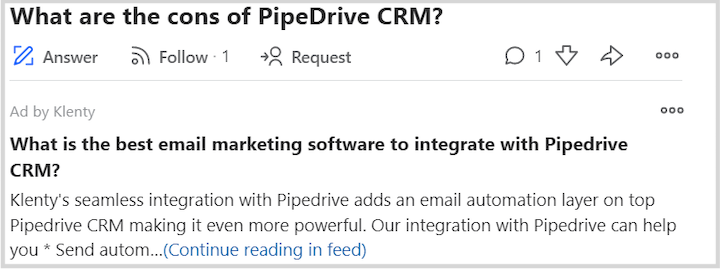 If users are researching the best CRM or, as in the example, flaws of specific CRMs, your ad can appear there, showcasing your product’s superiority. However, question targeting has limited reach, so I suggest starting with Topics or Interests.
Quora question targeting has limited volume, making Topics or Interests a better starting point. Quora categorizes questions under Topics. Targeting a Topic displays your ad on any question within it while a user is on that page. Interests work similarly, targeting users who’ve recently interacted with a Topic’s questions or answers.
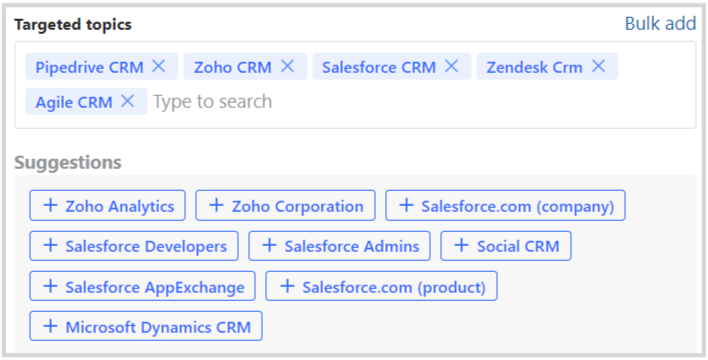 Here, my competitors appear as Topics on Quora. These five Topics receive 200,000 to 300,000 weekly impressions—a decent volume. What about the recommended bid?
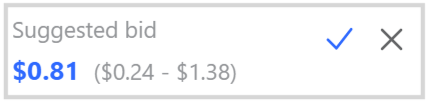
It ranges from $0.24 to $1.28! Even the highest bid is significantly lower than Google Search. You likely have room in your budget to shift wasted ad spend to test Quora. **>>**Use our Free Google Ads Grader or Free Facebook Ads Grader to identify areas for improvement.
6. LinkedIn Member Groups
LinkedIn ads can be costly, but it doesn’t have to be that way. Alternatives to popular (and pricey) Job Title or Company targeting exist. I utilize Member Groups to find users interested in my services or, in this case, my competitors’. For this example, I could target groups related to Salesforce, Zoho, Pipedrive, Agile, and Zendesk:
 These are just a few, but targeting users engaged in product-related discussions can be very effective. Admittedly, convincing brand loyalists to switch can be challenging, so assess each group’s discussions. If you spot complaints, pain points, or opportunities to highlight your superior features, targeting these groups might be worthwhile.
What about the cost for these Member Groups?
These are just a few, but targeting users engaged in product-related discussions can be very effective. Admittedly, convincing brand loyalists to switch can be challenging, so assess each group’s discussions. If you spot complaints, pain points, or opportunities to highlight your superior features, targeting these groups might be worthwhile.
What about the cost for these Member Groups?
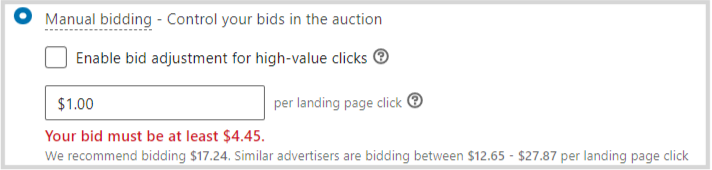 It’s $12.65 – $27.87, with a $17.24 recommendation. Manual bidding allows a minimum bid of $4.45—far less than Google Search. Even using recommendations, it remains cheaper. This presents another avenue if competitor Search campaigns aren’t delivering.
Converting dedicated product users in groups is difficult. Analyze group discussions for complaints or pain points to leverage.
7. Twitter follower look-alikes
This is less direct than other options but still viable. While directly targeting Twitter followers is impossible, you can target those exhibiting similar behaviors. How does Twitter identify them? Twitter’s states explanation: “We determine users similar to those who follow accounts based on a variety of signals, including what they Retweet, click on, Tweet, and more.” When setting up your ad group, go to Targeting Features and find Follower look-alikes. Input and select your competitors’ Twitter handles.
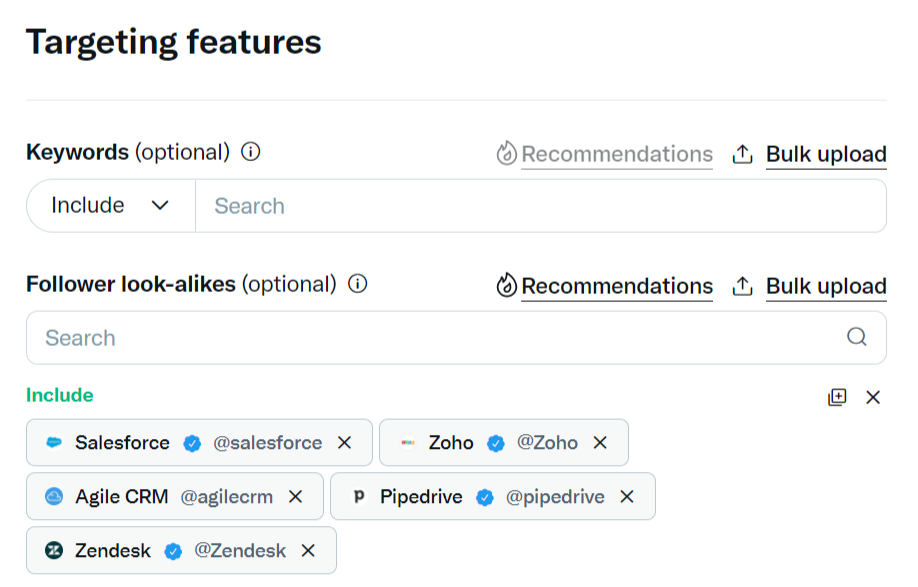 Twitter suggests targeting at least thirty accounts, but take that with a grain of salt. Focus on accounts aligning with your audience, regardless of the number. Let’s examine the costs.
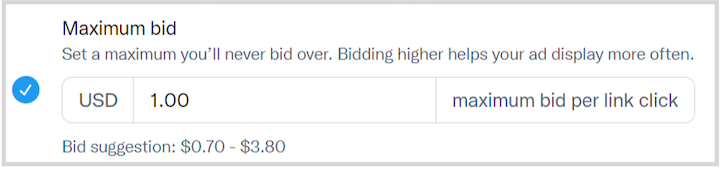 It’s $0.70 – $3.80 without additional targeting layers. Again, significantly lower bids than Google. Though less precise than keyword targeting, it leverages your competitors’ brand recognition to reach a relevant audience.
Twitter advises targeting at least thirty accounts for follower look-alikes, but prioritize accounts truly relevant to your audience.
8. Reddit Communities
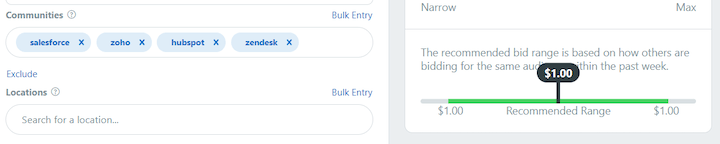
Reddit, while not a social media giant, is among the most visited websites globally, suggesting a portion of your target audience uses it. Naturally, Reddit offers advertising. While basic targeting options are broad (and not recommended unless you have a large budget), one area stands out: “Communities.” Communities are essentially Subreddits—topic-specific groups on Reddit that can often be targeted with ads. Explore if your competitors are listed.
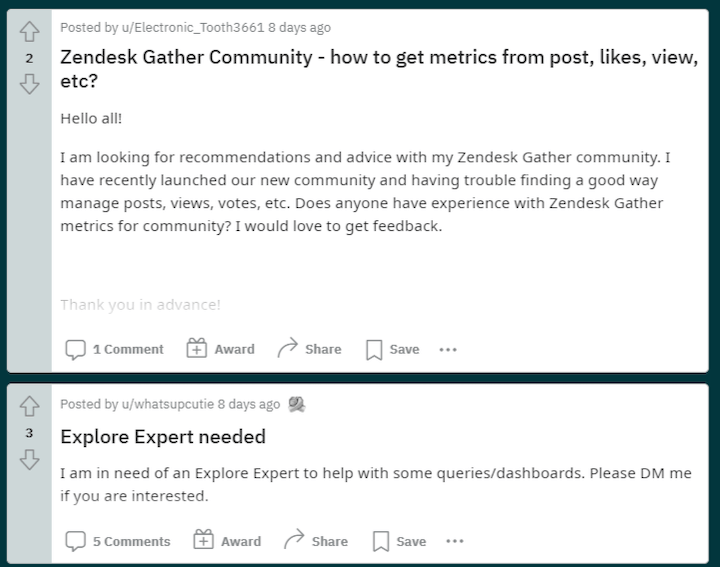 In this example, I chose an industry with larger competitor brands because not all Subreddits are targetable Communities. This option might suit brands with well-known competitors or those targeting audiences similar to their competitors’.
So, for my CRM platform, I might target Communities related to Salesforce, Zoho, HubSpot, and Zendesk.
In this example, I chose an industry with larger competitor brands because not all Subreddits are targetable Communities. This option might suit brands with well-known competitors or those targeting audiences similar to their competitors’.
So, for my CRM platform, I might target Communities related to Salesforce, Zoho, HubSpot, and Zendesk.
 Caution! Reddit’s user base is unique—many dislike overt advertising and won’t hesitate to voice their opinions. Research each targeted Community:
- How do users engage within the Community?
- What’s the overall tone and communication style?
- Is it primarily educational or entertainment-focused? Your ads should mirror the Community’s tone, crucial when targeting competitors, as you’ll reach potentially loyal users.
9. Almost everywhere (with retargeting)
This often-overlooked strategy is incredibly effective for staying top-of-mind with your competition’s audience. Most paid media platforms offer URL-based audiences for retargeting, including:
- Google (Search, Display, Discovery, YouTube)
- Facebook/Instagram (Facebook retargeting tactics here.)
- Microsoft (Search, Audience Ads)
- Quora
- Snapchat
- TikTok
- Taboola
- Outbrain
- Yahoo Native
- And many more! Retargeting effectively re-engages users who initially found your site through a competitor campaign. For guidance, check out these resources:
- All the Remarketing Audiences You Should Be Targeting in PPC
- 7 Super-Creative, Crazy-Effective Retargeting Ad Ideas
- The Best Remarketing Ads We’ve Ever Seen
Caution! Whether targeting via Search or other means, add UTM parameters to your ad URLs. Use clear naming conventions to differentiate traffic from competitor-targeted campaigns.
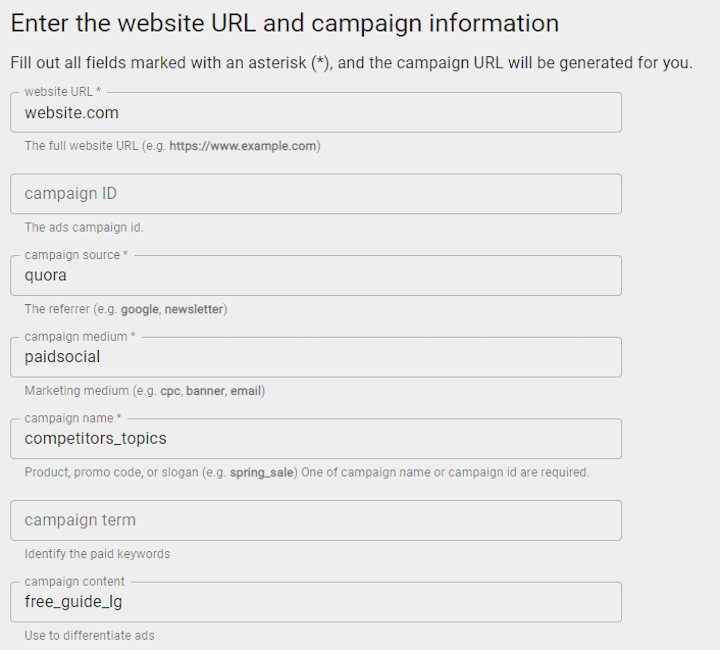 This example from Google’s Campaign URL Builder shows how I used “competitor” in my campaign name for a hypothetical Quora Ads campaign. This tracks visits from this specific campaign. Replicate this across all competitor campaigns and channels within your paid media strategy.
Consistent competitor naming conventions across channels are crucial for combining all competitor campaign visits into one audience, providing a larger pool for retargeting and potentially saving money compared to expensive competitor keywords.
This example from Google’s Campaign URL Builder shows how I used “competitor” in my campaign name for a hypothetical Quora Ads campaign. This tracks visits from this specific campaign. Replicate this across all competitor campaigns and channels within your paid media strategy.
Consistent competitor naming conventions across channels are crucial for combining all competitor campaign visits into one audience, providing a larger pool for retargeting and potentially saving money compared to expensive competitor keywords.
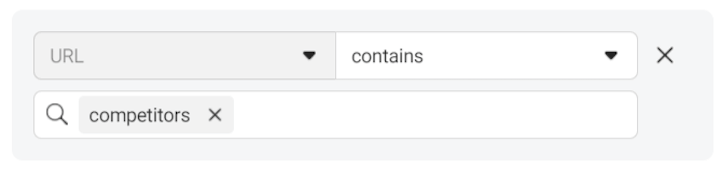 If needed, segment competitor campaign audiences based on the channel or initial ad experience using your UTM parameters. Remember, tailor your retargeting approach to the user journey after their first interaction with your brand.
Reach competitor audiences affordably
While search engine keywords indicate stronger intent, people visit far more than just Google or Bing. Paid social platforms offer effective, budget-friendly alternatives for leveraging competitor targeting. As mentioned earlier, most accounts have room for optimization. Redirect that budget to experiment with various paid media strategies on different channels. Explore how to enhance your competitor analysis here. The outcomes might surprise you!