The power of words cannot be overstated. People may not read everything, but they do scan. In milliseconds, they subconsciously process information and decide whether to engage or leave. Therefore, seemingly harmless words, like “Submit” on a button, can have significant consequences, driving visitors away in large numbers.
Let’s explore why this happens and uncover other conversion-killing words to eliminate from your emails, ads, and landing pages immediately.
Conversion Killer #1: “Submit”
“Submit” originates from the word submission, which poses a problem. This isn’t about 50 Shades of Grey, but rather the negative association with yielding to something or someone dominant. Generally, people dislike yielding. (Think back to the American Revolution.) This feeling intensifies when there’s even a hint of potential payment involved. Dan Zarella and HubSpot proved this years ago by analyzing the conversion rates of over 40,000 customer landing pages. A significant difference quickly emerged…
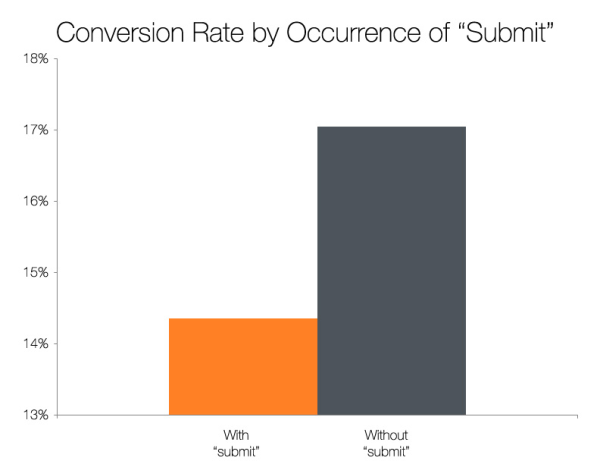
Conversion rates consistently plummeted by a few percentage points when CTA buttons featured the word “submit.” To confirm these findings, they ran another test, randomly rotating CTA text between various options. Here are the results:
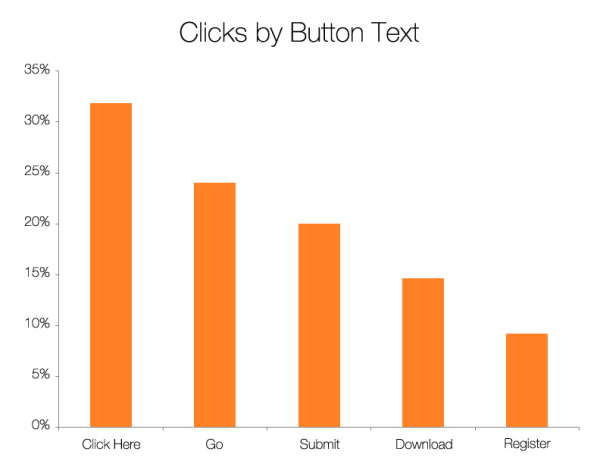
Unsurprisingly, “submit” underperformed compared to other common CTA options like “click here” or “go.” The hypothesis is that these alternatives feel less committal and suggest a smaller investment of time and effort. Besides the negative connotation, the word “submit” is also vague and generic. Generally, the most effective CTAs are specific and action-oriented. They begin with a verb or action word that conveys the benefit received (e.g., “Click Here to Download Your Report”). Here’s why generic quickly becomes meaningless.
Conversion Killer #2: “Synergy”
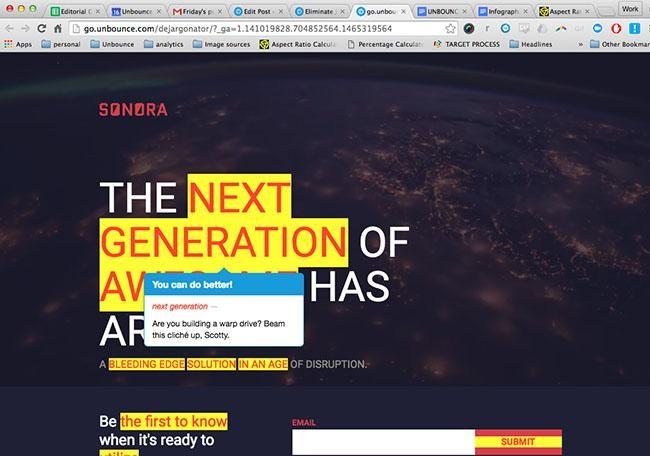
Want to learn terrible copywriting quickly? Get an MBA. In just a few short weeks, you’ll find yourself using words like “synergy,” “competencies,” and other meaningless clichés that make old professors nod in approval (coming from someone with an MBA). For proof, visit almost any B2B website outside of marketing and advertising. Get ready for your eyes to glaze over, your face to contort, and a sudden wave of sleepiness to hit you. Often, clients and bosses don’t even notice the problem initially. They’ve been drinking the Kool-Aid for too long, much like your crazy cat-lady aunt who’s oblivious to the overpowering scent of catnip, hairballs, and litter boxes in her house. Thankfully, the good folks at Unbounce created the amazing Dejargonator to quickly and humorously identify these problems for the people we report to.
The issue with “best in class” and all other common business jargon (apart from appearing on every competitor’s website) is that customers see right through it. Peep at ConversionXL explains this best, referring to cognitive fluency and “the heuristic that Easy = True.” Sounds ridiculous, right? However, Peep references research demonstrating that company names that are easy to pronounce perform perform better in stock markets (hardly the epitome of rational decision-making), and simple fonts are more believable. In other words, as the Boston Globe highlights, “it turns out that people prefer things that are easy to think about to those that are hard.” But wait, there’s more! The average person’s reading comprehension is ain’t that good. So anything beyond a 7th or 8th-grade reading level becomes too challenging and complex (which is quite low, really). Secondly, people don’t focus or read online; they scanning and multitasking and browsing and tweeting while partially looking at your page. The solution in most cases? Cut the fluff. Rewrite anything remotely resembling what you learned in skool school.
 Want even more ad copywriting tips? Download our free guide
>> 10 Tricks to Write Exceptional PPC Ad Copy (With Examples!)
Conversion Killer #3: “Spam”
Not the canned meat, but the overwhelming flood of unwanted graymail your customers endure daily. They are bombarded with hundreds of emails each day. Marketers send out Trillions every year. Logically, reassuring visitors that you won’t spam them should boost conversions. Right? Wrong. “Spam” is a major stop word that makes people wary and hesitant. A test by Michael Aargaard revealed surprising consequences. He added the seemingly harmless phrase “100% privacy - We will never spam you” between the form fields and the submission button. Typically, these extra credibility indicators around a CTA boost conversions. But not this time.
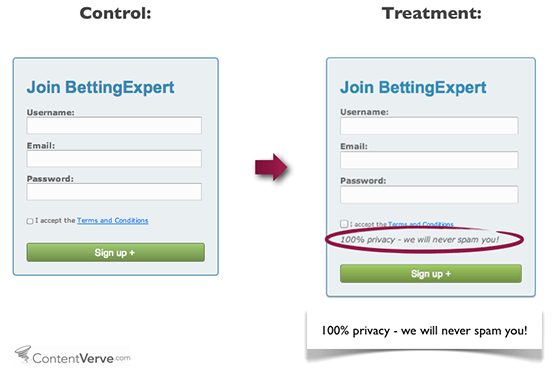
Surprising, right? A statement assuring privacy backfired by over 18%. So Michael adjusted his approach. He wanted to convey the same message but change the wording from a negative connotation (mentioning “spam,” which people weren’t thinking about) to a positive one. The winning variation, “We guarantee 100% privacy. Your information will not be shared,” increased conversions by 19.47%.
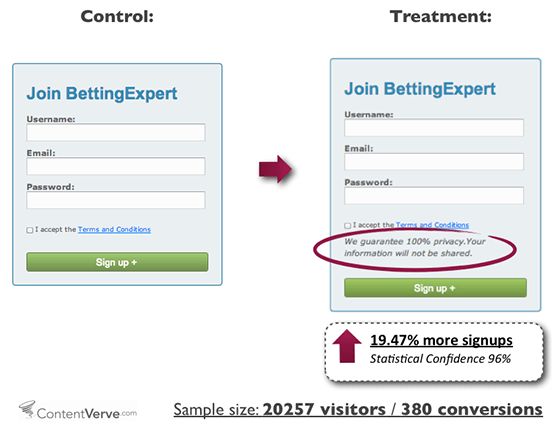
Michael replicated this experiment multiple times, consistently observing poor results when introducing the possibility of “spam.”
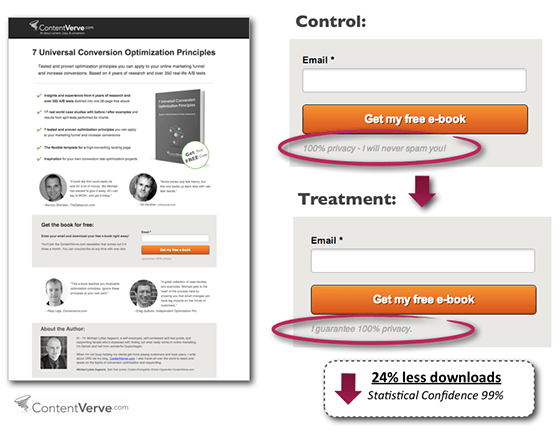
The takeaway? Avoid words with negative connotations (like “submit”) and reinforce the positive aspects of what someone is about to gain through additional messaging.
Conversion Killer #4: “We”
“We” is like the gateway drug of bad copywriting. One taste, and you’re hooked on stronger stuff. Though seemingly harmless, “we” puts you on a slippery slope to craving “synergy” and “best in class” in no time. Remember, people generally don’t care about you. They seek a “better version of themselves.” This holds especially true for top-of-the-funnel visitors who haven’t realized their need for your product or service. They’re Googling solutions for hanging a picture, not searching for a drill (yet).
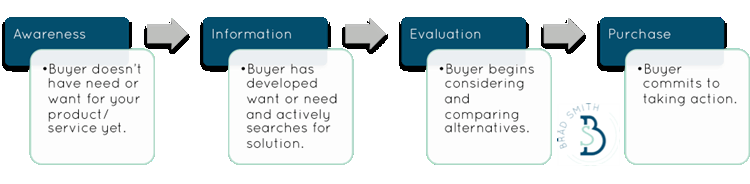
Therefore, your messaging should focus on their problem and its solution, not a specific tool, product, or service.

Joanna Wiebe attributes this to a lack of trust. She quotes Rohit Bhargava on Likeonomics: “The first and most basic reason for distrust is because there are so many companies and people who choose to lie to us either by making misleading claims or simply by hiding the truth.” Instead of “we,” Joanna suggests starting with:
- “You”… or
- No pronoun at all (like a question or a call to action)
Conversion Killer #5: “Your”
Most website copy uses the second person, which is good! Copywriters are taught to use “you” instead of “they” when explaining the benefits of a product or service. Take, for instance, writing a blog post about words that hurt conversions. To maximize impact, you would address a specific audience using “you” as much as possible. However, there are exceptions. When emphasizing a CTA or a specific conversion event, switch the “possessive determiner” back to the first person. Another test from Michael Aagaard illustrates this perfectly. Initially, Michael believed using “your” in CTA button copy would be most effective. After all, it’s everywhere online. However, here’s what he discovered.
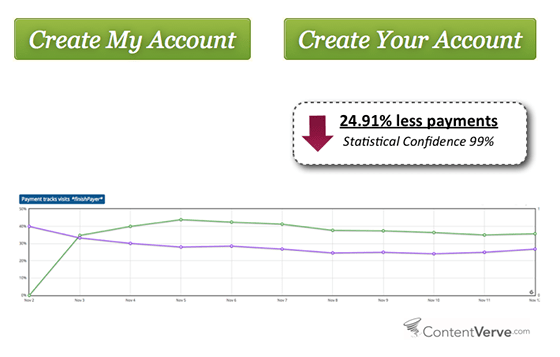
A nearly 25% difference from changing just one word. He replicated this on an Unbounce landing page, replacing “your” free trial with “my” free trial, and observed similarly significant results.
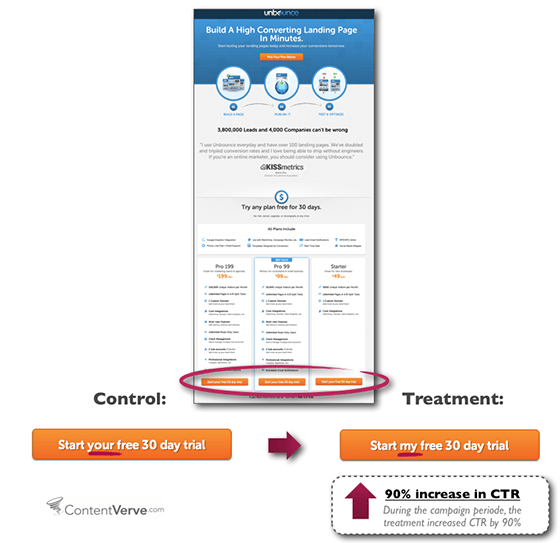
While most landing pages and blog posts should address a single person using “you” and “your” frequently… When crafting CTA copy, switch to “my” to give people ownership of the benefit they’re about to receive.
Conversion Killer #6: “Free”
While it seems counterintuitive, “free” doesn’t always increase conversions. The previous example used a “free trial” to pique interest (and clicks). But as always, there are exceptions. The first (minor) problem is that “free” can trigger spam filters in emails. The second, more significant issue is a curious case of over-optimization. For example, fewer form fields generally lead to higher conversion rates. Shortening your landing page form from a daunting 11 fields to just four can boost conversions by 120%. The problem is that more conversions aren’t always better. A Totango study revealed that 70% of free trial sign-ups are useless, with only ~20% actively evaluating the product.
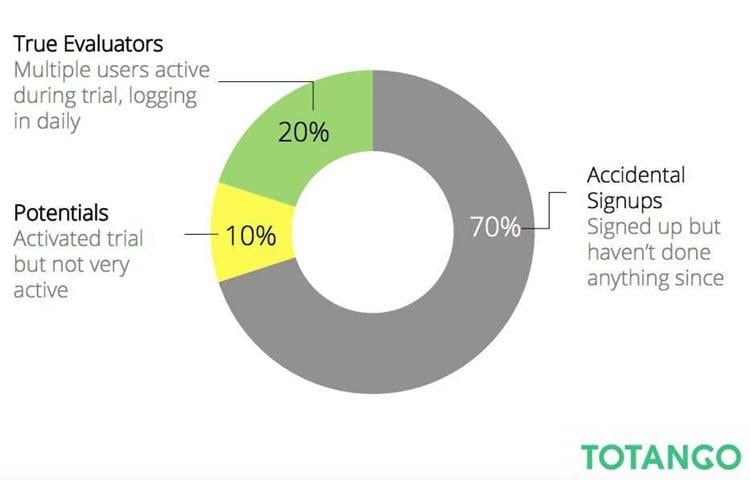
Years ago, software company Moz discovered that their most valuable customers converted after 8+ visits, not on their first or second. Rand Fishkin reported. While “free” can increase initial conversions, you should optimize for sales and revenue – not vanity metrics like leads or impressive (but empty) conversion rates. Robert from Neuromarketing suggests that “if you are trying to encourage sampling of a product that appeals to a specific audience…a very modest charge will throttle demand but will eliminate most samplers who have no use for the product.”
Conversion Killer #7. “Save Time & Money”
We’ve established that vague, meaningless, and overly generic phrases harm conversions. “Save time and money” embodies all of these – the epitome of conversion-repelling phrases. This seemingly harmless phrase is particularly disliked by Joanna Wiebe, who refers to it as “lazy ass messaging.” Why would this phrase evoke such strong feelings in someone known for her pleasant demeanor? Because it combines the worst aspects of the previous six words into one conversion-killing monster. It violates one of copywriting’s cardinal rules: writing to a specific audience. Joanna demonstrates that people value either time or money, not both equally. The easiest solution isn’t a copywriting trick but rather a strategic one. Implement inbound funnel segmentation to target only one audience per dedicated page (by linking your content to a specific acquisition channel or segment).
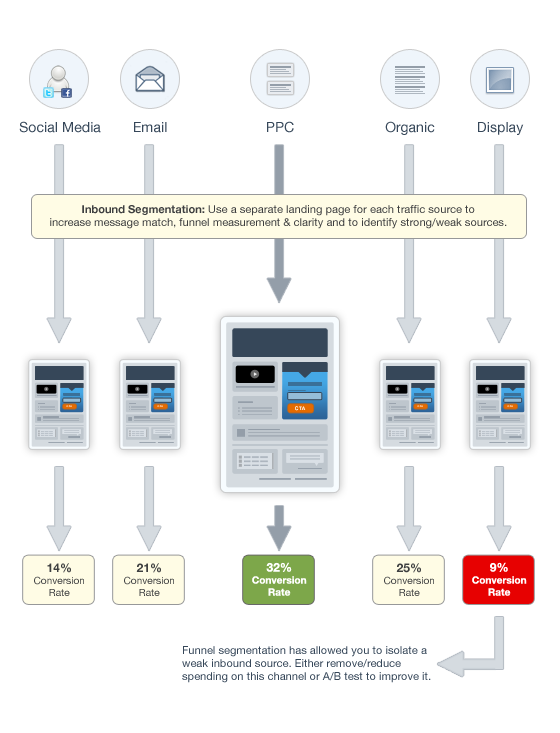
But what if catering to multiple audiences is unavoidable, like on your homepage? Then dig deeper into who you’re addressing and what matters most to them. Joanna demonstrates this perfectly gets all the credit with her impressive Venn diagram skills:
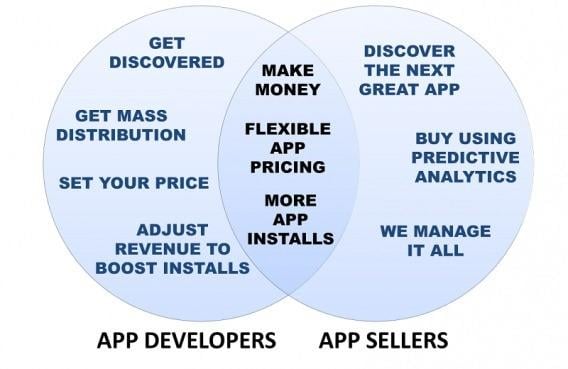
The key is identifying the unique and valuable aspects of your offering that both audiences appreciate. Focus on the overlapping areas to create a specific value proposition that reinforces your primary goal (driving conversions) while avoiding the generic language plaguing your competitors’ websites.
In Conclusion…
Not every successful landing page is a lengthy squeeze page with thousands of words. Many, if not most, are concise, with a captivating headline and a strong CTA. In such cases, maximizing the impact of every word is crucial. You can’t afford to waste words and phrases that don’t contribute to your goal. Online, this includes “stop words” and language that shifts the focus from your audience to yourself. Fortunately, research and testing have already illuminated the path. We just need to acknowledge and follow it.