To achieve a successful Google AdWords campaign that yields high conversions at a low cost, there are numerous factors to consider. A well-structured campaign targeting the optimal number of keywords is crucial for attracting relevant searchers. Compelling ads are essential to boost click-through rates, while strategic bidding ensures maximum return on investment. Among the many tasks involved, a fundamental question arises: where to begin?
Of the various approaches, prioritizing landing pages is a strategic starting point for any AdWords campaign. The relevance and quality of these pages directly impact Quality Scores, influencing cost-per-click (CPC). Optimizing landing pages can lead to cost savings and improved conversion rates. This article outlines six methods to reduce CPCs through effective landing page optimization.
1. Align Landing Pages with Search Queries
A fundamental principle of Google AdWords is the significance of Quality Scores. Accounts achieving scores of 6 or higher benefit from a 16-50% reduction in CPC, while scores of 4 or lower can result in a 25-400% increase in CPC.
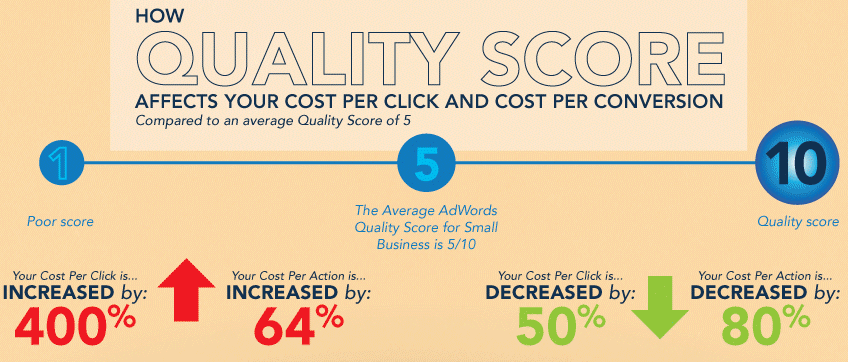
Landing pages play a pivotal role in determining Quality Scores. AdWords expert Brad Geddes emphasizes the importance of relevance: “Rarely will you see a quality score higher than 3 if your landing page is not relevant.” Achieving relevance involves aligning landing pages with the purchase intent of ad groups and their corresponding keywords.
Importantly, keywords vary in intent. They are commonly categorized into three levels of intent:
- Informational keywords: Aim to answer questions or provide information.
- Commercial investigation keywords: Used to research products or services.
- Transactional keywords: Indicate an intent to make a purchase.
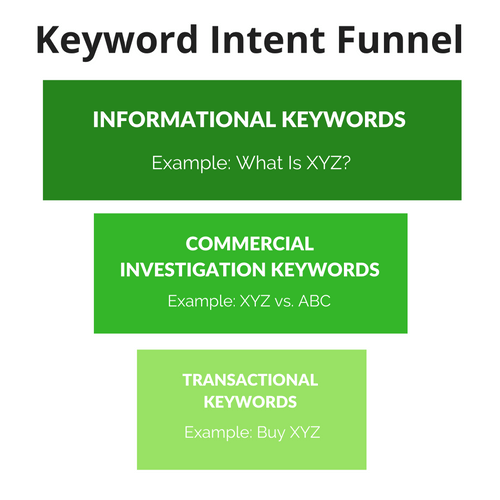
Segmenting keywords based on intent during research is a best practice. This allows for tailored ads and landing pages, enhancing relevance and potentially improving Quality Scores and conversion rates. For instance, a search for “best DSLR cameras 2016” suggests a commercial investigation intent. A landing page offering an ebook about the top DSLR cameras of 2016, focusing on education rather than sales, would align with this intent. This relevance can boost Quality Score and lower CPC.
2. Craft Visitor-Centric Copy
Relevance is key, but engaging and captivating copy is crucial to prevent visitors from bouncing off your site. Optimizing landing page copy benefits both parties: visitors gain clarity on your offer and remember your brand, while you avoid spending on unprofitable traffic.
The guiding principle is to prioritize the visitor. Speak their language, address their concerns, and provide valuable and engaging content. Remember, their primary focus is on solving their problems, not your product.
One effective approach is to evoke emotions. Persuasion is inherently emotional. To motivate action, appeal to your audience’s emotions. Shanelle Mullin’s article “The Advanced Guide to Emotional Persuasion” outlines four pillars of emotional persuasion:
- Sadness: Feelings of loss, disappointment, or despair.
- Anxiety: Unease, worry, or dread about future events.
- Awe: Wonder and amazement.
- Anger: Strong emotional response to a perceived injustice.
Incorporating these emotions can enhance the persuasiveness of your message.

A prime example of emotionally charged advertising. Addressing a visitor’s pain point, particularly one connected to the emotional pillars, can effectively capture attention. However, capturing attention is only half the battle. Equally important is maintaining interest and motivating desired actions, such as signing up for an ebook.
A classic copywriting formula, the PAS formula, proves effective in achieving this. PAS stands for Problem, Agitate, and Solution:
- Highlight a problem: Capture attention by addressing a pain point evoking sadness, anger, or anxiety.
- Agitate the problem: Deepen engagement by emphasizing the negative implications of the problem.
- Present a solution: Offer your product or service as a resolution to the problem, making conversion a natural next step.
Dan Shewan’s article provides further insights into PPC copywriting principles applicable to landing pages.
3. Emphasize a Single Focus
Avoid ambiguity on your landing pages. Visitors should instantly grasp the purpose of the page. Attempting to achieve multiple goals, such as making a sale and gaining social media followers in one visit, is unrealistic.
High-performing landing pages typically center around a single focus: one problem, one solution, one unique value proposition, and one goal.
Begin by highlighting a specific problem that resonates with your audience.
Emphasize the benefits of your offer. How does it address their problem? What value does it provide?
Clearly articulate your unique value proposition. What differentiates your offer? Why should visitors choose you?
Most importantly, make your desired action clear.
If the goal is a purchase, include a single “Add to Cart” button. For phone inquiries, prominently display your number with a “click-to-call” button. Clarity is key.
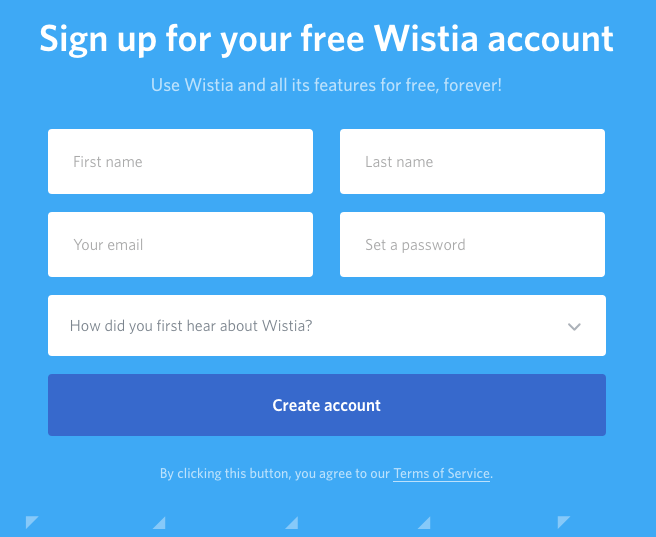
Wistia’s account sign-up landing page exemplifies this singular focus: account creation.
4. Cultivate Trust
While content is abundant, trust is invaluable and requires time and effort to build. Trust is fundamental to any transaction, and it cannot be fabricated. Earning trust requires being trustworthy.
Several strategies can enhance the trustworthiness of your landing pages.
Provide company information. Briefly introduce your company, its mission, and the team behind it. Keep it concise and informative, limiting it to a paragraph or two.
HelpScout effectively conveys team size and location, particularly relevant as a remote company.

Lumosity showcases its team directly on its homepage.
Incorporate social proof. Utilize psychological trigger such as awards, testimonials, ratings, security badges, press mentions, and achievements to bolster credibility.
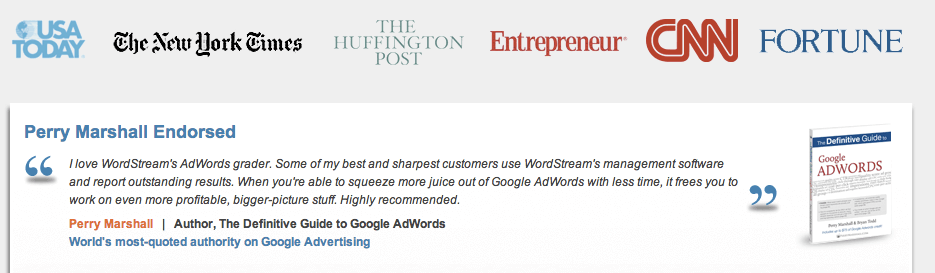
Testimonials and “As Seen On” sections are effective ways to display social proof.
Display trust elements. Include security badges, guarantees, or seals to assure visitors that their information is safe.

Common security badges provide a sense of security.
5. Embrace Modern Design
Unless you possess professional design expertise, seeking assistance is recommended for optimal landing page design. Modern design principles are essential for creating visually appealing and user-friendly pages.
Landing page builders often provide templates with well-structured elements. However, understanding design principles is beneficial for enhancing relevance and user experience.
Structure for easy navigation. Ensure visitors can quickly find what they need. A clear layout aligned with the landing page’s single focus is crucial.
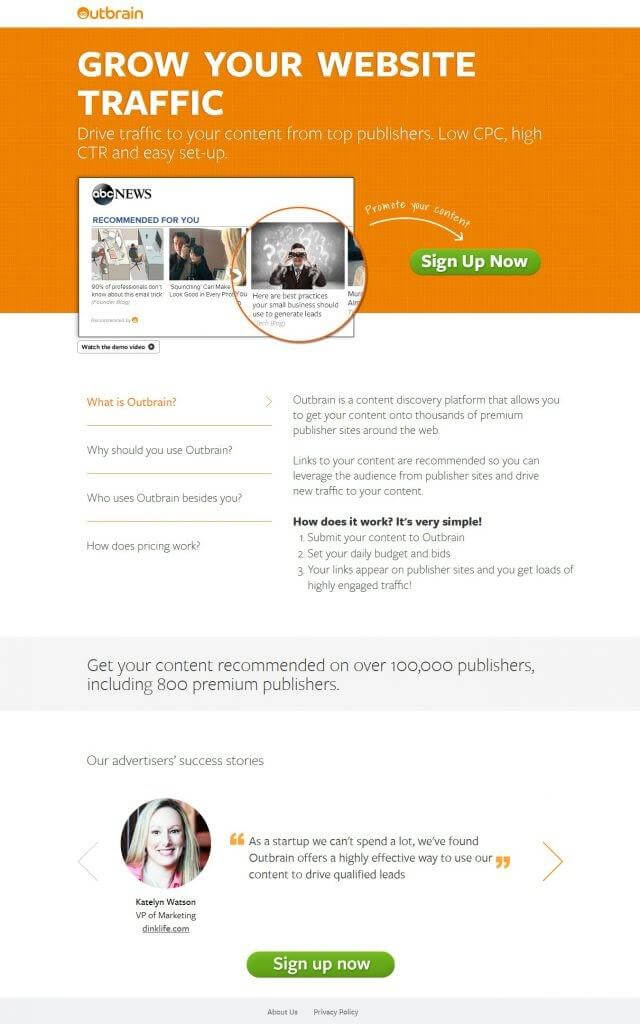
Outbrain’s landing page effectively presents comprehensive information, allowing visitors to explore features without leaving the page.
Simplify the desired action. Make it effortless for visitors to take the intended action. If the goal is ebook download, a prominent CTA above the fold is recommended.
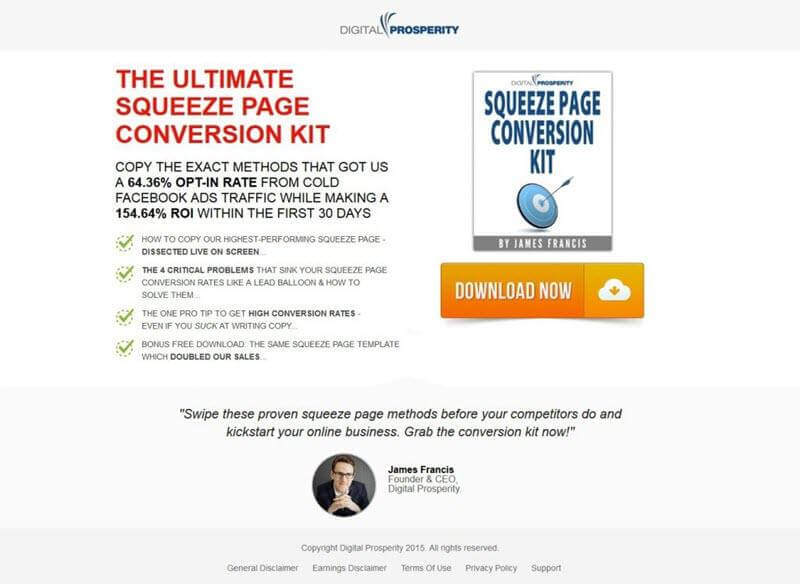
James Francis’s landing page employs a direct approach, focusing on a free “conversion kit” with a concise design.
Minimize distractions. Avoid intrusive pop-ups that hinder navigation and potentially deter conversions. While pop-ups can be effective, as as many experts suggests, their impact should be carefully tested. The same applies to navigational bars, sliders, banners, and similar elements.
Prioritize mobile optimization. According to Adobe, “Companies with mobile-optimized sites triple their chances of increasing mobile conversion rate to 5% or above.”
Use tools like this tool by Google to assess your landing page’s mobile-friendliness.
Seek professional feedback. Consult a web designer to evaluate your landing page’s design and identify areas for improvement. Online communities like the startups subreddit or relevant Facebook groups can also provide valuable insights.
6. Optimize for Speed
Slow-loading websites can be frustrating for users and detrimental to conversions.
KISSmetrics reports that “73% of mobile internet users say that they’ve encountered a website that was too slow to load.” A slow-loading landing page can render all other efforts futile.
Google AdWords emphasizes the importance of page speed: “If it takes too long for your website to load when someone clicks on your ad, they’re more likely to give up and leave your website. This unwelcome behavior can signal to Google that your landing page experience is poor, which could negatively impact your Ad Rank. That’s why you want to make sure your landing page load time is up to speed.”
Research suggests that even a one-second delay can significantly impact conversions. Search Engine Land found a correlation between page speed and conversion rates.
To improve landing page speed, utilize tools like Pingdom or Google’s PageSpeed Insights. These tools provide insights into page speed, size, and potential issues, offering solutions for optimization.
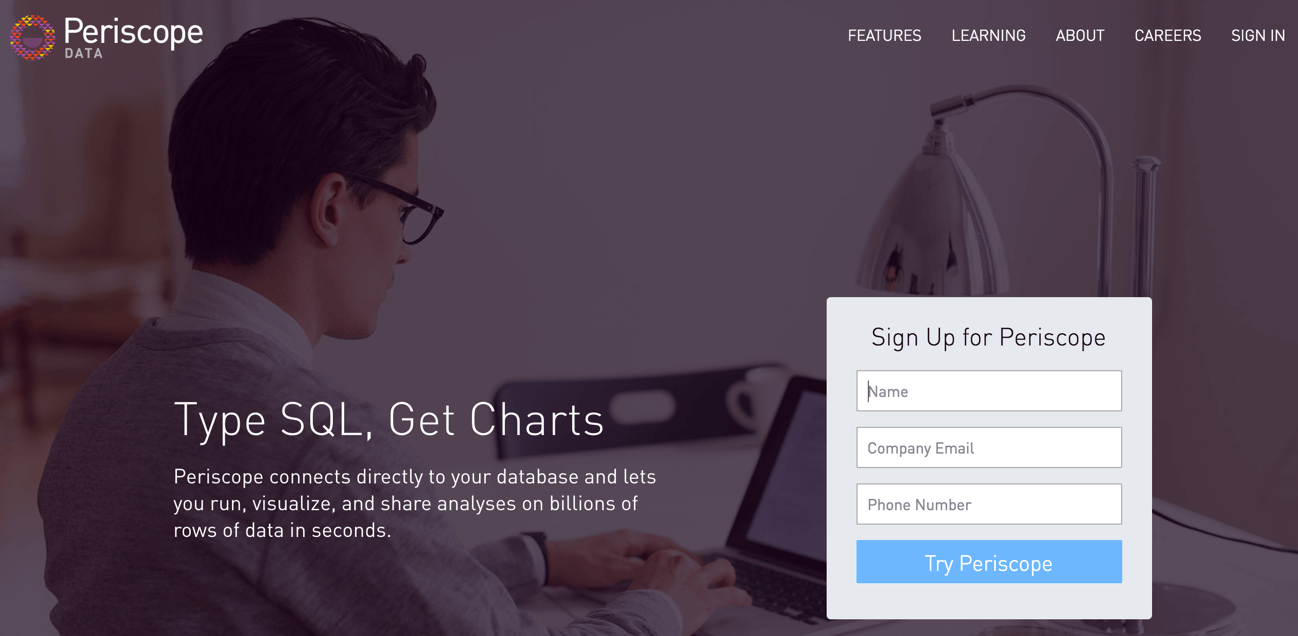
Periscope’s home landing page loads impressively fast, outperforming 91% of tested sites according to Pingdom.
Common solutions for improving landing page speed include:
- Image optimization: Compress images using tools like TinyPNG to reduce file size without sacrificing quality.
- CSS and Javascript minification: Eliminate unnecessary characters, spaces, and comments from code to reduce file sizes. Refer to Google’s guide for instructions.
- Browser caching: Enable browsers to store static elements locally, reducing loading times for returning visitors. This article provides a comprehensive guide to browser caching.
Conclusion
Optimizing Google AdWords landing pages is a multifaceted process requiring meticulous attention to relevance, copywriting, design, and technical aspects.
While it demands significant effort, improving relevance, crafting visitor-centric copy, focusing on a single goal, building trust, embracing modern design, and optimizing for speed are crucial for enhancing performance and reducing AdWords costs, ultimately contributing to business growth.