As I mentioned in my earlier post, I’m back with the second part of leveraging Facebook objectives for a successful cross-funnel campaign strategy. In case you missed part one, here’s a recap of the essential takeaways:
- Facebook provides advertisers with three campaign objective choices: awareness, consideration, and conversion.
- When setting up a campaign, it’s essential to pay close attention to your objective, optimization settings, bid strategy, and budget selections.
- Facebook’s ad auction uses algorithmic learning based on these settings to make decisions. To enable this algorithm to optimize effectively based on your marketing objectives, you need to define the right signals and track important data. With that refresher from part one….

In this part, I’ll guide you through the six crucial steps involved in building a comprehensive full-funnel advertising strategy on Facebook. Let’s dive in!
Step #1: Understand Your Marketing Funnel
Before we delve into Facebook tactics, let’s briefly discuss the marketing funnel. It represents the journey users take as they interact with your marketing efforts. There are different ways to define and structure your marketing funnel, but it generally resembles this:
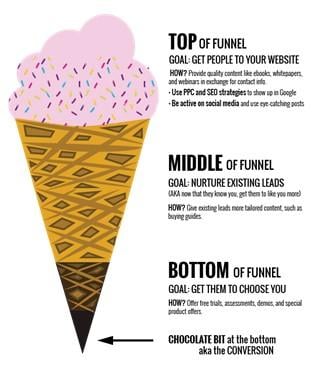
Recognizing and understanding your own marketing funnel is crucial for optimizing your cross-funnel strategy. Start by reflecting on these questions:
- How do prospects discover your brand? What are their initial touchpoints?
- What are the significant milestones in a prospect’s journey? Consider the number of interactions you have (website visits, form submissions, specific actions, etc.).
- What offers align with these milestones? Having diverse offerings to match your prospect’s intent at each stage is extremely valuable. For instance, offer a white paper to new prospects and a free trial to those further down the funnel.
- How long does it take for a prospect to move from the top to the bottom of the funnel?
- Where are the potential points of prospect loss in your funnel? Identify areas for improvement. Answering these questions will put you in the right frame of mind to proceed.
Step #2: Structure Your Facebook Ads Account Effectively
Now that you’re thinking about your marketing funnel’s structure, let’s focus on your Facebook ad account. How you organize it can significantly impact your ability to manage and optimize campaigns effectively. As a quick reminder, here’s an example of a Facebook ad account structure:
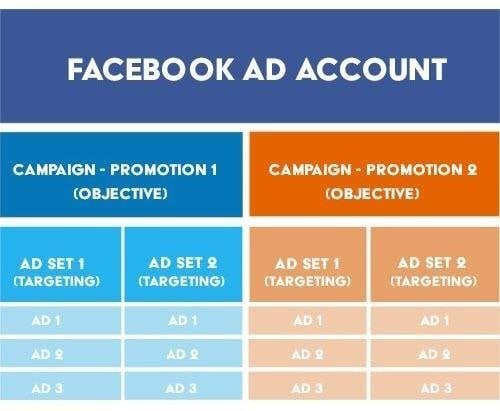
Consider campaigns as containers for your ad sets. Besides the objective, most decisions happen at the ad set level on Facebook. This includes your target audience, optimization settings, bid strategy, and budget. Each ad set contains ads where you can differentiate your offer, creative elements, and messaging. Since you’re reading this, you’re interested in targeting prospects across your funnel. Therefore, we’ll discuss an account structure that mirrors your marketing funnel. I recommend creating campaigns for each stage. The number of campaigns will depend on your funnel’s complexity and desired granularity. Here’s a simplified example: Campaign 1: Top of Funnel (TOF) Campaign 2: Middle of Funnel (MOF) Campaign 3: Bottom of Funnel (BOF) This structure provides a clear overview of your investment and key performance indicators (KPIs) for each funnel stage directly in your Ads Manager. Next, utilize ad sets within each campaign to test different offers and audiences. For example: Ad set 1: Offer 1 & Audience 1 Ad set 2: Offer 1 & Audience 2 Ad set 3: Offer 2 & Audience 3 Ad set 4: Offer 3 & Audience 4 This way, you can compare performance within each campaign to understand budget allocation and test new offers or audiences for that specific funnel stage. Lastly, each ad set houses your ads. This is where you experiment with different creatives, ad formats, and messaging within an ad set. For instance: Ad #1: Offer > Creative Variation 1 > Copy Variation 1 Ad #2: Offer > Creative Variation 1 > Copy Variation 2 Ad #3: Offer > Creative Variation 2 > Copy Variation 1 Ad #4: Offer > Creative Variation 2 > Copy Variation 2 As shown above, a clear naming convention is essential for transparent reporting and effective account management. By naming your campaigns, ad sets, and ads descriptively, you can easily identify components and make decisions without diving deep into each element. In short, a well-structured ad account is crucial for a successful cross-funnel strategy on Facebook.
Step #3: Align Objectives with Funnel Stages
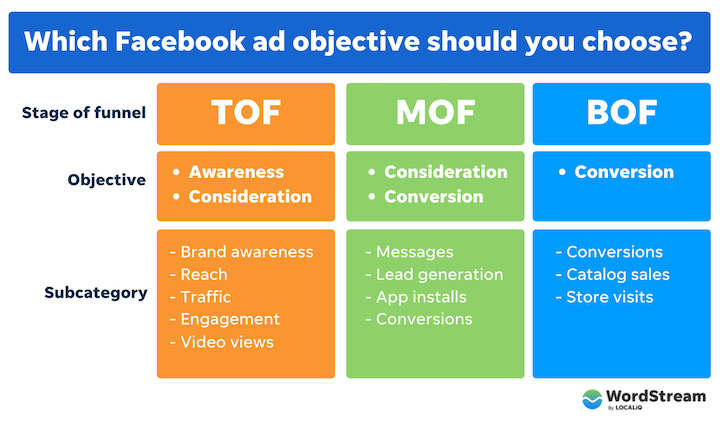
With your campaigns structured by funnel stage, align them with the appropriate Facebook objectives:
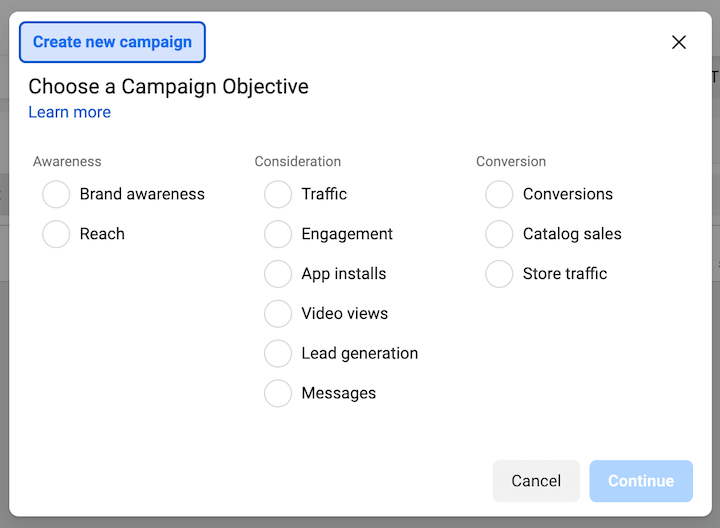
Refer to this guide when choosing objectives based on your marketing funnel:
Step #4: Choose the Right Targeting Types
To achieve your campaign objectives, you need to understand the most suitable targeting types and audiences for each ad set. Luckily, Facebook offers a wide array of targeting options. These options allow you to create audiences ranging from broad to highly specific:
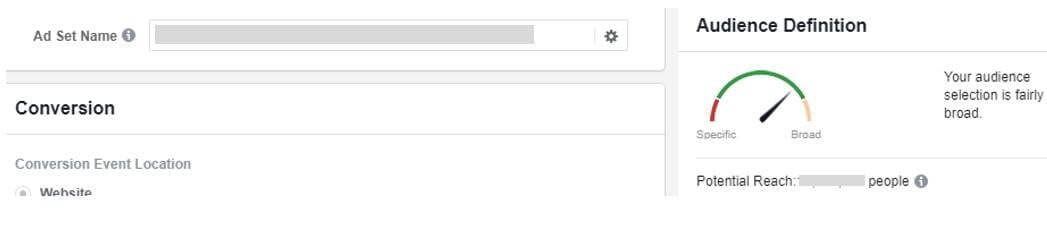
These audiences can be derived from Facebook’s core audience options (demographics, interests, behaviors) or your own data (website visitors, custom audiences, lookalike audiences or LAL, etc). As prospects move down the funnel, your targeting should become more focused, addressing a more qualified audience. Here are some recommendations for choosing audiences for different funnel stages:
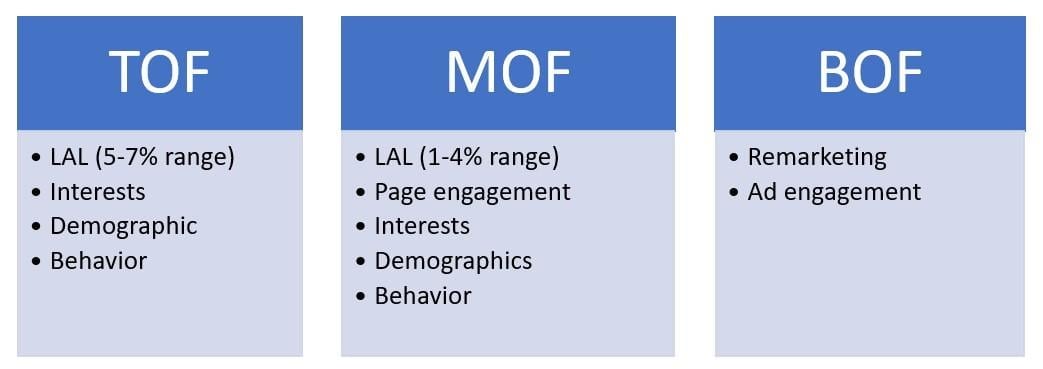
Notice the overlap between funnel stages. The key is to refine your audience as you progress. For example, with lookalikes, start with a broader range at the TOF, allowing the algorithm to target a larger pool of potential prospects. As you move to MOF ad sets, narrow the range to focus on a more qualified group. Also, consider using exclusionary audiences across your ad sets. This prevents prospects from seeing ads from previous stages as they move down the funnel. This controls wasted spend and improves the prospect’s experience.
Step #5: Make the Most of Engagement Audiences
Engagement audiences offer a powerful way to move prospects through your funnel on Facebook. Engagement audiences let you reach people who have previously interacted with your page. Facebook currently provides six engagement audience options:
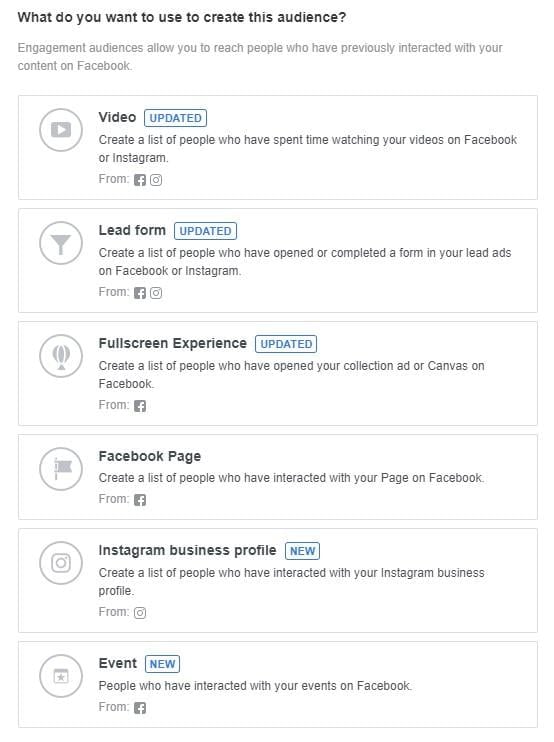
Here’s how engagement audiences can boost your funnel strategy from beginning to end: Step 1: Utilize an awareness campaign with broad audience targeting to reach potential prospects with an engaging video. Step 2: Create a consideration campaign with a lead generation objective, targeting those who engaged with the video from step 1. Promote a valuable piece of content through a lead generation ad. Step 3: Build a conversion campaign targeting users who completed the lead ad and entice them to convert on a product-focused offer, pushing them to the bottom of the funnel. Bonus: Engagement audiences are excellent for leveraging organic reach within your paid campaigns. This allows for collaboration between your organic and paid efforts. In our experience, engagement audiences often result in a lower cost per acquisition.
Step #6: Optimize Settings & Conversion Events
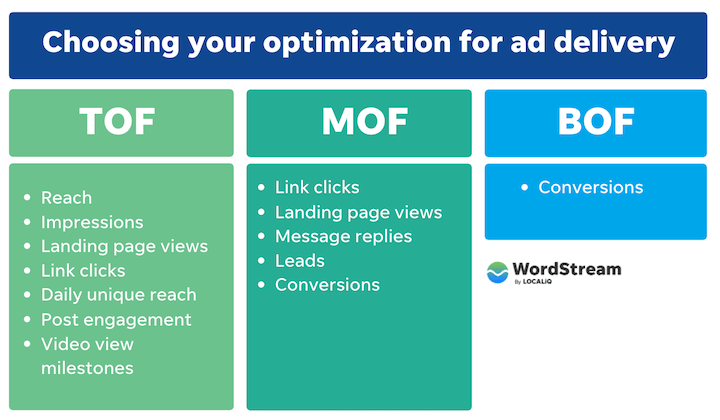
As highlighted in part one, achieving your marketing goals requires implementing the right settings, including your conversion event and optimization for ad delivery settings. The conversion event is relevant only for ad sets under a conversion campaign. This is because a conversion objective relies on external signals (through your pixel) for optimization. Therefore, you don’t need to set a conversion event for your TOF campaign, as the algorithm can optimize based on internal signals. However, for MOF and BOF campaigns with a conversion objective, you’ll need to select a conversion event. Ensure it aligns with your objective and offer. For instance, if promoting a whitepaper in your MOF campaign, choose a conversion event that tracks successful downloads. In contrast, your BOF campaign likely promotes a higher-value offer, so your conversion event should reflect that. If you’re struggling to generate enough BOF leads, consider selecting a leading signal for your conversion event to provide the algorithm with enough data during its learning phase. The optimization for ad delivery setting tells the algorithm what defines success for your ad set. Since your goals vary across the funnel, communicate this through your optimization settings. Here’s an example of appropriate settings for each stage:
Witness Results with a Funnel-Driven Facebook Strategy
Facebook provides a fantastic platform for advertisers to acquire new prospects and guide existing leads through their marketing funnel. By following these six steps, you’ll have a promotional strategy that resonates with prospects and maximizes your advertising ROI. Once your cross-funnel strategy is running, continue iterating by testing new audiences, offers, and creatives to optimize and scale your account. Before you go, try our Facebook Grader today to see how your Facebook ads can be further improved!