Mobile marketing offers incredible potential, but it’s easy to fall into a rut using methods that don’t yield the desired outcomes.

If this resonates with you, it’s time to explore unconventional mobile marketing approaches that can help you expand your reach and convert more leads. To guide you, we’ve curated a list of six highly effective mobile marketing strategies that you might not have considered – either because they haven’t crossed your mind or you’re skeptical about their effectiveness for your business.
1. Hyperlocal Targeting
Hyperlocal mobile marketing encompasses techniques such as geofencing, which involves designating a virtual perimeter around a specific geographical area. If a user with your app installed enters this geofenced zone, it triggers a push notification.
A prime example is when Burger King geofenced rival McDonald’s locations. Upon entering the designated area, users received a Burger King discount coupon. A bit cheeky, but undeniably effective.

Currently, only one in five businesses report utilizing hyperlocal targeting. However, this approach holds immense potential across diverse business sectors. For instance, retail stores can leverage geofencing to send personalized product recommendations and notify users about ongoing in-store discounts. Taxi services could establish geofences around airports and travel hubs, prompting users with ride offers. Similarly, massage parlors could geofence bustling urban areas, reminding commuters to schedule relaxing massages upon their return. The possibilities for leveraging hyperlocal marketing, particularly geofencing, to boost user engagement are virtually limitless.
2. Augmented Reality
Concepts like virtual reality and augmented reality are relatively new, leaving many marketers perplexed. Virtual reality provides a simulated, immersive experience where users wears a headset transporting them to virtual environments, such as museums or the vast expanse of outer space.
In contrast, augmented reality overlays virtual elements onto real-world scenes. This can be achieved through headsets and visors, or simply by pointing your smartphone camera at your surroundings. Familiar examples include Pokemon Go and Snapchat filters.
While virtual reality marketing tools like virtual showrooms can be expensive to develop, integrating augmented reality components into your mobile marketing campaigns can be surprisingly accessible. DIY AR tools like ZapWorks or Blippar simplify the process of adding an augmented reality layer to your mobile campaigns.
A compelling illustration is Domino’s Pizza used AR, enabling customers to visualize different pizza variations right in their dining rooms – an ingenious way to whet their appetites!
3. Vertical Videos and Animations
Here’s a striking statistic: 94% of smartphone users hold their phones However, a significant portion of videos and animations are still designed for square or horizontal formats, stemming from our ingrained habit of viewing them in landscape mode on TVs, cinema screens, and computers.
By creating vertical videos and animations tailored specifically for mobile screens, you can significantly enhance the user experience and drive engagement.
Consider using an app like Animaker, specifically designed for intuitive creation of vertical animations. Research conducted by Buffer reveals that vertical videos perform better on Facebook (with 96% of its active users check Facebook on mobile devices) compared to square or horizontal videos, leading to remarkable cost-per-view reductions of up to 68%!
4. Targeting Bing and Yahoo Users
A significant portion of mobile SEO and paid search marketing revolves around Google, given its dominant market share of mobile users (95%). In contrast, Bing holds a mere global market share of approximately 1%, while Yahoo trails behind at around 2%.
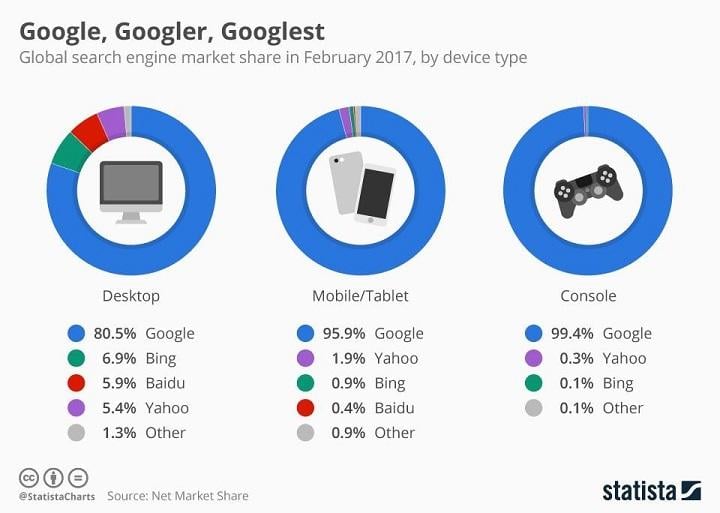
However, a compelling 33% of Bing search clicks originate from mobile devices, presenting a valuable opportunity to tap into an often 137 million Bing users.
Furthermore, Bing boasts an older user base, with 54% of its users aged 45 and above. Over a third of Bing users have household incomes exceeding $100,000, making them, on average, more affluent than their Google counterparts. Additionally, the majority of Google users are under 44 years old, implying that focusing solely on Google means missing out on a whole generation of affluent Baby Boomers.
5. Voice Search Optimization
Only 4% of US businesses are voice search ready.
This is largely because voice search is often misconstrued as a passing trend. However, it’s an undeniable reality that’s here to stay, with projections indicating that voice searches set to take over 50% of all searches by 2020.
Presently, nearly a third of all smartphone users use voice search at least once a week, and a remarkable 71% of individuals under 29 use mobile personal assistants.
So, how can you adapt? Here are some actionable steps to optimize your website for voice search:
- Integrate long-tail keywords into your content, phrasing them conversationally, mirroring how people speak rather than type. Typed searches often prioritize brevity, while spoken queries tend to be more elaborate.
- Ensure your business information is consistently updated as many voice searches are conducted on the go to locate businesses. People often use the phrase “near me” when searching for venues, so incorporate it strategically into your SEO keywords.
- Address frequently asked questions directly on your website. Utilize tools like Answer the Public to uncover popular question topics within your niche and provide comprehensive answers within your content. Structure these responses by placing the question above the answer using H2 tags, making it easier for search engine crawlers to identify them.
6. User-Generated Content Campaigns
Crafting compelling marketing content presents two significant challenges:
- The substantial time and creative investment required to produce fresh and impactful content.
- Convincing your audience of your brand’s value proposition.
User-generated content offers a clever solution to both these hurdles.
Firstly, it effectively outsources a significant portion of creative work to your audience, who become content creators for your brand.
Secondly, it enlists a team of passionate brand advocates to spread the word about your business, leveraging the power of authentic word-of-mouth marketing. Research consistently shows that people place greater trust in recommendations from friends and family than in brand messaging.
While marketers often adopt a broadcasting approach, disseminating pre-designed messages to the masses, the mobile era has ushered in the reign of community-based communication. User-generated content campaigns thrive in this environment. Consider this: users carry portable content creation devices with them constantly, enabling them to capture photos, write, film videos, and instantly share them on social media.
KitKat’s #HaveABreak campaign exemplifies this approach, encouraging users to share their “have a break” moments.
Another compelling example is Walkers’ campaign, which invited fans to propose new crisp flavor ideas. Their Do Us A Flavor campaign garnered an impressive 1.2 million entries, with the winning recipe ultimately being produced and sold by Walkers!

There you have it: six mobile marketing strategies you might not have explored yet. These tactics could be the key to revitalizing your marketing efforts and propelling your brand’s growth to new heights!