As humans, we tend to believe in our rationality, but decades of cognitive research suggest otherwise. Studies have revealed that subtle, seemingly insignificant adjustments can significantly impact consumer choices. These subtle adjustments hold such sway due to cognitive biases, which are essentially common reasoning errors that arise when perception or beliefs are prioritized over reality.
Some of these cognitive biases are so prevalent that their influence on consumer behavior is almost guaranteed, making them valuable tools to incorporate into marketing strategies. Here are six such cognitive biases that can be leveraged to boost sales.
Cognitive Bias #1: The Mere Exposure Effect
In a 1968 study, Charles Goetzinger, a professor at Oregon State University, conducted a classroom experiment. Unbeknownst to the rest of the class, one student was instructed to attend each session concealed within a black bag, with only their feet visible. Goetzinger’s objective was to observe the reactions of the other students. Initially, the “black bag” was met with hostility. However, as time passed and the black bag became a constant presence in their daily classes, their hostility gradually transformed into curiosity. Eventually, classmates even formed friendships with the student inside the black bag.
Goetzinger’s experiment served to validate a long-standing theory: familiarity breeds acceptance. This principle can be strategically employed.
How to Use the Mere Exposure Effect to Boost Your Sales
1. Leverage retargeting to boost sales. When promoting your products or services, targeting individuals who have previously visited your website yields significantly better outcomes than targeting entirely new prospects. In fact, a particular study revealed that retargeted ads have a click-through rate 10 times higher than standard display ads and that website visitors exposed to retargeted display ads are 70% more likely to convert.

2. Repurpose and distribute existing content. Sales can also be boosted by extending the reach of your existing content through repurposing and distribution. A single blog post can be transformed into various formats such as infographics, videos, podcasts, slide presentations, and more. Distributing this repurposed content across multiple channels increases the likelihood of individuals encountering it multiple times, ultimately benefiting your sales.
3. Reshare existing content on social media. Resharing existing content on social media is another effective way to leverage the mere exposure effect. researched this effect by analyzing 100 million articles conducted research and found that consistently resharing articles on social media can lead to a 686% increase in reach and engagement.
Cognitive Bias #2: Loss Aversion
In a 1979 study, psychologists Daniel Kahneman and Amos Tversky discovered that people generally exhibit a stronger preference for avoiding the loss of something they already possess compared to acquiring something of equal value. In simpler terms, the pain of losing $10 outweighs the missed opportunity of gaining $10 for most individuals. This phenomenon, known as loss aversion, is supported by a growing body of research suggesting its deeply ingrained nature. a 2005 study involving capuchin monkeys yielded similar conclusions, indicating that monkeys are more inclined to gamble on a potential gain than a potential loss, even when both options hold the same economic value.
Incorporating this cognitive bias into your strategy involves acknowledging that your prospects will actively seek to minimize potential losses.
How to Use Loss Aversion to Boost Your Sales
1. Offer free trials and samples of your product. Providing opportunities for individuals to experience your product or service firsthand through trials or samples fosters a stronger sense of attachment compared to simply presenting them with the option to purchase it outright. By eliminating the financial risk associated with engagement, you significantly increase the likelihood of sign-ups and trials. Consider offering free samples, demos, or even a free trial period, similar to Amazon Prime’s approach as illustrated below.

2. Offer a limited-time bonus. By advertising a time-sensitive offer, you create an atmosphere of scarcity that incentivizes consumers to act quickly and commit to a purchase. This presents a clear choice: capitalize on the bonus by purchasing immediately or miss out on the offer.
3. Use a countdown timer. Employing a countdown timer effectively conveys the urgency of your offer. Allowing potential customers to witness the countdown of hours and minutes leading up to the offer’s expiration not only leverages the scarcity principle but also instills a tangible sense of urgency.
Cognitive Bias #3: The Compromise Effect
In a 1992 experiment, researchers offered participants a choice between two 35mm Minolta cameras:
- Minolta X-370 priced at $169.99
- Minolta Maxxum 3000i priced at $239.99
The results showed an even split, with participants equally divided between the two options.
The experiment was then modified to introduce a “compromise” option. This time, participants were presented with three choices:
- Minolta X-370 priced at $169.99
- Minolta Maxxum 3000i priced at $239.99
- Minolta Maxxum 7000i priced at $469.99
The inclusion of the middle option, the “compromise,” significantly influenced the outcome. The majority (57%) opted for this middle ground. The remaining participants were almost evenly distributed between the other two options, with 22% choosing the lowest-priced option and 21% choosing the highest-priced option.
This study highlights how the simple introduction of a “compromise” option, a middle ground, can effectively sway people’s choices.
How to Use the Compromise Effect to Boost Sales
1. Accompany the option you really want people to choose with extreme options on both ends. The effectiveness of the compromise effect hinges on the presence of extreme options on both the lower and higher ends. If the options are too similar or difficult to differentiate, they may lead to user confusion.
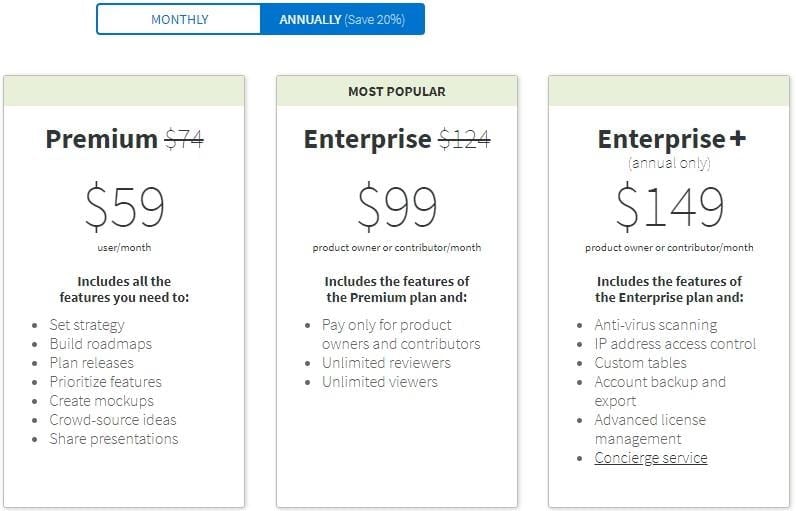
2. Put the “compromise option” in the middle. When structuring your pricing plans, strategically positioning the “compromise option” (your intended target) in the middle draws special attention to it, making it stand out from the extreme options. This strategic placement increases the likelihood of users opting for the featured option.
The pricing plan of Aha!’s pricing page shown below exemplifies compromise pricing in action, with the “Enterprise” plan strategically positioned in the middle:
Cognitive Bias #4: The Framing Effect
In a 1984 experiment, psychologists Daniel Kahneman and Amos Tversky presented participants with a scenario concerning an impending outbreak of an unnamed disease in the United States.
The question posed was as follows:
“Imagine that the U.S. is preparing for the outbreak of an unusual Asian disease, which is expected to kill 600 people. Two alternative programs to combat the disease have been proposed. Assume that the exact scientific estimates of the consequences of the programs are as follows:
- If Program A is adopted, 200 people will be saved.
- If Program B is adopted, there is a one-third probability that 600 people will be saved and a two-thirds probability that no people will be saved.
Which of the two programs would you favor?”
Faced with these options, 72% of participants selected Program A, while 28% chose Program B.
The researchers then presented the same question to a different group of participants, but with a slight alteration in the framing of the options:
- If Program C is adopted, 400 people will die.
- If Program D is adopted, there is a one-third probability that nobody will die and a two-thirds probability that 600 people will die.
Despite the options being practically identical (Program C, like Program A, would save 200 lives), the framing significantly impacted the results. With the reframed options, only 28% chose Program C, while 72% opted for Program D.
This experiment demonstrates the profound influence of framing on responses. The manner in which something is presented can significantly alter how people perceive and react to it.
This finding has substantial implications for boosting sales and conversions. The way you frame your offer will directly influence its reception among your target audience.
How to Use the Framing Effect to Boost Your Sales
1. Frame your offer in such a way that it is clear that not taking up the offer is a losing proposition. To illustrate, in a study published in the Journal of Economic Behavior & Organization in a 2009 study, researchers observed that when Ph.D. students were encouraged to register for an economics conference, a higher registration rate was achieved when the early registration “discount” was framed as a penalty fee for late registration, rather than simply a discount. This underscores the human tendency to be more apprehensive about losing what we already possess compared to gaining something new.
2. Frame your offer in comparison to something similar. Contextualize the value proposition of your offering by providing a comparison to a similar product or service. I employ this tactic on the Website Builders of my own website:
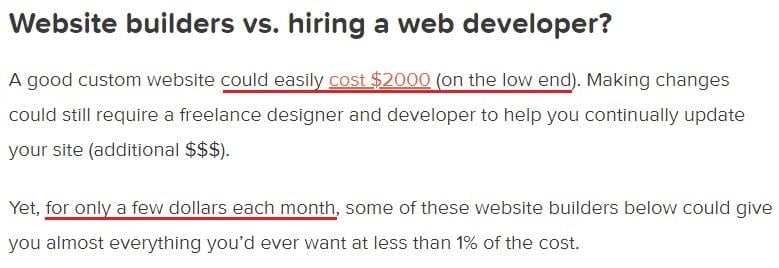
Instead of simply stating that “website builders cost $XX a month,” I framed the alternative option in a comparative manner, highlighting its cost as “a few dollars each month.”
Cognitive Bias #5: The IKEA Effect
In a 2011 study, researchers conducted observations of consumers engaged in tasks such as assembling IKEA furniture, folding origami, and building Lego structures. The study revealed that participants attributed a value to their “amateurish creations” that was comparable to the value they perceived in expert-made counterparts. What’s more intriguing is that participants anticipated others to share their perspective on the value of their creations.
Based on these findings, the researchers concluded that individuals tend to place a higher value on products in whose creation they have been actively involved, even if their initial interest in such involvement was minimal. This phenomenon was termed the “IKEA effect.”
The implications of the IKEA effect for marketing strategies are clear: involving users in the product development process increases their likelihood of converting into customers when the product is eventually brought to market.
How to Use the IKEA Effect to Boost Your Sales
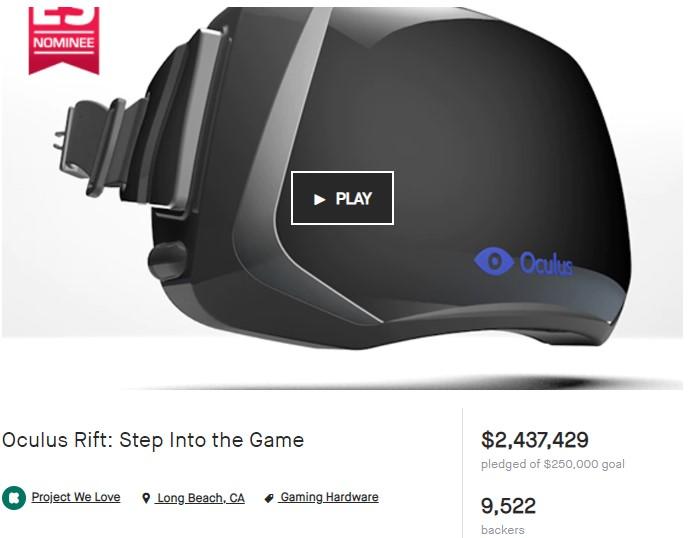
1. Involve consumers in the process of building your products. There are multiple ways to encourage consumer involvement, such as seeking their time commitment during product development, soliciting their input during the creation or improvement phases, or even inviting financial investment. Crowdfunding campaigns serve as a prime example of this principle in action. When individuals contribute financially to a product’s development before its actualization, they become more invested in its success. While Oculus Rift’s massive success as a crowdfunded project is partially attributed to the funds raised, researchers have attributed its triumph to the sense of community and ownership fostered through crowdfunding.
2. Give users the option of having your products customized for them. Offering customization options, whether it’s for the product packaging or specific product features, enhances personal engagement with your customers and potential customers. Coca-Cola’s “Share a Coke” campaign is a testament to this approach. By allowing users to personalize their Coke bottles, Coca-Cola witnessed a surge in sales almost instantaneously. Within just within the first year, the campaign yielded remarkable and measurable success:
- “Share a Coke” earned its place among the most successful marketing campaigns in Coca-Cola’s history.
- Over 500,000 photos adorned with the #ShareaCoke hashtag surfaced online.
- Coca-Cola users generated over six million virtual Coke bottles.
- Coca-Cola’s Facebook following experienced a surge of 25 million new followers.
Cognitive Bias #6. Peltzman Effect or Risk Compensation Theory
In a a 1975 study published in the Journal of Political Economy, University of Chicago Professor Sam Peltzman observed that the implementation of laws aimed at regulating driving and enhancing safety, such as mandatory seatbelt use and other safety device regulations, had an unintended consequence. Drivers, feeling a sense of increased security due to these safety measures, exhibited riskier driving behavior when using these devices compared to when they were absent. This behavioral adaptation partially offset the safety improvements attributed to the introduction of such laws.
This study’s findings have broader applications. Individuals tend to adjust their behavior in response to perceived risk. They exercise greater caution when they perceive a higher risk associated with a particular action and demonstrate less caution when the perceived risk is low.
This phenomenon, known as the Peltzman effect or risk compensation theory, holds significant implications for sales conversion rates. By minimizing the perceived “risk” associated with engaging in business with you, you can effectively increase your conversions.
How to Use the Peltzman Effect to Boost Your Sales
1. People will judge a book by its cover – and your business by your website. In a study conducted by a study of 2,000 consumers, it was revealed that 32.2% of individuals prioritize the professionalism and design quality of a website when assessing its trustworthiness. Incorporating trustmarks and optimizing site speed can contribute to establishing credibility. The same study indicated that 48% of people feel more secure making purchases on websites that display trustmarks, while 23.65% expressed difficulty trusting websites with slow loading times. By actively reducing the perceived risk associated with your website, you can encourage higher conversion rates among your visitors.
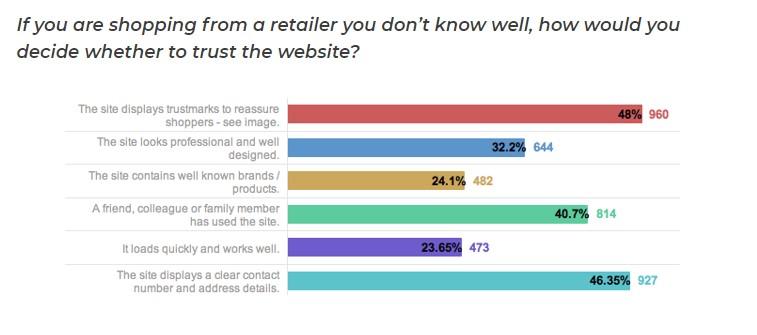
2. Make it easy for prospects to contact you. Accessibility fosters trust. Econsultancy’s findings revealed that 46.35% of individuals perceive the absence of contact details as a red flag, signaling a lack of trustworthiness. Therefore, it’s crucial to prominently display your contact information in multiple easily accessible locations throughout your website to instill confidence in your prospects.
3. Outline a clear “no-risk-on-you” refund/return policy. A clear and concise refund/return policy that eliminates risk for the customer is another effective way to build trust. By offering an unconditional refund/return policy, you mitigate the perceived risk associated with doing business with you, thereby encouraging conversions.
For the Best Results, Use Cognitive Biases Sparingly
While each of these cognitive biases can be strategically integrated into your marketing efforts to drive sales growth, it’s important to avoid overusing them. Carefully consider your target audience and marketing objectives to determine the most effective tactics for your specific context. Implement these tactics gradually, testing their effectiveness one at a time, to identify the approaches that yield the most favorable results.