The art and science of copywriting lie in choosing the perfect words to market a product or service. Advertising legend David Ogilvy, often hailed as the father of the industry, notably said:
“I don’t know the rules of grammar. If you’re trying to persuade people to do something, or buy something, it seems to me you should use their language.” This is the essence of copywriting: strategically employing specific language to boost sales—or in the digital age, conversions—for an online store. When crafting effective, high-converting copy, word choice is paramount. As illustrated in the following case studies, even subtle adjustments like swapping a word or two in calls to action, product descriptions, or landing pages can yield remarkable conversion increases, translating into significantly higher sales and revenue over time. Testing these copywriting tweaks is simple—why not see if they impact your conversions?
1. “Buy” Vs. “Shop”—Do They Really Mean the Same Thing?
We often overlook the nuances of synonyms. While they convey similar meanings, their impact on online audiences can be surprisingly different. This distinction can mean a difference of thousands, even hundreds of thousands, of dollars in revenue…a significant impact for such a small change. Depending on your business scale, that’s far from insignificant. Black & Decker discovered this firsthand when they A/B tested one of their product pages. DeWalt, a power-tool manufacturer, is one of Black & Decker’s brands. Initially, the main call to action on the DeWalt website used the button copy “Buy Now.” However, after analyzing the page, the Black & Decker team speculated that switching “buy” to “shop” would soften the commitment implied, potentially encouraging more clicks.
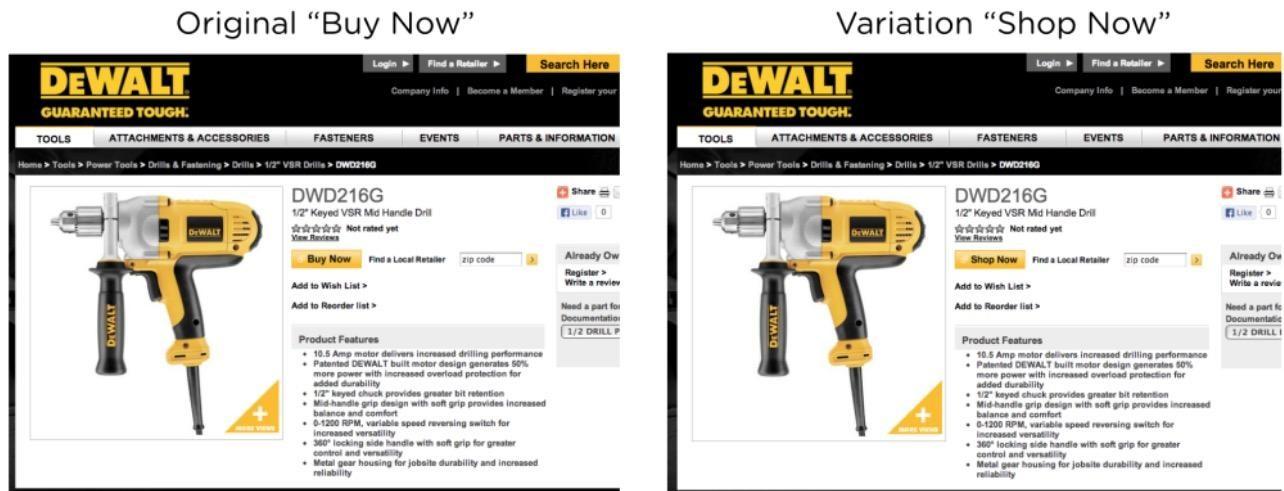
Image via Optimizely Contrary to their expectations, the A/B test revealed that “Buy Now” was the more effective CTA, resulting in 17% more click-throughs than “Shop Now.” This might seem like a minor difference, but projected annually, it equated to six figures in revenue. This highlights the importance of A/B testing before implementing any changes based solely on assumptions. It also underscores how a single word on a product page can significantly impact revenue, positively or negatively.
2. Low-Price Guarantee Vs. Authenticity
Product pages often leverage low-price guarantees to persuade customers and drive sales. While effective, seals of authenticity can sometimes be more persuasive in boosting conversions. This case study demonstrates how a minor wording adjustment led to a substantial conversion increase for an e-commerce retailer. Express Watches, a UK-based retailer specializing in Seiko watches, faced customer skepticism about the authenticity of their products. Customers were unsure if they were getting genuine Seiko watches. Digital marketing agency High Position designed an A/B test to address this trust issue. The control page displayed the phrase “Never Beaten on Price” on the right side. The variation aimed to clearly communicate the retailer’s legitimacy by using the phrase “Seiko Authorized Dealer Site,” anticipating it would alleviate customer concerns and increase conversions.
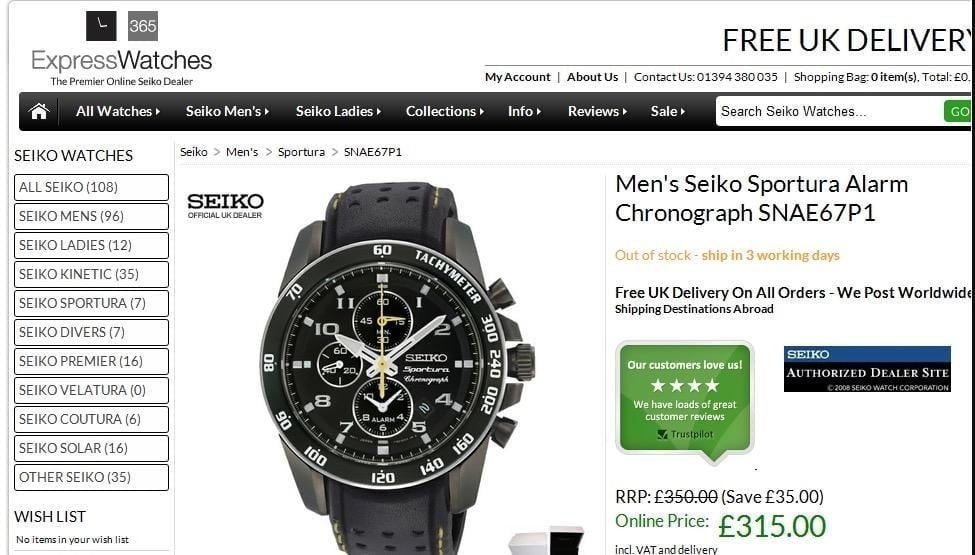
Image via VWO This new phrase replaced the original text in the same location on the page. High Position’s hypothesis that this seemingly insignificant change, involving just four words, would impact conversions proved correct. The results demonstrated that the variation lifted conversions by an impressive 107% during a 30-day test. The conversion rate jumped from 1.81% to 3.76%, effectively doubling it. This highlights that even the smallest wording changes on a page can significantly influence shoppers, emphasizing the importance of regular A/B testing when introducing new words or phrases.
 Free guide: The 36 Best Call to Action Phrases (Ever)
3. Contact Us or Request a Quote?
Optimizing web forms can be challenging. Like any aspect of digital marketing, A/B testing is crucial for definitive answers. B2B company Iron Mountain partnered with digital performance agency iProspect to improve the quality of leads generated through their form. Their primary concern was that the form wasn’t clearly communicating its purpose to potential leads. This issue stemmed largely from the headline, which initially read “Contact us today.” The problem was that the form was designed to encourage leads to inquire about their business solutions. To address this, the treatment headline in the A/B test read “Request a quote,” clearly conveying the form’s purpose. Additionally, the treatment form incorporated visual form validation to better guide users.
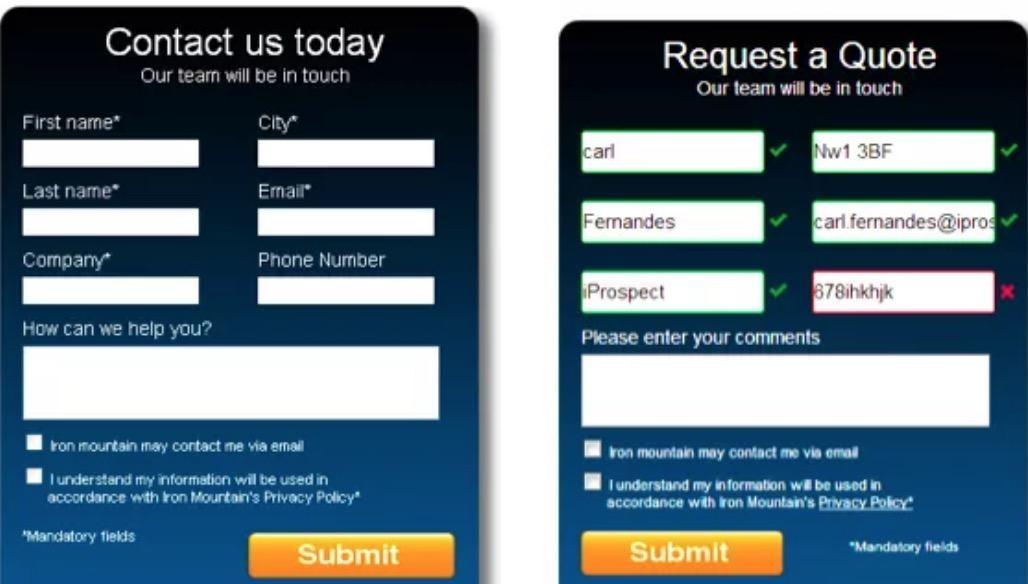
Image via Optimizely Iron Mountain anticipated that these changes would enhance both lead quality and, consequently, revenue. They were right: The treatment form generated a 140% conversion lift, which turned out to be the highest quality leads their sales team had ever encountered. While “contact us” and “request” might appear similar, the context in this case study was key. “Request” directly addressed the form’s objective – to inquire about Iron Mountain’s business solutions.
4. The Allure of Free Offerings
Sometimes, explicitly stating that something is free works wonders for conversion rates. Viadeo, a job recruitment and online address book app formerly known as Soocial, discovered this through a simple A/B test on their homepage. Their homepage featured a large, green call-to-action button prominently displaying the phrase “Sign up now!” Their goal was to increase sign-ups. Viadeo tested different hypotheses and variations. They experimented with:
- Various colors
- Different copy options
- Adding the word “free”
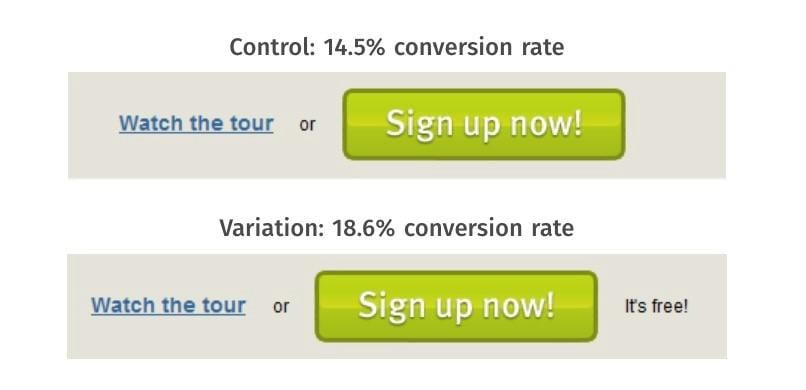
Image via VWO The most significant conversion lift resulted from adding the two-word phrase “It’s free!” right next to the prominent “Sign up now!” CTA. Including these two simple words resulted in a 28% conversion jump. The original layout had a 14.5% conversion rate, while the “It’s free!” variation achieved an 18.6% conversion rate. Interestingly, the “It’s free!” copy wasn’t very noticeable due to its small, subtle font. However, the sheer power of the word “free” proved effective.
5. Regional Personalization in a Few Words
Another WiderFunnel case study focuses on a short phrase and its impact through regional personalization. In this instance, a small caption beneath a field significantly boosted conversions for an insurance rate-quote form. The DMV, a state-level government agency often associated with frustration and confusion due to poor service, provided the backdrop for this case study. DMV.org, a website offering information to simplify DMV experiences (and not affiliated with the government), sought to enhance user experience and optimize their conversion rate. DMV.org’s limited optimization team posed a challenge, restricting their ability to conduct extensive A/B testing. WiderFunnel focused on an underperforming insurance quote form, particularly the lack of captions below the input fields. They hypothesized that incorporating regional personalization by adding state-specific references indicating the quote’s origin would improve conversions.
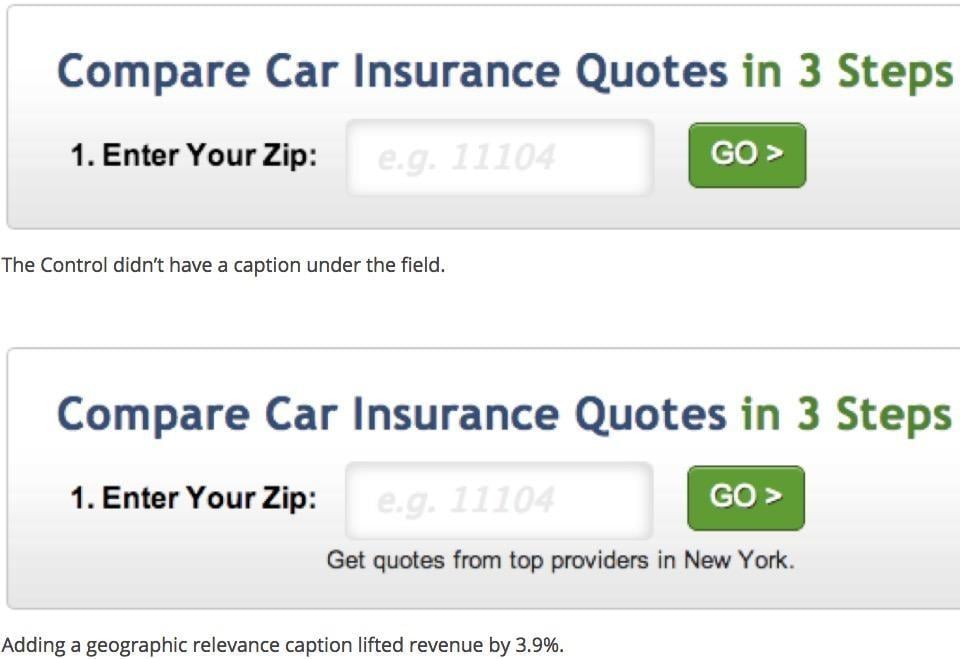
Image via WiderFunnel Their hypothesis proved accurate. By adding the short caption, Get quotes from top providers in New York, the variation form increased revenue by 3.9%. The original form had no caption beneath the field. This demonstrates that even the slightest modifications, both in terms of word count and font size, can significantly impact revenue.
6. Quote Vs. Pricing—Are They Truly Interchangeable?
It’s tempting to dismiss some changes as merely semantic differences. While this might hold true from a purely linguistic perspective, it’s a misconception in business. In one of the most dramatic examples of a single-word change impacting conversion rates, substituting “quote” with “pricing” yielded remarkable results. Veeam Software, a developer of data protection and virtual infrastructure management solutions, conducted a survey to understand what additional information visitors desired on their product pages. A majority expressed interest in seeing pricing details.
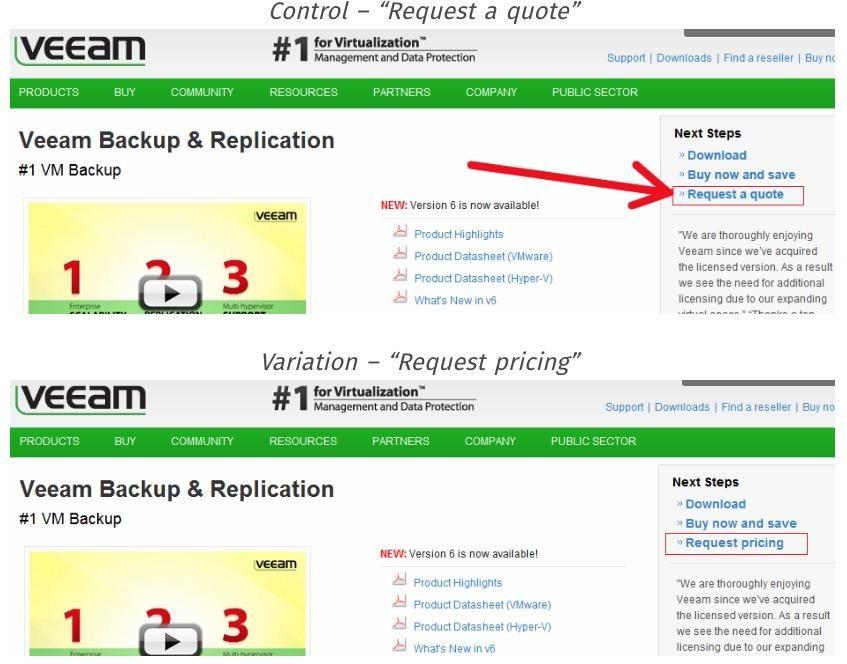
Image via VWO Based on this direct customer feedback, Veeam Software hypothesized that changing the anchor text on their product page from “Request a quote” to “Request pricing” would be beneficial. The results were astounding – the click-through rate jumped by 161% simply by changing that single word!
Harnessing the Power of Words
These case studies highlight the undeniable influence of words on conversion rates. Copywriting, regardless of the platform, can motivate action. The challenge lies in identifying which words resonate most effectively. Since there’s no foolproof formula, A/B testing landing pages, product pages, and even specific words within calls to action is essential. Begin with a hypothesis, conduct A/B testing, and if you observe higher conversions, you’ve struck gold.