As October progresses, you should be well underway with your 2020 holiday advertising plan. But don’t stress if you’re not quite there yet. Life happens - delays, pandemics, and those inevitable last-minute scrambles are all part of the process. However, what you should be thinking about is whether YouTube has a place in your 2020 holiday paid media strategy.
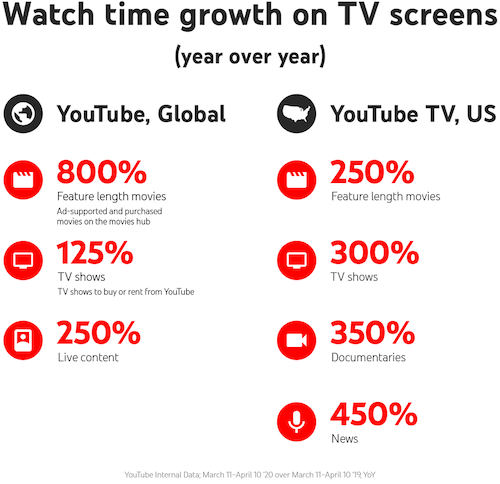
With the significant increase in YouTube viewership brought about by pandemic-related lifestyle shifts, it’s safe to say that video ads can be a powerful tool for boosting your holiday sales. To make things even better, I’m going to share four strategies I’ve personally used to ensure a good return on investment for my holiday YouTube video ad campaigns. These include:
- Shopping campaigns
- Sitelink extensions
- Call-to-action extensions
- Lead form ads (yes, really!).
I’ll explain the how and when of each strategy, along with any potential drawbacks to consider. Let’s dive right in so you can start testing and optimizing your campaigns.
4 YouTube video ad strategies to maximize holiday sales
I’ve said it before, and I’ll say it again: YouTube is fantastic for raising brand awareness. And while that remains true, brand awareness is probably not your primary goal for Black Friday or Cyber Monday. During the holidays, your focus shifts to driving purchases. Whether you operate online, in a physical store, or both, here are the best ways to use YouTube video ads to encourage customers to buy your products this holiday season.
1. YouTube shopping campaigns
YouTube advertising offers a campaign subtype known as “YouTube shopping campaigns.” If you’re running a TrueView in-stream campaign with a goal of Product and Brand Awareness, you have the option to display up to six of your products alongside your YouTube video ad as it plays. What’s even better is that even if a viewer skips your ad, your products will still be visible in case they want to find out more.
Even if viewers skip your YouTube shopping ad, the featured products will remain visible on the right side of the screen should they wish to explore further.
This feature is possible because this type of campaign requires you to link your video ad to one of your product feeds in Google Merchant Center.

Selecting products for YouTube Shopping campaigns
There are three ways to go about choosing products for the YouTube Shopping campaign subtype. Option one: “All products” This option works well if you have a limited number of products or if your video creative is general and doesn’t focus on specific items (a common approach for feel-good holiday ads). Option two: Manual Selection For a more targeted approach, you can manually select the products you want to showcase.
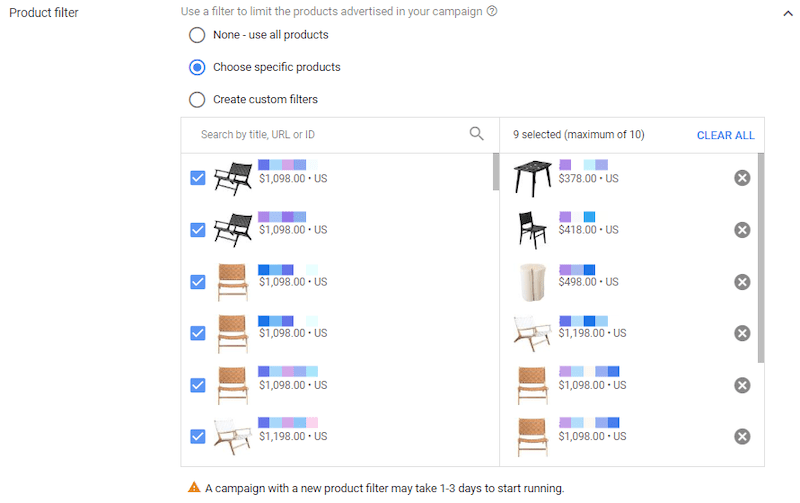
Although only six products can appear alongside your video ad, you can choose up to ten products in total. Selecting more than six provides a safety net if some products go out of stock, as out-of-stock products won’t be displayed. Your ads will automatically include in-stock replacements, and the out-of-stock products will reappear once your product feed reflects the updated inventory. This selection method makes the most sense if your video highlights specific products, giving viewers an immediate path to purchase what catches their eye!
While YouTube shopping campaign ads only display six products simultaneously, you can select up to ten to ensure your campaign remains active even if some products sell out. Option three: Custom labels This option utilizes the same custom labels you set up in your product feeds. If you’ve labeled specific products with “Black Friday” or “Cyber Monday,” you can ensure that only those products appear. This strategy is incredibly effective when combined with creative featuring special holiday deals to promote the sale products. RELATED: 8 Perilous PPC Mistakes to Avoid During the Holidays
What to keep in mind with YouTube shopping campaigns
If you’re working within a tight timeframe, TrueView for Shopping might present some challenges. Product selection happens at the campaign level, meaning you’ll need to create multiple campaigns for extensive product testing within your video campaigns. Another limitation is that this subtype isn’t yet supported by Google Ads Editor. While I wouldn’t discourage anyone from exploring this potentially very effective ad format, setting up a comprehensive TrueView for Shopping strategy can be time-consuming.
The fact that Google Shopping campaigns are not available in the Google Ads Editor makes this campaign subtype more time-consuming to manage.
2. YouTube sitelink extensions
If, for any reason, you’re unable to implement a TrueView for Shopping campaign, you can still guide traffic to your sale or product pages using sitelink extensions, which are also available for video campaigns in Google Ads. To incorporate sitelinks with your TrueView in-stream ads, you’ll need to run a TrueView for Action campaign. This involves selecting one of the following campaign goals: Sales, Leads, or Website Traffic. You’ll need to link at least two sitelinks (and up to four) for them to appear with your video ad. Here’s Google’s mockup of a YouTube video ad utilizing sitelink extensions.
Things to note about sitelink extensions
Here are a few points to remember about sitelink extensions for your video ads. Sitelink extensions are campaign-level only, work solely with video campaigns utilizing Google video partners, and are exclusively displayed on mobile devices. While you can choose pre-existing sitelinks from your account, ensure the ones selected for your video campaigns don’t get cut off on smaller screens. Regardless of what you’re promoting, always double-check that both your messaging and the landing page are optimized for mobile to provide a seamless user experience.
It’s important to remember that sitelink extensions for video ads only appear on mobile devices. This makes it crucial to confirm that your sitelinks are fully visible and that both the messaging and landing page are optimized for a positive mobile experience.
3. YouTube call-to-action extensions
Call-to-action extensions are perhaps the simplest and most widely used action-oriented feature you can add to your YouTube ads (which is why I also recommended them in my YouTube advertising during COVID-19 tips). They’re compatible with nearly every campaign type that uses TrueView in-stream ads. A call to action extension appears briefly over your video during the ad. Regardless of whether the viewer skips the ad or watches it in its entirety, a second call-to-action extension remains in the upper right corner of the page. This CTA remains visible until the viewer moves on to another video or page.
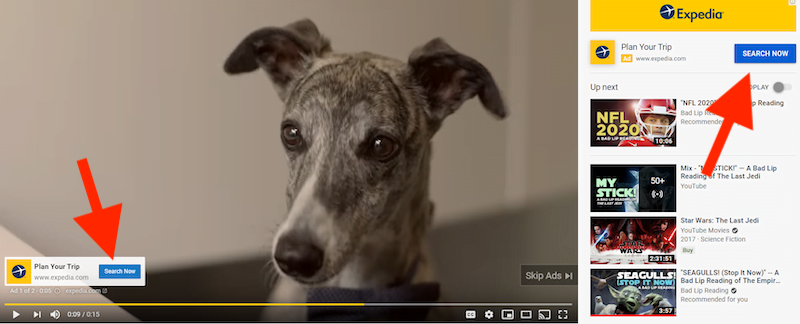
One of the biggest advantages of using call-to-action extensions to boost traffic to your website is their accessibility directly within the ad creation process. This makes it easy to experiment with different CTAs, even if your holiday ad creative is limited.
Call-to-action extensions can be used with almost every campaign type that utilizes TrueView in-stream ads. Plus, testing different CTAs is very straightforward. Here is a simple example of what I mean:

Besides testing out different video content within your ads, you can also play around with the messaging in your extensions to see what drives the highest click-through rates. In the example above (these are just examples; I’ve never worked with Blizzard Entertainment), we could keep the creative consistent and experiment with two different headlines and call-to-action messages. Which one would encourage more clicks: a “Shop Now” button or an “Ends Soon” message? The only way to know for sure is to test them out!
Things to consider with call-to-action extensions
A potential limitation you might encounter is the character restriction for both the headline and the call-to-action text. You only have ten characters for the call to action and fifteen for the extension’s headline. While this might require you to get creative with your messaging, sometimes a direct approach is the most effective.
Character limits for call-to-action extension headlines and CTAs might require some creativity!
4. YouTube lead form ads
You might be thinking, “Lead gen forms? For the holidays?! I don’t need more leads. I need sales!” I completely get it. But hear me out because I’ve used YouTube lead gen forms for e-commerce accounts in the past, and while it’s more of a top-of-funnel strategy, it’s definitely something to consider for your 2020 holiday advertising. This feature allows you to gather information directly from your video ad viewers.
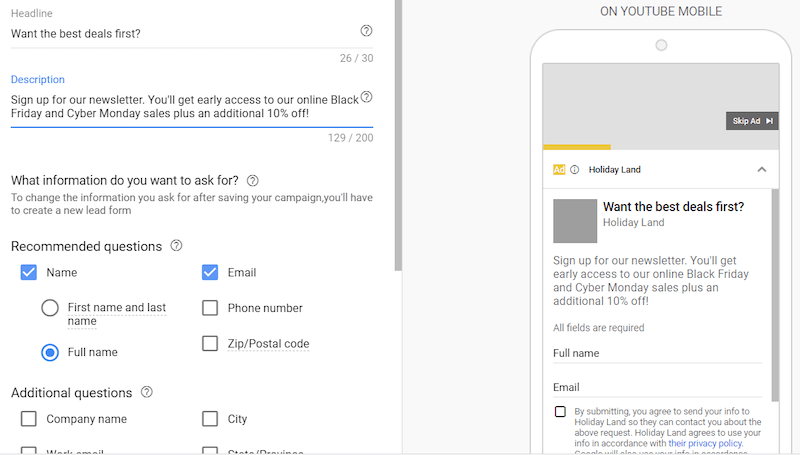
While the image above shows a variety of form field options, I’ve found that sticking with just name and email fields has been successful for some of my ecommerce clients. The goal here is to grow your email database. To encourage sign-ups, I recommend using an enticing message like: “Want early access to all the best deals this holiday season? Subscribe to our newsletter!” Ask for the bare minimum information to make it as easy as possible for users to convert (remember, people come to YouTube to watch videos, not fill out forms!).
YouTube lead form ads allow you to gather valuable audience information (and build your email list!) directly within the ad experience.
Once someone subscribes, you can encourage them to visit your website or a specific landing page, driving even more traffic. From there, you can leverage your awesome email nurture strategy to encourage customers to return to your site. See? Two strategies working together in perfect holiday harmony!
What to be aware of with YouTube lead form ads
Just like our first two holiday video ad strategies (shopping campaigns and sitelink extensions), lead form ads are only available for advertisers running TrueView campaigns - specifically, TrueView for Action campaigns. Also, keep in mind that YouTube lead form ads are still in beta testing for many accounts, so you might have to reach out to your Google representative to get access.
Since YouTube lead form ads are still in their beta phase for many accounts, you might need to contact your Google representative to enable them.
Find your winning combination for hitting those holiday targets
It’s important to remember that not all your sitelink extensions will always appear, depending on how many you’ve chosen, and some will only be visible on mobile devices. Lead gen forms won’t always appear for every user, and TrueView for Shopping campaigns don’t support sitelink extensions or lead gen forms. In essence, you can’t use all the features we’ve discussed within a single campaign. To find what works best for your holiday sales goals, you’ll need to test a few different campaign types and subtypes.
Because you can’t utilize all of these powerful YouTube ad features within a single campaign, experiment with different campaign types and subtypes to determine what delivers the best results for your holiday sales goals.
Even if only one or two features we’ve covered are a good fit for your business, prioritize testing. I understand that the holidays often mean shorter campaign durations. However, thanks to YouTube’s impressive reach, you can usually gain valuable insights into what’s working (and what’s not) fairly quickly. Now that you’re armed with the tools to create more profitable YouTube advertising campaigns this holiday season, it’s time to jump into testing and optimizing. Good luck, and happy holidays!