The last year has been a period of significant change for marketers. Artificial intelligence has made content creation incredibly easy, and with PPC expenses continuing to increase for many industries, organic search remains a budget-friendly method to connect with your desired audience online. Therefore, staying informed about the key SEO developments in 2024 can give you a competitive edge with your SEO approach.
Table of contents
- Search intent will be king
- Increase in question keywords and answers
- Creators will share more first-hand experience
- Building topical authority will be important
- Topical maps in content strategy will be huge
- AI content will be created at scale
- Content will need to be regularly updated
- Brand signals will grow in importance
- Google will place more emphasis on user interactions and engagement metrics
- Mobile page performance will continue to be a big ranking factor
- Businesses will need to make page experience updates
- SEO communities will be crucial
2024 SEO trends
This year will revolve around how Google and searchers react to the massive wave of AI-generated content flooding the internet as we speak. While some marketers might use AI to simply churn out AI-written drafts, those who go the extra mile to produce the best content will climb to the top of search results in 2024. With this surge in AI-generated content, backlinks, brand signals, and other authority indicators will likely regain importance this year. Google aims to provide the highest quality search results for users, and it wants those results to come from the most reliable, trustworthy, and authoritative websites. By following these essential 2024 SEO trends, you can ensure that your content meets both the quality and authority benchmarks that Google will be looking for in 2024.
1. Search intent will be king
Understanding and fulfilling search intent will remain the guiding principle for organic marketers crafting content this year. Search intent represents the actual reason behind a user’s search. Successfully addressing search intent requires a deep understanding of how your audience uses search engines.
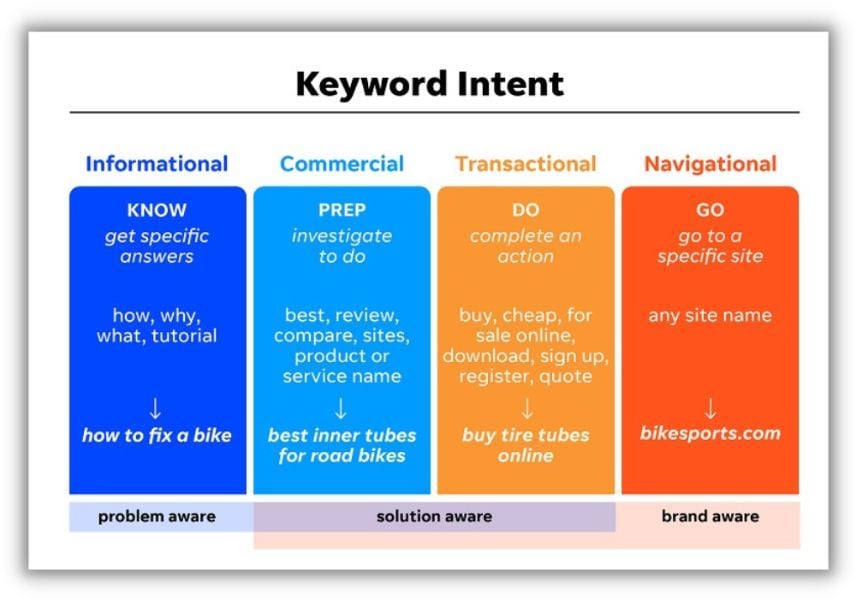 Marketers have traditionally categorized search intent into four main types: Navigational, Transactional, Commercial, and Informational searches. A recent recent study revealed that transactional and commercial keywords appear to be growing, while informational and navigational queries are declining.
Some keyword tools now include search intent alongside metrics like search volume and cost-per-click, allowing you to grasp the intent behind your targeted keywords.
Marketers have traditionally categorized search intent into four main types: Navigational, Transactional, Commercial, and Informational searches. A recent recent study revealed that transactional and commercial keywords appear to be growing, while informational and navigational queries are declining.
Some keyword tools now include search intent alongside metrics like search volume and cost-per-click, allowing you to grasp the intent behind your targeted keywords.
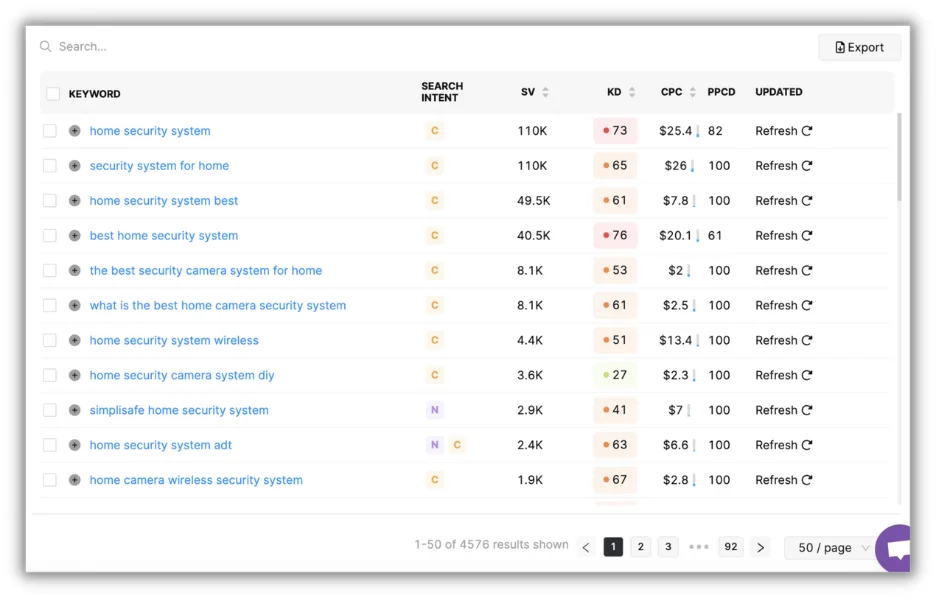 Source
However, it remains crucial to examine the top-ranking pages to discern what Google believes users are seeking. While the four search intent categories are useful, it’s also essential to consider the type of content users anticipate and their specific needs.
Are they after a quick answer? A comprehensive explanation? A product page? A practical guide? A video tutorial? A list of options for comparison? Might they have follow-up questions to their initial search that you can address proactively?
While Artificial Intelligence tools can certainly mimic the topics found in top-ranking pages, thoughtfully considering users’ precise needs still demands a human perspective.
Google recently simplified its Search Rater Quality Guidelines on how it defines content that satisfies user needs. This simplification, however, doesn’t imply that your content can be anything less than high-quality and helpful.
It signifies that Google prioritizes ranking the most pertinent and useful results and expects webmasters to understand what quality content entails. To reach the top of search results for your target keywords, your content needs to demonstrate a clear understanding of what users are looking for.
Source
However, it remains crucial to examine the top-ranking pages to discern what Google believes users are seeking. While the four search intent categories are useful, it’s also essential to consider the type of content users anticipate and their specific needs.
Are they after a quick answer? A comprehensive explanation? A product page? A practical guide? A video tutorial? A list of options for comparison? Might they have follow-up questions to their initial search that you can address proactively?
While Artificial Intelligence tools can certainly mimic the topics found in top-ranking pages, thoughtfully considering users’ precise needs still demands a human perspective.
Google recently simplified its Search Rater Quality Guidelines on how it defines content that satisfies user needs. This simplification, however, doesn’t imply that your content can be anything less than high-quality and helpful.
It signifies that Google prioritizes ranking the most pertinent and useful results and expects webmasters to understand what quality content entails. To reach the top of search results for your target keywords, your content needs to demonstrate a clear understanding of what users are looking for.
 Need help finding the right keywords to target? Try our free keyword tool!
2. Increase in question keywords and answers
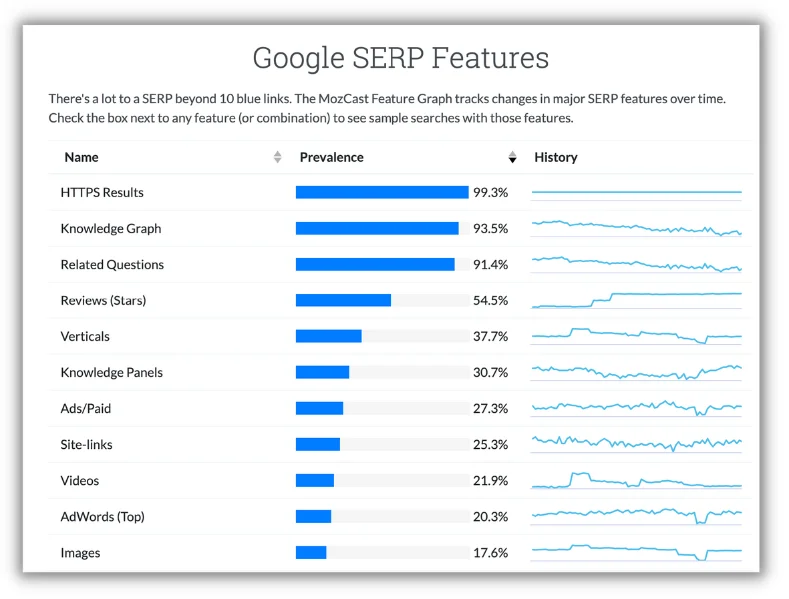
Providing answers to user questions will continue to be a significant SEO trend and a valuable tactic in 2024. According to MozCast, People Also Ask results are now displayed in over 90% of searches.
 Source
Despite Google simplifying how it displays answers (they removed both the FAQ and How-To rich results in 2023), addressing questions remains an effective way to secure a spot on the first page of search results.
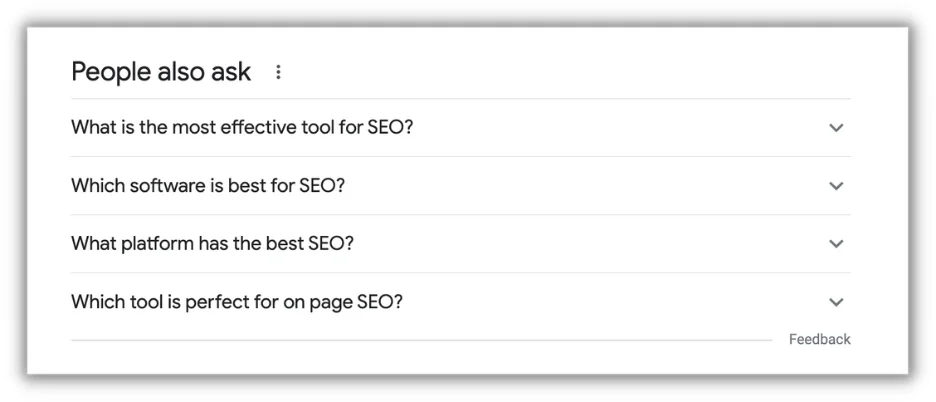
To discover relevant questions, you can directly examine search engine results pages (SERPs) to see what questions populate the People Also Ask section.
Source
Despite Google simplifying how it displays answers (they removed both the FAQ and How-To rich results in 2023), addressing questions remains an effective way to secure a spot on the first page of search results.
To discover relevant questions, you can directly examine search engine results pages (SERPs) to see what questions populate the People Also Ask section.
 Alternatively, utilize a keyword tool that simplifies the identification of related question keywords from a seed keyword.
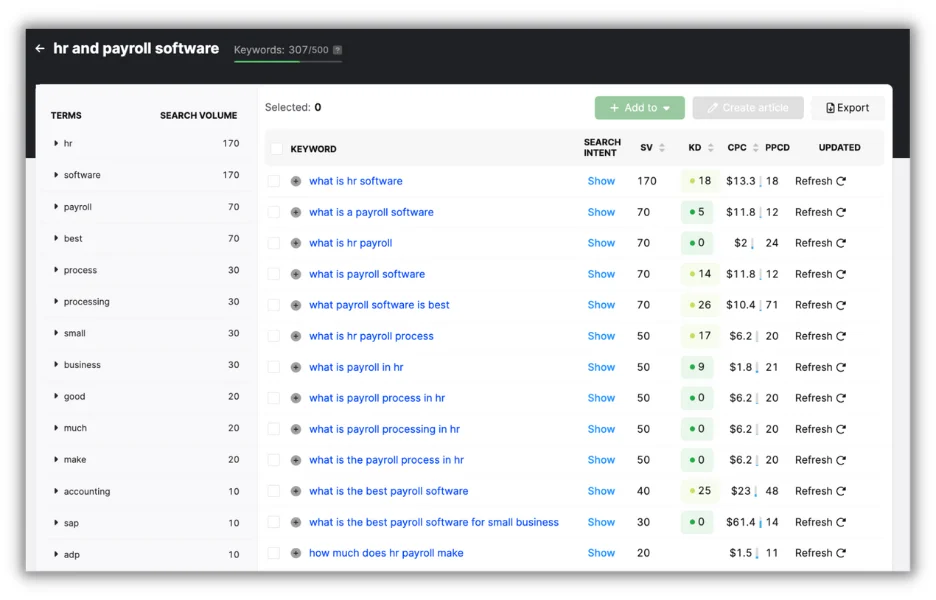 Then, incorporate these questions and answers into your content through methods such as:
- Integrating FAQ sections into your web pages. These can be seamlessly included in your web design using expandable dropdown menus.
- Crafting blog posts centered around questions that necessitate detailed responses. You can structure your post using H2 headings to present common questions about a topic and provide answers within the corresponding sections.
- Creating a dedicated page for the most frequent questions people have about your products or services. This can also serve as a valuable resource for your customer support and sales teams when interacting with existing or potential customers.
Another advantage of targeting question keywords is their typically lower Keyword Difficulty, making them easier to rank for. This makes this strategy particularly effective for newer websites.
 Running Google Ads along with your organic strategy? Find out how you’re doing with a free, instant audit » Google Ads Performance Grader
3. Creators will share more first-hand experience
Google incorporated “Experience” into its E-E-A-T algorithm a little over a year ago. As more online content becomes AI-generated, demonstrating first-hand experience will be a crucial differentiator for top-ranking content in 2024. There are numerous ways to incorporate your experience into your content approach. First and foremost, consider adding the following elements to your content to highlight your expertise:
- Real-world examples: These can stem from your clients, previous customers, or your own personal experiences within your industry. Real-world, personal, and original examples are something AI cannot replicate.
- Case studies: Case studies showcase your work with past clients and customers, highlighting the tangible outcomes of your first-hand experience in your field.
- Data and insights: Sharing hard data and statistics gathered from your own research or reporting is an excellent way to build credibility and demonstrate your real-world experience. Beyond the content itself, including bylines, author bios, and linking to your creators’ social media profiles will emphasize that your content is produced by experienced individuals.
 Source
For instance, I’ve invested considerable effort in establishing my expertise as an SEO professional by writing articles, actively engaging on social media, and consistently updating my personal website content.
Consequently, Google now recognizes me as an SEO professional and acknowledges my first-hand experience in that domain.
Source
For instance, I’ve invested considerable effort in establishing my expertise as an SEO professional by writing articles, actively engaging on social media, and consistently updating my personal website content.
Consequently, Google now recognizes me as an SEO professional and acknowledges my first-hand experience in that domain.
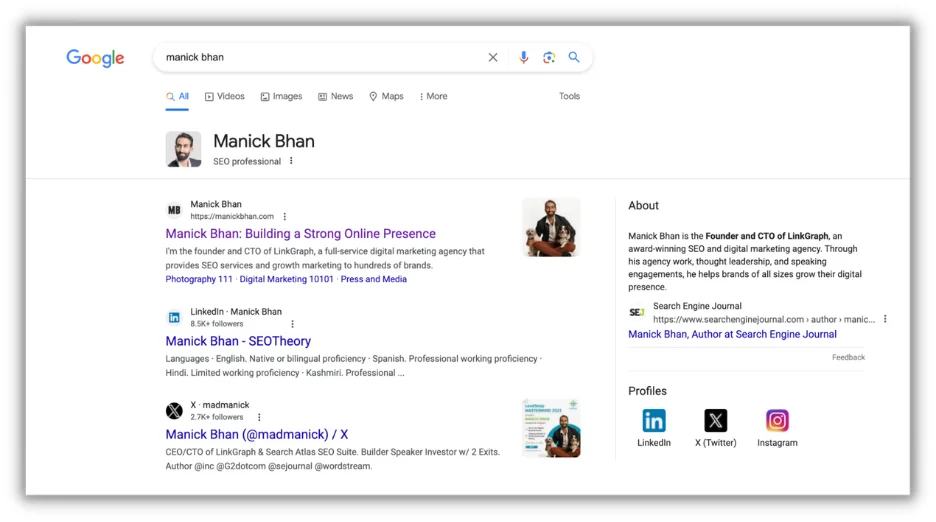 This not only enhances the organic ranking potential of the content I publish on my own websites but also increases my value as a guest blogger or author on other platforms.
Therefore, when creating your content in 2024, ensure you’re leveraging your experience. And if you’re hiring content writers, factor their experience into your selection process.
This not only enhances the organic ranking potential of the content I publish on my own websites but also increases my value as a guest blogger or author on other platforms.
Therefore, when creating your content in 2024, ensure you’re leveraging your experience. And if you’re hiring content writers, factor their experience into your selection process.
Brought to you by

Ready to grow your business?
Unlock the results you’re looking for with technology-backed solutions designed for small businesses and agencies.
4. Building topical authority will be important
Topical authority has been a long-standing ranking factor for Google, holding particular importance for websites focusing on news, health, finance, and politics. Google’s Topic Authority system prioritizes rankings for websites demonstrating greater expertise in specific topics or areas of coverage. However, even if your website falls outside those niches, you should still strive to cultivate topical authority within your industry. Topical authority is primarily demonstrated through:
- Content breadth: Having multiple high-quality content pieces that comprehensively explore all relevant subtopics within your primary topic areas.
- Content depth: Featuring detailed, in-depth articles that thoroughly address all questions related to those specific subtopics. Including original reporting and insights (i.e., showcasing your “experience”) further strengthens your authority.
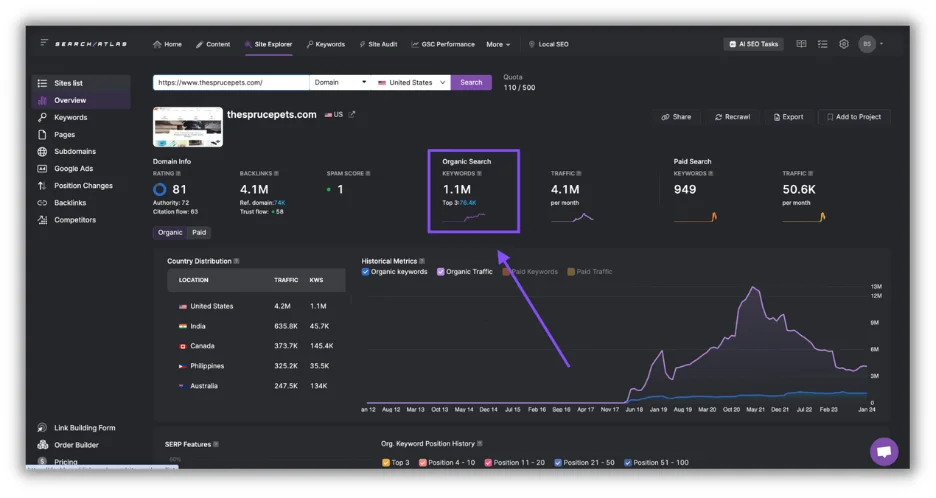
- Internal links: Strategically linking between related content pieces, illustrating to both users and search engines the breadth and depth of your content offerings. For example, consider this pet website. They’ve diligently built out hundreds of informative content pieces about dogs, covering subtopics such as dog breeds, dog health and wellness, dog nutrition, and more.
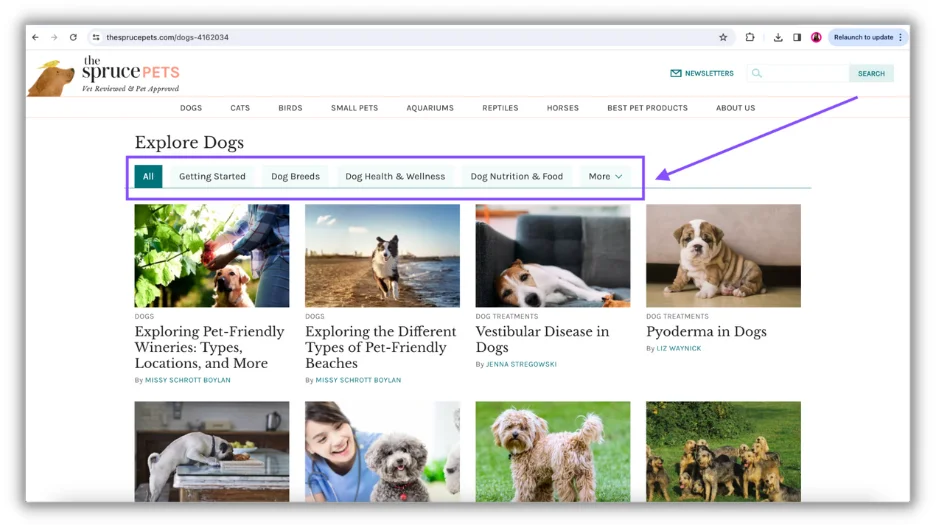 What’s the payoff for this extensive content depth and breadth? This website ranks for over 1.1 million organic keywords.
 High-quality backlinks can also reinforce your brand’s topical authority. If numerous websites within your industry link to your content, it signals to Google that your website is regarded as an authority by your peers.
Therefore, promoting your content through public relations, digital PR, and social media, with the hope of earning backlinks, is also a valuable strategy for building topical authority in your niche.
High-quality backlinks can also reinforce your brand’s topical authority. If numerous websites within your industry link to your content, it signals to Google that your website is regarded as an authority by your peers.
Therefore, promoting your content through public relations, digital PR, and social media, with the hope of earning backlinks, is also a valuable strategy for building topical authority in your niche.
5. Topical maps in content strategy will be huge
Topical maps will be a major SEO trend in 2024. Why? Because they provide a structured framework for establishing topical authority. A topical map outlines all the necessary SEO content to create in order to cover a specific topic comprehensively, both in breadth and depth. Here’s an example of a topical map created using a spreadsheet for technical SEO.
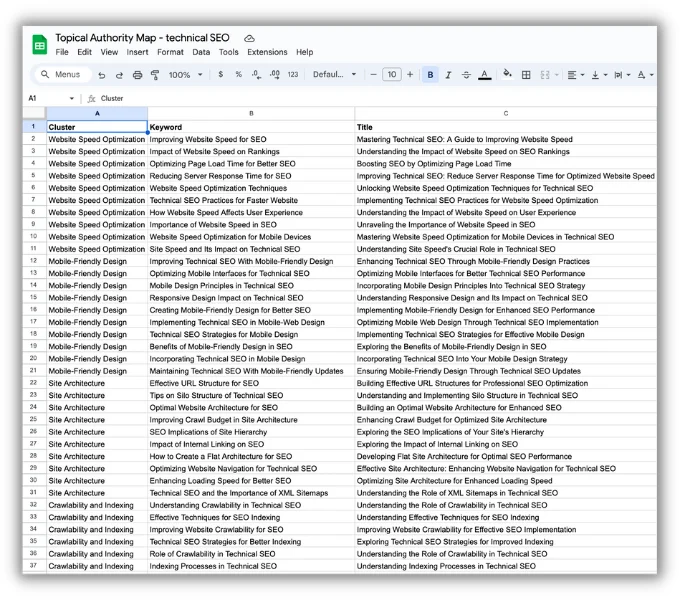 Manually creating topical maps can be time-consuming, requiring hours of keyword research and clustering. However, artificial intelligence has made topical mapping significantly faster.
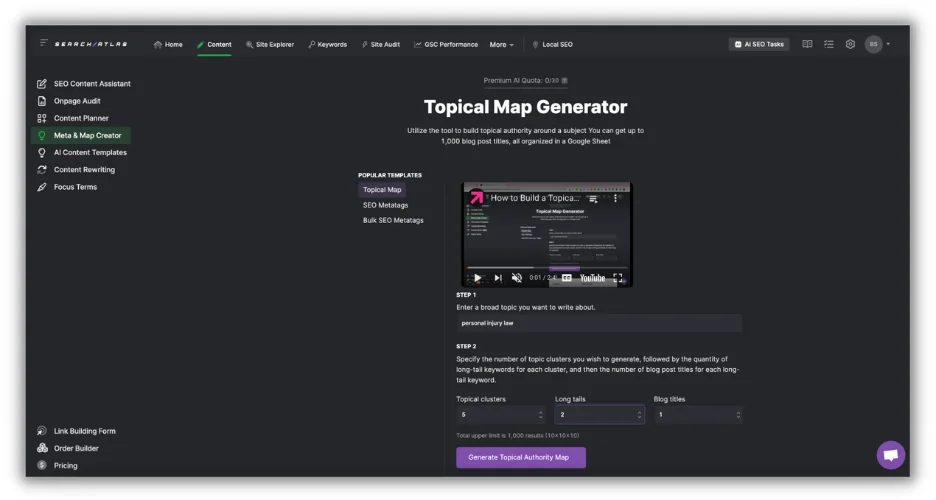 You can build topical maps with SEO tools like Search Atlas.
The primary advantage of topical maps is their ability to quickly generate a comprehensive SEO content plan. Your content team will have a clear understanding of the topics that need to be addressed to build authority in your niche and the target keywords to optimize that content for.
You can then leverage AI content tools to generate content ideas and outlines around those topics or hand off the topical map to your content writers. Replicate this topical mapping process for each of the main topic areas relevant to your website.
Adding these content pieces to your website and illustrating their interconnectivity through strategic internal links is a powerful way to gain hundreds or even thousands of new organic keyword rankings in 2024.
You can build topical maps with SEO tools like Search Atlas.
The primary advantage of topical maps is their ability to quickly generate a comprehensive SEO content plan. Your content team will have a clear understanding of the topics that need to be addressed to build authority in your niche and the target keywords to optimize that content for.
You can then leverage AI content tools to generate content ideas and outlines around those topics or hand off the topical map to your content writers. Replicate this topical mapping process for each of the main topic areas relevant to your website.
Adding these content pieces to your website and illustrating their interconnectivity through strategic internal links is a powerful way to gain hundreds or even thousands of new organic keyword rankings in 2024.
6. AI content will be created at scale (for better or worse)
Experts predict that by 2026, 90% of online content will be synthetically generated. Some AI tools now empower marketers to create content in bulk, potentially generating all the content for a topical map (hundreds of articles) in just a few hours. 2024 will see a dramatic surge in content production.
This mass content creation doesn’t inherently violate Google’s guidelines, as long as the resulting content is valuable, high-quality, helpful to users, and adheres to their E–E-A-T guidelines. A violation occurs when, as stated in their guidelines, it is used “to produce content for the primary purpose of manipulating search rankings.”
As AI becomes more sophisticated and capable of generating high-quality content, the line drawn by Google will undoubtedly become harder to define and penalize. Will some marketers exploit automation to generate mediocre content, rich in target keywords but lacking value, simply to attract organic traffic? Certainly.
However, it’s crucial to view AI outputs as a starting point, not the finished product. The most successful content creators of 2024 will utilize AI to accelerate their writing process while dedicating time to fulfill search intent, showcase their expertise, and deliver the most valuable, helpful content content for their users.
Marketers need to acknowledge that AI content represents the new frontier of SEO. It’s highly likely that some of your competitors will utilize AI content tools to create hundreds, if not thousands, of new content pieces this year. Failing to adopt these tools could leave you trailing behind.
Unsure about which tools to use or where to begin? Explore this list of AI content tools to discover options that best align with your needs.
 Want to use AI the right way? Free download » Emergency Guide to AI in Marketing
7. Content will need to be regularly updated
With the anticipated influx of AI-generated content this year, competition for keywords will intensify. To safeguard the top rankings of your well-performing content, ensure it is updated frequently. While Google’s ranking algorithm incorporates recency signals that might cause fluctuations in top rankings as new content is published, factors like backlinks, topic authority, and content quality will ultimately outweigh recency in the long run. Previously, updating content every 1-3 years was often sufficient to maintain rankings. However, in 2024, a yearly content refresh should become a standard practice. To refresh your content for optimal SEO, consider these suggestions:
- Verify the accuracy and up-to-dateness of all data and statistics.
- Incorporate links to the latest research, case studies, and news articles.
- Rewrite the content, crafting entirely new introductions, insights, and examples.
- Review all internal and external links, repairing broken links or replacing them with 301 redirects.
- Continue building backlinks! A content refresh or rewrite presents a prime opportunity to promote your content on social media, through public relations channels, and to your email subscribers.
8. Brand signals will grow in importance
Amidst the surge of synthetic content, your brand’s name and reputation will carry significant weight in SEO in 2024, provided you’ve put in the work to establish your brand online. To be clear: Google doesn’t favor large brands over smaller ones in search engine rankings. However, Google utilizes signals like branded anchor text and branded search volume to assess the trustworthiness and authoritativeness of your website. As Google increasingly prioritizes experience and expertise to differentiate between high-quality and low-quality content, there’s never been a better time to embrace and leverage your brand name. Here are a few simple ways to enhance your brand signals for SEO:
- Cross-link your website and social media pages. This demonstrates to Google that your website has an active social presence beyond its own domain.
- Create comprehensive About pages and Contact pages. These pages confirm that real people, with experience, are behind your website and content.
- Invest in public relations outreach. Earning links and brand mentions on reputable websites enhances your credibility as a brand, business, or organization.
- Get listed in relevant directories, review sites, and third-party aggregators. Prioritize quality over quantity, focusing on platforms relevant to your industry. For instance, a plumbing company should create a listing on Thumbtack, while a software company should establish a profile on G2. These brand-building efforts can also increase your visibility in Google’s rich results. Want to appear more frequently in lists like this one?
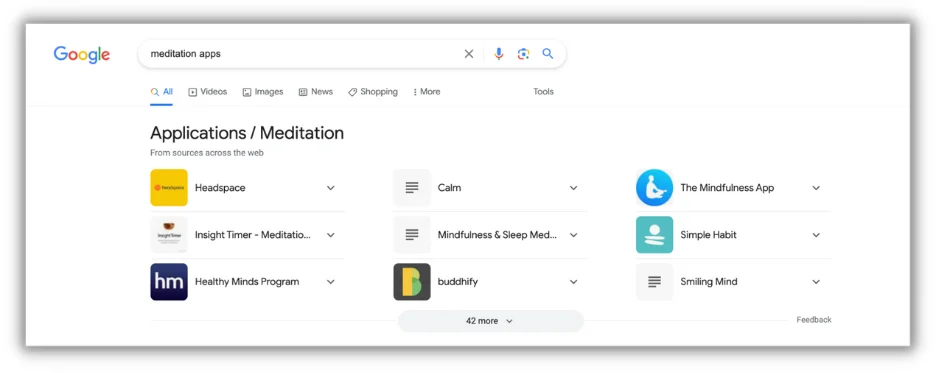 Google gathers data about brand names “from across the web,” not solely from the brand’s own websites.
Therefore, the effort you invest in establishing your brand name on trustworthy sources across the internet is invaluable in helping Google understand who you are, what you offer, and your brand authority within your industry.
Google gathers data about brand names “from across the web,” not solely from the brand’s own websites.
Therefore, the effort you invest in establishing your brand name on trustworthy sources across the internet is invaluable in helping Google understand who you are, what you offer, and your brand authority within your industry.
9. Google will place more emphasis on user interactions and engagement metrics
The extent to which Google incorporates engagement metrics into its ranking algorithm has been a subject of debate among SEO professionals. However, documents from the recent antitrust case against Google reveal that user engagement isn’t just a ranking factor – it’s a fundamental pillar of ranking. A slide from Google’s presentation titled “The 3 Pillars of Ranking” explicitly lists “User-Interactions” as a core ranking factor. It further clarifies that “clicks, attentions on a result, swipes on carousels, and entering a new query” all qualify as user interactions.
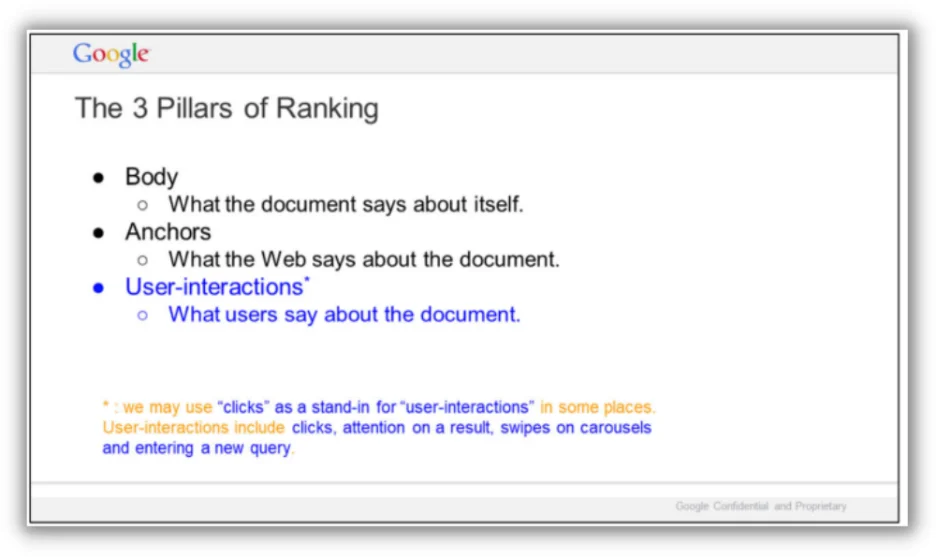 Source
Therefore, it’s essential to consider how your web content facilitates user interaction.
Interactive elements like jump links and carousels have always been beneficial for enhancing page experience. However, when users engage with these elements, it also signals to Google that your content is engaging and valuable.
However, avoid being overly promotional in your pursuit of increased interactions. These interactive features should enhance the user experience, not disrupt it.
Source
Therefore, it’s essential to consider how your web content facilitates user interaction.
Interactive elements like jump links and carousels have always been beneficial for enhancing page experience. However, when users engage with these elements, it also signals to Google that your content is engaging and valuable.
However, avoid being overly promotional in your pursuit of increased interactions. These interactive features should enhance the user experience, not disrupt it.
10. Mobile page performance will continue to be a big ranking factor
Mobile-first indexing is now the standard in search, and after years of implementation, Google announced it was officially completed in October 2023. While you’ve likely been hearing about the importance of mobile pages for years, it’s crucial to understand that your mobile pages, and your mobile pages alone, are what influence your rankings. This holds true even if your website primarily receives desktop traffic. Paying attention to the performance of your mobile pages is essential. Here are a few “must-haves” for your mobile pages:
- Responsive Design: In 2024, your web pages need to be responsive, meaning they adapt and display content seamlessly on mobile, tablet, and desktop devices from the same URL. Separate URLs for mobile and desktop are outdated, and Google advises against anything other than responsive websites.
- Proper Character Counts: Remember that mobile meta descriptions are limited to 120 characters, unlike the 160-character limit on desktop. It’s best to optimize all your meta descriptions to 120 characters as a standard practice.
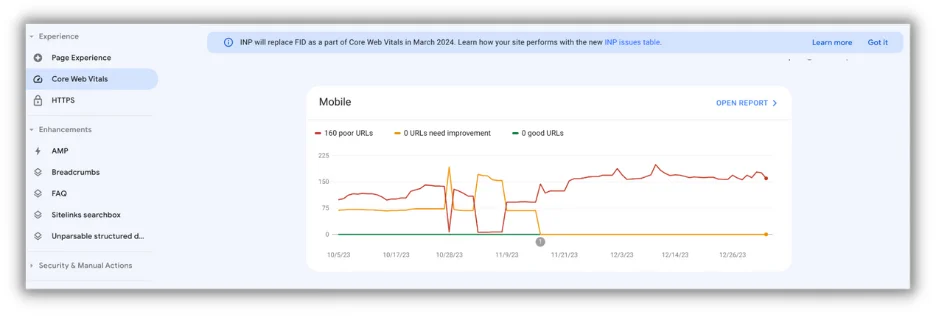
- Mobile-Friendly Testing: Regularly testing your mobile pages should be an integral part of your publishing process. Utilize Google Search Console to verify if your pages meet Google’s standards. Navigate to “Experience” > “Core Web Vitals” > “Mobile” to access a comprehensive report on your mobile pages, as illustrated below.
11. Businesses will need to make page experience updates
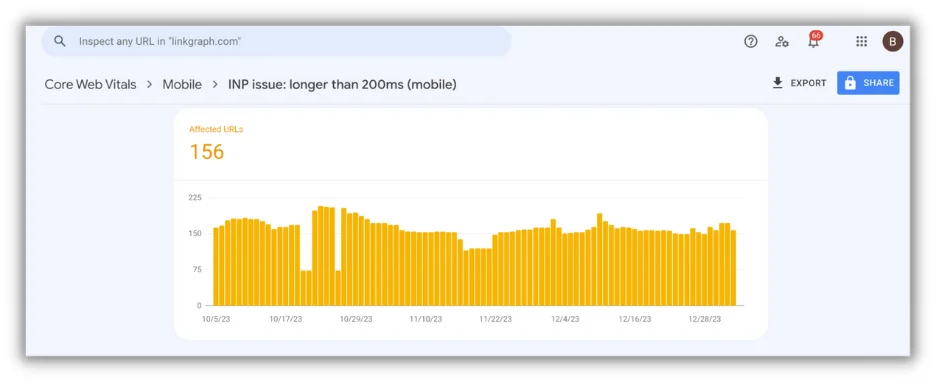
In April 2023, Google expanded its guidance regarding page experience, emphasizing its role in delivering helpful content. Essentially, a poor page experience is the antithesis of helpful content. Therefore, your pages need to load quickly, be responsive, and pass Google’s Core Web Vitals assessment. In March 2024, Google will be incorporating Interaction to Next Paint (INP) into its Core Web Vitals metrics. This metric measures how quickly a page responds to user interactions, such as clicks or keyboard inputs. Given the significance of user interactions in ranking, this addition is a logical step for Google to gauge the overall quality of a page. Prepare for this change by reviewing your Interaction to Next Paint (INP) report, accessible within your Google Search Console account.
12. SEO communities will be crucial
While not always explicitly acknowledged, SEO has long thrived on shared knowledge and crowdsourced insights. Community is an indispensable element of SEO success, whether for SEO professionals, agency owners, or entrepreneurs managing their SEO efforts. Therefore, among all the anticipated SEO trends in 2024, I believe SEO community groups will be one of the most valuable resources for organic marketers. Sharing insights, strategies, and experiences will be crucial in navigating the many changes ahead. There are numerous ways to connect with like-minded SEO individuals. Events, conferences, Facebook groups, online SEO courses, online forums, podcasts, and LinkedIn are all valuable platforms for finding others who prioritize delivering high-quality content to users and leveraging the power of organic SEO in 2024 to achieve results for themselves or their clients.
Make these SEO trends work for you in 2024
If you’re dedicated to SEO success this year, here are the 12 most important SEO trends to focus on in 2024:
- Prioritize creating content that effectively addresses user needs.
- Provide comprehensive answers to users’ questions about your products, services, industry, or areas of expertise.
- Ensure your content creators possess first-hand experience and showcase it prominently.
- Build topical authority by publishing a wealth of high-quality content that explores topics in both breadth and depth.
- Utilize topical maps to develop comprehensive content strategies in 2024.
- Leverage AI content tools to enhance content production and streamline your content workflows.
- Regularly update your content to maintain its relevance and freshness.
- Strengthen your brand signals on third-party websites and aggregators.
- Incorporate interactive elements to encourage user engagement with your content.
- Ensure your mobile pages are fully optimized for a seamless user experience.
- Prioritize page experience and prepare for upcoming Core Web Vitals updates.
- Join SEO communities to benefit from collaboration and shared experimentation. Need more 2024 marketing trends? We’ve got you covered:
- 7 Must-Know Digital Marketing Trends for 2024
- The 5 Biggest Google Ads Trends for 2024 (+6 Predictions)
- 7 Content Marketing Trends You Need to Know in 2024 (+Tips to Prepare)
- 9 Must-Know Facebook Advertising Trends & Tips for 2024
- AI Marketing Trends for 2024 & What They Mean for You
- 9 Video Marketing Trends to Watch in 2024
- The Top 2024 Social Media Marketing Trends
- 8 Important Mobile Marketing Trends to Know for 2024
- 9 Email Marketing Trends That Will Deliver Growth in 2024